

InsurTech Unicorn InsGeek Files IPO Prospectus: How It Conquered China's Trillion-Yuan Group Insurance Market
In the healthcare and wellness sector,Health insurance on the payer side is undoubtedly one of the hottest niche sectors in recent years.
How so? In terms of investment enthusiasm, according to data from the VCBeat Orange Database, since 2020, there have been over 35 financing events in China’s primary health insurance market, with total financing exceeding RMB 10 billion. This places it among the leading segments within the broader healthcare industry.
The sector’s boom has attracted a wave of innovative enterprises., and each has explored its own unique model. For instance, some companies focus on channel innovation, others prioritize precision marketing, while still others build a closed-loop ecosystem integrating pharmaceuticals and insurance. Many of these enterprises have secured financing, with some on the verge of going public.
It is worth noting that,In the corporate group insurance sector, a dark horse has emerged—InsGeek., established in 2014 and headquartered in Beijing, has served over 7,000 enterprises and more than 1.2 million employees, with premium growth exceeding 100% and a premium renewal rate of 100%. Due to its outstanding market performance, InsGeek has attracted significant investment interest and completed its Series C financing in 2020. It boasts strong shareholder backing, including the National Fund for SME Development, SIG, China Renaissance, and Tsinghua Holdings Ginkgo.
It should be noted that,The corporate group insurance market is highly complex. While traditional health insurers primarily target large enterprises, Insgeek has taken a contrarian approach by entering the market through group insurance for growing companies and then gradually expanding its customer base.This path is clearly extremely challenging. The fact that InsGeek has successfully entered the market and achieved notable results is attributable to its accumulated technical expertise and innovative breakthroughs.
Where do the challenges of corporate group insurance truly lie? How has Insgeek addressed them from a technical perspective? What is the logic behind aligning technology with business needs? To explore these questions, VCBeat held an in-depth discussion with Ye Hui, CTO of Insgeek, in early winter.
In the fiercely competitive health insurance sector, few companies have entered the group insurance market.
The underlying reason is that group insurance is highly complex.First, as an insurance product, group insurance is fundamentally a financial product and is therefore subject to stringent government regulation. Second, the purchaser of group insurance is the enterprise; since enterprises operate in different industries and at varying stages of development, their needs differ accordingly. Third, group insurance serves corporate employees, each of whom has personalized demands. As one of the most frequently utilized types of insurance in the sector, with nearly universal applicability, it places exceptionally high demands on the technical capacity to deliver services.
These factors make group insurance services highly complex and labor-intensive in offline scenarios.For instance, from a temporal perspective, as a company grows, the average age of its employees tends to increase, which may increasingly impact the company’s employee benefits budget. Additionally, employees seek both convenient claims processing and benefit plans that cover their family members. However, insurance companies vary in their interfaces, data standards, and claims rules. Relying solely on an individual insurer’s internal systems makes it difficult to meet the needs of both enterprises and employees.
To address this industry pain point, insgeek leverages digital technology to integrate the entire corporate group insurance service chain, spanning from front-end sales to back-end services, risk control, underwriting, and claims settlement. AndThe underlying logic of this business model is the development of technological capabilities and the integration and analysis of user data.
“Insgeek is laying the foundation; weThe core underlying system is integrated with insurance companies on the data front and connected with the foundational systems of healthcare institutions, thereby meeting the needs of corporate employees in medical care and health management.“Ye Hui told VCBeat that Insgeek’s underlying core system covers product design, risk control, claims processing, and service systems, providing a comprehensive suite of solutions for precision marketing and customer relationship management. ‘Leveraging BI (Business Intelligence) and the middle-platform engine, we can achieve more effective benefits administration, monitoring, and health management.’”
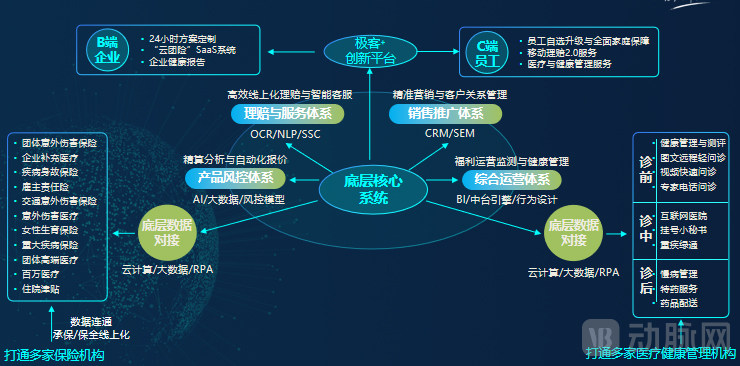
Built upon its underlying core, InsGeek has developed the “Geek+” innovative group insurance solution, primarily serving businesses on both the consumer (C-end) and corporate (B-end) sides.For B-side enterprises, “Geek+” addresses HR departments’ needs in customizing employee benefit plans and enhancing the overall health resilience of the workforce. For C-side users, “Geek+” primarily offers personalized upgrade options and comprehensive family coverage (including parents, spouses, and children), while enabling mobile claims processing and online consultations through its WeChat Official Account.
“As you can see, we have been deeply cultivating the corporate health and benefits sector. By establishing actuarial models to analyze corporate data from multiple dimensions, we enable precise pricing and offer flexible product design,” said Ye Hui.Although the purchaser of group insurance is the enterprise, it is essentially an employee benefit product; therefore, product design should ensure that employees can clearly perceive and understand its value.To this end, Insgeek enables corporate employees to better perceive and utilize relevant features through a comprehensive operational system.
Specifically, supported by underlying technologies, corporate employees can initiate claims via mobile devices, with InsGeek handling claim verification and settlement. Claims under RMB 300 are settled within two days, while those under RMB 3,000 do not require paper documents and can be processed through photo uploads and other digital methods.
Additionally, Insgeek’s intelligent customer service has achieved a 70% first-contact resolution rate, rapidly addressing user inquiries. It also provides comprehensive services across the entire healthcare journey, meeting needs for pre-consultation health advice and expedited appointment scheduling; facilitating in-consultation expedited care access and online medical services; and enabling post-consultation rapid claims processing and medication delivery. “These capabilities have allowed us to truly create a closed loop for health benefits,” said Ye Hui.
It is precisely through the construction of a closed-loop service chain that insgeek has gained the capability to serve enterprises of all types.For small businesses with dozens or hundreds of employees, Insgeek’s system addresses the need to balance cost sensitivity with a fast claims experience for employees. For companies with around 1,000 employees, Insgeek offers fully customized, tiered HR benefit solutions tailored to individual needs (“a thousand faces for a thousand people”), while providing valuable health data insights to enable digital health management. For large enterprises with over 10,000 employees, Insgeek provides deep integration, linking employee purchase and enrollment processes directly with the company’s core systems, thereby transforming the employee benefits platform into a true competitive advantage for the enterprise.
It is not difficult to see that Insgeek has integrated the entire corporate group insurance service chain, spanning from front-end sales to mid- and back-office services, including risk control, underwriting, and claims settlement.At the same time, the high complexity of the group insurance market dictates higher technical barriers. So, how exactly has InsGeek built its technological capabilities?
From a technical support perspective, InsGeek has built a four-layer architecture in its system.
The bottom layer is insgeek’s business and data middle platform.“This is the core of all our business systems, including the metadata/data center and the user/permission center. Everything is built upon the business and data middle platforms,” said Ye Hui. Above the business and data middle platforms lies the business layer, which serves different user groups depending on the specific business line.
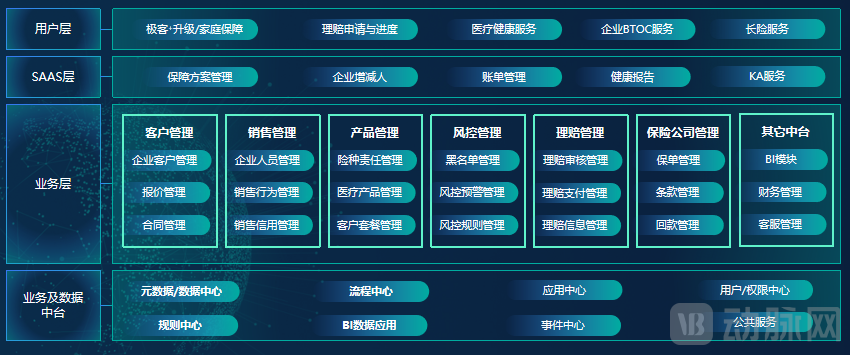
Above that is the SaaS layer., primarily targeting corporate HR professionals, assisting them with insurance enrollment and related tasks, while also providing access to corporate health reports.The top layer is the user layer.C-end users can upgrade to “Geek+” and obtain family coverage on this platform, as well as initiate claims and access medical and health services.
When discussing the reasons behind insgeek’s construction of a four-layer architecture, Ye Hui stated that the core driver remains business-led logic.“For example, a client mentioned that there is a community hospital across the street and expressed the desire for their employees to receive medical treatment and submit reimbursement claims at that facility. This type of corporate requirement necessitates special handling during the underwriting process. A small enterprise may have several such requests, while a large enterprise could have dozens or even hundreds. If each request were developed individually, the sheer volume would be unsustainable for the R&D team. Additionally, over time, accumulated obsolete and unused code becomes difficult to manage. Therefore, on this basis, we performed deeper-level abstraction by extracting metadata from business models to describe these operations.”
Metadata serves as the foundation for the complexity and flexibility of InsGeek’s group insurance business, encompassing insurance-related configurations, rules from the Rule Center, and workflows from the Process Center. The core components fall into three categories: first, the definition of metadata attributes; second, the identification of complex relational associations; and third, validation rules built upon these attributes and relationships. Based on this foundation, InsGeek enables comprehensive combinations and interactions.
It is the underlying system that enables end-to-end integration of business data, allowing InsGeek to establish a systematic framework for data accumulation, data supply, data mining, and data security.A common challenge in building a data middle platform is data consistency. Insgeek has achieved end-to-end data integration at the underlying level and employed strategies such as enterprise knowledge graphs for data matching and governance. As a result, the integrated data is highly clean, laying a solid data foundation for business innovation leveraging big data, AI, and other advanced technologies.
Certainly, although data has been integrated,However, data security remains the top priority for InsGeek.“We are continuously driving technological innovation, effectively building an open ecosystem. Of course, we also hope to collaborate with distributors, platforms, insurance companies, and health management organizations to leverage technology in addressing current challenges in medical insurance and healthcare payment, thereby genuinely facilitating the digital transformation of the entire industry,” said Ye Hui.
Relevant data indicate that the health insurance market is expected to exceed RMB 2 trillion in 2025, with the group insurance segment—accounting for nearly one-third of the health insurance market—recording an average annual growth rate of over 30%, pointing to substantial future potential.
However, establishing a firm foothold in the group insurance market is no easy feat, as the sector’s high complexity imposes significant technical challenges on new entrants. In this process, innovative companies represented by InsGeek are accelerating the construction of competitive moats through comprehensive digital group insurance solutions, thereby opening up new avenues for exploration across the industry.