

Tencent's Healthcare-Focused HunYuan Large Model Poised for Rapid Clinical Deployment, Highlights from Latest Filing
At the recently concluded Tencent Global Ecosystem Conference, Jiugeng Medical AI, a Tencent-backed company, finally unveiled its proprietary large medical language model, even though this sector has already become highly crowded.
For months, internet healthcare companies and medical IT firms have taken turns entering the market, frequently completing coverage of the high-frequency pre- and post-consultation interactions between doctors and patients within hospitals. Moreover, innovators are venturing into broader health sectors such as new drug development and commercial insurance claims processing.
However, decades of experience in digital health have long confirmed the limitations of purely technological change. For large models to deeply integrate into medical scenarios, they must align with genuine clinical needs, demonstrate significant incremental value, and collaborate with other technologies to build a comprehensive system.
It is precisely because of these stringent conditions that Tencent, though a latecomer, may well overtake its rivals on the curve and achieve large-scale implementation in the healthcare sector sooner than others.
Tencent Upgrades “Digital-Intelligent Doctor” with Large Model Trained on Trillions of Tokens
Tencent’s capabilities in large medical models are derived from its fully self-developed general-purpose large model, “Hunyuan,” which delivers top-tier performance across the three key metrics of algorithm, data, and knowledge.
Let’s begin with the model’s scale. As a large language model with hundreds of billions of parameters, Hunyuan was pre-trained on a dataset comprising up to 2 trillion tokens, an order of magnitude larger than many other models. At this scale, Hunyuan demonstrates highly reliable intelligent capabilities. Demonstrations at the conference showcased its robust Chinese content creation abilities, strong logical reasoning in complex contexts, and dependable task execution performance.
Next is specialized data and knowledge. To enhance the medical knowledge capabilities of large language models, the Tencent Medical LLM has progressively incorporated a medical knowledge graph covering 98% of medical knowledge—comprising 2.85 million medical entities and 12.5 million medical relationships—as well as Chinese and English medical literature. This knowledge base not only extracts information from a vast number of academic papers, encyclopedias, and drug package inserts but also integrates targeted medical articles authored by various medical experts in Tencent Yidian. All knowledge sources have been verified, thereby providing an authoritative basis for the outputs generated by the large language model.
Finally, conversational training is incorporated to enhance interactive capabilities. On one hand, this training data is derived from patient-facing scenarios, such as online consultations, medical Q&A, triage guidance, and pre-consultation assessments. On the other hand, it stems from physician-oriented scenarios, including medical examination questions, medical record generation, discharge summaries, examination recommendations, diagnostic results, and medication advice. By aggregating these conversational scenarios, Tencent’s large medical language model has incorporated over 30 million question-and-answer dialogues covering patients, physicians, pharmaceutical companies, and various medical processes, thereby effectively improving the model’s medical interaction capabilities.
Having established its foundational capabilities, Tencent’s medical large language model can now respond to a wide range of medical inquiries with the patience, professionalism, and accuracy of a real physician. In healthcare—a field that demands frequent communication between doctors and patients—this capability covers the entire diagnosis and treatment workflow, effectively guiding patients, accurately addressing their questions, and bridging the information asymmetry between providers and patients.
At the conference, Wu Zhigang, General Manager of Tencent Health’s User Platform, provided a comprehensive overview of the capabilities of Tencent’s medical large language model. He stated that medical knowledge graphs and medical large language models are currently being used to upgrade AI-driven triage and diagnostic support applications, including intelligent medical Q&A, digital human patient assistants, intelligent auxiliary consultation, automated medical record generation, AI-based rational drug use, intelligent follow-up management, and end-to-end patient management. These technologies offer more precise support throughout the entire medical decision-making process, helping to enhance patients’ healthcare experience while simultaneously improving the service efficiency and quality for clinicians and pharmacists.
Full-process patient management is a prime example of large language model (LLM) empowerment. In the pre-consultation phase, beyond implementing intelligent medical Q&A—a classic application in the LLM era—Tencent has upgraded its digital human healthcare assistant to provide 24/7 intelligent customer service and professional health education. During the consultation phase, leveraging the LLM’s capability to learn from millions of doctor-patient dialogues and analyze deductions for over 3,000 diseases, Tencent has enhanced applications such as auxiliary consultation with more realistic free-form dialogue simulation, automated medical record generation that better adheres to documentation standards, and auxiliary diagnostic recommendations with interpretable evidence. In the post-consultation phase, a new model combining artificial intelligence with internet-based healthcare has been adopted to upgrade applications such as intelligent follow-up management and full-process patient management.
Meanwhile, large language models can also facilitate follow-up management for family doctors, such as dynamically generating follow-up tasks via tagging and batch-delivering them to patients through WeChat. Based on the content of individual doctor-patient communications and inquiries, the system automatically generates tags covering diet, exercise, and disease management, thereby assisting physicians in delivering personalized health education. After the follow-up session, AI can classify valid information from the dialogue, generate records and summaries according to standard templates, and send them together with previous follow-up recommendations to the patient. This represents a transformative upgrade in both management efficiency and user experience for both physicians and patients.
Planting an “AI Digital Intelligence Tree”
Although the practical capabilities of large language models have brought epoch-making performance improvements to artificial intelligence, every technology has its limitations; even large models cannot meet all the demands of medical scenarios.
The primary value proposition of current large language models (LLMs) is concentrated on enhancing quality and efficiency in text-based medical scenarios, while their capabilities in generating and analyzing multimodal data remain relatively weak. In healthcare, a domain characterized by extensive multimodal interactions, for LLMs to truly deliver value, enterprises must build a comprehensive intelligence matrix that aligns with medical institutions’ infrastructure and leverages various cutting-edge technologies in synergy to address healthcare challenges.
For instance, in the medical imaging sector, where Tencent has invested for many years, although large models can also generate and analyze images, they are not as cost-effective as deep learning in terms of training and deployment. In this scenario, the comparative advantage of large models lies in data processing; they can govern imaging data at a lower cost and with higher efficiency, thereby accelerating the research and development of related AI applications.
In the past, Tencent Miying’s digital-intelligence medical imaging platform has leveraged AI capabilities such as deep learning and knowledge graphs to successfully develop three clinical-grade AI-assisted diagnostic products for pneumonia, glaucoma, and colorectal conditions. These products have obtained Class III medical device registration certificates. Additionally, the platform has developed an integrated medical imaging solution covering production, academia, research, and management, while opening up more than 20 self-developed Tencent AI engines to support independent R&D and training of AI models by scientific research institutions. With large language models accelerating data governance processes, Tencent’s medical AI capabilities will further expand. We may see Tencent’s medical AI applied in more specialized scenarios, and more physicians will benefit from the iterative improvements of its research platforms.
New drug development also requires the integration of superior AI technologies. According to Liu Wei, Head of AIDD Technology at Tencent, Tencent’s “Yunshen” (iDrug) platform has simultaneously achieved accelerated discovery capabilities for both small-molecule and large-molecule drugs. Particularly in the area of protein structure prediction, the “Yunshen” (iDrug) platform has developed a novel algorithmic framework, tFold, whose advanced performance has been repeatedly validated by international protein structure prediction assessment platforms. In terms of predicting drug ADMET properties, the platform has developed and launched over 70 ADMET predictors, which have been demonstrated through training that combines physical-chemical features and collaborative data from pharmaceutical companies to outperform mainstream software.
Furthermore, the “Yunshen” platform has leveraged generative AI to develop two scaffold-hopping molecular generation algorithms, leading to the discovery of nanomolar-level lead compounds. This approach has been effectively validated in three to four projects. Additionally, by incorporating reinforcement learning techniques into small-molecule drug generation, the platform achieved a 97% compliance rate for generated molecules meeting the required criteria.
Tencent’s footprint in the healthcare sector has gradually evolved into an “AI-driven digital intelligence tree.” To date, Tencent has developed a large healthcare language model, a medical knowledge graph, and medical imaging analysis capabilities, and has secured more than 1,000 AI-related healthcare patents. Building on this foundation, Tencent is leveraging its intelligent capabilities to optimize scenarios such as patient care services, family doctor assistants, computer-aided diagnosis, life sciences, and disease management, thereby repeatedly accelerating the advent of the era of digitally intelligent healthcare.
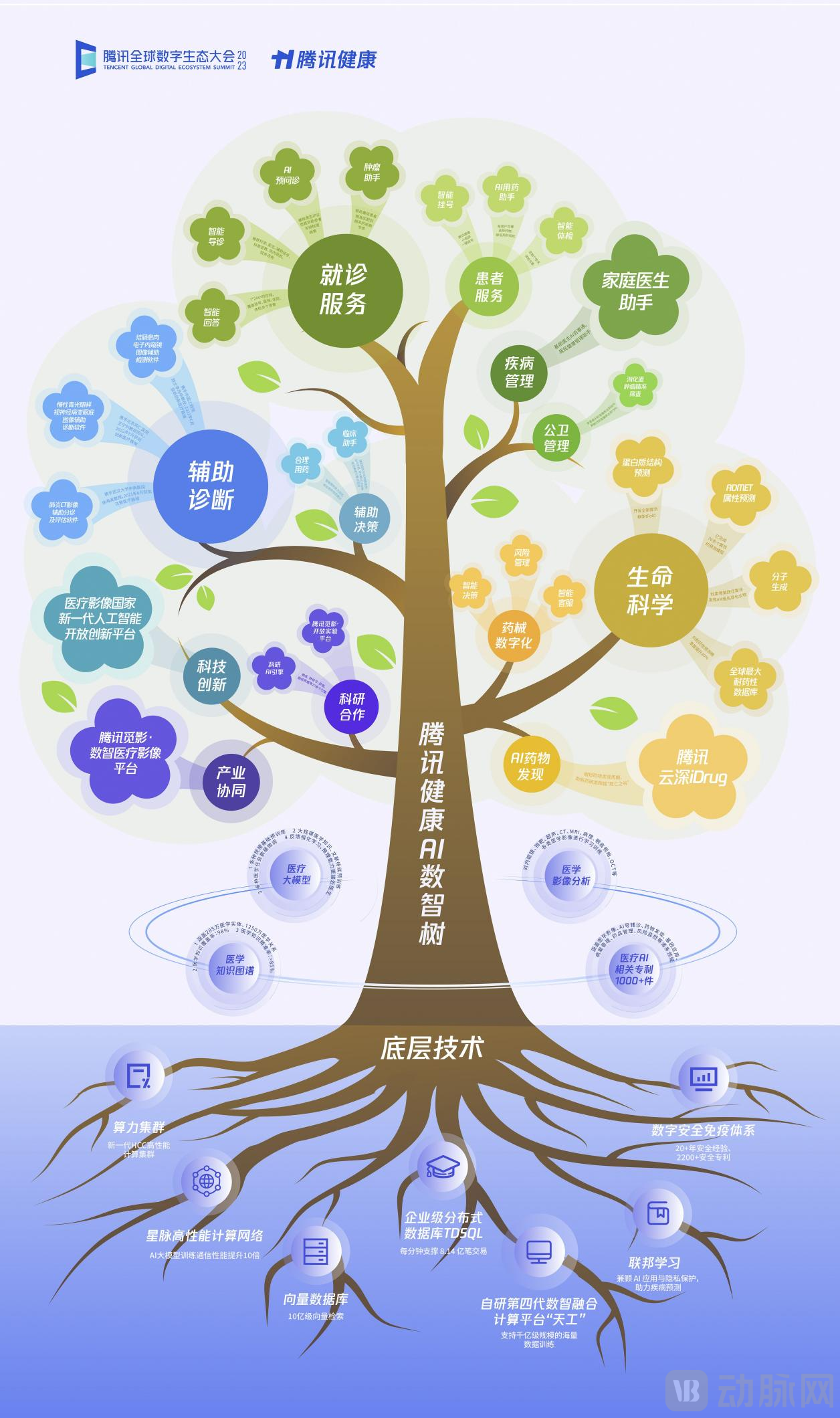
Cloud and “Connectivity”: The Core Support for Tencent’s Medical AI
If the goal is merely to clean data and build applications, most medical AI companies in China can, to varying degrees, develop tools that help clinical departments improve quality and efficiency. In contrast, another advantage of Tencent Health’s strategic layout lies at the base of its “AI Digital Intelligence Tree.” These robust roots enable Tencent to provide hospitals not just with individual smart products, but with a comprehensive suite of solutions.
Taking the deployment of large language models (LLMs) as an example, the existing resource infrastructure in most hospitals is primarily based on CPUs designed for general-purpose computing, with few hospitals possessing GPU resources tailored for graphics processing and parallel computing. Therefore, to achieve practical implementation of LLMs, the challenge of deployment environments must be overcome.
For hospitals, there are currently two viable solutions to this issue, each with its own advantages and disadvantages. First, healthcare institutions can deploy large model applications by equipping themselves with GPUs at the time of procurement, ensuring sufficient storage capacity and high-speed network connectivity. The limitation of this approach lies in the size of the models; if the models are too large, the configuration costs for hospitals will rise sharply, necessitating strict control over model size. Second, healthcare institutions can leverage cloud computing to offload the computational processes of large models from their internal environments, directly obtaining results from cloud-based computations. This approach requires careful consideration of data security issues and the degree to which healthcare institutions are willing to adopt cloud computing.
As China’s largest cloud service provider, Tencent holds a natural advantage in this second approach. At the Tencent Global Ecosystem Conference, Tencent presented personalized cloud-based solutions tailored to various types of healthcare entities.
In the hospital setting, the first to benefit from cloud technology and large language models is the Tencent Miying Digital Intelligence Medical Imaging Platform. Tencent Miying enables the development of AI applications with greater speed, lower cost, and higher quality, thereby advancing scientific research. Meanwhile, Tencent Cloud distributes these intelligent capabilities, implementing them in every medical scenario where there is a need.
In industrial applications, Tencent provides cloud-based solutions for multimodal imaging types, enabling doctors and patients to perform remote viewing and manipulation. Empowered by large models, AI can process a significantly wider range of diseases and data modalities, thereby enhancing the capabilities of physicians operating via mobile platforms.
Next is "Connection"。“Data silos” are a classic challenge facing China’s healthcare system, with the core issue being a lack of standardization that prevents any single system from integrating various operational workflows. Leveraging its ecosystem advantages, Tencent has established multiple connectivity pathways to enable standardized interoperability across diverse healthcare scenarios.
It is well known that primary healthcare represents both the scenario where medical AI can deliver the greatest value and the most challenging environment for its deployment. Particularly in the era of large language models, these institutions lack the feasibility of deploying GPUs, necessitating cloud computing to distribute intelligent capabilities. Furthermore, a standardized entry point is required to connect patients with physicians. Within Tencent’s primary healthcare solution, this “connection” is realized through the “Family Doctor Assistant.”
Positioned as an intelligent assistant for family doctors, this product leverages WeChat and WeCom to establish communication channels between patients and physicians, while also being powered by Tencent’s large medical language model, thereby making its products and services more intelligent and user-friendly.
First, Tencent Health’s Family Doctor Assistant ensures the validity of the enrollment process and facilitates use by families with elderly members and children. Its underlying infrastructure is integrated with primary healthcare information systems, enabling physicians to comprehensively access enrollment and patient record data. Second, its self-developed, precise, and comprehensive tagging system further assists physicians in delivering more personalized services to residents.
Currently, there are many intelligent applications on the market that can reduce costs and increase efficiency for family doctor services. However, most of these applications operate in isolation, failing to form integrated solutions; they lack interoperability, requiring doctors and patients to access multiple platforms. In contrast, Tencent leverages its ecosystem advantages to connect doctors and patients, enabling the comprehensive delivery of its intelligent capabilities through this connection.
Revisiting scenarios such as pharmaceuticals, medical devices, and new drugs, this critical connection has become WeChat.
On July 3, 2023, iCreate Technology and Tencent Cloud signed a strategic cooperation agreement. The two parties will jointly launch product solutions for end-to-end compliant traceability in the pharmaceutical and medical device sectors, assigning authentic, traceable, and verifiable unique “code” data to pharmaceutical and medical device products. By scanning GS1-standard QR codes via WeChat’s “Scan” feature, users can access traceability information, thereby enhancing the authority and convenience of pharmaceutical and medical device traceability and ensuring safer and more convenient medication use. Meanwhile, staff members can eliminate the need for various handheld devices and perform code update reviews anytime and anywhere using only a mobile phone.
Following the integration of AI, the collaboration between iCreate Technology and Tencent Cloud in the digital traceability of pharmaceuticals and medical devices has become more quantifiable and controllable. In the future, both parties will leverage their respective advantageous resources to engage in deep cooperation across product solutions, business strategies, operational models, and user markets. By strengthening regulatory measures and risk control capabilities, they aim to establish a “security code” for the healthy development of the industry, meet the multidimensional needs of pharmaceutical and medical device enterprise customers, and achieve mutual development and long-term win-win outcomes.
Exploring Medical Scenarios Best Suited for Technology
Returning to the initial question. The reason why Tencent’s large language models are likely to be deployed in healthcare scenarios at the fastest pace is that Tencent possesses a comprehensive AI ecosystem, enabling it to identify the genuine AI needs of each healthcare scenario and complement them with highly matched AI technologies, thereby avoiding misuse.
In other words, Tencent will not impose the capabilities of large models onto healthcare; instead, it will continuously explore application scenarios that best align with cost and value, fully leveraging the comparative advantages of large models.
For an innovative technology that has been commercialized for less than a year, Tencent’s approach may be the best fit for the current environment.
Rather than focusing on which large model applications will ultimately survive and profoundly transform healthcare scenarios, it is better to closely follow clinical needs, comprehensively develop AI technologies, and integrate them tightly with clinical practice.