

Brain Science and Digital Therapeutics Rapidly Penetrate the Market: A Trillion-Yuan Rehabilitation Industry Awakens | 2021 Annual Review
In the past two years, the rehabilitation market has been advancing at breakneck speed, quietly but surely.
A series of policies have paved the way for rehabilitation, spanning from macro-level strategies to practical implementation, and from hospital construction to talent development. Private healthcare providers are being encouraged, and capital is responding accordingly.
In the primary market, over 20 financing and investment deals took place in the rehabilitation sector in 2021. In the secondary market, many listed companies began or continued to increase their commitments to the rehabilitation industry through acquisitions and investments.
Is the rehabilitation industry poised for a new wave of development opportunities? What challenges and pain points remain? Which niche sectors have taken the lead? VCBeat aims to gauge the direction of the rehabilitation industry by examining key events and trends in the field in 2021.
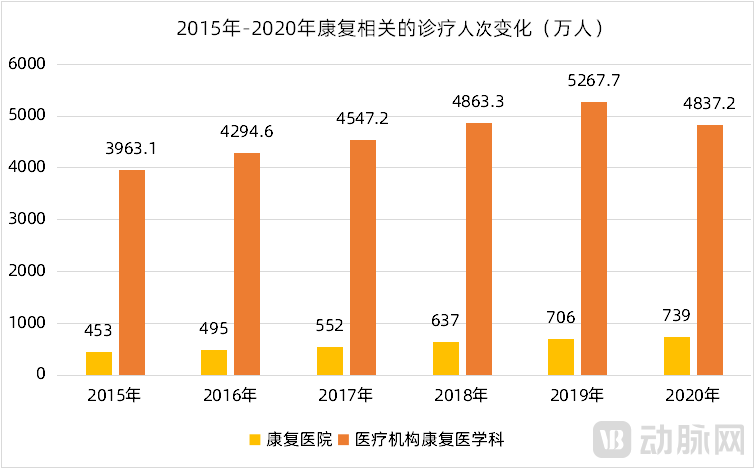
In recent years, the volume of diagnoses and treatments in rehabilitation hospitals and rehabilitation departments has risen rapidly. In 2019, the number of visits related to rehabilitation reached 52.677 million, setting a new record. In 2020, affected by the COVID-19 pandemic, the rehabilitation medical service industry suffered a significant impact, with offline rehabilitation services difficult to carry out in many regions. The number of rehabilitation-related visits decreased accordingly. The persistently high figures for diagnosis and treatment serve as a wake-up call that disease prognosis cannot be overlooked, and there is an urgent need to advance personal rehabilitation and the development of related industries.
As the concept of whole-process disease management becomes increasingly established, the rehabilitation sector is entering a phase of rapid development, with market gaps quickly narrowing. Driven by three major trends—population aging, shifts in the disease spectrum, and technological advancements—rehabilitation is emerging as a vast blue ocean for innovation and entrepreneurship.
The state has also repeatedly introduced policies to continuously encourage private investment in healthcare by improving market access conditions, streamlining administrative approvals, expanding financing and investment channels, and promoting tiered diagnosis and treatment. It emphasizes support for private healthcare providers to deepen their involvement in specialized medical services such as rehabilitation and nursing care, accelerating the development of a cohort of competitive branded service institutions.
In 2021 alone, a series of relevant policies were successively introduced, including the “Opinions on Accelerating the Development of Rehabilitation Medical Services” and the “Notice on Launching Pilot Programs for Rehabilitation Medical Services.” These policies provided comprehensive design and planning for the construction of rehabilitation hospitals, talent development, innovative rehabilitation therapies, and rehabilitation payment mechanisms, thereby delivering significant benefits to the rehabilitation medical sector and its related industrial chain.
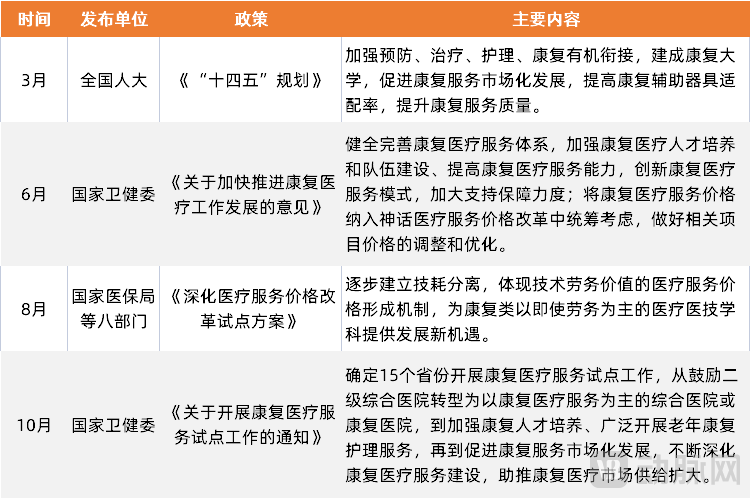
Even by simply aggregating these policies, we can clearly discern the underlying logic shaping the new era of rehabilitation: it is an industry driven by payer incentives and reliant on human capital. To ensure the steady delivery of rehabilitation medical services, constraining factors such as workforce development and the refinement of payment systems must be addressed in tandem.
Market participants have responded swiftly, flocking to the rehabilitation medical sector in search of lucrative opportunities, with well-capitalized listed companies among them.
On May 26, Shanghai real estate developer Tianchen Shares announced that its proposed Shanghai Tianchen Rehabilitation Hospital had received construction approval from the Shanghai Municipal Health Commission and obtained the “Approval Letter for Establishing a Medical Institution.” On November 6, Samsung Medical’s hospital acquisition case concluded with the purchase of Hangzhou Mingzhou Brain & Spine Rehabilitation and Nanchang Mingzhou Rehabilitation for RMB 516 million. On November 12, Shanghai Lanhai Rehabilitation Hospital, a subsidiary controlled by Lanhai Medical, received the “Medical Institution Practice License” issued by the Shanghai Municipal Health Commission.
Publicly listed companies venturing into rehabilitation services is not a new topic. In earlier years, particularly after 2012, major enterprises across various sectors announced their cross-industry entry into rehabilitation, either prominently or discreetly. According to incomplete statistics from VCBeat, nearly 16 publicly listed companies have entered the rehabilitative medical services industry and made corresponding strategic arrangements to date.
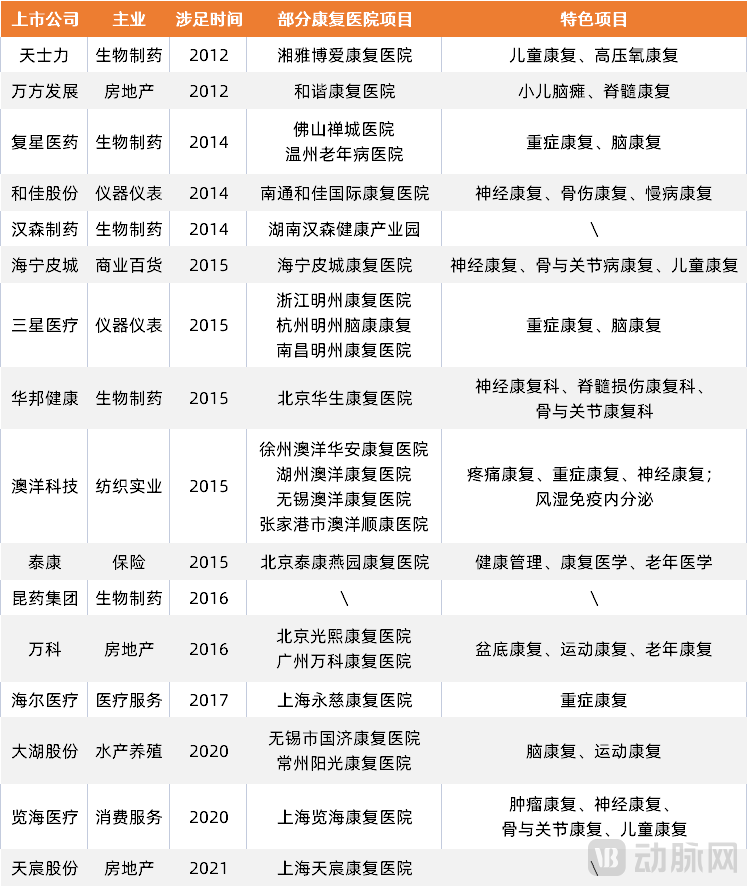
Among the rehabilitation hospitals established by numerous listed companies, there are many that feature neurological rehabilitation, sports rehabilitation, brain rehabilitation, and pediatric rehabilitation as their specialized disciplines.
Private capital is accelerating its push into the rehabilitation medical sector, while public healthcare systems are also rapidly entering the market.
In 2021, more than ten specialized rehabilitation institutions, including the Wuhan International Rehabilitation Medicine Center jointly established by Wuhan City and Tongji Hospital affiliated with Tongji Medical College of Huazhong University of Science and Technology, Jiangsu Provincial Rehabilitation Hospital (poised to become the first large-scale rehabilitation hospital in Jiangsu Province), the Lanting Campus of Shaoxing Second Hospital in Zhejiang Province with an investment of RMB 2.89 billion, and the Rehabilitation Hospital of the First Affiliated Hospital of Kunming Medical University with a planned capacity of 1,200 beds, either commenced construction or were completed.
According to the "2021 China Health and Health Statistical Yearbook" released by the National Health Commission, there were 706 rehabilitation hospitals nationwide in 2019 and 739 in 2020. Compared with 20,133 general hospitals, rehabilitation hospitals accounted for only about 3.6%, far failing to meet people's rehabilitation needs. Among them, the number of public rehabilitation hospitals was 150 in 2010 and 166 in 2020, remaining nearly stable over the past decade. The proportion of private rehabilitation hospitals rose continuously from 63.8% in 2015 to 77.5% in 2020. In terms of quantity, private hospitals occupy a dominant position.
In the primary market, the rehabilitation medical device industry began to heat up in 2021.
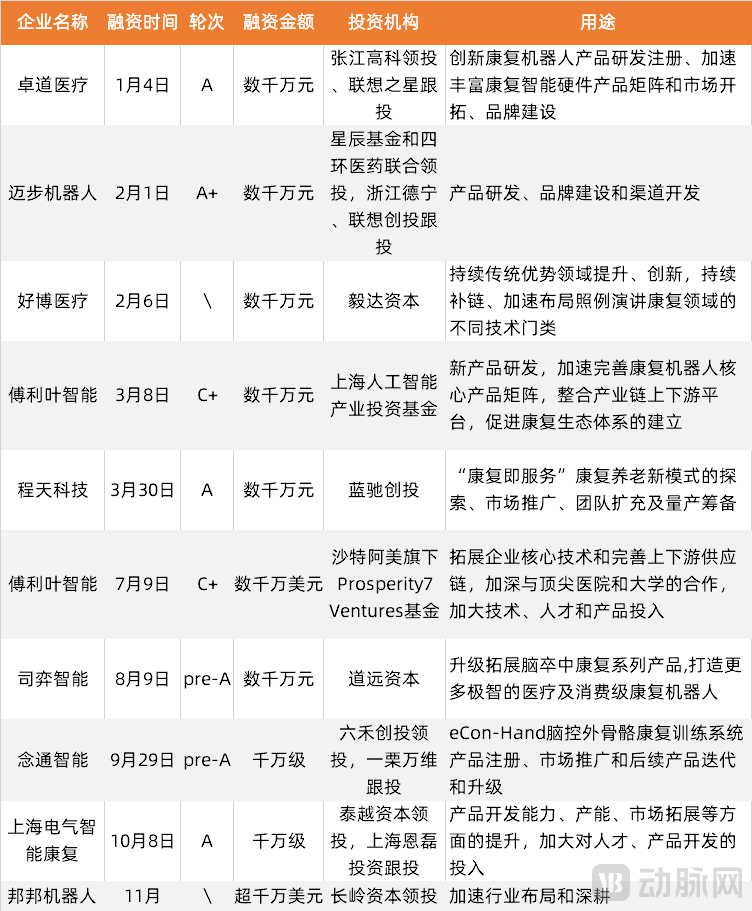
Financing in the Rehabilitation Medical Device Sector in 2021
This year, Bangbang Robotics and Fourier Intelligence completed substantial USD-denominated financing rounds, while other rehabilitation medical device companies remain in early-stage fundraising. In terms of fund allocation, these companies are primarily focused on refining and optimizing their products.
To meet rehabilitation needs, Bangbang Robotics has divided its product line into consumer-grade and professional-grade tiers, comprehensively covering the spectrum of tertiary medical rehabilitation from professional institutions to home settings. In the professional market, Bangbang Robotics has launched lower-limb rehabilitation robots and connected community rehabilitation centers with hospitals through its professional rehabilitation software service system, truly extending professional rehabilitation services to the home. In the consumer market, the company has introduced home rehabilitation assistance robots and intelligent walking aid robots, addressing users’ three major needs for independent living, rehabilitation, and mobility at home.
From a technical perspective, the performance of domestically produced exoskeleton robots is rapidly catching up with foreign counterparts, aided by AI. The application of artificial intelligence technology has accelerated the commercial deployment of rehabilitation robots, making the intelligentization of rehabilitation equipment a key driver of industry transformation.
The integration of brain-computer interface technology with rehabilitation robots has brought the science-fiction vision of human-machine “telepathy” into reality.
On September 29, 2021, brain science enterprise Niantong Intelligence announced the completion of its tens-of-millions-level Pre-A financing round, while also revealing in-depth collaborations with Shanghai Jiao Tong University and Huashan Hospital affiliated to Fudan University. Together, they developed the eCon-Hand brain-controlled exoskeleton rehabilitation training system for stroke patients.
eCon-Hand consists of an EEG headset and an exoskeletal robotic hand. The EEG headset is responsible for acquiring and real-time decoding of electroencephalographic (EEG) signals, while the exoskeletal robotic hand assists the patient’s affected hand in performing grasping or extension exercises based on decoded EEG commands. With the system’s assistance, patients can actively control their affected limbs using their own brainwaves to undergo proactive rehabilitation training.
At the Second Forum on Rehabilitation and Assistive Technology held this August, Professor Teng Fei of Xi’an Jiaotong University and Xu Guanghua, Director of the Shaanxi International Joint Research Center for Digital Medical Devices and Instruments, addressed the application of non-invasive brain-computer interaction technology in the field of rehabilitation. They stated, “This approach essentially paves the way and builds bridges for the motor command loop from the central nervous system to limb movements, utilizing brain-computer interaction technology to reconstruct damaged neural circuits.”
As early as 2017, Professor Xu Guanghua began exploring the application of brain-computer interfaces (BCI) in the field of rehabilitation. In September of that year, the BCI-controlled lower-limb exoskeleton rehabilitation robot, developed by Professor Xu Guanghua’s team at Xi’an Jiaotong University, was showcased at the finals of the 2017 Silk Road Robot Innovation Competition. By wearing a helmet capable of detecting the patient’s neural signals, the system transmitted these signals to the exoskeleton robot. The robot then executed actions based on the patient’s intent, enabling standing and walking to achieve rehabilitation training and gait correction, while also adapting to various terrain conditions. This marked the first domestically developed BCI-controlled lower-limb exoskeleton rehabilitation robot in China.
Capital drives the output of research results, but to bring these results to market, in addition to technological maturity, regulatory approval must also be obtained. Compared with the R&D cycle of surgical robots, that of rehabilitation robots is relatively shorter, and entering hospitals only requires Class II medical device certification.
In late March 2021, the lower-limb exoskeleton rehabilitation robot independently developed by Chengtian Technology—the first and only domestic product indicated for central nervous system disorders (covering patients with paraplegia and hemiplegia)—received renewed approval, successfully obtaining a Class II medical device registration certificate. In July, medical device manufacturer Vishee Medical announced that its lower-limb walking exoskeleton assisted training device had obtained a Class II medical device registration certificate, indicated for gait rehabilitation training in patients with lower-limb motor dysfunction caused by spinal cord injury. The commercialization process for exoskeleton rehabilitation robots was officially launched.
In October 2021, Huaquejing’s WisebotX5, a 3D upper-limb assessment and training robot, received approval from the National Medical Products Administration (NMPA). Based on rehabilitation theories such as neuroplasticity and mirror neurons, this intelligent rehabilitation robot is designed for patients with upper-limb motor dysfunction. It innovatively introduces intelligent assessment technologies for Brunnstrom staging and range of motion, thereby automatically generating personalized rehabilitation training prescriptions.
The Wisebot X5 simulates the movement patterns of the human upper limb in real time across multiple dimensions. It not only provides active, passive, and active-passive training modes but also pioneers a mirror training mode to achieve synchronized bilateral coordination training. The Wisebot X5 features carefully designed, diverse 3D task-oriented training programs that provide patients with multi-channel sensory stimulation involving motor, visual, and auditory inputs. While improving motor functions such as upper limb control, muscle strength, range of motion, and coordination, it simultaneously facilitates training in cognitive abilities, activities of daily living (ADL), and occupational performance.
In the secondary market, rehabilitation medical devices have also seen significant activity.
On March 31, Xiangyu Medical was listed on the STAR Market. Founded in 2002, Xiangyu Medical is a leading R&D enterprise in China’s rehabilitation medical device industry, currently offering three major product categories: rehabilitation assessment, rehabilitation training, and rehabilitation physiotherapy.
As a leading domestic manufacturer of rehabilitation and physiotherapy equipment, Xiangyu Medical has also made strategic investments in intelligent technologies, such as upper-limb feedback systems and intelligent lower-limb rehabilitation feedback training systems. The increase in newly granted patents further demonstrates Xiangyu Medical’s continuously improving innovation capabilities. According to the company’s 2021 semi-annual report, it added 140 new patents during the period, bringing the cumulative total to 971; it also registered eight new software copyrights, raising the cumulative total to 70.
In December 2021, Xiangyu Medical issued an announcement stating its plan to invest RMB 520 million in building a rehabilitation medical device industrial park in Zhengzhou. This initiative aims to introduce more advanced automation and improve related production processes on the basis of its existing production scale, thereby enhancing the level of intelligent manufacturing technology.
On November 7, Cofoe Medical, which had been listed for less than half a month, released two major announcements in succession, kicking off an acquisition spree: it fully acquired Oak International, the parent company of “Babaka,” for RMB 177 million, and acquired Jirui Medical, a wheelchair contract manufacturer, for RMB 50.2702 million. Through these two acquisitions, Cofoe Medical can fill the gaps in its independent R&D and manufacturing capabilities in physical posture correction, body-shaping products, wheelchairs, and mobility aids.
Rehabilitation therapy encompasses a broad spectrum of disciplines, including neurological rehabilitation, pediatric rehabilitation, orthopedic rehabilitation, sports rehabilitation, and cardiopulmonary rehabilitation. Based on financing event data, sports rehabilitation, psychiatric and psychological rehabilitation, and pediatric rehabilitation demonstrated strong growth momentum in 2021.
Sports Rehabilitation: Beyond Rehabilitation, A Holistic Solution from Treatment to Recovery Is Essential
Exercise rehabilitation is a systematic and targeted functional exercise training that, while fully considering the physiological recovery cycle of tissues, stimulates related tissue structures and the body's overall organs to achieve positive adaptations in biological form and function.
In February 2021, Demei Medical Devices secured RMB 150 million in Series E financing, less than six months after completing a previous funding round exceeding RMB 100 million, demonstrating strong market potential. Demei Medical is committed to providing patients with comprehensive, integrated solutions for sports medicine treatment. Its products have covered all provinces, municipalities, and autonomous regions across China, and the company has begun expanding into overseas markets, including South Korea, Japan, Singapore, and Southeast Asia.
In January 2021, Bang’er Orthopedic Hospital Group completed a Series D financing round of RMB 300 million, setting the highest single-round funding record in the sports rehabilitation sector over the past two years. This successful financing will also help Bang’er Orthopedic Hospital Group gradually realize its vision of “centering on the essence of healthcare, bringing leading orthopedic technologies and high-quality services to the general public, and becoming a global chain brand of orthopedic hospitals.”
In November 2021, Youfu Medical completed a Series B+ financing round amounting to tens of millions of US dollars. By integrating its online management platform “Yishu,” its offline chain of Youfu Rehabilitation Clinics, and its chain of Youfu Stretching centers in the broader health sector, Youfu Medical has established a closed-loop diagnosis and treatment system in orthopedics and rehabilitation medicine. With 12 clinics operating in Shanghai, it has become a leading domestic provider of sports medicine and orthopedic rehabilitation services, offering comprehensive medium- to long-term solutions that combine “in-hospital + out-of-hospital” and “online + offline” care for patients and users.
In clinical practice, sports rehabilitation is a protracted process that requires close collaboration across multiple disciplines to achieve optimal outcomes. In the future, providing a comprehensive rehabilitation service continuum—spanning from treatment and rehabilitation to long-term care—may become one of the prevailing trends.
According to data from the White Paper on China's Sports Rehabilitation Industry, the number of people engaged in physical exercise in China reached 430 million in 2020. Based on an estimated sports injury rate of 10%–20%, the number of individuals with sports injuries is projected to reach 100 million, indicating significant potential for future demand in sports rehabilitation. In terms of end-user demographics, as national fitness initiatives become more widespread, emphasizing scientific exercise has gradually become a trend. Consequently, the sports rehabilitation market is expanding from a niche sector catering primarily to professional athletes to a mass market serving sports enthusiasts.
Psychological and Mental Rehabilitation: Dominated by Diagnostic and Therapeutic Services, with the Emergence of Innovative Models Integrating AI and Digital Therapeutics
In May 2018, the National Health Commission released data at a conference showing that by the end of 2017, among China's population of 1.39008 billion, there were over 243.26 million individuals with mental disorders, resulting in an overall prevalence rate of 17.5%. The number of patients with severe mental disorders exceeded 16 million, with a prevalence rate surpassing 1%, and this figure continues to rise year by year.
Faced with this severe challenge, the existing supply of mental health services is woefully inadequate, creating an urgent need for new models, technologies, and concepts to enter the industry. No shortage of pioneers are exploring this promising sector. Consequently, some innovators have embarked on their exploratory journeys, while capital has begun to flow in behind them, providing strong support.
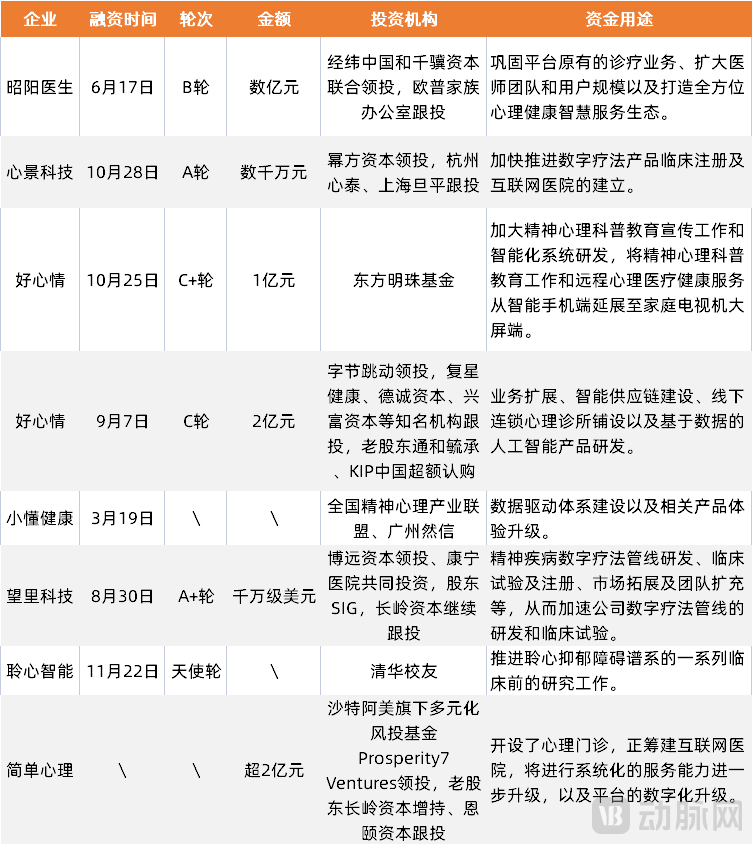
In addition to these innovative startups, many large corporations are also actively expanding into the mental health sector. ByteDance led the Series C financing round for Haoxinqing, while JD Health launched a mental health channel and introduced online-to-offline psychological counseling services.
An analysis of how these innovative companies allocate their funds reveals that the scarcity of diagnostic and therapeutic resources, as well as qualified professionals, for mental and psychological disorders, along with the need for market education, are urgent issues currently facing the market. Among emerging trends, innovative products and business models centered on diagnostic and therapeutic services, integrated with artificial intelligence and digital therapeutics, are beginning to appear. As mental health is an interdisciplinary field, treatment efficacy and clinical data serve as key indicators for assessing the reliability of these innovative technologies and models.
In the field of mental and psychological rehabilitation, autism rehabilitation is also a sector highly favored by investors. Autism predominantly manifests during infancy and early childhood, resulting in a strong demand for rehabilitation services among patients' families.
Capital is highly sensitive to market dynamics. Following a $23 million Series C1 financing round in February 2021, Oriental Speech completed an additional $60 million in Series C2 financing just four months later. This round stands as the largest single financing event in the field of pediatric speech rehabilitation and autism intervention.
In addition to their strong performance in the capital markets, many autism innovators also achieved significant progress in 2021 in addressing key pain points in autism rehabilitation.
In 2021, ALSOLIFE applied the innovative solution of digital therapeutics to the diagnosis and intervention of autism, and carried out a series of research and survey collaborations with institutions such as Peking University Sixth Hospital, Peking University Institute for Neuroscience, Institute of Psychology of the Chinese Academy of Sciences, School of Basic Medical Sciences of Xi’an Jiaotong University, Microsoft Research Asia, National Institute of Health Data Science at Peking University, and College of Language Rehabilitation of Beijing Language and Culture University.
To address the shortage of autism rehabilitation institutions and professionals, Dami and Xiaomi has launched a new strategy to “serve one million families of children with autism.” By integrating advanced domestic and international intervention and rehabilitation theories and methods, and leveraging big data and machine learning, the company provides high-quality service products to support children’s growth and development. In addition to operating rehabilitation and intervention centers in Shenzhen, Guangzhou, Dongguan, and other areas of the Pearl River Delta, Dami and Xiaomi is also preparing to open centers in Beijing, Shanghai, Zhengzhou, Wuhan, Chengdu, and other regions across North China, East China, and Central and Western China, striving to benefit more children with autism.
To address the gap in China’s early screening system for autism, an AI-based digital diagnostic and therapeutic system—the “Autism Spectrum Disorder Screening and Auxiliary Diagnosis System”—jointly developed by Beijing Anding Hospital (Capital Medical University), the Institute for Accessibility Development at Tsinghua University, and Beijing Zhengzai Guanhuai Technology Co., Ltd. (Enqi), launched a large-scale, multicenter clinical study in October. The system is also planned to be applied in the large-scale epidemiological survey on autism led by Anding Hospital.
As more people become aware of the existence and severity of mental illnesses, and understand the importance of diagnosis and treatment as well as the currently available diagnostic and therapeutic options, psychiatric care will gradually emerge as a rapidly growing segment within China’s healthcare market.
Postpartum Rehabilitation: Forging Ahead Amidst the “Three-Child Policy” and a “<1% Birth Rate”
The “three-child” policy introduced in June brought a ray of hope to the postpartum rehabilitation industry, while the birth rate falling below 1% has cast a shadow over its development.
First, the postpartum rehabilitation industry will usher in a dual “qualitative change” dividend driven by “post-90s mothers” and “third-child mothers.” The policy’s promotional effect stems not from an increase in the number of births, but from the greater demand for recovery from physical symptoms compared to first and second births. As the main childbearing cohort, individuals born after 1985 and 1990 are highly educated, have strong self-health awareness, and place significant emphasis on their personal value and self-care. They are gradually recognizing and breaking away from traditional misconceptions about childbirth, pursuing more scientific and systematic postpartum rehabilitation.
Secondly, the industry will undergo consolidation and upgrading, with postpartum rehabilitation medical institutions replacing “three-non institutions” as the primary service providers. A shortage of qualified professionals remains a key pain point in the industry, and high-quality postpartum rehabilitation medical institutions are still scarce. As the number of childbirths increases, postpartum symptoms among women become more pronounced, necessitating supportive treatment from professional medical institutions and healthcare personnel. Service quality and therapeutic efficacy will become the criteria for maternal choice, driving industry consolidation and upgrading, with postpartum rehabilitation medical institutions replacing “three-non institutions” as the main service providers.
However, given China’s current fertility rate, the number of births is projected to decline after 2021, leading to a reduction in the total number of new postpartum rehabilitation users and exerting some impact on the market size of the postpartum rehabilitation sector.
Overall, the goal of rehabilitation therapy is to help patients live better lives. Behind the rehabilitation industry lie the intertwined joys and sorrows of countless individual lives. Its growth does not occur as a sudden explosion at any single point in time; rather, it gradually improves alongside national economic growth and rising consumer and rehabilitation awareness among the public, thereby empowering an increasing number of patients with autonomy over their lives.