

Why Are Chinese Neurointerventional Companies Like MicroPort and CardioNexus Going Global? | 2021 Annual Review
In January 2021, even the biting cold winds could not dampen investors' enthusiasm.
“We are also very interested in your company,” Song Weiyang said to Li Qi, the head of a neurointerventional medical device company.
“We’ll launch our next funding round in the second half of the year, and we’ll definitely reach out to you then,” Li Qi replied with full confidence. He was the 47th investor he had spoken with over the past six months, all of whom had expressed proactive interest in investing in his company.
But by July 2021, even the scorching sun could not melt investors’ indifference.
Li Qi said excitedly, “Old Song, my product is about to get approved. As long as you invest…”
Song Weiyang interrupted, “Apologies, apologies. We’ve been looking into other areas recently.”
Li Qi was deeply frustrated. He had lost count of how many investors who had once pursued him were now turning him down. What exactly had happened between the beginning and the middle of the year? Why had the neurointerventional sector suddenly gone from being a “hot cake” to a “hard tack”?
VCBeat interviewed multiple investors and corporate executives in the neurointerventional field, finally uncovering the answer. In fact, the neurointerventional sector in 2021 was marked by dramatic changes.
First, investment by venture capital firms in the neurointerventional field rapidly returned to rationality starting in the second half of the year.
Secondly, products from companies in the neurointerventional field have been successively approved for market launch, intensifying competition to a fever pitch, while numerous neurointerventional firms are increasingly expanding into overseas markets.
Furthermore, the inclusion of certain consumables in the neurointerventional field in centralized procurement during the second half of the year had a significant impact.
Finally, the establishment of the Neurointerventional Innovation and Translation Alliance signals that exchanges between physicians and engineers in the field of neurointervention will become more frequent. With the support of clinical experts and industry stakeholders, innovations in neurointervention will be more closely aligned with clinical practice, better addressing unmet clinical needs.
To provide an in-depth discussion of the changes in the neurointerventional field in 2021, the impact of major events, and the future development trends of this sector, VCBeat has conducted interviews with multiple investors, entrepreneurs, and industry experts to produce this article for our readers.
From 2020 to the first half of 2021, the concept of neurointerventional medicine surged in popularity within the capital markets. For instance, listed companies such as MicroPort Scientific, Peijia Medical, and Weigao Group flocked to enter the sector, while star startups like TransMedics (Guichuang Tongqiao), Xinwei Medical, and Vobi Medical secured multiple rounds of substantial investment from top-tier venture capital firms.
According to incomplete statistics from VCBeat, as of June 2021, at least 24 innovative enterprises in China, including Jian Shi Medical, Like Technology, Xin Kai Nuo, Pu Wei Sen, Tai Jie Wei Ye, Nuan Yang Medical, Ai Ke Medical, and Jiu Shi Shen Kang, had R&D layouts for neurointerventional products; additionally, more than 60 investment institutions, including Hillhouse Capital, Chende Capital, SDIC Innovation, Anlong Fund, Honghui Capital, Sequoia Capital, Huagai Capital, Jifeng Capital, Qianhai Fund of Funds, and Cowin Capital, have placed bets on the neurointerventional sector.
From 2020 to June 2021, there were more than 15 financing and investment events in the neurointerventional field, with a total cumulative funding amount exceeding RMB 1.5 billion. During this period, companies in the neurointerventional sector were highly favored by numerous investment institutions, leading to intense competition among multiple investors vying for equity stakes in certain neurointerventional companies.
However, by the second half of 2021, the capital market had quickly returned to rationality, with only four financing and investment events in the field of neurointervention.
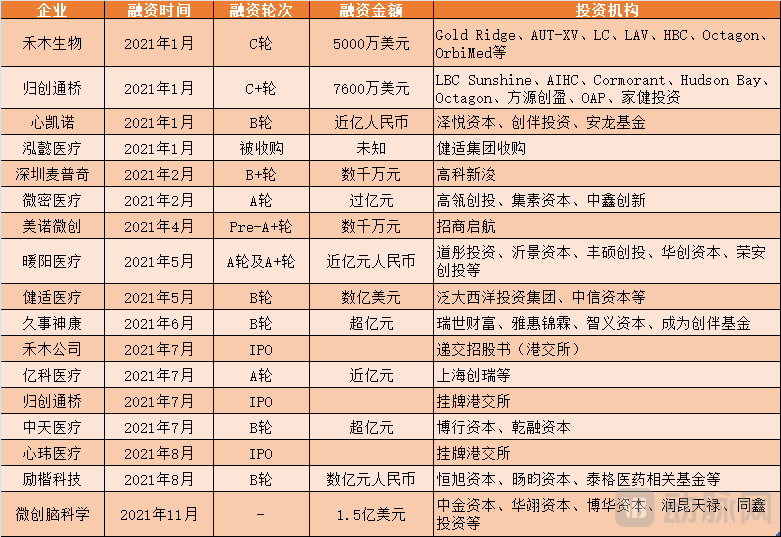
A review of investment and financing activities in the neurointerventional field in 2021 reveals that large-scale funding rounds were commonplace. Examples include Hemu Bio’s $50 million Series C, TransMed’s $76 million Series C+, Jianshi Medical’s multi-hundred-million-dollar Series B, both Jiushi Shenkang and Zhongtian Medical securing over RMB 100 million in their respective Series B rounds, Likai Technology raising hundreds of millions of RMB in its Series B, and MicroPort NeuroTech’s $150 million financing round.
Meanwhile, companies in the neurointerventional sector primarily secured Series B and C funding, with a total of eight such rounds accounting for approximately 61.5% of the total. Notably, Vision MedTech and HeartCare Medical went public in the second half of 2021, while Peijia Medical had previously listed in 2020.
From the perspective of the capital market landscape, the neurointerventional field presents a highly competitive environment characterized by a multitude of players.。
It is worth noting that in 2021, the investment and financing climate in the neurointerventional field shifted from “feverish” to “rational” in less than six months. Analysts from investment firms pointed out that this rapid transition was driven by waning confidence among secondary market investors, which spilled over into the primary market, prompting institutional investors to adopt a more rational approach to investment.
On the other hand, some attribute this to the severe homogenization of products among neurointerventional companies, with investors concerned that neurointerventional devices are poised to be included in centralized volume-based procurement (VBP). Such expectations have led investors to shift their focus to other sectors.
Regarding changes in the capital market, industry experts believe that regardless of whether capital sentiment is overheated or rational, the core competitiveness of neurointerventional companies remains their products. Therefore, irrespective of their performance in the capital market, neurointerventional enterprises hold enduring value by fulfilling their mission to “address unmet clinical needs.”
Moreover, changes in the capital market further indicate that companies in the neurointerventional field still have growth opportunities, whether through IPOs or angel financing rounds. This is because the competitiveness of neurointerventional companies lies not in the capital market, but in the value and quality of their products.
In 2021, Chinese neurointerventional companies finally entered a harvest phase after years of research and development. In May, Hemobio’s first domestically developed intracranial thrombus aspiration catheter system was approved by the National Medical Products Administration (NMPA). In July, Sino Medical Sciences Technology Inc.’s globally first intracranial drug-eluting stent system was approved for market launch. In August, Vobi Medical’s independently developed mechanically detachable coils obtained NMPA registration certification, marking the first neurointerventional embolization product in China to receive simultaneous certifications from the U.S. FDA, the EU CE, and Japan’s PMDA.
In addition, neurointerventional companies such as Acotec Scientific, Likai Technology, XinKaiNuo, TaJie WeiYe, Jiushi Shenkang, and Meinuo Micro-Invasive have also had multiple products approved by the National Medical Products Administration.According to incomplete statistics from VCBeat, as of December 2, at least 22 neurointerventional products were approved in China in 2021.。
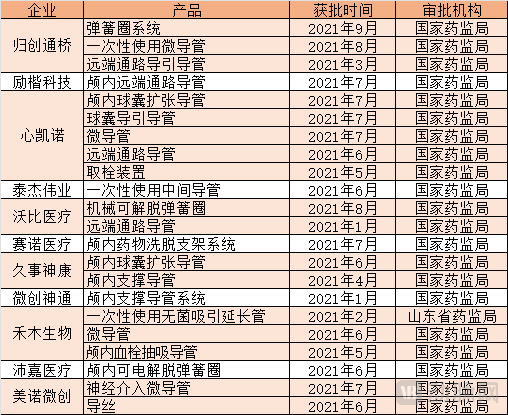
(Incomplete statistics by VCBeat: Approval status of domestically produced neurointerventional products in 2021)
A review of the approval status of domestically produced neurointerventional products in 2021 reveals that a variety of such products are currently on the market, including coils, microcatheters, microwires, intermediate catheters, and distal access catheters.The market launch of various domestically produced neurointerventional products signifies that Chinese manufacturers are now capable of meeting the clinical needs of the majority of relevant patients, as well as addressing the diverse requirements of different patient populations.。
For example, the BADDASS technique pioneered by JieCheng Medical in China provides standardized surgical procedures for patients with ischemic stroke through a suite of neurointerventional devices, including stent retrievers, intracranial support catheters, and balloon guide catheters. Existing clinical studies indicate that among all current thrombectomy techniques, the BADDASS technique achieves the highest rate of first-pass recanalization, making it the optimal combination for thrombectomy treatment of ischemic stroke. Based on procedural requirements and its product portfolio, JieCheng Medical has launched the “BADDASS Technique Trio,” comprising stent retrievers, intracranial support catheters, and balloon guide catheters.
On the other hand, the approval of numerous domestically produced neurointerventional products of the same type has led to intensifying competition in the neurointerventional market.. For example, nine domestically produced coil products have been launched on the market, and at least ten domestically produced microcatheters for neurointerventional procedures have been launched.
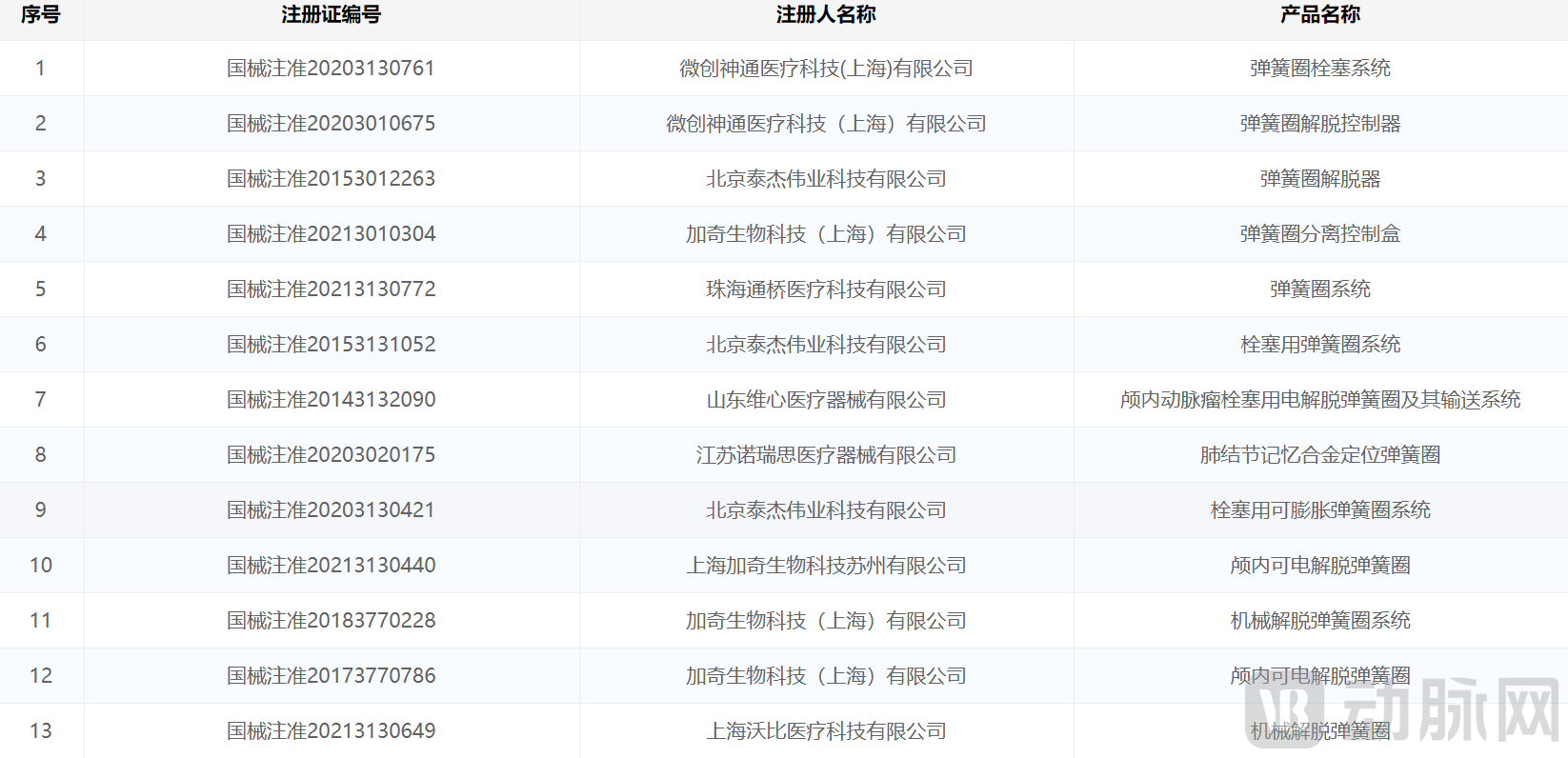
(Data source: Official website of the National Medical Products Administration)
In addition to product homogenization, certain products remain under the monopoly of overseas enterprises.. For example, among domestic enterprises, only Hemu Biologics has obtained approval for intracranial thrombus aspiration catheters, while products from other companies are still in clinical trials or other stages.
Notably, in 2021, Jianshi Medical entered into a strategic partnership with Penumbra, a global leader in interventional medical devices. Penumbra’s intracranial thrombus aspiration system, which has obtained import medical device registration certification in China, has been widely adopted across the country. In April 2021, in addition to its existing range of aspiration catheters, Penumbra’s next-generation ACE68 aspiration catheter was also approved for market launch.
Overall, most neurointerventional products in China have mastered core technologies and achieved domestic production; however, a small number of categories still require continuous R&D to break overseas monopolies. Meanwhile, globally leading neurointerventional products, such as intracranial drug-eluting stent systems, have also emerged in China.
With the approval and market launch of numerous domestically produced neurointerventional products in 2021, Chinese neurointerventional companies will compete with imported products. Fortunately, some domestic neurointerventional devices have achieved performance and quality comparable to imported counterparts. Meanwhile, globally first-of-their-kind neurointerventional products have also emerged in China.
For example, the micro-guidewire developed by MicroPort NeuroTech is a hybrid guidewire made from a combination of nitinol and stainless steel. It is available in 12 specifications and can be used for intracranial and extracranial peripheral applications. Among them,Enhanced MCL Specification Microcatheter: Enables Free Access to the Brain’s M3 and M4 Segments, Which Are Difficult for Other Products to Reach。
The Tongqiao Feng Coil System, launched by JuChuang TongQiao, is an ultra-soft mechanically detachable coil system that offers the advantages of exceptional softness, mechanical detachability, and a comprehensive range of specifications.Pre-market clinical trial data demonstrate that the softness of Tongqiao Feng coils is comparable to that of the latest-generation products from leading international brands, enabling safe and dense packing of irregular and ruptured aneurysms.。
SinoMedical’s globally first intracranial drug-eluting stent system has also gained significant clinical recognition. The “Progress and Results of Clinical Studies on Drug-Eluting Stents,” released by Professor Miao Zhongrong from Beijing Tiantan Hospital, Capital Medical University, shows:The SynoShenChang NOVA stent can significantly reduce the rate of in-stent restenosis, while also markedly lowering the incidence of recurrent ischemic stroke events in the mid-to-long term within the territory of the culprit vessel, with a safety profile comparable to that of conventional stents.。
Leveraging the high-quality advantages of domestically produced neurointerventional devices, amid fierce domestic competition and expectations of centralized procurement, Chinese neurointerventional companies have expanded overseas, seeking new growth drivers in the global market.
For example, Vascular Interventional Medical’s neurointerventional products have been exported to more than 20 countries and regions, including the United States, Germany, the United Kingdom, and Japan; Jiushi Shenkang has entered into a collaboration with Perflow, an Israeli medical device manufacturer, covering product registration, research and development, market access, and distribution, to help each other accelerate their internationalization processes.
Meanwhile, a number of Chinese neurointerventional companies registered and filed their products overseas in 2021 or earlier, with plans to launch them on the global market. Since 2021, Zenflow Medical has obtained CE certification for eight of its products; MicroPort NeuroTech’s microcatheters, thrombectomy devices, intracranial balloon dilation catheters, balloon guide catheters, distal access catheters, and other products received CE certification in May 2021; Vascular Medical’s independently developed aspiration catheter was officially granted U.S. FDA 510(k) clearance in December 2021. The coil embolization system, independently developed by MicroPort NeuroTech (a subsidiary of MicroPort Scientific), received certifications from the U.S. FDA, South Korea’s MFDS, and the EU CE in 2021...
In addition, MicroPort NeuroTech has formed a more comprehensive and diversified portfolio of neurointerventional products through strategic investment in the Israeli company Rapid Medical, driving the global application of its products. To date, MicroPort NeuroTech has successively obtained multiple system certifications, including ISO 13485:2016 and certification from Brazil’s National Health Surveillance Agency (ANVISA), establishing an internationally standardized quality management system.
Overall, an increasing number of domestically produced neurointerventional devices are expanding beyond China and entering the international market.。
In 2021, neurointerventional procedures combined with AI technology gradually moved into clinical practice.
For example, in May 2021, UnionStrong Intelligence and GE Healthcare jointly launched a one-stop AI solution for stroke CT imaging. This solution combines GE Healthcare’s CT image acquisition technology with UnionStrong Intelligence’s artificial intelligence algorithms to provide physicians with precise, one-stop AI-based assessment of ischemic stroke. Previously, UnionStrong Intelligence had already collaborated with GE Healthcare on DSA (Digital Subtraction Angiography) equipment. Building on these partnerships, UnionStrong Intelligence has achieved an intelligent solution covering the entire process of stroke diagnosis and treatment.
In terms of clinical application, in November 2021, clinicians in Yantai applied UnionStrong’s intelligent microcatheter shaping technology for the treatment of ophthalmic artery aneurysms. The physicians stated, “Microcatheter shaping is a critical step for the success of interventional aneurysm procedures. The use of artificial intelligence to assist in microcatheter shaping not only reduces the time required for microcatheter positioning and simplifies surgical manipulation, but also improves the success rate of the procedure.”Leveraging the advantages of artificial intelligence, its application is becoming increasingly widespread in clinical scenarios such as stroke treatment.。
Furthermore, Qianglian Zhichuang has launched the UKnow® system for hemorrhagic stroke and the UGuard® system for ischemic stroke.UKnow®System andUGuard®The system covers all stages of clinical care, including intelligent screening, precise diagnosis, treatment decision assessment, surgical planning, intraoperative assistance, and 3D follow-up.
Among them, the UKnow® system features intelligent flow diverter simulation, intelligent microcatheter shaping planning, intelligent 3D morphological measurement, and intelligent rupture risk assessment; whereas the UGuard® system offers intelligent CT-ASPECTS scoring, intelligent CTP cerebral perfusion assessment, and intelligent thrombus shape analysis.
In addition to Qianglian Zhichuang, Vobi Medical is also exploring the integration of AI technology with neurointerventional procedures. In August 2021, Vobi Medical signed a strategic cooperation agreement for the Greater China region with Brainomix, an AI medical imaging company. Under this partnership, Vobi Medical will accelerate the clinical adoption of Brainomix’s e-Stroke AI imaging software in stroke centers across China and collaborate with Brainomix to provide comprehensive, integrated solutions for the diagnosis and treatment of cerebrovascular diseases in clinical stroke care.
According to reports, Brainomix’s e-Stroke software is a platform that combines AI algorithms to support scan acquisition and imaging result assessment. By providing real-time analysis and interpretation of brain scans, it offers support and guidance to clinicians across the entire stroke care network, advising on treatment and transfer decisions for stroke patients. This ensures that more stroke patients receive the right treatment, at the right time, in the right place.
As can be seen, the application of AI technology in the field of neurointervention is gradually increasing, with AI now covering all stages from screening and diagnosis to treatment and follow-up.。
In early December, a post on WeChat Moments from a neurointerventional specialist commented on the procurement results for coils in Hebei Province: “The results of the Hebei coil centralized procurement are out—better than expected!”
Publicly available information indicates that in November 2021, Hebei Province issued a notice on the centralized volume-based procurement (VBP) of hernia meshes, dural patches, and embolization coils. The province has since announced the proposed winners of the VBP. According to industry insiders, the current VBP for embolization coils was relatively moderate, with price reductions kept within a controllable range. However, the detailed list of proposed winners from Hebei’s VBP has not yet been made public, so the specific magnitude of price cuts remains unknown.
In addition to Hebei Province, Zhejiang has also conducted centralized procurement of neurointerventional consumables. In September 2021, the Zhejiang Provincial Office for Centralized Volume-Based Procurement of Drugs and Medical Consumables released the “Catalogue for the Second Batch of Centralized Volume-Based Procurement of Medical Consumables by Public Medical Institutions in Zhejiang Province (Draft for Comments),” which planned to include specialized microcatheters for neurointerventional procedures in the volume-based procurement.
In late October 2021, the Zhejiang Provincial Pharmaceutical and Medical Device Procurement Platform announced the results of the volume-based procurement (VBP) for medical consumables. The results showed that foreign companies MicroVention and Covidien, along with Chinese manufacturers Neurovasc Medical (under Xinwei Medical), NICO Medical (under Jianshi Medical), Tongqiao Medical (under GuiChuang TongQiao), and MicroPort NeuroTech, were jointly selected as winners.
As of now, the centralized procurement prices for neuro-specific microcatheters in Zhejiang Province have not been publicly disclosed, and the specific price reduction remains unknown. However, on December 2, the Zhejiang Provincial Center for Drug and Medical Device Procurement issued the “Notice on Declaring and Listing Products with Remaining Usage Volume for Participation in the Second Batch of Centralized Volume-Based Procurement of Medical Consumables,” which set price caps for neurointerventional microcatheters: RMB 2,980 for imported products and RMB 1,900 for domestically produced products. It is speculated that RMB 2,980 and RMB 1,900 represent the highest winning bid prices for imported and domestically produced neurointerventional microcatheters, respectively, in this round of centralized procurement in Zhejiang Province.
Industry insiders believe that the volume-based centralized procurement of neurointerventional consumables in Hebei Province and Zhejiang Province has been relatively moderate, with price reductions ranging approximately from 45% to 65%. Meanwhile, these two rounds of centralized procurement will accelerate the localization of neurointerventional consumables and increase the penetration rate of neurointerventional procedures.
On one hand, the market for neurointerventional microcatheters was previously dominated by imported products; now, with domestic devices winning bids, the application of domestically produced neurointerventional microcatheters will be promoted, thereby increasing their localization rate.
On the other hand, as a critical ancillary product for neurointerventional procedures, the price reduction of neurointerventional microcatheters will drive down the overall cost of these procedures, ultimately encouraging more patients to opt for them. Meanwhile, declining costs and rising patient demand will motivate more physicians to learn and adopt neurointerventional techniques, thereby increasing their penetration rate. The growth in the number of neurointerventional procedures signifies a continuous expansion of the market size.
Overall, the inclusion of neurointerventional products in centralized procurement has resulted in a controllable price reduction, and the "price-for-volume" strategy is conducive to the development of domestic enterprises.。
In 2021, there were also significant changes in the community of physicians specializing in neurointervention.
In September, Professor Zhang Hongqi, Director of the Department of Neurosurgery at Xuanwu Hospital of Capital Medical University, joined forces with various medical innovation stakeholders to establish the China Neurointerventional Innovation and Translation Alliance (CNIT). As the first integrated platform for innovation and translation in the field of neurointervention in China, the alliance brings together key stakeholders from healthcare, research, industry, government, and investment sectors.
To date, the alliance has brought together renowned medical institutions such as Huashan Hospital Affiliated to Fudan University, the First Affiliated Hospital of Zhengzhou University, Xuanwu Hospital, and Tiantan Hospital, as well as numerous innovative neurointerventional enterprises including Aco Medical, StrongLink AI, Vobi Medical, Weimi Medical, Hemu Bio, Jiaqi Bio, Sanofi Shenchang, Xinwei Medical, Weixin Medical, and MicroPort NeuroTech.
Introduction to the Neurointerventional Innovation and Translation Alliance: Through seven key pillars—innovation training, innovation competitions, innovation summits, innovation dissemination, innovation incubation, innovation validation, and mechanism exploration—the Alliance aims to refine an ecosystem for project discovery, incubation, and industrial implementation, thereby driving innovative development in the field of neurointervention.
It is foreseeable that, with the support of CNIT, innovations in the field of neurointervention will become increasingly aligned with clinical practice. Meanwhile, the joint support from “medical professionals, researchers, enterprises, government, and investors” will also accelerate innovation in neurointervention and better address clinical challenges.
In addition, the number of neurointerventional physicians is also set to experience rapid growth.
On October 28, 2021, the Capacity Building and Continuing Education Center of the National Health Commission issued the "Notice on Carrying Out the Selection of the First Batch of Neurointerventional Construction Centers," indicating that a review meeting for these centers would be held on December 4–5. After being selected as a "Neurointerventional Construction Center" through the application process, participating institutions will be required to conduct training activities in accordance with unified standards, including demonstrations and guidance on quality control for standardized diagnosis and treatment in neurointervention.
Public information indicates that the goal of the Capacity Building and Continuing Education Center of the National Health Commission is to select 100 training bases nationwide within three years, mentor 1,000 neurointerventional centers, and establish them as standardized diagnosis and treatment centers through training, mentorship, and assessment; and to train 3,000 physicians capable of independently performing neurointerventional procedures within five years, ultimately ensuring that patients with acute and critical cerebrovascular diseases receive effective treatment within their respective regions.
It is evident that the number of neurointerventional physicians will grow rapidly over the next five years, and the penetration rate of neurointerventional procedures will also increase significantly.。
Reviewing the changes in the neurointerventional field in 2021, we believe that the following trends will emerge in the future of neurointervention:
1. In the healthcare industry, products serve as the core competitive advantage; innovative enterprises lacking capital advantages still have opportunities for development;
2. Market competition will intensify further; companies with severe product homogenization will be eliminated, while those with differentiated product advantages will seize development opportunities;
3. The penetration rate of neurointerventional procedures will rise rapidly, and the market size will continue to expand; companies with fast product rollout and strong commercialization capabilities will reap the first wave of benefits;
4. The scope of centralized procurement will continue to expand, making it imperative for domestically produced neurointerventional products to enter overseas markets;
5. With the support of “medical institutions, research organizations, enterprises, government, and capital,” product innovation in the field of neurointervention will accelerate;
6. In the field of neurointervention, the application of AI technology will continue to increase, while both the learning curve and surgical complexity will steadily decrease.
Note: Song Weiyang and Li Qi are pseudonyms used in this article.