

Neteera Files IPO Prospectus Following Back-to-Back CNBC Disruptor 50 Honors with Non-Contact Vital Signs Sensing Technology

Neteera
Developer of Non-Contact Vital Signs Sensing System
The sensor sector is undoubtedly one of the most closely watched medical subfields in recent years.
In the era of intelligence, the development of a series of “new information infrastructure” technologies, such as big data, 5G, and artificial intelligence, is redefining the future of humanity. As the starting point of intelligent technology, sensors shoulder the task of perceiving the environment and collecting information, thereby helping people achieve more precise and efficient disease prevention, control, and health monitoring in the medical field.
In terms of investment热度, data from the VCBeat Orange Database shows that as of November this year, there have been 104 financing deals in the global medical sensor sector, with a total amount exceeding hundreds of billions of RMB. In China’s medical sensor sector, there have been 41 financing deals.
In the “2021 Disruptor 50” list recently released by CNBC in the United States, Neteera, an Israeli company specializing in non-contact vital signs sensing, outperformed its peers to secure the ninth spot, marking its second consecutive year on CNBC’s annual list after its debut in 2020.
It is worth noting that this year, 36 disruptors have achieved unicorn status, with their valuations reaching or exceeding the $1 billion mark, while Neteera’s current valuation stands at only $40 million.
Had it not been for this prestigious honor, it would be hard to imagine that this “star” enterprise secured only two rounds of financing in the seven years since its inception. According to Crunchbase statistics, the company raised $2 million in seed funding in November 2015 and $6.5 million from Q Venture Partners and Plug and Play Tech Center in August 2017. Its total fundraising amounted to less than $10 million.
So, how has this seemingly unremarkable startup managed to outperform numerous tech companies and secure a spot on the “Top 50 Disruptors” list for two consecutive years? VCBeat will introduce key information about the company, including its founding team, core products, and revenue model, providing some reference for industry practitioners and audiences interested in the development of the medical sensor sector.
Neteera was founded in 2015 and is headquartered in Jerusalem. It was established by a group of former Mobileye executives, who were pioneers in automotive safety systems and possessed extensive technical and managerial expertise.
Founder Isaac Litman is a serial entrepreneur in the field of information technology.
Previously, Litman served as Chief Executive Officer of Sales and Marketing at Mobileye (NYSE: MBLY) and founded Neteera six years later. He also founded and served as CEO of Telepath, Motorola’s exclusive distributor in Israel and Eastern Europe, and was the founder and CEO of ABSC, a business intelligence services company. He is a highly accomplished executive.

Neteera Founder and CEO Isaac Litman
Neteera Identifies Pain Points in the U.S. Healthcare System:
Healthcare-Associated Infections (HAIs) in U.S. hospitals cause approximately 1.7 million infections and 99,000 associated deaths annually, adding billions of dollars to healthcare costs.
In the black market, personal health information (PHI) is “expensive,” and leaked personal information may be used for fraudulent insurance claims or the illegal purchase of medical supplies.
It is estimated that 65% of hospitalized patients and more than 90% of post-acute care patients require regular monitoring of vital signs, resulting in significant consumption of medical resources.
To address the aforementioned issues, Neteera has launched the Neteera 130.
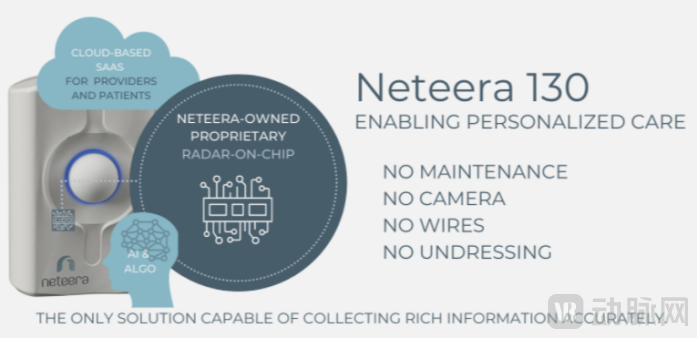
Neteera130 Product Image
Neteera 130 is Neteera’s flagship product. This device features a unique microsensor whose algorithm package employs a novel radar processing approach, specifically designed to eliminate physical noise generated in real-world environments. Its high-frequency system-on-chip radar operates in the sub-terahertz frequency band and is unaffected by lighting conditions, acoustic noise, environmental vibrations, or condensation, thereby delivering more precise monitoring results.
Neteera 130 offers aNon-wearable, non-contact, cable-free, and consumable-free RPM (Remote Patient Monitoring) method.Mainly used forChronic Disease Management, Post-Acute Care, Healthcare Facilities, Elderly Rehabilitation, Health Checkups, Sleep Apnea。
Neteera 130 features a compact, small-form-factor design measuring 6 x 8.2 cm, roughly the size of an adult male’s palm. Operating at extremely high frequencies (116 GHz–123 GHz), the system detects minute skin displacements through clothing and over distances, enabling it to penetrate opaque materials. Augmented by algorithms that monitor vital signs and other behavioral indicators, it is used to assess subjects’ physiological states.
Electromagnetic waves emitted by the sensor are reflected by the human body. Blood pumped from the heart flows through the blood vessels in the form of pulse waves, causing vibrations on the body surface. The Neteera 130 can measure these vibrations via its sensor, thereby monitoring various conditions of the cardiovascular system.
The detection parameters of this device currently includePulse, Respiratory Rate, Heart Rate Variability, and Respiratory Amplitude. Its R&D team is also working to enable features such as bed occupancy monitoring and biometric identification.
Due to its compact size, the product can be embedded in many areas, even car seats or home furniture.
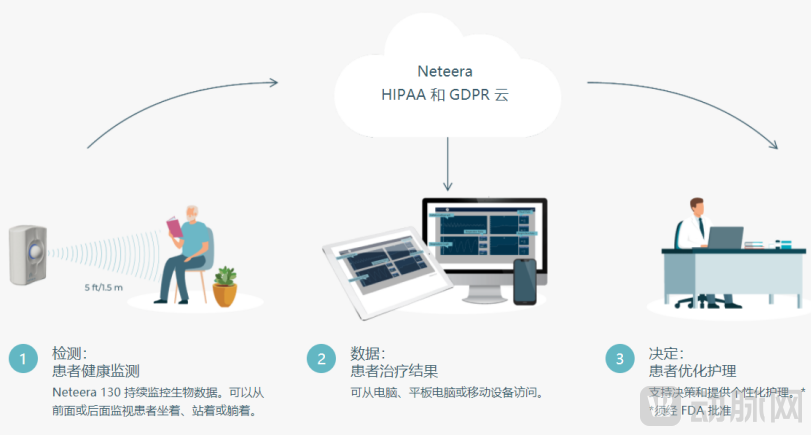
Neteera’s Workflow. Image source: Neteera official website
This product is easy to operate and has a low barrier to use.No professional caregiver presence or complex parameter setup prior to use is required; users simply need to position the product correctly and turn it on to begin use.
Good user experience.Traditional skin-contact vital sign sensing technologies require patients to wear devices that are strapped or tightly adhered to the skin, causing a sense of constraint and discomfort. Furthermore, the contact areas are non-breathable, making them prone to sweat accumulation, redness, and swelling. By adopting a continuous, non-contact biological data monitoring solution, users can enjoy unrestricted, through-clothing monitoring simply by being in the same room as the device.
Rich Use CasesNeteera’s solution can also be deployed in hospital emergency departments, workplaces, airports, shopping malls, and other public spaces to identify and flag potential COVID-19 patients. In addition to measuring body temperature, Neteera’s technology enhances the ability to detect infected individuals by monitoring additional vital signs, such as elevated heart rate and respiratory rate.
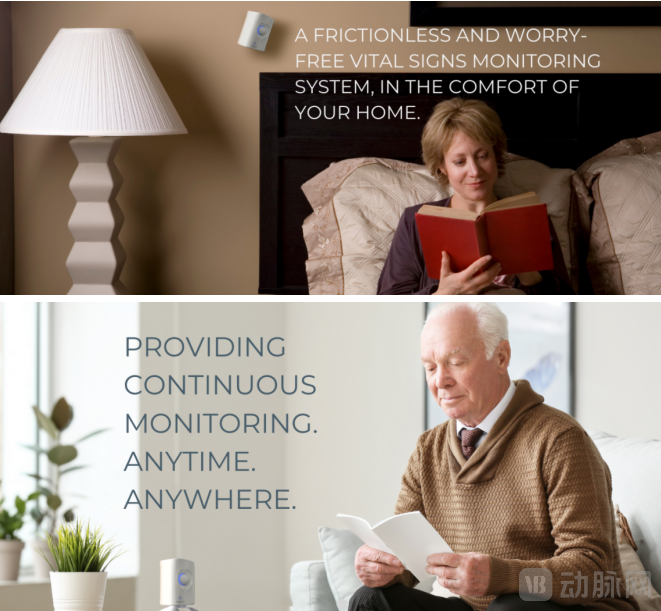
Neteera130 offers diverse application scenarios and an enhanced user experience
Image source: Neteera official website
Enhancing the Authenticity of User Monitoring Data. During sleep monitoring, the use of wearable straps can alter users' sleep habits, exacerbate anxiety and unease, and fail to accurately reflect their true sleep status. With the Neteera 130, however, users can simply go to sleep as they normally would.
Ensure user privacy.The intrusiveness of cameras and imaging devices on patients, and the resulting privacy concerns, have raised significant worries among many patients’ families. Neteera130’s technology is based on radar rather than vision and does not use cameras, thereby safeguarding users’ private data during operation. The collected data is uploaded to Neteera’s cloud platform, which complies with HIPAA and GDPR standards.
Reduce costs and decrease the demand for nursing staff at relevant medical institutions.Due to the user-friendly operation of Neteera 130, the service process is simplified, more medical resources are released, and the labor costs of relevant medical institutions are reduced, etc.
Enhance the work efficiency of healthcare professionals. As a standalone solution, Neteera 130 integrates into existing platforms, medical devices, or screening equipment via Wi-Fi. Healthcare professionals can access patient data continuously or intermittently from computers, tablets, or mobile devices, enabling flexible and convenient monitoring of patients' health status.
Reduce the risk of cross-infection.Neteera’s technology requires no user interaction, thereby minimizing the risk of hospital-acquired infections caused by contamination from contact between medical devices and humans.
Interestingly, in addition to healthcare, Neteera’s technology is also applied in the automotive and smart home sectors. This January, it announced a partnership with automotive supplier Valeo. Valeo will incorporate Neteera’s vital signs monitoring solution into its new passenger comfort technologies. Meanwhile, the company’s technology can also monitor vehicles, detecting whether children are present in the rear seats after the engine is turned off, thereby preventing tragedies caused by “careless” parents accidentally leaving children in the car.
In terms of profitability, Neteera primarily serves B-end clients, selling its systems to OEMs, equipment suppliers, and major hospitals and healthcare institutions; while there is also substantial demand for health monitoring among households, the C-end market plays a secondary role.
In March 2020, Neteera conducted sleep apnea testing in collaboration with Northwell Health, the largest healthcare provider in New York. This healthcare system comprises 23 hospitals and nearly 800 outpatient facilities. Once widely implemented, this partnership will enable Neteera to capture a significant market share.
It is worth mentioning that,Neteera’s true value lies not in its hardware, but in the rich data it captures behind the scenes—this “data oil.”Over time, the digestion of information will enhance the feature set. In the future, Neteera can add extra value and capabilities (skills) through software, algorithms, and the cloud, thereby expanding the company’s product offerings and market reach.
First, to forge iron, one must be strong oneself; technology is the core competitive advantage.Neteera’s core competency lies in its robust sensor technology. Sensors are at the heart of smart healthcare and, indeed, the entire Internet of Things (IoT). In recent years, the global sensor market has expanded year by year, with the healthcare application segment experiencing the fastest growth within the overall sensor market. Meanwhile, the domestic sensor market in China is also witnessing sustained rapid growth. For entrepreneurs in the field of novel medical devices, increasing investment in the research and development of sensing technologies is the key to success.
Second, the cross-domain capability transfer of technology-driven enterprises.Two key points are worth noting here. First, although Neteera operates across three sectors—healthcare, automotive, and smart home—its underlying technology is shared, exemplifying the principle that a single core competency can drive success across diverse markets. Second, the Neteera case demonstrates that seemingly unrelated fields can be interconnected. For instance, Neteera’s medical monitoring technology can be applied in the automotive sector to assess drivers’ health status, and it can also be integrated into smart home systems for routine health monitoring.
Finally,A Quote to Share with Fellow Entrepreneurs: “Though the road is long, you will arrive if you keep walking; though the task is difficult, you will succeed if you keep doing it.”