

Sanming Procurement Alliance (National) Upgrades to Accelerate Healthcare Reform Across China
“Without the centralized procurement of drugs and medical consumables as a breakthrough, how could there have been adjustments to medical service prices? Over nine years of reform, we squeezed out more than RMB 12 billion from drugs and medical consumables, and RMB 1 billion from diagnostic tests and laboratory examinations, generating a total dividend of approximately RMB 13.5 billion.” Zhan Jifu, the key architect of the Sanming healthcare reform and Director of the Standing Committee of the Sanming Municipal People’s Congress, reflected deeply on the breakthrough point for implementing the healthcare reform.
As the implementation vehicle for the centralized procurement of drugs and consumables under the Sanming healthcare reform, the Sanming Procurement Alliance (China) has been established for five years, completing five rounds of joint price-capped procurement for drugs and six rounds for medical consumables. On December 12, 2021, the Fourth Joint Conference of the Sanming Procurement Alliance (China) will be held in Xiamen to establish a normalized alliance procurement mechanism and invite healthcare institutions, medical insurance agencies, and pharmaceutical companies across China to join.
On the eve of the conference, VCBeat interviewed Zhan Jifu to gain insights into the latest developments of the Sanming Procurement Alliance (China) and the Sanming healthcare reform, and to interpret the value of the alliance in the context of healthcare reform.
Sanming’s healthcare reform, which took the centralized procurement of pharmaceuticals and medical consumables as its breakthrough point, has now been underway for nearly a decade. In Zhan Jifu’s view, Sanming’s healthcare reform has gone through three phases: the first phase focused on rectifying the “profit-centric” model by addressing chaos and plugging waste; the second phase shifted to a “disease-treatment-centric” approach by establishing regulations and institutional frameworks; and the third phase aims to build a “health-centric” system emphasizing preventive care and holistic health.
Currently, Sanming is in its third phase. In 2021, the Sanming Municipal Committee of the Communist Party of China and the Sanming Municipal People’s Government issued the “Action Plan for Implementing the ‘Six Major Projects’ to Relaunch Healthcare Reform in Sanming,” formally establishing the implementation pathway and objectives for this third phase.
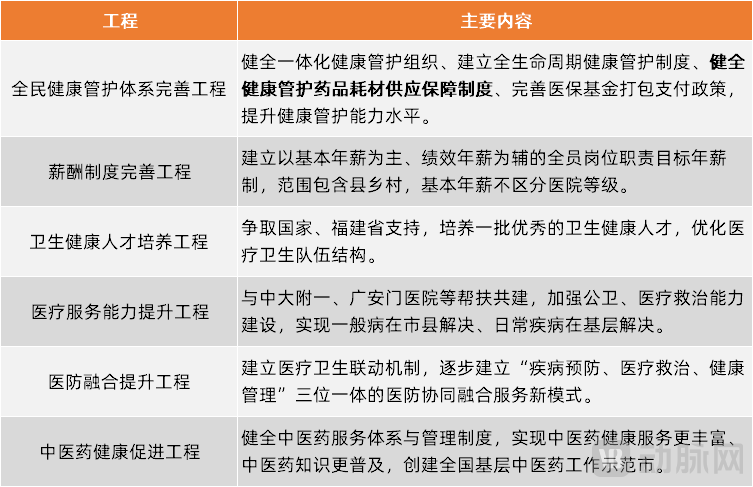
Sanming’s “Relaunching Healthcare Reform” Six Major Projects, Source: Official Website of the Sanming Municipal People’s Government
Among the “Six Major Projects,” the Project for Improving the National Health Management and Care System requires strengthening the supply guarantee system for health management and care-related drugs and consumables, and standardizing centralized, transparent, price-capped procurement of drugs and consumables.
As the implementation platform for centralized procurement of drugs and consumables under the Sanming Healthcare Reform, the Sanming Procurement Alliance (China) underwent new changes in 2021.
VCBeat has learned that the upcoming Fourth Joint Conference will establish the Office of the Sanming Procurement Alliance (China) to institutionalize the alliance’s procurement mechanisms, while strengthening cooperation and ties among member cities to form a closely integrated alliance.
The conference will also unveil the upgraded Sanming Procurement Alliance (China) platform, empowering the alliance’s management and operational systems through digital technologies. On November 21, 2021, the Sanming Municipal Healthcare Security Administration signed an entrusted cooperative operation agreement for the Sanming Procurement Alliance (China) with Sanming Sanyilian Digital Technology Co., Ltd., a holding company under WeDoctor Group, and Xiamen Haixi Pharmaceutical Trading Center Co., Ltd. This partnership aims to continuously iterate and upgrade the alliance platform, achieving intelligent, end-to-end operations covering joint procurement, trading, settlement, payment, supply, and regulation.
“Digitalization has enabled processes such as quoting, tendering, and bidding to be conducted online, and alliance meetings to be held virtually, thereby transforming the traditional model of face-to-face meetings and negotiations and significantly enhancing procurement efficiency and transparency,” stated Zhan Jifu.
By leveraging digital tools, the Sanming Procurement Alliance (China) aims to achieve cross-regional joint procurement and has currently realized “volume-based price negotiation” and cross-regional data interoperability. The volume-based price negotiation mechanism enables price linkage on the Sanming Procurement Alliance (China) platform. By aggregating procurement order volumes from member cities within the alliance, it achieves cost reductions through economies of scale, enhances bargaining power, and further lowers the procurement costs of pharmaceuticals and medical consumables. Meanwhile, built upon cross-regional data interoperability, provincial and municipal members of the Sanming Procurement Alliance (China) can implement a unified platform, unified catalog, unified pricing, and unified standards.
As a nationwide model, the Sanming healthcare reform, launched in 2012, initially aimed to address artificially inflated prices of pharmaceuticals and medical consumables in the distribution sector by initiating centralized procurement for all public medical institutions across the city. Following the success of these efforts, and encouraged and promoted by the General Office of the State Council starting in 2015, cities throughout China began signing agreements with Sanming to implement joint price-capped procurement of pharmaceuticals and medical consumables, thereby forming a cross-regional national procurement alliance. In March 2016, the Sanming Procurement Alliance (National) was formally established.
In recent years, Sanming’s centralized procurement model has not only benefited its own reforms but also continued to create value for alliance members since the establishment of the Sanming Procurement Alliance (National) in 2016. To date, the Sanming Procurement Alliance (National) has covered 27 prefecture-level cities across 16 provinces and four national healthcare reform demonstration counties in China, reaching a population of over 150 million. The value delivered by the Alliance to its members mainly falls into three categories:
Cost Savings
The most direct effect of centralized procurement is to reduce costs and save expenses for purchasers through a "volume-for-price" exchange. In 2020, the Sanming Procurement Alliance (National) completed China’s first centralized procurement of drugs that had not undergone consistency evaluation. Compared with the procurement prices of generic drugs in cities participating in this alliance-based centralized procurement, the overall average price reduction was 69.52%.
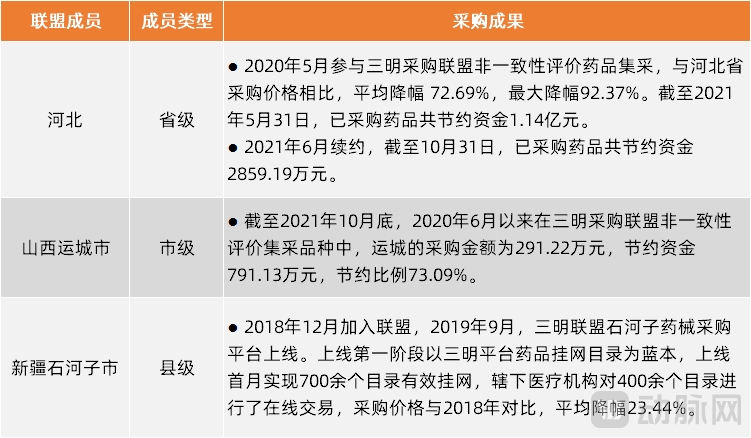
Sanming Procurement Alliance (China): Centralized Procurement Outcomes of Selected Members, Data Source: Public Reports
For example, in May 2020, the Hebei Provincial Healthcare Security Administration participated in the centralized procurement of drugs not subject to consistency evaluation organized by the Sanming Procurement Alliance (National), with 19 prefecture-level cities initially submitting volume commitments. Compared with the procurement prices in Hebei Province, the average price reduction from this centralized procurement was 72.69%, with a maximum reduction of 92.37%.
As of May 31, 2021, a total of 24.4614 million tablets/ampoules/capsules of selected drugs had been procured in Hebei Province, with a procurement amount of RMB 42.1918 million, achieving 122.77% of the contracted procurement volume (a combined total of 19.9244 million tablets for hospitals and pharmacies) and saving RMB 113.8502 million. Following the contract renewal on June 1, 2021, five drug varieties were retained. As of October 31, a total of 10.4830 million tablets/ampoules/capsules of selected drugs had been procured, with a procurement amount of RMB 14.4196 million, achieving 112.24% of the contracted procurement volume (a combined total of 9.3396 million tablets for hospitals and pharmacies) and saving RMB 28.5919 million.
Yuncheng City, Shanxi Province, which also participated in the centralized procurement of drugs that had not undergone consistency evaluation, implemented its first drug order at Yuncheng Tongde Hospital in June 2020. By the end of October 2021, Yuncheng City had purchased a total of 2.9122 million units of such drugs, saving RMB 7.9113 million.
To ensure timely and sufficient supply, the Sanming Procurement Alliance (China) has adopted the “two specifications per product” approach, whereby if one dosage form and strength faces a shortage, the alternative dosage form and strength can promptly serve as a substitute.
Optimization Platform
The Sanming Procurement Alliance (China) also provides technical support to its members, meeting their diverse needs for building centralized procurement platforms. It is understood that the platform of the Sanming Procurement Alliance (China) supports localized deployment of various functional modules, enabling alliance members to conduct volume-based price negotiations and centralized procurement across different types and regions.
Taking Handan City in Hebei Province as an example, as one of the first cities in North China to launch pilot measures for public hospital reform, Handan joined the Sanming Procurement Alliance (China) in 2016, sharing catalogs and resources with alliance members to achieve synergies in the procurement of pharmaceuticals and medical consumables across alliance cities.
In 2019, the Handan Municipal Healthcare Security Administration entrusted Xiamen Haixi Pharmaceutical Trading Center with the construction and operation of a sub-platform of the Sanming Procurement Alliance (National) Platform—the Handan Centralized Drug Procurement Management and Control Platform. Built upon a unified database compliant with national coding standards, the platform enables intelligent volume aggregation, smart price negotiation, automated tendering and procurement, online trading, electronic settlement, and end-to-end supervision for Handan City’s joint drug procurement, thereby achieving fully digitalized, intelligent, and systematic operations across all stages.
In July 2019, Handan City implemented its first centralized procurement program for pharmaceuticals and medical consumables. The program established a list of 17 anticancer drugs subject to national price negotiations, a list of 63 drugs under price-capped procurement, and a list of 25 drugs under volume-based procurement, achieving an average price reduction of 35.6%, with the maximum price reduction for a single product reaching 97.9%.
In the subsequent cross-regional volume-based price negotiations and centralized procurement of drugs carried out in Handan City, the Handan Drug Centralized Procurement Control Platform played a significant role, continuously expanding the range of drugs included in joint volume-based price negotiations.
Guaranteed Settlement
For suppliers, in addition to assessing the reasonableness of procurement prices, a key consideration in participating in volume-based procurement is whether payments can be settled in a timely manner.
Jian Jifu introduced that since the implementation of the Sanming healthcare reform, the operational mechanism for centralized procurement of drugs and medical consumables has become highly mature, adopting a model characterized by “order placement by medical institutions and payment settlement by the medical insurance fund.” “In Sanming, the Medical Insurance Fund Management Center directly pays for drugs and medical consumables on behalf of medical institutions, settling accounts and making payments to suppliers within no more than one month. This has established a stable credit relationship among medical institutions, the medical insurance fund, and suppliers, eliminating the issue of delayed payments to enterprises.”
Drawing on the experience of Sanming, the Sanming Procurement Alliance (China) also strives to ensure that alliance members provide enterprises with timely payment for drugs and consumables, thereby avoiding the formation of “triangular debt.”
For example, when Yuncheng City in Shanxi Province participated in the 2020 centralized procurement organized by the Sanming Procurement Alliance (China), it seized this opportunity to explore and implement direct settlement of drug payments from medical insurance funds. It became the first prefecture-level city in Shanxi Province to implement direct settlement between medical insurance funds and pharmaceutical enterprises, thereby accumulating experience for the subsequent promotion of drug and medical device procurement and settlement.
Currently, the members of the Sanming Procurement Alliance (China) primarily consist of local healthcare security administrations, medical institutions, and pharmaceutical and medical device enterprises. In recent years, as the implementation scope of volume-based procurement (VBP) for drugs has expanded at various levels, the sales prices of private medical institutions and pharmacies have faced challenges. Consequently, the Sanming Procurement Alliance (China) is exploring the provision of VBP services to private medical institutions and retail pharmacies, aiming to build the alliance into a more open and inclusive organization and platform.
“There is significant room for us to expand the provincial and municipal membership of the Sanming Procurement Alliance (China),” said Zhan Jifu. In fact, the Sanming Procurement Alliance (China) not only delivers measurable value to its internal members but also helps deepen healthcare reform on a broader scale.
In terms of procurement categories, the Sanming Procurement Alliance (China) has served as a beneficial supplement to the National Centralized Drug Procurement.
As of June 2021, five rounds of the National Centralized Drug Procurement had been conducted, covering 218 drug products, with the average price reduction for selected products reaching 54%. In 2020, the national centralized procurement expanded from drugs to medical consumables. To date, two rounds of state-organized centralized procurement for high-value medical consumables have been carried out, resulting in an average price reduction of 93% for selected coronary stents and 82% for selected artificial joints. Notably, drugs included in the National Centralized Drug Procurement are required to pass the consistency evaluation.
“There are over 200,000 pharmaceutical products approved by the National Medical Products Administration (NMPA) in China, while the clinical medication demand of Grade A tertiary hospitals covers approximately 1,500 varieties,” introduced Zhan Jifu. “The national centralized procurement program has achieved significant price reductions for more than 200 drug varieties; however, the procurement of pharmaceuticals and medical consumables remains an arduous and complex task. Provincial-level centralized procurement and the Sanming Procurement Alliance (National) can serve as beneficial supplements to national centralized procurement. Originator drugs and generic drugs that have not yet passed consistency evaluation can all be included in the procurement catalog of the Sanming Procurement Alliance (National), provided they are clinically necessary.”
Meanwhile, the Sanming Procurement Alliance (China) platform has achieved data interoperability with the National Centralized Procurement Platform and provincial procurement platforms, implementing dynamic adjustments to procurement catalogs and prices. If the price for the same product is lower on the National Centralized Procurement Platform, the Sanming Procurement Alliance (China) will adopt the national centralized procurement price.
Leveraging the Sanming Procurement Alliance (China), the experience of Sanming’s healthcare reform can be better replicated across the country.
In October 2021, the Leading Group for Deepening Medical Reform under the State Council issued the “Implementation Opinions on Further Promoting the Experience of Sanming City, Fujian Province, and Deepening the Reform of the Pharmaceutical and Healthcare System,” encouraging localities to join the “Sanming Procurement Alliance.” It encourages provinces, either individually or through inter-provincial alliances, to implement centralized volume-based procurement for pharmaceuticals and medical consumables with high usage volumes and substantial procurement expenditures that are not covered by national organized centralized volume-based procurement, ensuring participation in or conduct of such procurement for both drugs and medical consumables at least once annually. Regarding the number of varieties included in national centralized procurement, the Opinions propose striving to cover more than 300 generic drug names by the end of 2022, and by the end of the 14th Five-Year Plan period, each province should have more than 500 generic drug names covered under centralized volume-based procurement organized at both the national and provincial levels.
This is not the first time the state has promoted the experience of Sanming’s healthcare reform. In 2019, the State Council’s Leading Group for Healthcare Reform issued the “Notice on Further Promoting the Experience of Fujian Province and Sanming City in Deepening Healthcare System Reform.” Given the complexity and systemic nature of healthcare reform, and the continuous iteration and new achievements of Sanming’s model over the past two years, the 2021 document set forth more detailed requirements for learning from Sanming’s experience, including the recognition and promotion of the Sanming Procurement Alliance (National). This signifies that the Sanming Procurement Alliance (National) holds a status equally important as various provincial platforms, and even plays a significant role in healthcare reform practices. Unlike provincial platforms, it is the only digital pharmaceutical procurement platform that operates through market-oriented mechanisms, facilitates cross-regional collaboration, and complements national centralized procurement.
“Sanming’s healthcare reform first used the procurement of pharmaceuticals and medical consumables as a breakthrough point, essentially squeezing out the ‘dividends’ from these items,” introduced Zhan Jifu. Since implementing healthcare reforms nine years ago (note: 2012–2020), Sanming has squeezed out more than RMB 12 billion from pharmaceuticals and medical consumables and RMB 1 billion from diagnostic tests and laboratory examinations, totaling approximately RMB 13.5 billion in dividends. These savings were reflected in the reduction of total healthcare expenditures. “Over these nine years, our total healthcare expenditures decreased by RMB 11 billion, with part of the savings reducing patients’ out-of-pocket expenses and another part alleviating the payment pressure on medical insurance.”
The centralized procurement of pharmaceuticals and medical consumables has been coordinated with adjustments to medical service prices and reforms of the compensation system for healthcare professionals in Sanming, thereby creating fiscal space. Statistics show that the medical service revenue of 22 public hospitals at or above the county level in Sanming City increased to RMB 1.304 billion, with its proportion rising from 18.37% before the reform to 41.46%. The average annual income of all staff in public medical institutions increased from RMB 42,200 in 2011, prior to the reform, to RMB 133,700 in 2020.
Thus, through the “three-medical linkage” of pharmaceuticals, medical insurance, and healthcare services, Sanming has simultaneously advanced public hospital reforms, achieving a win-win outcome for hospitals, physicians, patients, and medical insurance funds.
As more members join the Sanming Procurement Alliance (China), various regions will leverage centralized procurement as a strategic breakthrough, tailoring their approaches to local conditions to effectively implement the Sanming model.
Healthcare reform has been a central thread running through the development of China’s healthcare system. Since the launch of the new round of reforms in 2009, China has accelerated the improvement of its basic healthcare system, continuously enhanced the equity and accessibility of basic healthcare services, and established a universal health insurance system. However, challenges such as uneven distribution of medical resources and rapid cost growth persist. As the first area to see breakthroughs within the system, drug and consumable prices will continue to play a pivotal role in the ongoing healthcare reform process.
Recently, the “soul-bargaining” price negotiations for inclusion in the National Reimbursement Drug List (NRDL) have gone viral. In parallel, China’s national centralized drug procurement program, launched in 2019, has now reached its fifth round, covering a cumulative total of 218 drug varieties, with an average price reduction of 54% among selected products. These remarkable achievements demonstrate the effectiveness of reforms driven by healthcare insurance as a mega-payer. Building on the fiscal space created by reduced drug procurement costs, reforms to the healthcare service delivery system have also been placed at the core of the policy agenda. The “Six Major Projects” proposed under the renewed Sanming Healthcare Reform initiative, including the establishment of “Health Stewardship Organizations,” represent a significant step toward the ultimate goal of shifting the focus of healthcare reform to “health-centered care.” At this pivotal juncture, the Sanming Procurement Alliance (National), serving as the foundational support platform underpinning the Sanming Healthcare Reform, has become a key instrument for helping other regions learn from Sanming’s experience and effectively implement healthcare reform outcomes.