

Dizal Pharmaceutical Co., Ltd. Lists on STAR Market with Backing from CIC and AstraZeneca

Dizal
Innovative Biopharmaceutical R&D Developer
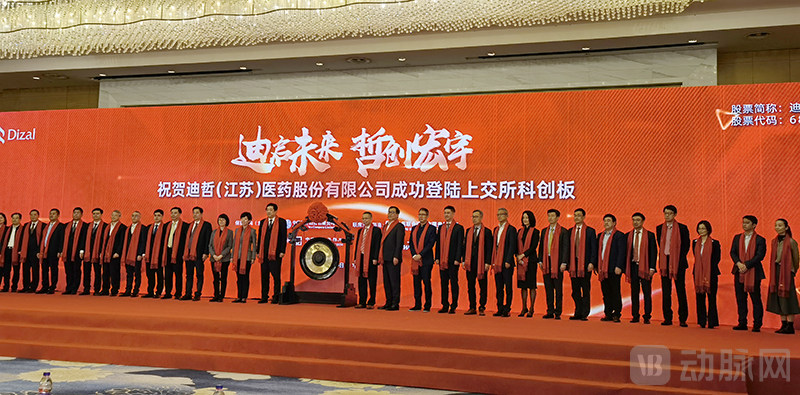
On December 10, Dizal Pharmaceutical officially made its debut on the STAR Market with an opening bell ceremony, pricing its shares at RMB 52.58 each and raising approximately RMB 2.1 billion in total. This bright spot in winter brought a promising conclusion to a challenging year for domestic innovative pharmaceutical companies navigating the capital markets. Behind this success, early investors such as SDIC Innovation, Sequoia Capital, and Lilly Asia Ventures have reaped impressive returns thanks to their trust and perseverance.
Around 2016, multinational pharmaceutical companies successively closed their R&D centers in China. Unlike peers that disbanded teams and ceased operations, AstraZeneca withdrew its business lines but retained its core team. Dizal Pharmaceutical was jointly founded by SDIC Innovation and SDIC Merchants (manager of the Advanced Manufacturing Industry Fund) and AstraZeneca, building upon the former AstraZencca Global Innovation Center (ICC), one of AstraZeneca’s four major global R&D centers. Its R&D team was transferred in its entirety from the former AstraZeneca ICC.
Dr. Zhang Xiaolin, CEO of Dizal, previously stated to the media that 70%–80% of the company’s core team members are former colleagues from AstraZeneca’s Innovative Chemistry China (ICC). The team has developed strong synergy and is well-versed in new drug development processes. Guided by shared objectives, the advancement of its drug pipeline has been smooth, with encouraging progress. Prior to its IPO, Dizal’s core products, DZD4205 and DZD9008, had already advanced to pivotal trials in both China and the United States. DZD4205 is the first selective JAK1 inhibitor globally to undergo clinical studies for peripheral T-cell lymphoma, while DZD9008 is a first-in-class small-molecule compound designed to target EGFR/HER2 exon 20 insertion mutations.
Furthermore, Dizal has established translational science-related technology platforms, including a research platform for central nervous system metastases in oncology, a research platform for combination therapy of tumor immunotherapy and radiotherapy, technologies for the discovery, validation, and clinical application of biomarkers, and model-informed drug development (MIDD) technologies for early-stage clinical studies. The company has built a robust pipeline of small-molecule products and is one of the few innovative pharmaceutical companies in China that is truly oriented toward the global market.
Gao Guohua, Chairman of SDIC Innovation and SDIC Merchants, stated, “Investment is ultimately about investing in ‘people.’ It has long been our core philosophy to invest in outstanding scientists with an entrepreneurial spirit. Dr. Zhang Xiaolin, who combines professional expertise with a broad vision and deep commitment, is an exemplary scientist who has successfully transformed into an entrepreneur. Dizal remains committed to source innovation, focusing on therapeutic areas with significant unmet and rigid treatment needs, such as malignant tumors and autoimmune diseases. Aiming to deliver first-in-class drugs and breakthrough therapies, the company retains full global rights to all its products and adopts a model of simultaneous global development.”
Chaoxiang
In the winter of 2016, amid the wave of multinational corporations (MNCs) shutting down their R&D centers in China, AstraZeneca’s headquarters was also planning the transformation of its Innovation Center China (ICC).
Dr. Zhang Xiaolin, the head of ICC, is a senior expert in molecular genetics. At the end of the last century, Dr. Zhang completed his postdoctoral research in molecular genetics at the Cancer Center of Harvard Medical School, worked for two years at the Center for Advanced Biotechnology and Biomolecular Gene Engineering at Boston University, and then joined AstraZeneca. Before returning to China to establish ICC, Dr. Zhang served as a Senior Scientist and Vice President of Global R&D at AstraZeneca, participating in the early development of a series of AstraZeneca’s blockbuster new drugs. During his 10 years at ICC, Dr. Zhang and his team achieved many notable milestones. In addition to leading and undertaking the R&D tasks for AstraZeneca’s lung cancer drug Tagrisso in China, they advanced multiple pipeline products into clinical trials.
At that time, in striking contrast to the withdrawal of multinational pharmaceutical companies, China’s innovative drug ecosystem was entering a fast track of growth, driven by reforms in the domestic drug regulatory system and the return of a large number of pharmaceutical professionals from multinational corporations. Zhang Xiaolin was determined to take a bold leap. His vision was straightforward: to develop Chinese innovative drugs that lead globally. “I firmly believe that the present moment offers an excellent opportunity for the development of the local biopharmaceutical industry, with highly favorable conditions across all fronts, including talent, policy, funding, and the overall macro environment.” Later, when recalling his original motivation for starting the business with the media, Zhang Xiaolin remained resolute: “In the future, we will see some local innovative pharmaceutical companies gradually expand into the global arena, and we also hope to see more new drugs developed locally truly break into the international market.”
During that period, Zhang Xiaolin’s interactions with Lu Dazhong, head of the life sciences team at SDIC Innovation, became increasingly frequent.
Lu Dazhong has long led his investment team in deeply cultivating the biopharmaceutical sector. After completing a series of investments in start-ups, they began exploring potential collaborations with multinational pharmaceutical companies. The investment team clearly recognized that multinational pharma giants possess profound R&D and medical resources, while start-ups demonstrate strong capabilities in specialized breakthroughs and operational flexibility—both of which are critical elements for novel drug development. Therefore, when AstraZeneca expressed interest in strategically adjusting its Innovative China Center (ICC), Lu Dazhong and his life sciences team proposed to AstraZeneca that Zhang Xiaolin lead the entire ICC team in this new venture. They argued that retaining an intact team with years of established collaboration would better accelerate the new company’s R&D progress and facilitate the development of globally innovative drugs.
Although the vision of achieving synergy where “1+1>2” was appealing, there was no precedent to follow, leaving little clarity on how to proceed. After extensive deliberations, the life sciences team at SDIC Innovation proposed a novel collaboration framework to AstraZeneca. Under this proposal, AstraZeneca would contribute its global industry perspective and an initial R&D pipeline; Advanced Manufacturing Fund would provide capital and domestic resource support, including backing for management equity ownership; AstraZeneca and Advanced Manufacturing Fund would hold equal equity stakes; and Mr. Zhang Xiaolin’s team would join as the third founding shareholder. This arrangement gave rise to Dizal Pharmaceutical. The new company strategically focuses on therapeutic areas with significant unmet and rigid treatment needs, such as malignant tumors and other major diseases, as well as immune-mediated disorders, aiming to develop first-in-class drugs and treatments with breakthrough potential.
Facts have shown that Dizal has achieved rapid growth under its innovative investment model. In its first year, the company initiated applications for clinical trial approvals for two oncology targeted inhibitors. Meanwhile, Dizal has progressively established multiple technical platforms integrating biosciences, medicinal chemistry, and drug ADME (absorption, distribution, metabolism, and excretion of xenobiotics). These platforms cover the entire R&D process for innovative drugs, from target discovery and mechanism validation, translational science research, compound design and screening, and preclinical studies to CMC (chemistry, manufacturing, and controls) and clinical protocol design and execution, granting the company a significant leading advantage in the industry.
As of June 30, 2021, the integrated R&D platform had enabled Dizal to independently discover and advance four compounds, including DZD4025, from inception to the clinical stage, thereby establishing a highly innovative and differentiated portfolio of small-molecule product candidates.
Novel Original Drug to Hit the Market in as Little as Two Years
Dizal, which was born with a silver spoon in its mouth, has always attracted considerable attention from the outside world, putting significant pressure on Zhang Xiaolin.
Like many start-up innovative drug developers, Dizal has invested heavily in R&D, making it difficult to balance revenues and expenditures. According to its prospectus, Dizal’s R&D expenses from 2018 through the first six months of 2021 were RMB 210.2042 million, RMB 421.4356 million, RMB 439.4948 million, and RMB 257.7368 million, respectively, with cumulative spending exceeding RMB 1.3 billion on preclinical studies and clinical trials for its product pipeline to accelerate product development.
“Previously at AstraZeneca, the primary focus was on how to smoothly advance projects according to the budget and timeline to achieve established goals. However, Dizal is an independent company; we strive to create maximum value based on the resources at hand,” Zhang Xiaolin once candidly remarked. “The shift in roles entails significant differences in mindset and decision-making criteria.”
Dizal has maintained steady and efficient growth. Its two flagship products, DZD4205 and DZD9008, are both in pivotal trials supporting dual filings in the United States and China. Dizal plans to submit New Drug Applications (NDAs) to the U.S. Food and Drug Administration (FDA) and China’s National Medical Products Administration (NMPA) in the first quarter of 2023. If all goes smoothly, approval from the U.S. FDA is expected in the second half of 2023, followed by NMPA approval in the first half of 2024. The NDA for DZD9008 is also scheduled for submission in both countries in 2023.
Although the JAK/STAT pathway has garnered significant attention, research efforts have been predominantly focused on autoimmune diseases and myeloproliferative neoplasms (MPNs). Specifically, only two JAK1 inhibitors have received global approval for oncology-related indications: Novartis’s ruxolitinib phosphate and Celgene’s fedratinib. Their approved indications worldwide are for myelofibrosis and polycythemia vera within the spectrum of MPNs. Notably, ruxolitinib phosphate has already been approved in China for the treatment of myelofibrosis.
Data show that DZD4205, the first highly selective JAK1 inhibitor globally to enter pivotal clinical trials for T-cell lymphoma indications, demonstrates significant efficacy in relapsed or refractory peripheral T-cell lymphoma (PTCL), with an objective response rate of 51.9% at the recommended Phase II dose. In Phase II clinical trials of DZD9008 for patients with non-small cell lung cancer harboring EGFR exon 20 insertion mutations, the best overall objective response rate (ORR) reached 48.4% and the disease control rate reached 90.3% at the key study dose.
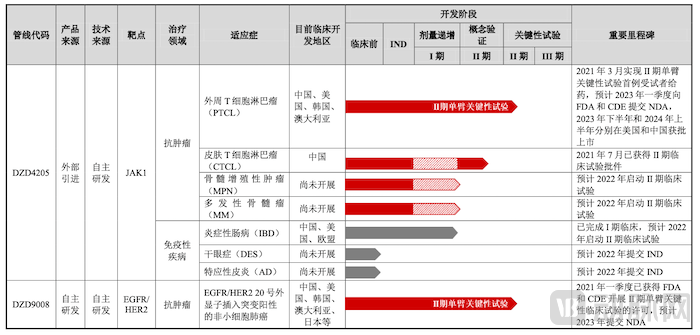
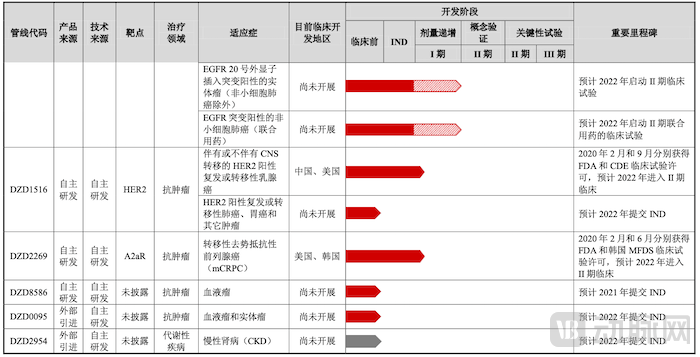
Dizal’s Pipeline Under Development (Source: Prospectus)
Furthermore, Dizal is currently conducting a Phase I clinical trial of DZD1516 for its first-in-human application in metastatic HER2-positive breast cancer. Meanwhile, DZD2269 is undergoing a series of clinical studies, including a Phase I clinical trial in patients with metastatic castration-resistant prostate cancer (mCRPC). According to the prospectus, DZD1516 is a highly selective small-molecule HER2 tyrosine kinase inhibitor independently developed by Dizal, featuring the ability to penetrate the blood-brain barrier. It is indicated for HER2-positive breast cancer and other HER2-positive solid tumors, particularly those with existing or at risk of central nervous system metastases. DZD2269 is a highly selective adenosine A2a receptor antagonist designed for tumor immunotherapy in high-adenosine environments, with its first indication being metastatic castration-resistant prostate cancer (mCRPC).
Over the past four years, the SDIC Innovation team has stood by Dizal’s side. They assisted in refining the corporate governance structure and optimizing management mechanisms, enabling Dizal Pharmaceutical to quickly get its operations on track and focus on new drug R&D and commercialization. “Almost from day one, the R&D team was engaged in high-intensity work.” Members of the entire Dizal project team still speak with considerable emotion when recalling the early days of Dizal Pharmaceutical’s establishment. In August 2020, driven by SDIC Innovation, Dizal Pharmaceutical brought in top-tier institutions such as Lilly Asia Ventures, Sequoia Capital, and Sanyi Innovation, raising approximately USD 100 million in Series A financing, which injected significant momentum into innovative R&D. Over the four years since its inception, Dizal Pharmaceutical’s development has largely realized the vision articulated by Gao Guohua, Chairman of SDIC Innovation and SDIC Merchants: leveraging an international platform to fully harness the strength of its scientist team, capitalizing on the rapid growth of the Chinese market, enhancing competitiveness in novel drug creation, and advancing into the forefront of global new drug R&D.
Data shows that the global market size for innovative drugs far exceeds that of generic drugs and biosimilars. In 2019, innovative drugs accounted for 66.26% of the total global pharmaceutical market, reaching $887.7 billion, and this market size is projected to reach $978.7 billion by 2021. For Dizal as well as its early investors and promoters, this may represent a promising future.
The DNA of Going Global
In line with Zhang Xiaolin’s original vision, Dizal holds global rights to its entire R&D pipeline, and all clinical studies are conducted as international multicenter trials. Currently, the company has launched or initiated clinical trials in China, the United States, Australia, Japan, South Korea, Europe, and other countries and regions, aligning closely with the growing overseas expansion demands of domestic innovative pharmaceutical companies in recent years.
In fact, for teams integrated from multinational pharmaceutical companies, developing global first-in-class innovative drugs is almost a tacit understanding.
On one hand, Dizal has adopted the currently mainstream global new drug development model, which involves continuously deepening the understanding of basic and clinical sciences, effectively gaining insights into unmet clinical treatment needs, and developing new drugs that can address clinical pain points based on Translational Science research capabilities. It has established multiple core technology platforms in the field of translational science to target the development of first-in-class or innovatively therapeutic drugs with breakthrough advantages, thereby forming high technical barriers.
For instance, the company has innovatively established a research platform for oncology drugs and radiotherapy, excelling in the discovery of biomarkers and their application in drug discovery and clinical development. It was also among the early adopters in the industry of Model-Informed Drug Development (MIDD) techniques to guide early-phase clinical studies of new drugs. Furthermore, it has overcome key technical challenges in the industry, such as enabling drugs to cross the blood-brain barrier. The main innovative drug candidates in Dizal’s R&D pipeline, including DZD4205, DZD9008, DZD1516, and DZD2269, are typical outcomes of the company’s translational science research.
On the other hand, the multinational pharmaceutical R&D experience of Dizal’s research and development team has streamlined the process of creating novel drugs globally. Most team members have over 20 years of experience in innovative drug development or clinical research at multinational pharmaceutical companies. Their accumulated expertise has equipped them with extensive experience in communicating with global clinical experts and patients regarding clinical needs and study design. They are also well-versed in the detailed regulatory registration requirements of major authorities such as the FDA, EMA, and NMPA. This global mindset ensures the efficient and smooth advancement of the company’s innovative drug clinical trials.
There was a minor episode before Dizal submitted its listing application to the STAR Market. According to the initial plan, Dizal intended to pursue an initial public offering (IPO) in the United States. For this group of scientists, developing drugs with novel global approaches and eventually listing on the U.S. stock market once the company reached a certain stage of growth seemed like a natural progression. However, Dr. Zhang Xiaolin firmly believed that Dizal was rooted in China and aimed to become a world-class innovative pharmaceutical enterprise expanding from China to the global market; therefore, the listing venue must remain in China. Coinciding with the establishment of the STAR Market, which provided new opportunities for innovative enterprises to access the capital markets, and driven by the support of SDIC Innovation and the Wuxi Municipal Government, Dizal became the eighth pharmaceutical company to list on the STAR Market under the fifth set of listing criteria.
For Dizal, which has just passed its fourth anniversary, the IPO is an external recognition of its past achievements, but more akin to a coming-of-age ceremony. What is past is prologue; for this rapidly growing innovative pharmaceutical company, how to bring new global drugs to market and benefit more patients is both a test from the market and an expectation.