

WeDoctor Restructures into Four Core Business Units to Build a Digital Health Maintenance Organization
It is the right time to upgrade digital health strategies. Recently, leading domestic internet healthcare platforms such as WeDoctor, AliHealth, Ping An, and JD Health have intensively rolled out new plans for business upgrades or organizational restructuring. For instance, WeDoctor has completed an organizational upgrade across its four major business segments—medical care, pharmaceuticals, insurance, and data; AliHealth has integrated its online platforms under the “Yilu App” and the “Alipay Healthcare Channel”; and Ping An has expanded its health ecosystem by acquiring Peking University Medical Group.
Behind this series of transformations lies the industry’s consideration in seeking new anchors for growth.
In October this year, the National Health Commission released the Detailed Rules for the Supervision of Internet-Based Diagnosis and Treatment (Draft for Comment), which clarified the previously ambiguous and blurred boundaries of internet healthcare, broke the previous unclear situation involving “medical services, pharmaceuticals, and technical support,” and promoted the industry’s return to the essence of “serious medical care.” In the same month, the Leading Group for Deepening Medical Reform under the State Council issued the Implementation Opinions on Further Promoting the Experience of Sanming City, Fujian Province, and Deepening the Reform of the Medical and Healthcare System (Guo Yi Gai Fa [2021] No. 2) (hereinafter referred to as “Document No. 2”), which set standards for how to deliver serious medical services, with “medical consortiums (medical alliances)” being one of the most frequently mentioned terms. Guided by these developments, internet healthcare companies are seeking the key to unlock the next new era.
Currently, the environment in which pharmaceutical e-commerce operates is undergoing rapid and profound changes, with the entire industry experiencing a wave of healthcare-oriented “upgrades.”
For instance, Ali Health is actively advancing the upgrade of its business architecture. The most significant change lies in the integration of its online platforms—namely, the “Yilu App” and the “Alipay Medical Health Channel”—to coordinate medical health and digital services, encompassing a range of offerings such as vaccinations, physical examinations, nucleic acid testing, dental care, psychological counseling, and nursing services. Notably, although this unit’s revenue-generating capacity pales in comparison to that of its pharmaceutical e-commerce segment, it is regarded as pivotal to building a closed-loop service ecosystem.
Similar to Alibaba Health, JD Health’s primary revenue also stems from its pharmaceutical e-commerce business. In 2020, it launched “JD Family Doctor,” a strategic product hailed by the media as a “billion-dollar business experiment.” This year, JD Health has continued to channel resources into leveraging its supply chain capabilities to provide proactive services through family doctor teams. Disclosures indicate that the service achieved strong results during the “Double 11” shopping festival, gradually opening up new growth avenues.
By comparison, Ping An’s moves can be described as “bold.” In the second half of this year, Ping An participated in the bankruptcy reorganization of Founder Group, acquiring a 51.1%–70% equity stake in New Founder Group for a consideration of RMB 37.05–50.75 billion, thereby incorporating Peking University Healthcare (which comprises a healthcare service system anchored by Peking University International Hospital as its flagship hospital and more than ten other medical institutions) into its portfolio. The company stated that this is a significant step for Ping An to further deepen its strategic layout in the healthcare industry and actively build a healthcare ecosystem.
In contrast to the transformation of pharmaceutical e-commerce toward healthcare, enterprises originally in niche segments of digital health are upgrading in both depth and breadth.For instance, the digital health platform WeDoctor has adjusted and upgraded its business segments by comprehensively integrating its various business units and capability modules to establish four profit centers, thereby building a business foundation encompassing “medical care, pharmaceuticals, insurance, and data.” This strategy brings the entire business to the forefront, independently forming a “business loop,” a “capability loop,” and a “value loop,” which together generate synergistic ecosystem effects.
Specifically, in terms of “medical care,” WeDoctor operates 31 internet hospitals across China and has established “Digital Health Communities” in regions such as Tianjin and Shandong, forming digitalized health management organizations. In terms of “pharmaceuticals,” WeDoctor owns the Haixi Pharmaceutical Trading Center, which supports the Sanming healthcare reform, as well as inter-provincial online trading platforms for traditional Chinese medicine (materials). It has also formed a pharmaceutical supply system by linking with the supply and payment sides of medical services. Regarding “insurance,” 18 of WeDoctor’s internet hospitals are connected to the national basic medical insurance payment system. The company has implemented global budget management and diagnosis-related group (DRG)/capitation-based payment models in multiple regions, while promoting integrated products combining basic medical insurance and commercial insurance, such as Qilu Bao, as well as commercial health insurance products like cancer insurance. Finally, “digital” refers to its digital healthcare infrastructure, encompassing integrated hardware and software capabilities including internet hospital construction, intelligent medical insurance monitoring, digital chronic disease management systems, and smart terminals.
As the leading platforms in their respective niche sectors, they represent the development trends of the internet healthcare industry. A clear trend is evident from their strategic deployments:E-commerce platforms in the pharmaceutical sector, leveraging their supply chain advantages, are accelerating their entry into healthcare services; meanwhile, digital health platforms that have long focused on healthcare are advancing the development of multidimensional capabilities encompassing “medical care, pharmaceuticals, insurance, and data”—a trend closely aligned with the current new healthcare reform initiatives.
“Document No. 2” explicitly calls for intensified efforts to promote the healthcare reform experience of Sanming, proposing measures such as advancing the construction of medical consortia, exploring the implementation of a “global budget payment” system for medical insurance funds, and encouraging localities to join the “Sanming Procurement Alliance.” The core objective of this document is to comprehensively promote the establishment of an integrated healthcare service system, shifting the focus from paying for medical services to investing in public health, implementing health accountability mechanisms, and achieving effective health management. This new trend in healthcare reform anchors a fresh direction for the internet healthcare industry.
It is worth noting that in 1973, to curb rapidly rising healthcare expenditures, the United States enacted the Health Maintenance Organization Act, encouraging the rapid development of Health Maintenance Organizations (HMOs). Against this backdrop, UnitedHealth Group, a globally renowned managed care organization, was established. Although the healthcare systems of China and the United States differ significantly, they share a common core objective: achieving cost reduction and efficiency improvement across the entire health service system by building a managed care framework, strengthening effective oversight of hospitals, physicians, and other stakeholders, and prioritizing patient health maintenance. In this sense, the “UnitedHealth” model offers valuable insights for constructing a health maintenance system centered on health.
UnitedHealth Group’s most distinctive feature lies in the strategic synergy between its two core segments: UnitedHealthcare, which provides health insurance, and Optum, which delivers health management and services. Optum is further divided by business type into OptumHealth (providing health services), OptumInsight (providing health information services), and OptumRx (providing pharmacy benefit management, or PBM). This structure corresponds to UnitedHealth Group’s four fundamental capabilities:
First is the capability of insurance.From an insurance perspective, Medicare, the federal government’s health insurance program for the elderly and disabled, and Medicaid, the medical assistance program administered by state governments, account for two-thirds of UnitedHealth’s business.As China implements a basic medical insurance system, with medical insurance being the most critical component of the insurance framework, the core of building a Chinese-style HMO lies in whether it can secure large-scale purchasing power from medical insurance funds.
Secondly, the capability for medical care and health management.OptumHealth has 6,500 hospitals and healthcare service institutions across the United States, covering 1.4 million general practitioners and specialists. One insight is that,It is evident that a single or a few medical institutions alone are insufficient to meet the demand for patient health management and care. Therefore, platforms need to connect as many healthcare service providers within a region as possible to form a tightly integrated medical consortium, thereby delivering coordinated services to patients. Consequently, another prerequisite for establishing an HMO is participating in, or even leading, the development of such regional medical consortia.
Third, the capability of the pharmaceutical supply chain.UnitedHealth leverages demand-side aggregation and payer-side scale advantages to negotiate prices with pharmaceutical companies and pharmacies through OptumRx, exchanging volume for price concessions to better control prescription drug costs. Currently, China’s ongoing promotion of the separation between medical services and pharmaceutical sales is creating an environment conducive to developing Pharmacy Benefit Management (PBM) models tailored to China’s specific context, according to industry analysts.Whoever can master the upstream and downstream of the supply chain and effectively integrate the multi-tiered medical insurance system will have the opportunity to aggregate demand and scale on the payment side, thereby enabling effective price negotiations with the pharmaceutical sector.
Finally, UnitedHealth’s success largely hinges on its first-mover advantage in informatization, digitalization, and intelligence. This has not only provided data and decision-making support for its own health insurance plans and medical services but also effectively achieved cost reduction and efficiency improvement. This is perhaps the area where domestic internet healthcare platforms excel the most.
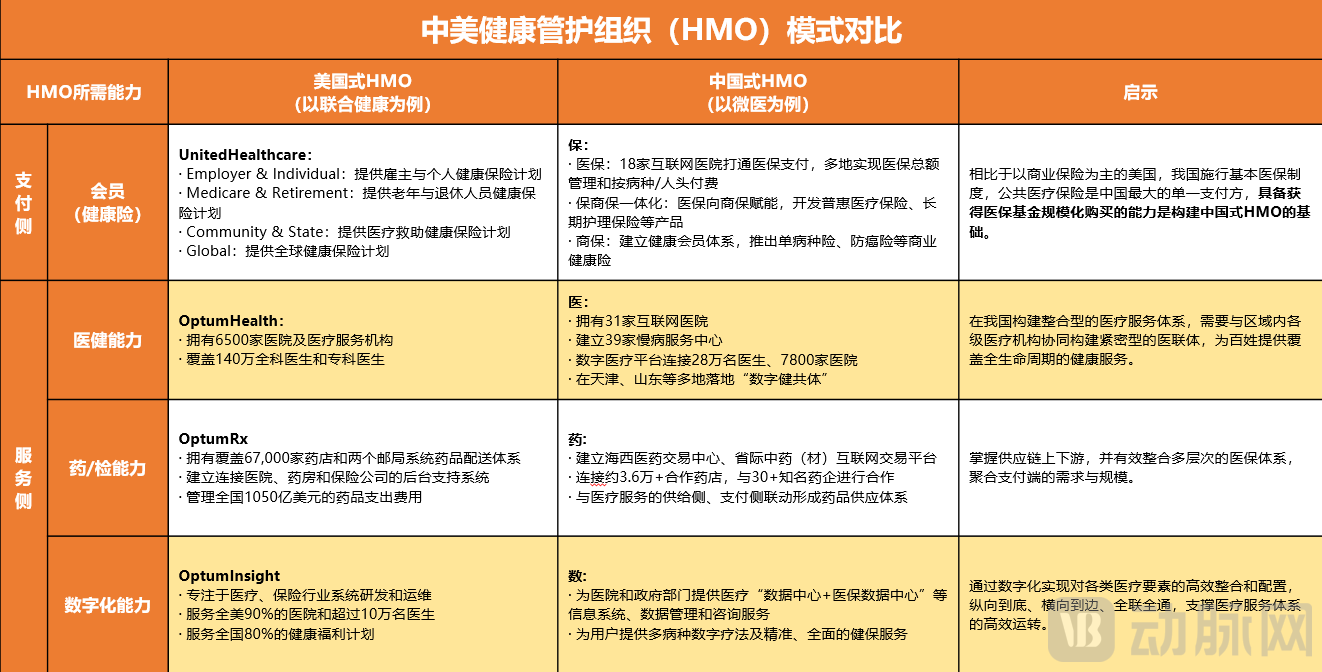
Currently, some regions are actively exploring and achieving fruitful results, with the initial framework of a Chinese-style HMO beginning to take shape.
“China’s Healthcare Reform Learns from Sanming”: The Most Exemplary Reform Zone Is Sanming, Fujian. In this small city in central Fujian, numerous healthcare reform measures that have been promoted and studied nationwide were pioneered, including the “Two-Invoice System,” “Tri-Medical Linkage” (coordinated reform of medical care, health insurance, and pharmaceuticals), “General Hospital Groups,” and “Unified Management of Chronic Diseases.” These achievements are the fruitful outcomes of the “Sanming Healthcare Reform” launched in 2012. This September, Sanming issued the Action Plan for Implementing the “Six Major Projects” to Advance Healthcare Reform Further, requiring further implementation of the project to improve the universal health stewardship system, establish a rational tiered diagnosis and treatment order, strengthen the health stewardship system, and refine health stewardship regulations. The plan also specifies that surplus funds from the bundled payment of basic medical insurance may be included in medical service revenue, to be used for health stewardship, chronic disease management, health promotion, and related activities.
In addition, the new model explored in Tianjin is equally remarkable. In early 2020, under the guidance of the Tianjin Municipal Health Commission, WeDoctor Internet Hospital took the lead in collaborating with 267 primary healthcare institutions to establish a closely-knit internet-based medical consortium—the Tianjin Primary Digital Health Community. Of breakthrough significance, it used chronic disease management as an entry point to explore and implement payment methods such as “global bundled payment” and “bundled payment by disease type and capitation” under the medical insurance system, thereby implementing a new health accountability mechanism and driving the healthcare system from focusing on “price differentials” to “efficiency differentials,” thus stimulating the overall effectiveness of the medical service system. At the 2021 National Conference on Promoting Experience in Deepening Healthcare Reform, the Tianjin Primary Digital Health Community was selected as one of the “Top Ten New Measures to Advance Healthcare Reform and Serve Public Health.”
Looking back at the direction of healthcare reform and the upgrading trends in the internet healthcare industry, both are gradually evolving toward the construction of a Chinese-style HMO. On one hand, this is driven by national top-level policy guidance; on a deeper level, as economic and social development progresses, public demand for more diversified healthcare security continues to rise, while the rapid growth of medical expenditures has become increasingly unsustainable. Various stakeholders are calling for a new form of healthcare service organization that can provide high-quality health maintenance services to the general public at affordable costs. In this context, the Health Maintenance Organization (HMO) model has emerged as an important option.
Achieving this significant transformation is no overnight feat. China’s vast territory, large population, and substantial disparities in regional economic development and healthcare capabilities have made healthcare reform exceptionally complex. With no domestic precedents to follow and foreign models not directly applicable, China must develop health stewardship organizations tailored to its national conditions and guided by a people-centered philosophy for the new era.The deepening of China’s new healthcare reforms, coupled with the rapid development of digital health during this process, has created a breakthrough opportunity. Digitalization’s capacity to connect and integrate various healthcare elements and enhance the operational efficiency of the healthcare system makes it a core lever for building Chinese-style Health Maintenance Organizations (HMOs), as evidenced by practices in Sanming and Tianjin. This opens up significant growth potential for the future development of the internet healthcare industry, where the construction of multi-dimensional capabilities across medical care, pharmaceuticals, insurance, and data will be key to realizing value.
Judging from the business models of major platforms discussed earlier, platforms such as Ali Health and JD Health, which primarily focus on pharmaceutical e-commerce, are leveraging their supply chain and capital advantages to address weaknesses in healthcare services. In the future, they may further promote the construction of an integrated ecosystem encompassing medical care, pharmaceuticals, insurance, and data, offering promising prospects. Meanwhile, digital healthcare platforms represented by WeDoctor are further consolidating their first-mover advantage, benefiting from their early strategic layout in medical care, pharmaceuticals, insurance, and data, as well as their “Digital Health Community” practices in multiple regions. Going forward, replicating this model across more regions nationwide is likely to become their key focus.
With Document No. 2 as a new starting point, China is embarking on the journey of building a “health-centered” healthcare management system, ushering in fresh opportunities for the internet healthcare industry. How can companies advance strategic upgrades and solidify core competencies in medical care, pharmaceuticals, insurance, and data? How can the industry realize its value by supporting the nation’s new healthcare reforms and improving public health? These explorations will provide new answers to break through current industry bottlenecks.