

How This Medical Device Company Solved the Vascular Calcification Challenge and Achieved a 10x Market Cap Surge Within 3 Years of IPO

Shockwave Medical
Cardiovascular Disease Treatment Device Developer
In recent years, China's vascular intervention market has experienced rapid growth, with the annual number of PCI procedures exceeding one million.
Vascular interventional techniques are becoming increasingly diverse, with numerous players entering fields such as bare-metal stents, drug-eluting stents, bioresorbable stents, and drug-coated balloons; however, the treatment of vascular calcification remains a persistent clinical challenge.
The higher the degree of coronary artery stenosis, the greater the probability of concomitant vascular calcification.
Among the 1 million coronary artery disease patients undergoing percutaneous coronary intervention (PCI) in China, approximately 200,000 to 300,000 have moderate-to-severe calcified lesions. In the United States, up to 30% of the 1 million patients receiving PCI annually present with vascular calcification.
Coronary artery calcification impedes stent implantation and expansion, leading to difficulties in stent delivery, malapposition, and an increased risk of in-stent thrombosis, restenosis, and coronary rupture. Consequently, this reduces the success rate of percutaneous coronary intervention (PCI) and results in poorer patient prognosis. Furthermore, vascular calcification predisposes vessels to occlusion and thrombus formation, while the rupture of calcified plaques can trigger cardiovascular events.
Coronary artery calcification can be classified into intimal calcification and medial calcification. Intimal calcification may be associated with inflammatory responses and osteogenic transformation of smooth muscle cells induced by lipid deposition, whereas medial calcification is linked to factors such as advanced age, diabetes mellitus, and chronic kidney disease.
Simple deep calcification (medial and adventitial calcification) can be managed with standard procedures and generally requires no special treatment. Severe superficial calcification (intimal calcification), however, directly impedes device passage.
For mild to moderate cardiovascular calcification, oral antiplatelet agents and lipid-lowering therapies can be administered to prevent further progression; for severe cardiovascular calcification, further interventional treatment is required. Currently, there are four main interventional therapies for vascular calcification in clinical practice.
Cutting Balloon Angioplasty (CBA)
The most common interventional therapy in clinical practice is cutting balloon angioplasty, which is primarily used to treat patients with mild-to-moderate calcified lesions.
Physicians utilize cutting balloons for predilation in calcified lesions, resulting in intimal-medial tearing accompanied by uniform outward expansion of the vessel wall plaque and mild plaque compression. As the surface of a cutting balloon is equipped with 3–4 rigid blades, it can effectively dilate stiff fibrotic lesions, including those with a certain degree of calcification.
When dilating with a cutting balloon, the maximum pressure should not exceed 12 atm to prevent blade incarceration due to excessive pressure, which would make retraction difficult. Furthermore, cutting balloons are primarily indicated for mild-to-moderate calcified lesions and are not suitable for treating severely calcified vessels.
Rotational Atherectomy (RA)
Physical methods are used to eliminate atherosclerotic plaques. By utilizing a high-speed rotating burr based on the principle of "selective cutting," calcified plaques are abraded into tiny microparticles, followed by stent implantation. This approach improves the success rate of interventional therapy and reduces the incidence of complications, primarily for heavily calcified lesions. With the development of drug-eluting stents, rotational atherectomy (RA) has been redefined as an important tool for plaque modification.
This interventional procedure requires a certain level of physician expertise,Emphasize slow advancement and rapid retraction.. If the operator performs the procedure improperly, rotational atherectomy (RA) is prone to cause complications. Common complications include coronary artery spasm, dissection, guidewire fracture, and perforation. Multiple clinical studies have shown that the incidence of RA-related complications ranges from 3% to 8%. Moreover, calcium particles generated by ablation may travel with the bloodstream to the distal vessels, potentially leading to distal embolization.
Excimer Laser Coronary Atherectomy (ELCA)
Deliver the ablation catheter to the lesion site, perform repeated excimer laser ablation, followed by repeated high-pressure balloon dilation to achieve therapeutic efficacy, thereby eliminating the need for stent implantation.
Laser therapy for intracoronary lesions dates back to the 1980s, but it was gradually phased out due to its high rate of early complications and low safety profile, with laser-induced coronary artery rupture being the most common complication.Excimer laser is a type of cold laser., its emergence has brought laser ablation back into clinical practice. This cold light source delivers pulsed irradiation, differing from the continuous irradiation of previous thermal lasers.The pulse duration is extremely short, significantly reducing damage to vascular tissue.
ELCA is primarily suitable for mildly to moderately calcified lesions; for severely calcified lesions, combining ELCA with rotational atherectomy can further improve procedural success rates. In 2015, Beijing Anzhen Hospital performed the first ELCA procedure in China.
Intravascular Lithotripsy (IVL)
The only technology with therapeutic efficacy for deeply calcified lesions.Previously, most interventional therapies could only treat superficial calcium, failing to address deep-seated calcium and thus unable to treat severely calcified, rigid diseased vessels.
Intravascular lithotripsy (IVL), developed by Shockwave Medical, Inc. (hereinafter referred to as “Shockwave”), is a technology adapted from acoustic lithotripsy used in the treatment of kidney stones. It delivers pulsed ultrasonic pressure waves via a fluid-filled balloon to the vessel wall to treat calcified lesions.
For vascular calcification, particularly deep-seated vascular calcification, intravascular lithotripsy (IVL) is currently the only safe and effective treatment modality, with a relatively straightforward operational procedure. In July 2021, the Chinese People's Liberation Army General Hospital utilized Shockwave devices to perform the first domestic case of intravascular shockwave therapy for severe coronary artery calcified lesions.
However, IVL technology also has certain limitations and offers limited therapeutic efficacy for vessels with severe calcification where balloon guidewires are difficult to pass. This is because calcified vascular lesions can impair the deliverability of interventional devices.In clinical applications of IVL technology, it is often necessary to first dilate the diseased vessel with a small balloon before inserting the lithotripsy balloon.
According to the Chinese Expert Consensus on the Diagnosis and Treatment of Coronary Artery Calcified Lesions (2021 Edition),For mild to moderate coronary artery calcification lesions, conventional PCI remains the primary treatment modality.Cutting balloons have certain value in treating mild to moderately calcified lesions, but current clinical research evidence is relatively limited.
The emergence of innovative technologies such as coronary rotational atherectomy and intravascular lithotripsy will further enhance the efficacy and adoption rate of interventional treatments for vascular calcification. Globally, Shockwave Medical pioneered IVL technology; its IVL system is approved for use in both peripheral and coronary arteries and has treated over 30,000 patients.
The story begins with a bold vision.
In 2009, an engineer, a cardiologist, and a salesperson came together. They conceived a bold idea: Could lithotripsy address the problem of vascular calcification? As a proven treatment for kidney stones, lithotripsy had been used in clinical practice for many years, and it held the potential to resolve vascular calcification in an easier and safer manner.
Building on this “innovative concept,” Shockwave Medical was established in the United States. The company’s intravascular lithotripsy (IVL) product combines traditional balloon angioplasty with ultrasonic lithotripsy, delivering unfocused, circumferential, and pulsed acoustic pressure waves to diseased vessels during low-pressure balloon inflation.
The entire procedure is simple to operate, building upon the coronary balloon angioplasty with which physicians are already familiar, resulting in a short learning curve for doctors. Moreover, ultrasound features high amplitude and low frequency, causing minimal damage to human blood vessels.
The Shockwave IVL System comprises three components: the IVL Generator, the IVL Connector Cable, and the Balloon Catheter.The treatment process can be divided into the following four steps:
1. The IVL catheter is advanced over a 0.014-inch guidewire to the calcified lesion, and the integrated balloon is inflated to 4 atm (approximately 1.4 mm) to facilitate effective energy delivery.
2. Discharge from the emitter vaporizes the fluid within the balloon, forming rapidly expanding and collapsing bubbles that generate acoustic pressure waves. In experiments, due to the significant density difference, these acoustic pressure waves were able to fracture calcium models made of plaster with only a few pulses.
3. Pressure waves generate localized field effects, penetrating soft vascular tissue,Selectively fragment calcium deposits on the inner vascular wall and intima, while minimizing trauma to the vessel wall.
4. After modification of calcified material, the integrated balloon can then be used to dilate the diseased vessel under low pressure.
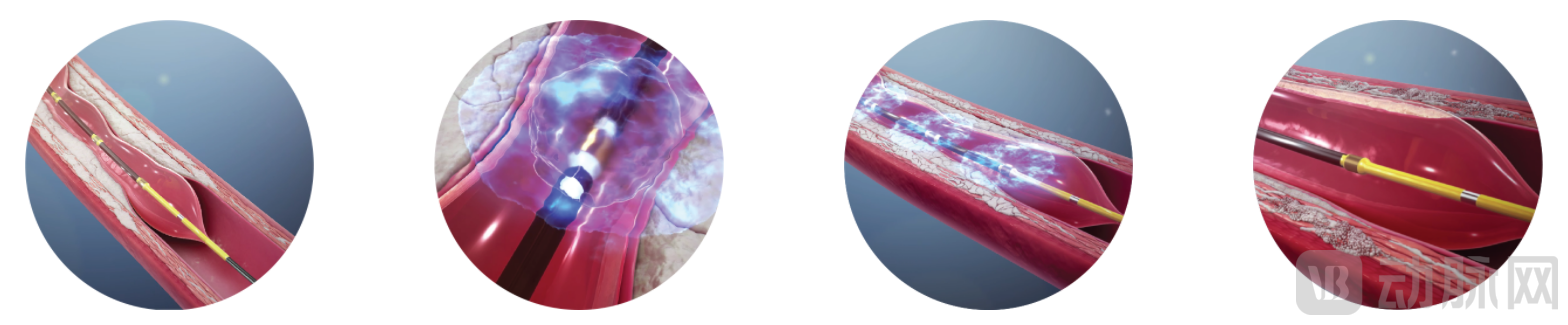
Four Key Steps in IVL System Therapy Source: Shockwave Medical Official Website
Using the ultrasonic device on the IVL system, physicians can eliminate both superficial and deep calcification in patients’ blood vessels, thereby softening the vessel walls while expanding the arterial lumen.
Shockwave Medical primarily utilizes IVL technology for the treatment of peripheral artery disease (PAD) and coronary artery disease (CAD).Based on the same technological principles, the Shockwave IVL systems for coronary and peripheral applications differ primarily in the balloon catheter, while the generator and cable are universal.
In addition, the company recognizes the potential of Intravascular Lithotripsy (IVL) technology in treating aortic stenosis and is developing related products. With aging, the human aortic valve gradually becomes calcified and narrowed, obstructing blood flow from the left ventricle into the aorta. Currently, both clinical practitioners and industry stakeholders are focusing on Transcatheter Aortic Valve Replacement (TAVR); however, this procedure is technically challenging and costly, posing certain difficulties for its widespread adoption.
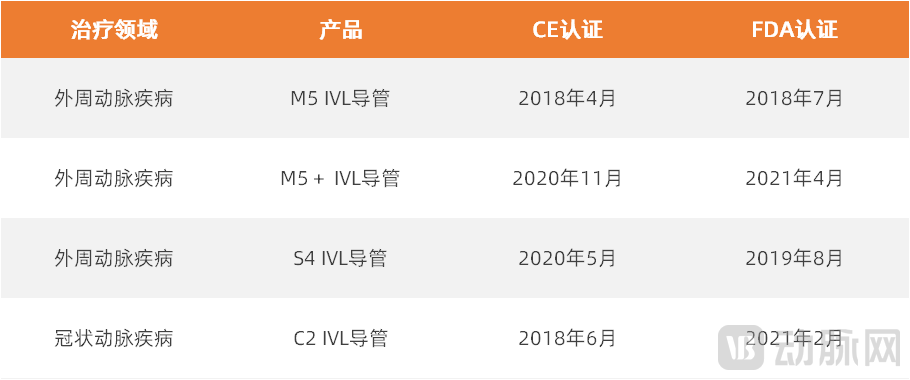
Shockwave Receives Approval for IVL Product Source: Shockwave Medical’s 2021 Semi-Annual Report
Since Shockwave launched its IVL system for treating coronary artery disease in Europe in 2018, more than 30,000 patients have used the system.
Previously, Shockwave conducted the DISRUPT CAD III study based on the C2 IVL device, which was a prospective, multicenter, randomized clinical trial. This trial enrolled a total of 431 patients with severely calcified de novo coronary artery lesions from four countries: the United States, Germany, Austria, and New Zealand.
At 30 days post-treatment, 92.2% of patients had no observed MACE (major adverse cardiovascular events). In the trial, stent expansion rates reached as high as 102%, even in areas with the most severe vascular calcification.
The trial results confirmed that,For patients with severely calcified coronary artery lesions, intravascular lithotripsy (IVL) can disrupt calcified plaques through acoustic pressure waves, thereby facilitating stent delivery and expansion. This may improve patient prognosis and reduce the incidence of perioperative clinical complications.
To date, Shockwave Medical’s management team has undergone a major overhaul.
Douglas Godshall has served as the Company’s President and Chief Executive Officer and joined its Board of Directors since May 2017. Previously, he served as Chief Executive Officer of HeartWare International, a Nasdaq-listed company, and remained on its board of directors until the company was acquired by Medtronic. Prior to joining HeartWare, he held executive and management positions at Boston Scientific.
Meanwhile, Isaac Zacharias has served as Chief Business Officer of Shockwave Medical since November 2018. Previously, he held the positions of General Manager of the Structural Heart Disease Division and President of International Sales at the company. Prior to joining Shockwave Medical, he served as General Manager of the PCI business at Boston Scientific. His career began as a R&D engineer, and he has since held various clinical and marketing roles.
The addition of two key executives from Boston Scientific to Shockwave is the icing on the cake for the company.In March 2019, the company successfully listed on NASDAQ.
The company has consistently made substantial investments in research and development, with R&D expenditures totaling $36.9 million in 2020. As of the end of 2020, the company held 45 U.S. patents and 59 foreign patents.
Moreover, the company has been continuously strengthening its marketing capabilities. To date, Shockwave has established direct sales operations in the United States, Germany, Austria, and Switzerland, and has built an extensive distributor network across more than 50 countries in North and South America, Europe, the Middle East, Asia, Africa, and Australia.
The continuous approval of the company’s products, particularly the authorization for market entry in the United States, has significantly increased Shockwave Medical’s market capitalization and revenue.In just over two years since its IPO, Shockwave Medical’s market capitalization has surged more than tenfold.Moreover, according to the company’s 2021 semi-annual report, product revenue increased from $25.5 million as of the end of June 2020 to $87.8 million as of the end of June 2021, representing a growth rate of approximately 245%.
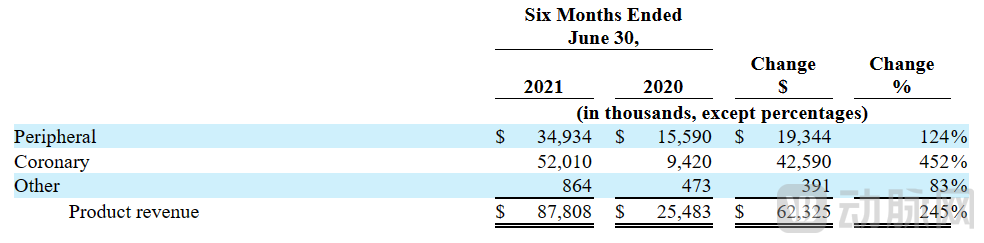
Revenue from Peripheral, Coronary, and Other Products Source: Shockwave Medical’s 2021 Semi-Annual Report
In 2020, the company’s revenue from peripheral vascular products exceeded that from coronary artery products. However, in 2021, coronary products experienced a surge of 452%. This was primarily driven by the FDA clearance of the company’s C2 IVL product in 2021, enabling its commercialization in the United States and significantly boosting the company’s overall revenue in the coronary segment.
Despite having IVL products approved, Shockwave remains unprofitable to date.As of the end of 2020, the company’s net loss reached $65.7 million, with an accumulated deficit of approximately $240 million.Due to the impact of the COVID-19 pandemic, the company may remain in a loss-making position for an extended period.
The United States is the primary market for Shockwave Medical.As mentioned in Shockwave Medical, Inc.’s 2021 semi-annual report, product revenue categorized by the primary geographic regions of shipment was $64 million in the United States and $23.8 million in all other countries.
Currently, Shockwave’s products have not yet entered the Chinese market. However, in March 2021, the company announced a strategic partnership with Genesis MedTech to establish a joint venture named Genesis Shockwave, jointly promoting the research and development, manufacturing, and commercialization of Shockwave’s IVL products in China.Jian Shi Medical will serve as the exclusive distributor of Shockwave in China, distributing the company’s full product portfolio domestically.
In recent years, the “License-in (authorized introduction of medical devices) + independent R&D” model has gradually matured in the healthcare sector. Just five months after Joincare Medical, Grand Pharma announced in August 2021 that it would acquire 100% equity interest in FastWave Medical for a total consideration of up to $72 million. FastWave Medical is a newly established company, founded this year, primarily focused on developing shockwave balloons for the treatment of coronary artery disease, making it a competitor to Shockwave Medical.
As a pioneer in the global intravascular lithotripsy (IVL) balloon field, Shockwave Medical has demonstrated the feasibility and efficacy of IVL technology through more than a decade of clinical practice, trial data, and approved products. Currently, Chinese companies such as Saihe Medical and Zhonghui Medical (a subsidiary of Huihe Medical) are also independently developing IVL balloons. In October 2021, Saihe Medical’s coronary IVL system enrolled its first patient in a clinical trial.
Meanwhile, with the introduction of advanced intravascular lithotripsy (IVL) technologies and products by Jian Shi Medical and Grand Pharma, leveraging the platform’s robust resources and localization advantages, IVL technology may gradually gain traction in China, thereby addressing the challenges associated with treating vascular calcification.
Reference Article: "Chinese Expert Consensus on Coronary Rotational Atherectomy"
“Chinese Expert Consensus on the Diagnosis and Treatment of Coronary Artery Calcified Lesions (2021 Edition)”
“Zhou Yujie: Challenges and Prospects in the Treatment of Coronary Artery Calcified Lesions” — Chinese Journal of Cardiology
“TCT 2020 | Commentary by Zhou Yujie: Disrupt CAD III—Safety and Efficacy of Intravascular Lithotripsy (IVL) in Treating Severe Coronary Artery Calcification” — “Outpatient New Horizons”
“CCI Innovation Express | Balloon Acoustic Lithotripsy: An Interview with Scott Shadiow” – China.org.cn Medical Channel