

Hengrui's Global First-in-Class Dual-Target Autoimmune Candidate SHR-1139 Advances Toward Global MRCT as Company Rejects MNC Buyout Offers

Hengrui Pharma
Innovative and High-Quality Pharmaceutical Developer

Johnson & Johnson
Medical Device R&D and Manufacturer

Innovent
High-end Biologics Developer
Akeso
Innovative Antibody Drug Developer

Hengrui Pharma is getting serious this time.
Ustekinumab has proven one thing over the past decade: in the autoimmune field, the breadth of indications is truly the ultimate ceiling for blockbuster drugs. Starting from psoriasis, it went on to conquer Crohn's disease (CD) and ulcerative colitis (UC), with sales jumping to $5.2 billion in 2018, becoming a textbook example in the autoimmune track.
Today, Hengrui Pharma is attempting to replicate this pathway with SHR-1139 — but instead of playing a "follow" card, it holds an unprecedented double-target combination card globally: IL-23p19 × IL-36R.
The logic behind this combination is not complicated: IL-23p19 keeps the "arsonists" (adaptive inflammation of the Th17 axis) in check, while IL-36R repairs the "firewall" (skin and mucosal barriers). These two pathways are highly active and mutually amplifying in psoriasis and IBD. Single-target inhibition carries the risk of systemic "compensatory escape," making dual-target synergy the true "powerhouse" of this molecule.
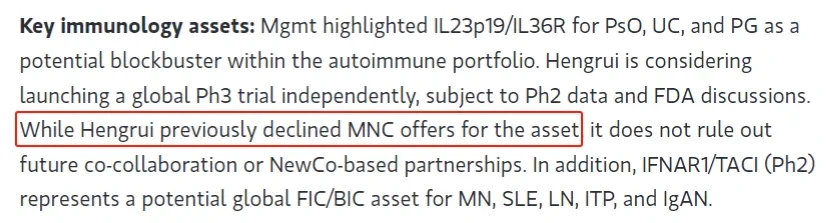
Big Brother is full of confidence in this molecule. According to a Morgan Stanley research report on Hengrui Pharma's statements at the China Summit 2026:Previously rejected MNC'sSHR-1139The company is considering advancing the drug's Phase III MRCT independently despite the acquisition offer.
01
This dual-targeting approach is truly different.
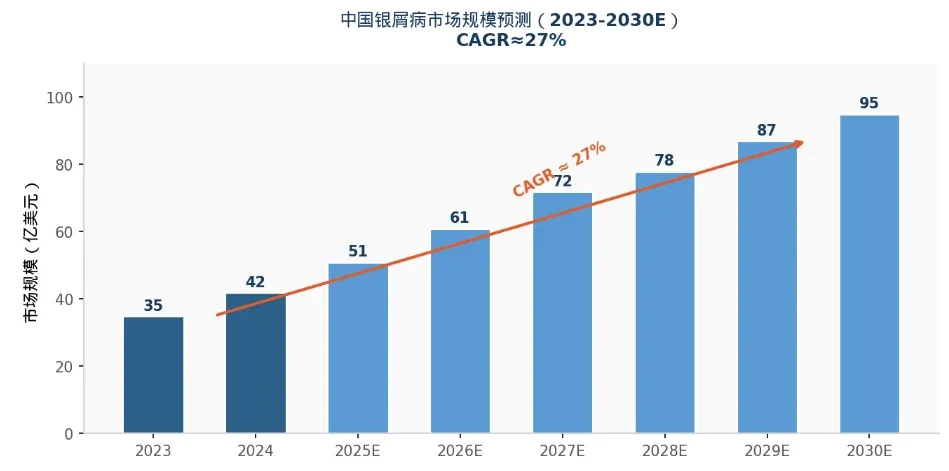
This is a track that appears to lack innovation. There are over 7 million psoriasis patients in China, and the market size is expected to reach $9.5 billion by 2030, with a CAGR of approximately 27% — figures that are quite enticing. However, the speed of iteration in the treatment landscape is equally astonishing: TNF-α inhibitors opened the door to biologics, IL-17A antibodies (secukinumab, ixekizumab) further improved efficacy, and IL-23p19 achieved a new round of iteration with a more precise upstream entry point.
The competition in China's IL-23p19赛道 has entered a white-hot stage. Johnson & Johnson's Tremfya (guselkumab) and AbbVie's Skyrizi (risankizumab) have already been launched in China; Innovent Bio's pikinib is advancing its marketing application; Akeso’s yiruqi was just approved in April 2025. Adding Boehringer Ingelheim’s spesolimab (targeting IL-36R, primarily for pustular psoriasis), the "cake" in this track has long been divided up with little left.
In this landscape, a follow-on IL-23p19 monoclonal antibody simply has no future. But the answer for SHR-1139 lies in targeting two pathways.
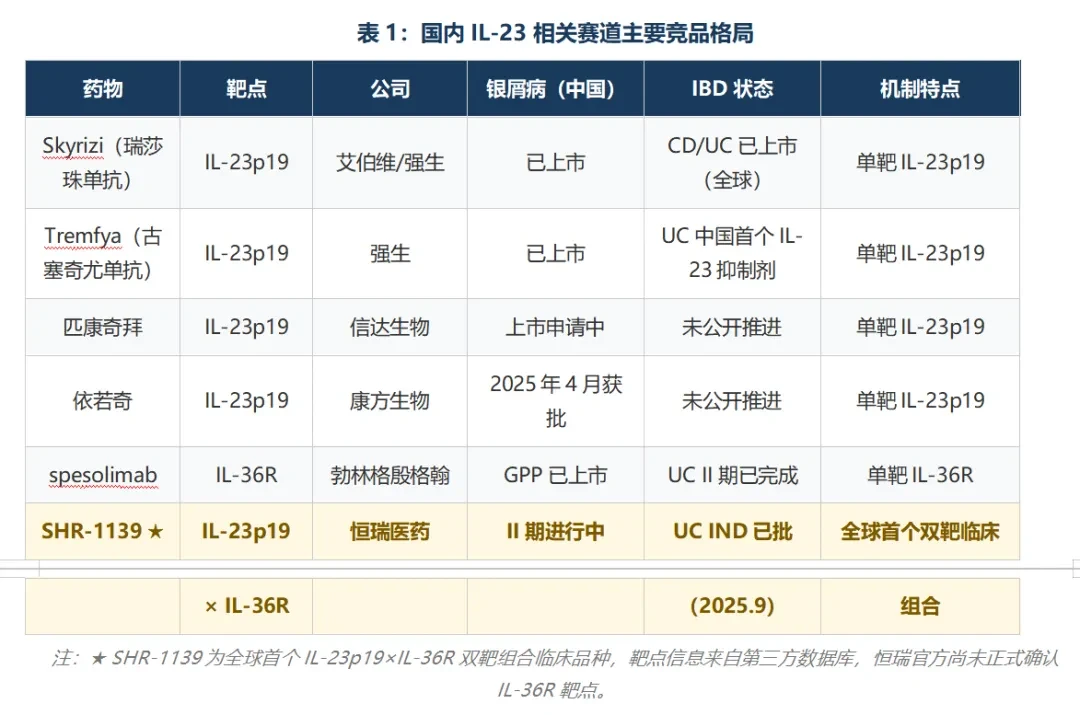
The differentiation of SHR-1139 comes from the biological synergy of two targets:
IL-23p19 is a key node upstream of adaptive immunity. The IL-23 cytokine drives the differentiation and expansion of Th17 cells through the p19 subunit, and Th17 cells release effector molecules such as IL-17A and IL-22, triggering a cascade of inflammatory responses in the skin and gut. Blocking IL-23p19 is equivalent to cutting off the most upstream source of this "fire."
IL-36R is a key receptor in another pathway. IL-36 signaling activates skin and mucosal epithelial cells, compromising the integrity of physical barriers and amplifying the inflammatory cascade of innate immunity. Spesolimab (a single-target IL-36R inhibitor) developed by Boehringer Ingelheim has been approved for marketing in generalized pustular psoriasis (GPP) and completed a Phase II RCT in ulcerative colitis (UC), independently validating the biological relevance of this pathway in skin and intestinal inflammation.
The cross-activation of the two pathways is precisely the root cause of the "compensatory escape" risk faced by single-target strategies: residual inflammatory drive from the IL-36R pathway may sustain mucosal damage after IL-23p19 is blocked, and vice versa. The dual-target design of SHR-1139 is aimed at sealing off this escape route.
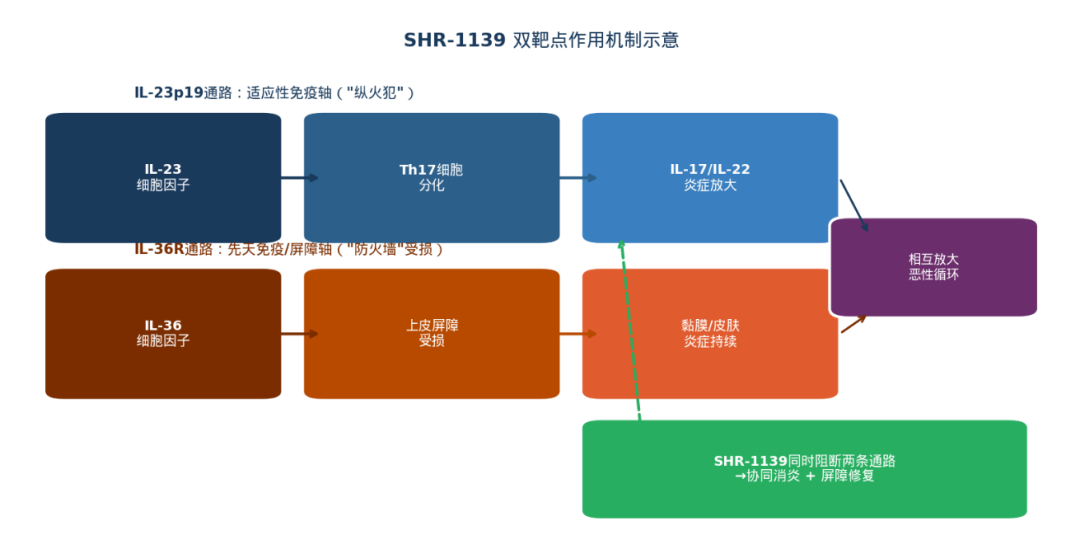
The wording used by Hengrui in the announcement — "synergistic effect," "inhibiting inflammatory responses and maintaining epithelial barriers" — fully corresponds to the above dual-target biological logic.
"The 'world's first' is more than just a marketing slogan. Globally, no combination product targeting IL-23p19 × IL-36R has entered the clinical stage. Brazikumab (a pure IL-23p19 monoclonal antibody) co-developed by AstraZeneca and AbbVie announced the termination of IBD indication development in 2023, further clearing space for the differentiated positioning of SHR-1139."
In terms of current progress, the Phase II clinical trial of SHR-1139 for psoriasis has been confirmed. The IND for the UC indication was approved in September 2025, and the Phase I trial in Australia has completed registration — the first step of going international has been achieved.
02
UC Indications — The Real Incremental Space
To understand the value ceiling of SHR-1139, the best reference is ustekinumab (Stelara).
In 2009, this monoclonal antibody targeting the IL-12/23 p40 subunit was first approved for psoriasis, with annual sales of less than $1 billion at the time; in 2013, it secured approval for psoriatic arthritis (PsA); in 2016, it made a breakthrough in Crohn's disease (CD); and in 2019, it moved into ulcerative colitis (UC) — this very step pushed Stelara to the true peak of sales, reaching $5.2 billion in 2018 (on the eve of UC approval).
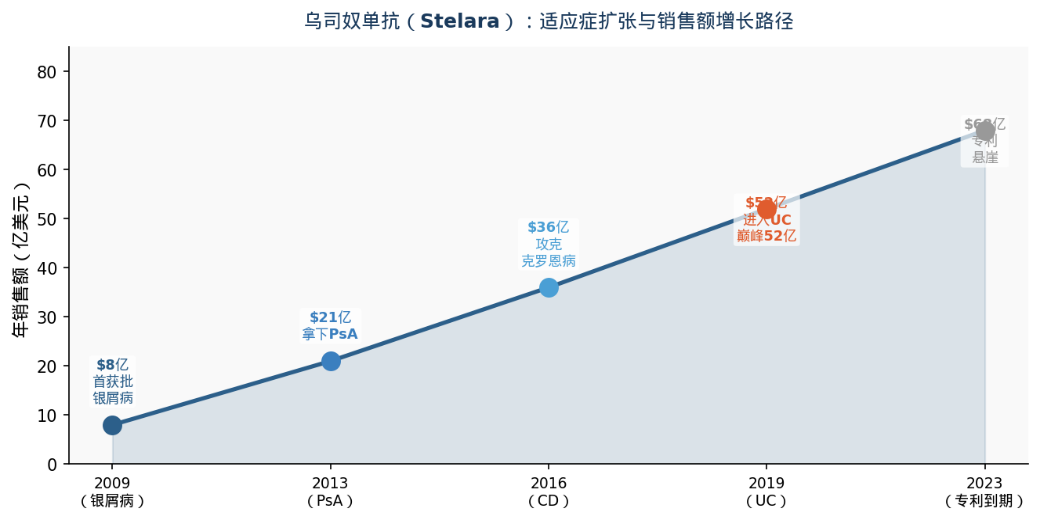
(Figure 3: Ustekinumab Indication Expansion Pathway and Sales Growth))
The greatest differentiated incremental value of IL-23 inhibitors may not lie in dermatology, but in the gastrointestinal field. The number of IBD patients is large, their conditions are severe, and the extent of unmet treatment needs is far higher than that of psoriasis. This is evidenced by Skyrizi's nearly 50% 52-week clinical remission rate in Crohn's disease (CD), and Tremfya securing the first IL-23 inhibitor indication for UC in China, both underscoring the same logic.
The IBD logic of SHR-1139 is based on independent clinical evidence from two pathways:
The efficacy of monoclonal antibodies targeting IL-23p19 in IBD has been well validated. Skyrizi achieved nearly a 50% clinical remission rate at 52 weeks in CD, significantly outperforming placebo; Tremfya met the primary endpoint in a global Phase III study for UC and is set to become China's first approved IL-23p19 inhibitor for UC in 2025, demonstrating the feasibility of this target in intestinal inflammation.
Independent evidence of IL-36R in UC also exists. Boehringer Ingelheim's spesolimab completed a Phase II randomized controlled clinical trial for UC, demonstrating that IL-36 signaling is highly upregulated in the intestinal mucosa of IBD patients, and mucosal barrier repair is a crucial dimension in UC treatment. This is one of the key scientific pivots in the SHR-1139 dual-target design.
The differentiated bet of the dual-target approach lies in: for the subgroup of moderate to severe UC patients with deep mucosal damage, IL-23p19 addresses inflammation-driven processes, while IL-36R promotes mucosal healing — this combination theoretically offers a "dual repair" depth unattainable by single-target therapies. Mucosal healing has increasingly become one of the core endpoints in UC clinical research, a trend that aligns closely with the mechanistic design of SHR-1139.
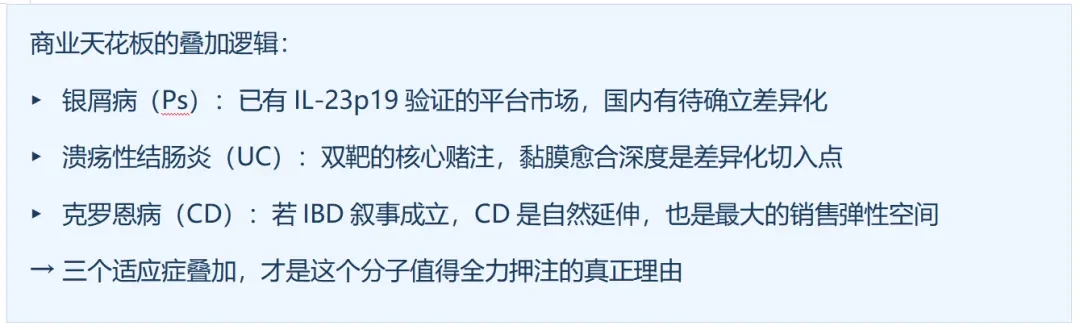
Of course, the urgency of the competitive time window is real. Johnson & Johnson's Tremfya has secured the first-mover advantage in China's UC market.In terms of momentum, Skyrizi holds an extremely strong position in the global IBD market; the window for SHR-1139 to enter the UC space is narrowing. Its Phase II data must be powerful enough to outperform single-target therapies in order to secure a foothold in an already highly crowded field.
03
Old Ambitions Rekindled, Independent Expansion Overseas
Hengrui initially considered going global independently but failed. Later, people only remembered it as the king of licensing out, forgetting that it once dreamed of becoming the "King of the Seas." Now, Hengrui is planning to use this globally first-in-class innovation in the autoimmune field to realize that dream.
SHR-1139 is a typical "can only rely on itself" asset. The reason is simple: being a first-in-class dual-target drug means there is no global reference data available. Before the Phase II data readout, potential buyers cannot assess whether this path is viable, making licensing negotiation premiums extremely limited. Only when Hengrui Pharma takes the lead in conducting global multicenter Phase II and even Phase III trials, accumulating a credible international data package, can it truly gain pricing power at the negotiating table.
The registration of Phase I in Australia is the first cornerstone of the international clinical data package.
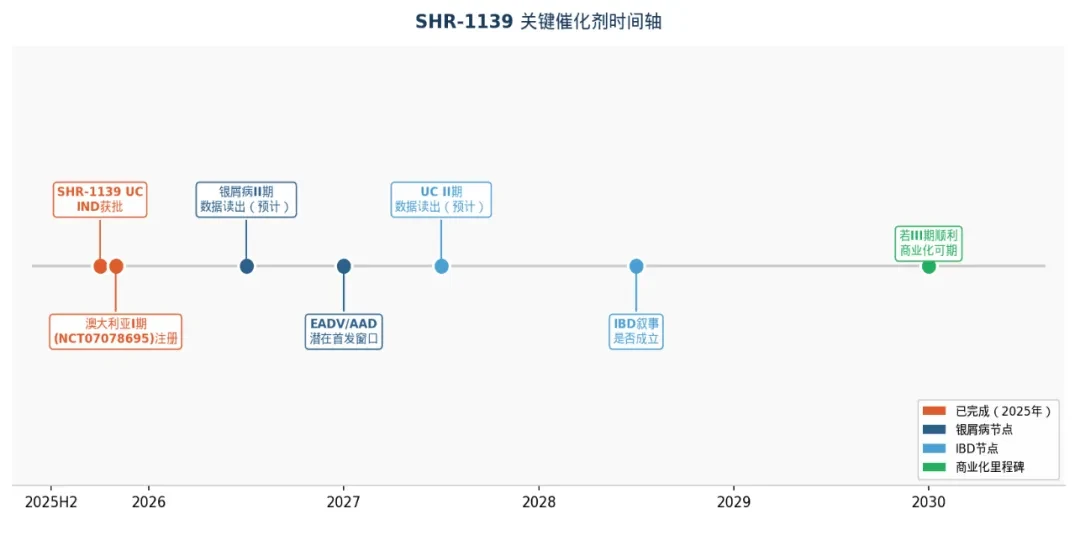
Based on the current progress, the timeline for key catalysts is roughly as follows: 2026-2027, Psoriasis Phase II data readout, with EADV/AAD as the potential international debut window; 2027-2028, UC Phase II data to determine whether the IBD narrative holds; if Phase III is approved to commence, it will be the critical battle to truly test the "independent international launch" capability, with a market launch no earlier than 2030.
This timeline corresponds to the competitive market landscape, by which time Skyrizi and Tremfya will further solidify their moats in the IBD market — the space that SHR-1139 can penetrate must be differentiated data genuinely demonstrated by the dual-target mechanism in terms of mucosal healing depth, rather than merely the narrative of "yet another IL-23 inhibitor."
However, if independently leading international multicenter Phase III trials, the financial burden is a real test. The HKD 11.4 billion raised from the H-share listing needs to simultaneously support the advancement of over 20 overseas clinical pipelines. Based on cost estimates for global Phase III trials in autoimmune diseases, a single indication often consumes several hundred million US dollars. If SHR-1139 is to advance global Phase III trials for both psoriasis and IBD concurrently, the demand for capital efficiency is extremely high. This is one of the most significant implicit constraints at the current stage.
Conclusion:SHR-1139 is a structurally compelling story: its dual-target innovative mechanism has no global competitors, its indication matrix follows the path of ustekinumab, and its independent international expansion is anchored by the first step of Phase I trials in Australia.
But a good story needs data to deliver. It took ustekinumab ten years to transform from a psoriasis monoclonal antibody into a $5.2 billion IBD blockbuster. SHR-1139 has already embedded the narrative logic of "psoriasis → IBD" in its mechanism design, but between embedding and delivery stand three major hurdles: Phase II data, Phase III barriers, and commercial timing.
The Psoriasis Phase II data readout for 2026-2027 is the first certification barrier for this molecule to transition from "expectation" to "reality."
Only then does the story truly begin.

Click "MedPoint" below”, follow more exciting content
Disclaimer
The push rules of WeChat Official Accounts have changed again. If you don't tap"Views"Or not set to"Star Mark", we might just dissipate in the vast ocean of text~ Click here, don't miss out on the latest news from PharmaDJ!?