

Beyond Regulatory Approval: The Next Chapter for AI in Medical Imaging Across Industry, Academia, and Clinical Practice
Since the first Class III medical device certificate for imaging AI was issued by the National Medical Products Administration (NMPA) in January 2020, approximately 20 imaging AI products have gained regulatory approval within just 20 months. However, overcoming regulatory hurdles does not mean that imaging AI has yet achieved market viability.
To explore the next chapter in the development of medical imaging AI, a panel of experts convened at the 6th GAIR Global Artificial Intelligence and Robotics Conference, recently hosted by Leiphone. The distinguished participants included Zhou Shaohua, Researcher at the Institute of Computing Technology, Chinese Academy of Sciences (CAS); Jiang Tianzi, Researcher at the Institute of Automation, CAS; Li Chunming, Professor at the School of Information and Communication Engineering, University of Electronic Science and Technology of China; Peng Hanchuan, Founding Dean of the Institute of Brain and Intelligence Technology at Southeast University; and Zheng Yefeng, Director of Tencent’s Tianyan Laboratory. Together, they engaged in an in-depth discussion on the future trajectory of imaging AI, seeking to provide answers through the cross-pollination of ideas.

2021 can be regarded as the year when medical AI companies went public. Four enterprises—Keya Medical, Airdoc, Infervision, and Shukun Technology—successively submitted their prospectuses. Airdoc successfully listed in November, becoming the first publicly traded company in the field of medical imaging AI.
Not only that, the revenue growth reported by various companies has been quite impressive, driven by the approval of regulatory reviews. Airdoc’s full-year revenue in 2020 increased by 50% year-on-year; Infervision saw an annual growth rate of 318%; Shukun Technology even achieved a 32-fold increase, with its half-year revenue exceeding RMB 50 million.
However, compared to the annual investments of hundreds of millions made by each company, the surge in data has failed to win favor from investors. Taking Airdoc Technology, which is listed on the stock exchange, as an example, its shares fell approximately 10% in the grey market trading the night before its listing. On the Hong Kong Stock Exchange, where liquidity is relatively poor, Airdoc has not yet demonstrated a breakthrough in its stock price.
At the roundtable, Director Zheng Yefeng summarized the post-approval implementation challenges of AI into two categories: commercial and technical.
“Regarding regulatory review and approval, Tencent’s pneumonia AI also received NMPA certification this year. However, from the perspective of the overall AI industry, there are still issues with AI’s business models and technical capabilities. Medical AI commercialization has been highly successful in the United States, with many AI products gaining reimbursement coverage. One key reason is that in the U.S., equipment costs and diagnostic fees for radiological examinations are billed separately, and labor costs are particularly high. In contrast, in China, radiological examination fees are low, not itemized separately, and predominantly cover equipment costs. This explains why AI applications in the U.S. can currently be billed and reimbursed independently.”
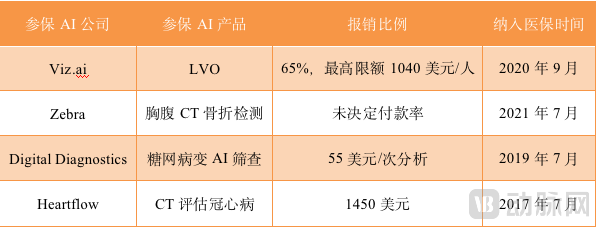
Examples of AI Products Covered by Some U.S. Insurance Plans (Data Source: Medicare.gov)
“Technical issues are somewhat linked to the business model dilemmas of AI. Judging from AI products currently approved by the NMPA, AI can only address specific one or few problems. However, for radiologists, all diseases observed during image interpretation—including chronic obstructive pulmonary disease and pleural effusion in the lungs, fractures outside the lungs, and heart-related conditions—must be reported. Therefore, AI with single-point functionality may not necessarily reduce physicians’ workload; instead, it could have the opposite effect. In other words, AI requires comprehensive development and all-around upgrades.”
Furthermore, the issue of distribution shift in deep learning has not been adequately addressed. Zhou Shaohua highlighted a concern regarding robustness: “While AI can accommodate the data distribution of current hospitals, it often fails to perform at its optimal training level when faced with the data distribution of new hospitals.”
Over the past five years, although medical AI has overcome numerous hurdles, the industry still requires synchronized advancements in both technology and business. At this juncture, AI needs new momentum.
In the view of scholars, industry-academia-research collaboration centered on innovation can, to some extent, address two challenges facing AI. However, the industry-academia-research model for AI itself may have certain issues and must undergo self-optimization to align with AI’s development. As stated by Dean Peng Hanchuan: “Industry-academia-research collaboration needs to achieve genuine innovation and ensure that R&D is as closely aligned as possible with clinical needs.”
From the perspective of the global growth rate of artificial intelligence papers, we can see a growth rate of up to 50% in recent years, but such massive growth also brings certain challenges.
Professor Li Chunming stated, “Deep learning papers are now severely homogenized. While many papers do propose methods, these methods lack sufficient innovation and are largely similar, resulting in a high degree of similarity across most articles. During peer review, this forces reviewers to either reject or accept them en masse. This situation may lead to several issues; for instance, to meet the substantial demand for peer reviews, the number of reviewers must be increased, which could introduce reviewers with relatively lower competence. Consequently, many low-quality articles may be accepted for publication, creating a vicious cycle.”
Therefore, to establish a viable model for industry-academia-research collaboration in supporting AI development, reviewers should strengthen their scrutiny, while entrepreneurs must proactively pursue innovation. After all, the ultimate test of innovative outcomes is not the number of papers published by companies, but the number of hospitals willing to purchase their equipment.
Secondly, AI development cannot rely solely on the research mindset of academia. Zheng Yefeng believes that while academic research enjoys greater freedom, industrial research is more constrained yet better positioned to address problems closest to clinical practice. Viewing either approach in isolation has its limitations; a more effective strategy is to integrate both—using an industrial mindset to define research objectives closely aligned with clinical needs, while continuously monitoring academic innovations to promptly identify valuable advancements emerging from academia.
Finally, it is essential to establish a collaborative partnership with physicians. If medicine is viewed as a service, physicians are among the few professionals who hold a dominant position in their interactions with service recipients. Therefore, when collaborating with physicians, it is crucial to practice active listening; otherwise, they will remain “too busy every day.”
Furthermore, as Professor Jiang Tianzi stated, physicians have a better understanding than industry practitioners of which innovations hold genuine value and which do not. Therefore, developing AI based on clinical needs to address practical demands is both the core principle and the fundamental foundation.
At the roundtable, Director Zheng Yefeng cited the following example.
“Minimally invasive aortic valve replacement is a high-risk procedure. In elderly patients, cardiac valves often undergo calcification, necessitating replacement in severe cases. Previously, surgeons performed open-chest valve replacement, which carried a mortality rate of approximately 10%. With the advent of minimally invasive techniques, mortality has been significantly reduced, allowing patients to be discharged on the same day as their morning surgery.”
“However, performing this procedure requires the physician to locate the valve, which necessitates the administration of a contrast agent to the patient. Since contrast agents can cause renal injury, we communicated with the physicians, who expressed the need for a navigation system. Such a system would reduce the patient’s exposure to contrast media and enable precise monitoring of the prosthetic valve’s position and movement after implantation, thereby determining the optimal timing for deployment. After all, if the prosthetic valve is not deployed in the correct position, open-heart surgery would be required to retrieve it. Therefore, navigation is crucial.”
“At that time, we explored numerous approaches and engaged in multiple discussions with physicians. The final solution involved acquiring circumferential X-ray images of the human body, a method that received unanimous approval from both parties. For me, the entire process was deeply fulfilling.”
Therefore, as a type of medical device, AI also requires developers and physicians to communicate step by step and gradually find solutions. Products developed with an Internet-centric mindset and then handed over to physicians for clinical use are unlikely to succeed.
In recent years, the terms “deep learning” and “artificial intelligence” have often been used interchangeably, creating the mistaken impression that “deep learning equals artificial intelligence.”
Professor Jiang Tianzi stated: "Deep learning is a methodology, not synonymous with artificial intelligence. To be effective, deep learning requires large volumes of data; however, this approach cannot address all challenges, particularly for many diseases where only small sample sizes are available."
Peng Hanchuan also stated that many issues are not suitable for resolution via deep learning. For instance, challenges related to data transmission—such as how to improve transmission rates and how to efficiently collect and store data—are not classification problems amenable to deep learning solutions. Therefore, researchers need to construct a comprehensive logical framework, rather than focusing solely on intermediate classification tasks.
Nevertheless, there is a consensus that the fervor surrounding deep learning will persist for some time. Since 2020, the pace of publication of deep learning-related papers has gradually slowed, with growth rates dropping from 30%–50% in the preceding five years to single digits. This deceleration may be attributable to the pandemic or market saturation.
Neural networks emerged in the 1980s, but were overshadowed in the 1990s by the rise of alternative technologies. However, as of now, no viable alternatives have emerged to replace them.