

China's Top 100 Hospitals See Sharp Decline in 'Bronze-Level' IT Performance: From 65% to 14%
In 2018, VCBeat compiled a ranking of the informatization levels of China’s “Top 100” hospitals.“China’s Top 100 Hospitals ‘Kings’ List Released, but 65% of Hospitals Still at ‘Bronze’ Level in Informatics”It was revealed that among the “Top 100” hospitals in China as ranked by Fudan University, 65 failed to pass even a single level of accreditation. Two years later, VCBeat updated the list again to examine how the informatization capabilities of these Top 100 hospitals have changed after two years of digital infrastructure development.
VCBeat used the “Top 100” hospitals from the China Hospital Rankings officially released by the Fudan University Institute of Hospital Management as its data foundation, integrating the National Healthcare Information Interoperability Standardization Maturity Assessment organized by the National Health Statistics Information Center, the Institute’s “Grading Evaluation Standards for Electronic Medical Record System Application Levels,” and the “Hospital Smart Service Grading Assessment Standard System (Trial)” issued by the National Health Commission, providing interpretation and analysis from an informatization perspective.
VCBeat has drawn the following conclusions from its analysis:
1. Overall, compared with 2018, the level of informatization in hospitals across China has significantly improved over the past two years; however, a number of top-tier hospitals still exhibit an imbalance between the comprehensive development of their clinical specialties and their informatization capabilities.
2. The level of informatization is relatively high in North China, East China, and South China; however, significant regional disparities persist in the development of hospital informatization.
3. IT infrastructure development may become an accelerator for the growth of non-"Top 100" hospitals.
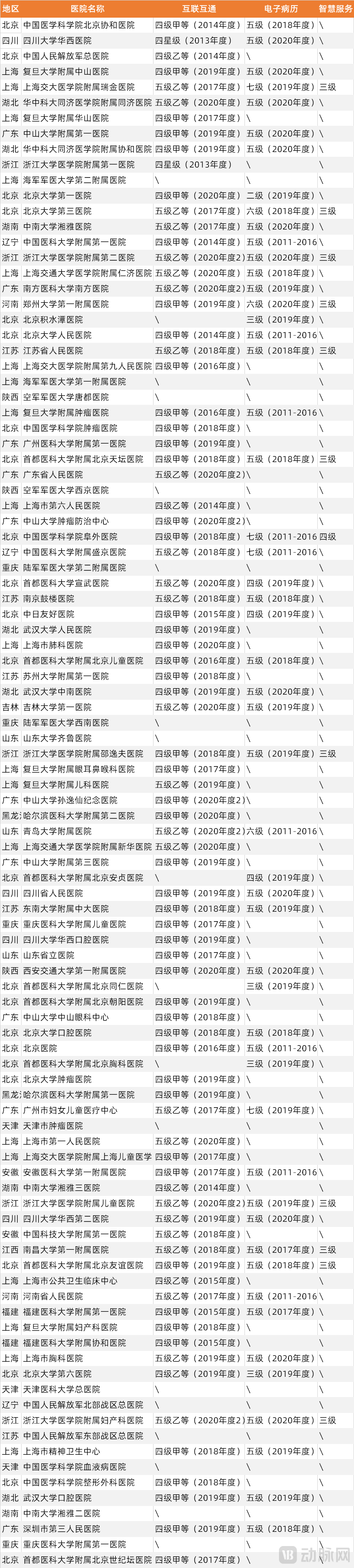
Below is the ranking of IT maturity levels among the “Top 100” hospitals, compiled by VCBeat:
Large hospitals are massive in scale, with complex internal systems where changes to one component can have far-reaching consequences across the entire organization. Moreover, informatization is a “top-leader project” characterized by long construction cycles, substantial investment, and limited short-term economic returns, requiring strong commitment from hospital leadership to enhance participation across all departments. Consequently, under the heavy burden of clinical operations, hospitals often lack significant momentum for such initiatives.
However, driven by mandatory requirements from the National Health Commission and other departments in recent years, the patient-centered healthcare philosophy, hospitals’ intrinsic needs for development and self-imposed management standards, social influence factors, and competitive pressures from peer institutions, medical institutions have actively promoted informatization construction and continuously enhanced its application within their facilities, achieving favorable outcomes.
Distribution of IT Maturity Levels Among the “Top 100” Hospitals:
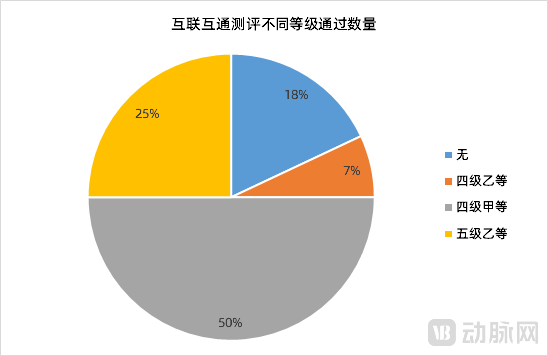
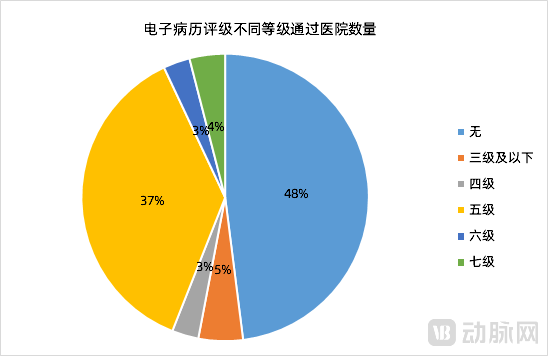
50% achieved Level 4 Grade A in the Interconnectivity Maturity Assessment, while 48% had no EMR system rating.
In recent years, to promote the greater role of information systems in hospitals across China, the National Health Commission has been continuously implementing mandatory evaluation standards for hospital information systems. The Interconnectivity Standardization Maturity Assessment and the Electronic Medical Record (EMR) Functional Application Level Evaluation are key assessment indicators.
As of December 2021, a total of 163 regional health authorities and 595 secondary-and-above hospitals had passed the Interconnectivity Maturity Assessment. Among them, 13 regional health authorities and 53 hospitals achieved Level 5 Grade B certification.
Released by VCBeat"153 Regions and 503 Hospitals Over Eight Years: Three Major Trends Emerge from the Medical Interconnectivity Assessment"It is noted that from 2013 to the present, regardless of whether targeting regional health information authorities or medical institutions, the proportion of entities rated as Level 4 Grade A has consistently exceeded three-fifths. Level 4 Grade A has thus become the current target and benchmark for interoperability in healthcare information systems. This trend is also evident in the “Top 100” Informatics Ranking, where 50 hospitals have passed the Level 4 Grade A interoperability assessment, establishing a dominant position.
Currently, the assessment of standardization maturity for hospital (regional) interconnectivity is divided into seven levels. Among these, Level 5 Grade B is the highest level in China's assessment of standardization maturity for healthcare information interconnectivity and represents the best performance achieved by domestic hospitals in this evaluation to date.“Top 100” Hospitals: 25 hospitals have achieved the Level 5 Grade B rating for interoperability, accounting for 47% of the total number of hospitals in China with this rating.
As of2021Year11In , there were a total of in China118Hospitals participating in the EMR evaluation that have achieved Level 5 or higher. EMRThe continuous improvement of in-hospital application levels has also laid a solid foundation for the standard database of medical informatics.Among the "Top 100" hospitals, the number of hospitals with an electronic medical record (EMR) rating of Level 5 or above is44Home, among which,VGrades include37Home,VIGrade3Home,SevenGrade4Home.
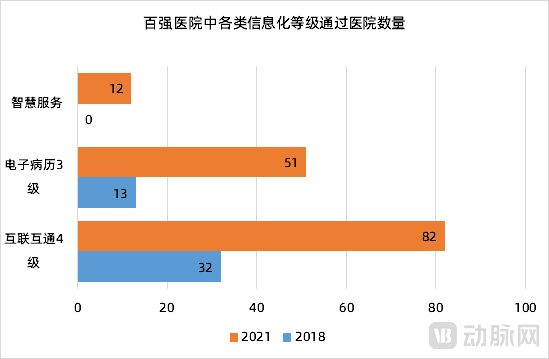
As shown in the table,Among the "Top 100" hospitals, 82 have achieved Level 4 or above in the Interconnectivity Standardization Maturity Assessment, 51 have reached Level 4 or above in the Electronic Medical Record (EMR) System Application Level Evaluation, and 12 have attained Level 3 or above in the Smart Service Rating.
On August 22, 2018, the National Health Commission issued the “Notice on Further Promoting the Construction of Information Systems in Medical Institutions with Electronic Medical Records at the Core.” The Notice stipulated that by 2020, tertiary hospitals were to achieve interconnectivity and interoperability of information across all clinical care processes within the hospital, attaining Level 4 maturity in the Standardized Assessment of Hospital Information Interconnectivity. This would enable authorized access to relevant clinical information from any terminal in any department within the hospital. Furthermore, by 2020, all tertiary hospitals within each jurisdiction were required to reach Level 4 or above in the Graded Evaluation of Electronic Medical Record Application Levels, thereby achieving hospital-wide information sharing and incorporating clinical decision support capabilities.
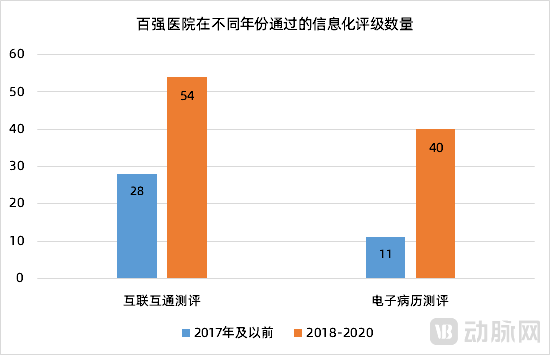
Following the implementation of this policy, the number of “Top 100” hospitals participating in and passing the assessments for health information interoperability and electronic medical record (EMR) application maturity levels increased significantly. In terms of interoperability, 16, 20, and 18 hospitals passed the assessment in 2018, 2019, and 2020, respectively. Regarding EMR systems, 10, 16, and 14 hospitals achieved certification in these three years, respectively.
Compared with the Interconnectivity Maturity Assessment, which began in 2013, and the Electronic Medical Record (EMR) Grading System, launched in 2011, the Hospital Smart Service Classification Assessment, initiated only in August 2019, remains very young.
In August 2021, the results of the hospital smart service grading evaluation for hospitals at Level 3 and above in 2019 and 2020 were announced.Among the 29 hospitals that have passed Level III or higher evaluations, 12 are listed among the “Top 100” hospitals. Moreover, all 12 of these hospitals have achieved Level IV-A or higher in the Interconnectivity Standardization Maturity Assessment and Level 5 or higher in the Electronic Medical Record (EMR) grading system.
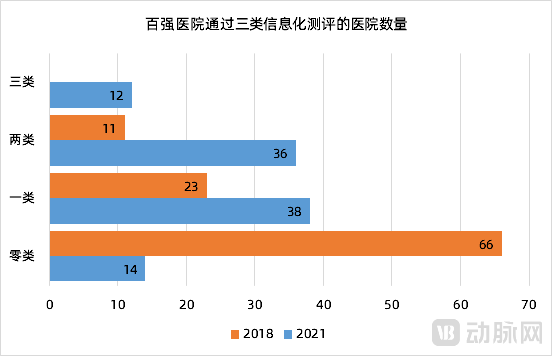
VCBeat has tallied the number of categories passed by the “Top 100” hospitals, revealing that 86 hospitals have passed at least one of the three evaluations: Interconnectivity, Electronic Medical Records (EMR), and Smart Services. Conversely,14% of the “Top 100” hospitals failed to pass any level of accreditation. Compared with 65% in 2018, this figure has seen a substantial decline, partly due to fluctuations in hospital rankings.
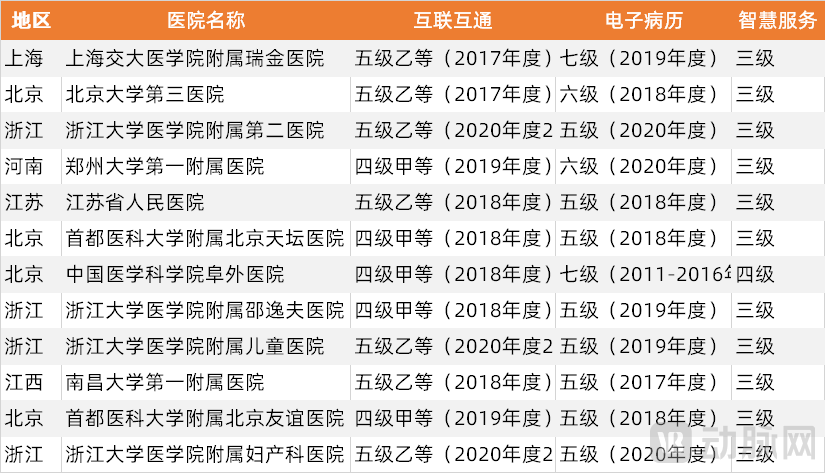
Among them,Twelve hospitals passed the three-tier evaluation. Notably, these include Ruijin Hospital, Shanghai Jiao Tong University School of Medicine, and Fuwai Hospital, Chinese Academy of Medical Sciences.
Not only do these two hospitals rank among the top in comprehensive disciplinary capabilities, but they have also achieved remarkable success in information technology construction. Ruijin Hospital, Shanghai Jiao Tong University School of Medicine, ranks fifth in the “Top 100” list for disciplinary reputation and comprehensive research and academic strength. It has attained the highest existing levels for both Interconnectivity Standardization Maturity and Electronic Medical Record (EMR) System Functional Application Level evaluations, and was among the first batch of hospitals publicly recognized for passing the Smart Service grading. Fuwai Hospital, Chinese Academy of Medical Sciences, was one of the two hospitals (the other being Shengjing Hospital of China Medical University) to achieve Level 7 EMR certification before 2017, and remains the only hospital in China to have passed the Level 4 Smart Service evaluation.
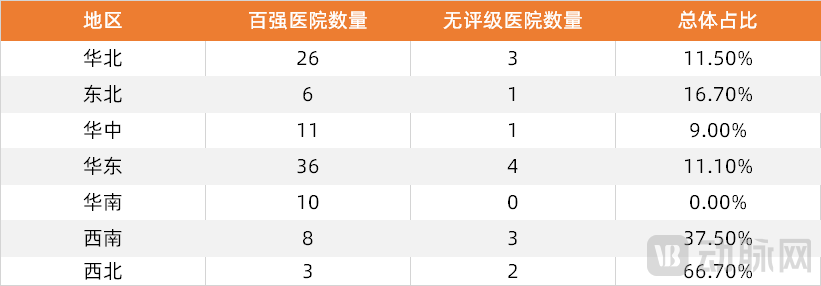
From the perspective of national geographic regions, East China (Shandong Province, Jiangsu Province, Anhui Province, Shanghai Municipality, Zhejiang Province, and Fujian Province) has the largest number of hospitals listed in the “Top 100,” yet it also has a relatively high proportion of hospitals without an informatization rating.
In North China (Beijing and Tianjin), 23 hospitals in Beijing made the list. Among these 23 hospitals, Peking University Third Hospital demonstrated the strongest informatics capabilities. In addition to achieving Level 5 Grade B for Interconnectivity Standardization Maturity, it also attained Level 6 for Electronic Medical Records (EMR) and Level 3 for Smart Services, making it the only hospital to pass all three informatics assessments.
The level of hospital informatization in Central China (Hubei, Hunan, Henan, and Jiangxi) is relatively balanced. Among them, the First Affiliated Hospital of Zhengzhou University in Henan Province and the First Affiliated Hospital of Nanchang University in Jiangxi Province are the only two hospitals that have passed all three informatization assessments.
In addition to achieving Level 5 Class B in Interconnectivity Standardization Maturity and Level 6 in Electronic Medical Records, The First Affiliated Hospital of Zhengzhou University ranked 19th nationwide. The First Affiliated Hospital of Nanchang University is the only hospital in Jiangxi Province listed among the “Top 100” hospitals. Although it has attained Level 5 Class B in Interconnectivity and Level 5 in Electronic Medical Records, its ranking in terms of disciplinary reputation and comprehensive scientific research capabilities is relatively low, placing 80th on the “Top 100” list.
Guangdong Province in South China accounts for 10 spots. Its representative in informatization is the Guangzhou Women and Children’s Medical Center, which has achieved the highest national levels currently attained in China for both the Interconnectivity Standardization Maturity Assessment and the Electronic Medical Record System Functional Application Level Evaluation.
Based on the results of three information technology assessments, the level of informatization in Southwest China (Sichuan and Chongqing) is relatively weak. Among seven hospitals listed in the “Top 100,” three did not participate in or pass any of the graded evaluations. Of the remaining four hospitals, West China Second University Hospital of Sichuan University stood out, achieving Level 5-Yi for Interconnectivity and Level 5 for Electronic Medical Records.
In Northeast China (Liaoning, Jilin, and Heilongjiang provinces), Shengjing Hospital of China Medical University is a representative institution. It has not only achieved the highest level in healthcare information interoperability but was also one of the few hospitals to attain Level 7 of the Electronic Medical Record (EMR) system before 2017, the other being Fuwai Hospital.
This year, only three hospitals in Shaanxi Province from Northwest China were included in the “Top 100” list. Among them, only the First Affiliated Hospital of Xi’an Jiaotong University obtained the Level 4 Class A certification for Interconnectivity and the Level 5 certification for Electronic Medical Records in 2020. The other two hospitals did not pass any informatics assessments.
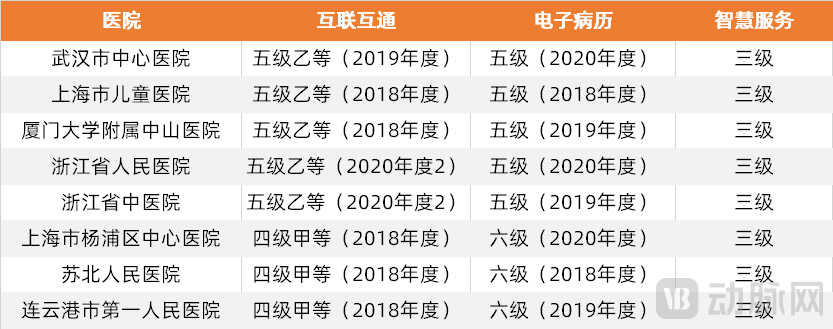
In addition to compiling the three informatization assessment metrics for hospitals in the “Top 100,” VCBeat also curated a list of hospitals that did not make the “Top 100” ranking but demonstrate strong informatization capabilities.
Among the 50 hospitals that have passed the Level 5-Yi rating in the Interconnectivity Maturity Assessment, 29 are not included in the “Top 100” list; among the 20 hospitals that have passed the advanced-level Electronic Medical Record (EMR) System Functional Application Evaluation at Levels 6 and 7, 13 are not on the “Top 100” list; and among the 29 hospitals that participated in and passed the Smart Service Grading Evaluation, 17 fall outside the “Top 100” list.
The table below lists hospitals not among the “Top 100” that have passed three IT assessments: the Interconnectivity Maturity Assessment, the Electronic Medical Record (EMR) Grading Evaluation, and the Smart Service Tiered Assessment.
In June 2021, the General Office of the State Council issued the "Opinions on Promoting High-Quality Development of Public Hospitals," which proposed promoting the deep integration of next-generation information technology with medical services, advancing the construction of smart hospitals featuring a "trinity" of electronic medical records, smart services, and smart management, as well as standardizing hospital information systems; and vigorously developing telemedicine and internet-based diagnosis and treatment. Informatization is a significant driving force for hospital advancement and will play an even greater role in the future.
However, whether for hospitals strengthening their informatization infrastructure or those currently focusing on medical services and not yet undergoing informatization assessments, the objective remains consistent: to enable patients to receive better medical care.
We sincerely thank Wu Kun, Software Engineer at the Information Center of Tongji Hospital, Tongji Medical College, Huazhong University of Science and Technology, for his support.