

What Ignites Their Passion for Medical Innovation? Insights from 100 Interviews
Although the number of interviews appears substantial, answering this question is by no means difficult.
First, from a policy perspective.Since the 18th National Congress of the Communist Party of China proposed the innovation-driven development strategy and placed innovation at the core of national development, China has established the tone for promoting the translation of medical research achievements, successively focusing onNational Strategies, Laws and Regulations, Industry GuidelinesA series of key policies have been introduced across three dimensions, completing the “trilogy” of policy support for the translation of scientific and technological achievements.
Secondly, from the perspective of clinical needs.Currently,There remain numerous unsolved challenges in the medical field., for exampleCOVID-19, CancerMajor diseases continue to pose significant challenges to human life and health, urgently necessitating the development of more effective therapeutic approaches through innovation.
On the other hand,The Pursuit of Higher-Quality Medical Services, people not only seek a cure but also desire a non-invasive and painless treatment process that does not impose excessive physiological burden.
Finally, from the perspective of the inherent seriousness of medicine.With the continuous advancement of modern science, medicine has become increasingly rigorous and logical, but this does not mean that weCurrent medical research is far from being able to explain everything, especially in terms of basic scientific research based on mechanisms, where there are still many directions worth exploring.
In addition, our medical knowledge also needs to be continuously updated. BecauseWhat we once believed to be correct may not necessarily hold true today., without innovation, we would remain trapped in ignorance and stagnation, which is unacceptable in the medical field, where human life and health are at stake.
However, these “answers” are all from a macro perspective; if analyzed from a micro perspective,What Exactly Is the “Intrinsic Drive” Behind Innovation in the Healthcare Sector?
Innovation Potential Hidden in Hospitals and Universities Is Being Unleashed
As the source of innovation in the medical field, physicians are inevitably the primary consideration.
In our observations over the past year or two, we have identified several intriguing phenomena among physicians:First, an increasing number of chief physicians are beginning to devote themselves to innovative ventures., with participation primarily through scientific research projects and enterprise establishment;Second, an increasing number of young physicians are beginning to find their “sense of purpose” through innovation., their presence can be seen in the team composition of numerous scientific research projects and innovation initiatives;3. A large number of overseas-trained doctors are “returning home”, their names are increasingly appearing both among hospital research teams and on the lists of founders at innovative enterprises.
But why have they collectively become so energized to join the wave of medical innovation?
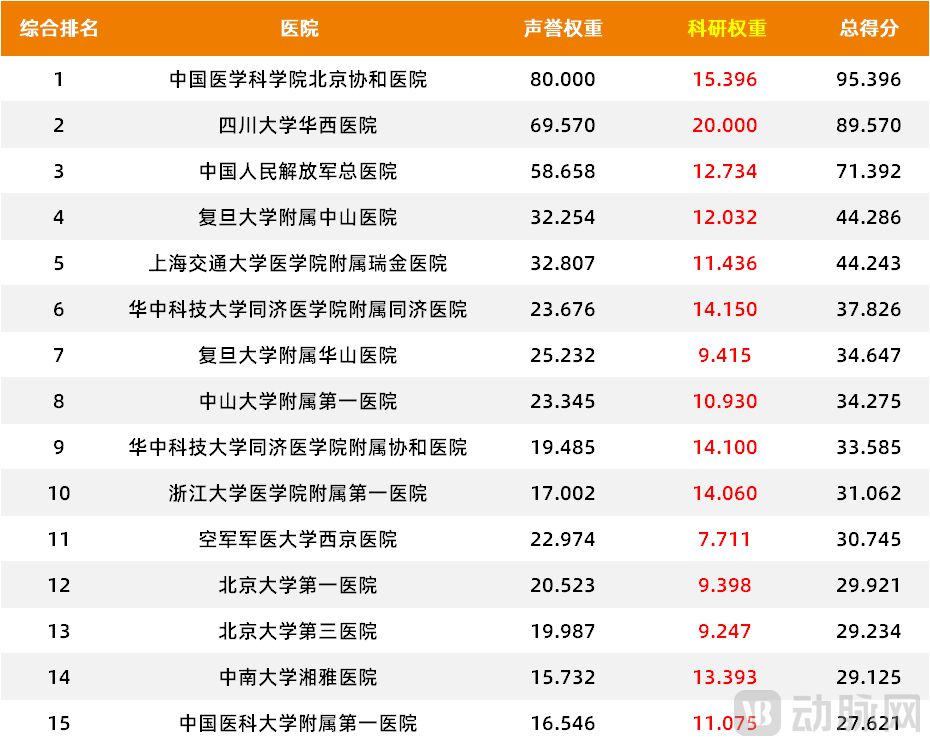 2020 China Hospital Comprehensive Ranking, Data Source: Institute of Hospital Management, Fudan University
There is actually a reason for this.First and foremost is the coercive force of “hard metrics.”On January 30, 2019, the translation of scientific research achievements was officially incorporated into the performance evaluation indicators for tertiary hospitals. Under the new assessment system, as an integral part of the hospital, doctors naturally bear greater pressure to innovate.
Of course, hospitals do not “mistreat” these physicians engaged in innovation. According to the Circular on the National Monitoring and Analysis of the Performance Appraisal of Tertiary Public Hospitals Nationwide in 2018, issued by the General Office of the National Health Commission in July 2020, 80.34% of tertiary public hospitals received research funding support in 2018.The revenue from the commercialization of scientific and technological achievements per 100 health professionals reached RMB 13.0593 million, representing a 165.96% increase compared with 2016.
However, having money alone is not enough; the corresponding supporting services must also keep pace.To create a favorable environment for innovation among physicians, hospitals are making every effort to remove “obstacles” on the path to innovation, both in terms of institutional framework development and the allocation of specific resources. Notably, the vast majority of hospitals have currently established translation centers dedicated to providing innovation support services to physicians.
With mandatory requirements in place and a supportive soft environment established, another factor is also crucial:Physicians' Own Sense of Identity with Innovation, which is the true prerequisite for driving its innovation.
At this point, we have observed some encouraging changes. First, regardingSenior PhysicianFor them, they hope to better present their years of accumulated experience through a certain approach; in addition, forYoung Physiciansthey are full of ideas for innovation and dare to break free from various constraints to devote themselves to the cause of medical innovation; finally, regarding"Overseas-Educated Doctors Returning to China"For them, they are standing in the best era of domestic medical innovation, so they are eager to introduce advanced overseas innovative technologies and incubation systems into China.
On the other hand, as another important force driving innovation,Universities have also expressed strong interest in medical innovation.By the end of 2019, universities and colleges across China had jointly revised and improvedOver 3,000 Policy Documents,88% of universities directly under the Ministry of EducationManagement systems such as the Implementation Measures for Promoting the Transformation of Scientific and Technological Achievements have been formulated and issued, which has, to some extent, promotedConvergence of Medicine and Engineering Industriesinnovation and translation.
Meanwhile, universities and colleges haveTechnology Licensing, Technology Transfer, Industry-Academia-Research Collaborationthrough multiple channels and in various forms, continuously delivering high-quality innovative achievements in the medical field to enterprises and society, thereby providing strong support for industrial development in China’s healthcare sector. According to statistical data, in 2018, the total contract value of scientific and technological achievements transformed by 3,200 universities and research institutes in China through assignment, licensing, and equity investment based on valuation amounted toRMB 17.73 billion, representing a year-on-year increase of 52.2%. Among these, 32 entities reported total conversion contract values exceeding RMB 100 million, a year-on-year increase of 14.3%. Notably,Of the 32 projects with investments exceeding RMB 100 million, 12 were in the healthcare sector.
IPO Timelines Compressed at a Frenzied Pace, Forcing Investment Firms to “Pivot” to Earlier-Stage Projects
As physicians’ willingness to innovate strengthens, a multitude of patents and laboratory achievements will naturally emerge. However, how can these innovations be advanced and commercialized? This necessitates the rapid influx of investment capital. Therefore,Investment institutions will be the second key factor we consider.
November 1,Sequoia ChinaAnnouncement of Capital Contribution500 million yuan“World Laureates Association Prize” Exclusive Donation, This is Sequoia ChinaA Permanent “Public Welfare Investment” in Human Technological AdvancementIt is understood that the World Laureates Association Prize comprises two individual awards, namely the “Prize in Mathematics and Intelligent Sciences” and“Medicine and Life Sciences Award”, evaluated annually, with an annual single-award prize pool of RMB 10 million, aiming to support global innovation in basic scientific research.
In addition, on November 17, 2021, Sequoia China and Illumina jointly launchedSequoia China Smart Healthcare Genomics Incubator (Powered by Illumina Technology)Officially Launched. After more than six months of selection, the first two incubatees have moved into the park to begin a six-month, technology-driven accelerated incubation program.
In terms of scientific research layout, Sequoia China is clearly not an “exception.” Currently, many well-known investment institutions in China are throughEstablishment of an Innovation FundorParticipate in the Early-Stage Project Growth Programthrough various means, are flocking to the field of medical innovation, hoping to “gain access” to more early-stage medical project resources.
This is, in fact, a “change made out of necessity.”
According to statistics,In 2020, a total of 71 healthcare projects went public, with a combined IPO market capitalization of RMB 15.6 trillion.Among these companies, biotechnology and medical device firms are the primary categories, with 42 and 20 companies respectively. Within biotechnology IPOs, innovative drug projects account for 25 cases, making them the most predominant type. Medical device IPOs are primarily driven by in vitro diagnostics (IVD) projects, totaling 10.
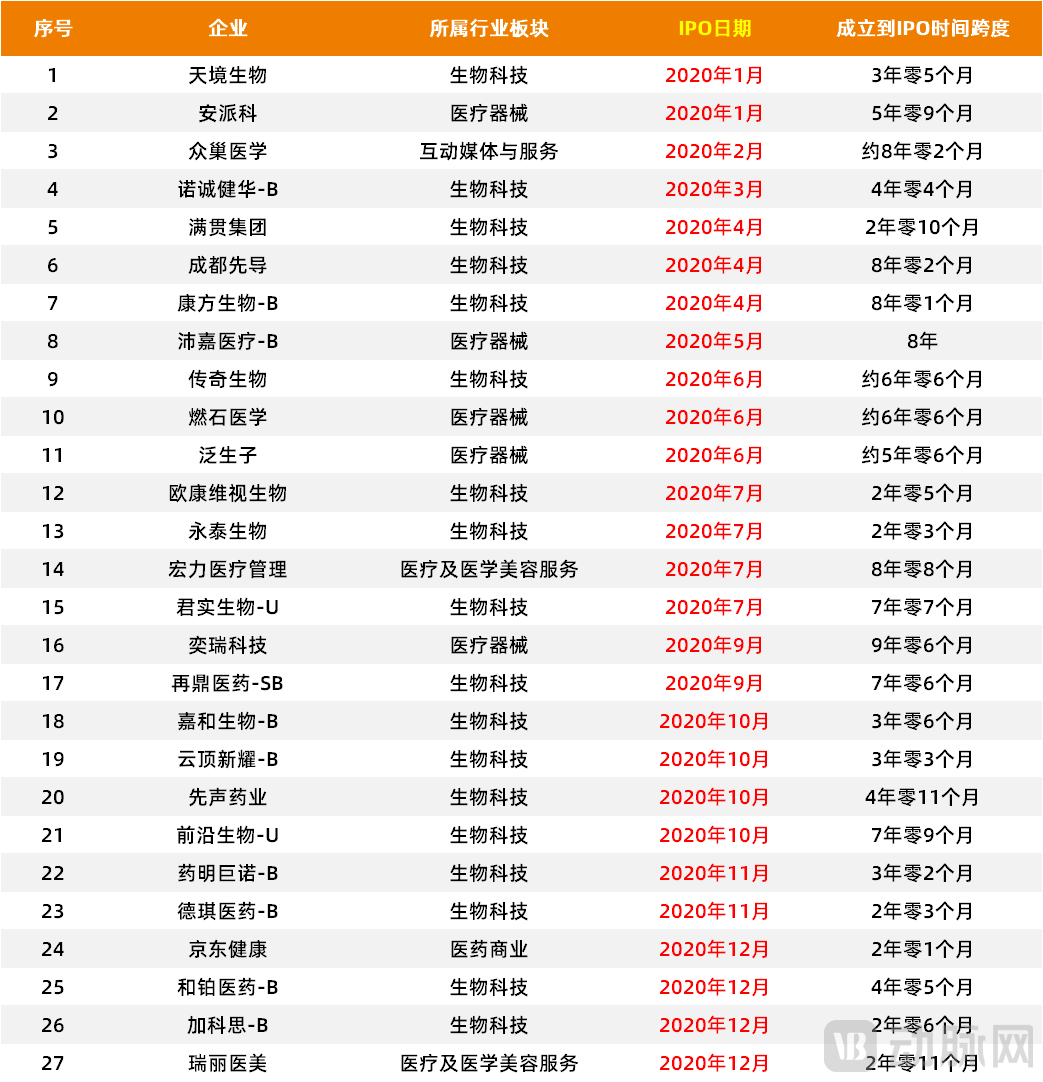
In addition to the surge in quantity, another major change has been “eye-catching,” namelyThe IPO Process for Companies Has Been Significantly Accelerated Compared to the Past. According to the analysis, among 71 listed companies,There are 27 companies that have been established for less than 10 years., the trend toward a younger demographic among listed companies is becoming increasingly pronounced.
As going public becomes increasingly “easy,” the overall pace of investment and financing is also accelerating.
According to statistics from the VCBeat database,In 2020, a total of 767 investment and financing transactions occurred in China's healthcare sector, with the total funding amount reaching a record high of RMB 162.65 billion., a year-on-year increase of 58%.
This year, such investment enthusiasm continues. According to data, in the first half of 2021,A total of 546 investment and financing transactions occurred in China's healthcare sector, with the total amount reaching RMB 92.7 billion., representing a nearly 70% increase compared to the same period last year.
In this “rapid matching” investment environment, corporate fundraising has become increasingly swift, asDeepwise Medical, Keya Medical, DeepModelingCompanies such as these have completed three rounds of financing within a single year. This level of “high efficiency” was previously unimaginable; in 2015, and even in 2016, healthcare-related companies took an average of two years to secure a single round of financing, making the contrast evident.
However, while this “fast-paced” approach enables investment institutions to secure rapid returns, it is also subtly imposing new demands on them, namelyAs the IPO timeline is drastically compressed, investment boundaries become increasingly blurred. Investment firms that traditionally focused on mid-to-late stages are finding it difficult to identify suitable entry points “in the middle,” forcing them to shift their focus to the earliest-stage projects and nurture companies from “ground zero.”
Innovation Enters a New Cycle: Companies That Fail to Innovate Are Doomed to Perish
With a patent in hand and further “incubation” by investment firms to grow into a startup, the task at this stage is considered complete. But how can the company “survive” going forward? This requires the enterprise’s core competitive strengths. More specifically, it necessitatesThe Company Has Established Core Barriers and Advantages in Innovation, which is the key to determining whether a company can successfully penetrate the market.
Especially in the healthcare sector, enterprises are often held to higher standards of innovation capability.First, among start-ups, those that secure funding quickly and raise substantial amounts are generally high-quality companies with core technologies in specific fields. The establishment of such technological barriers is primarily driven by innovation.
This is, in fact, a very simple principle. In the current healthcare industry,Leading companies have emerged in virtually every sub-sector., in such a market environment, if startups want to get a share of the pie, they must rely on innovation, justMust possess key technologies capable of breaking industry monopolies or driving industry transformation, this is one of the few ways for startups to achieve “overtaking on a bend.”
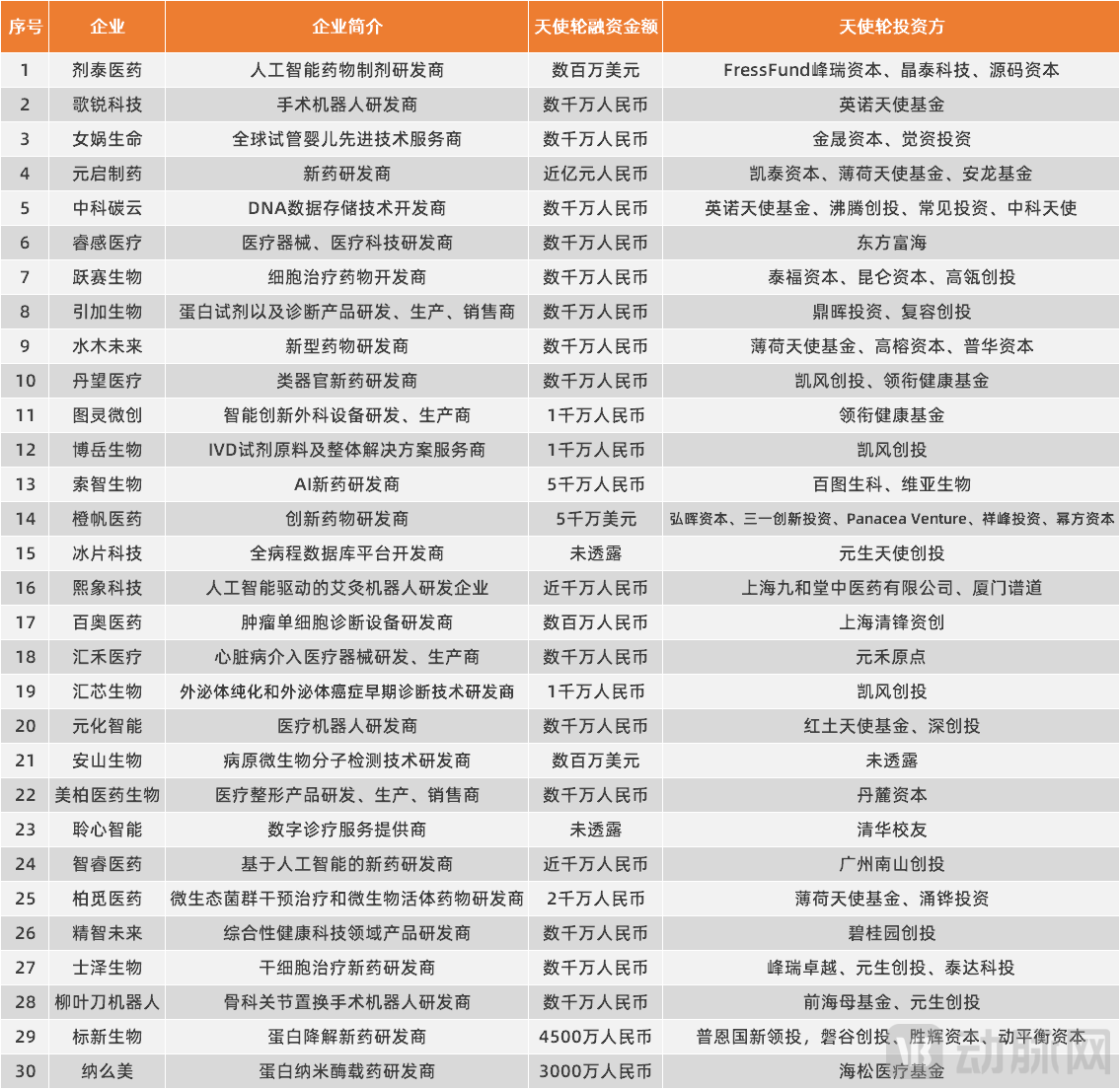 A Review of 30 Companies in Angel Round Financing (Timeframe: January 2020 to November 2021)
A seasoned investor once remarked that innovation capability and technology are indispensable components for startups, representing a high degree of “intrinsic value.” For such companies, having “shortcomings” is not alarming, as these can be gradually addressed and improved over time; however,A company's "long board" must be sufficiently long, as this is the core driving force that truly propels corporate growth.
So, does this mean that listed companies no longer need to innovate? Of course not.These industry “giants” often need to make greater efforts in innovation.
Currently, we are clearly observing that listed companies are engaging in innovation-related activities more frequently than before, with overseas enterprises demonstrating greater proactivity in their innovation efforts.
WithSiemens Healthineersas an example. According to statistical data, Siemens Healthineers currentlyHolding over 560 patented technologies in China alone, with annual innovation investments reaching hundreds of millions of euros. In recent years, Siemens has achieved fruitful results in artificial intelligence, securing more than 500 patents in machine algorithms, 125 patents in deep learning algorithms, and over 40 AI-based solutions.
President, Siemens Healthineers Greater ChinaWang Haostated that Siemens will focus on localized innovation in the future, making every effort to promote cooperation with local Chinese startups, medical institutions, and research institutes to create truly “meaningful innovation.”
This is, in fact, a critical step for publicly listed companies to maintain their competitive edge in the market.Currently, China’s healthcare industry is experiencing robust growth and is in a transitional phase characterized by the rapid evolution and convergence of digitalization, automation, and intelligence. Whether it involves iterating cognitive frameworks and product solutions or constructing business models, there is an urgent need for sustained innovative thinking. Only through continuous innovation and by identifying strategic “leverage points” that align with their own capabilities amidst industry changes can enterprises truly achieve leapfrog growth.
Certainly, for healthcare enterprises, the present is also the best era for innovation.Industries have development cycles, and so does innovation. Against the backdrop of an entrepreneurial era characterized by the rapid integration of internet technology into the healthcare sector and the dominant theme of “domestic substitution,” the low-hanging fruits have largely been picked. What remains are hard nuts to crack, and future opportunities will undoubtedly arise from interdisciplinary innovation.
Moreover, both the policy landscape and the overall innovation environment are now more substantive and “grounded” than ever before, which undoubtedly provides enterprises with greater room and leverage for innovation.
Local Governments That Shun “Adoption” and Prefer to Nurture Their “Own Flesh and Blood”
On the ecosystem chain for translating scientific and technological achievements into practical applications, local governments must never be overlooked, as they are key to the ultimate implementation of innovation.
Currently,Vigorously developing the healthcare industry has become a near-consensus among local governments.. withSuzhouas an example. In recent years, the Suzhou Municipal Government has attached great importance to the development of the biopharmaceutical industry and regards it as“No. 1 Industry”, and issued a series of related policies, clearly stating the goal of establishing itself as the most competitive and influential biopharmaceutical industry landmark in China within ten years.
“City of Innovation”ShenzhenSimilarly, it has demonstrated a strong interest in the biopharmaceutical industry. According to the "Shenzhen 2020 Annual Intellectual Property Data Statistical Analysis Report,"In 2020, the number of domestic invention patent publications in Shenzhen's biopharmaceutical industry was 5,605., representing a year-on-year increase of 13.44%. The number of PCT international patent applications reached 616, ranking third among major cities nationwide. Shenzhen is rapidly emerging as one of China’s key hubs for innovation in the biopharmaceutical industry.
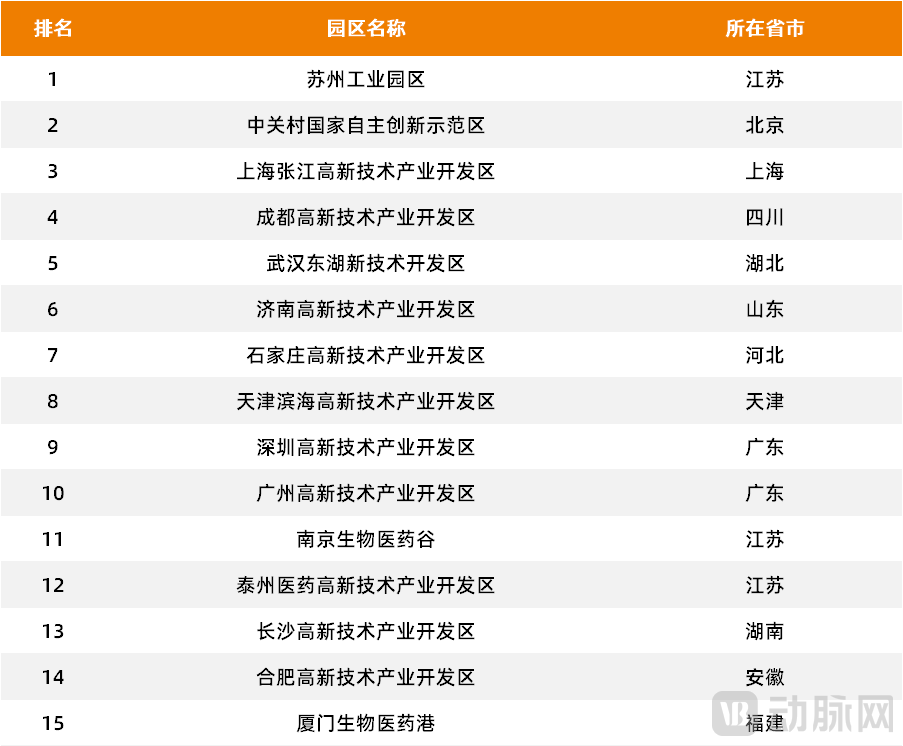 Top 15 National Biopharmaceutical Industrial Parks by Comprehensive Competitiveness in 2020, Data Source: Yuanquhui
It is certainly positive that local governments are “venturing into” the biopharmaceutical industry, but much like entrepreneurship, success is often limited to a few. According to the Blue Book of China’s Health Industry (2020 Edition),By 2020, the number of biomedical industrial parks in China had reached 640., but so far, the only ones that have truly emerged areSuzhou BioBAY, Shanghai Zhangjiang Hi-Tech Park, Beijing Zhongguancun, Wuhan Optics Valley Biocity, Chengdu High-Tech Industrial Development ZoneApart from a handful of outstanding exceptions, the majority remain largely "unknown."
But this is, in fact, an unavoidable reality. For industrial parks, enterprises are the lifeblood; however,The number of high-quality enterprises is extremely limited., so competition is necessary, which follows the same logic as corporate recruitment.
In addition,It is also difficult for high-quality enterprises to cover every industrial park.. It is evident that many local governments have demonstrated ample “sincerity” in attracting high-quality enterprises, yet the actual outcomes have been less than ideal. This is not because these high-quality enterprises are “unappreciative of the favors offered”; rather, the most fundamental reason lies in theseHigh-quality enterprises will conduct a cost-benefit analysis to determine whether establishing operations in the industrial park can truly bring substantive benefits to their business or development.
This is entirely understandable. After all, once a company establishes its presence in a particular location, it must inevitably invest significant human resources and effort, entailing substantial costs. If the returns are not commensurate with these investments, it would actually hinder the company’s development. Naturally, companies will not engage in such counterproductive ventures where the costs outweigh the benefits. In addition, when companies settle in industrial parks, there will also be"Assessment Indicators", which undoubtedly places greater pressure on enterprises.
If high-quality enterprises cannot be attracted, local governments have no choice but to “cultivate them personally.”In recent years, local governments have begun to focus more on early-stage projects, primarily throughEstablish talent acquisition mechanisms, launch early-stage project funds, and build innovation project incubatorsand other means, deeply engage in medical innovation initiatives, with a strong focus on the introduction and incubation of early-stage projects.
WithSuzhou BioBAYas an example. To discover more innovative elements, BioBAY has equipped itself with"Two Legs". Among them, "one leg" refers to BioBAY'sWalking alongside the world’s leading scientists, such as the landmark buildings within the park—Cold Spring Harbor Asia Conference Center, this is an academic conference platform led by global Nobel laureates, hosting at least 12 sessions annually in BioBAY, and attracting Nobel laureates and the most prominent Chinese scientists to Suzhou.
In addition, “one leg” refers to BioBAY’s continuousActively recruit more senior technical or managerial talent with years of hands-on experience in the biopharmaceutical industry., these are the key individuals who can truly drive the implementation of innovative projects.
Whether it is global high-tech industry clustersSilicon Valley, but also a domestic hub for innovationSuzhou BioBAY, the development and growth of these industrial clusters have not relied on “introduction,” but rather on continuously tapping into innovation potential within the industry and establishing a robust service ecosystem to facilitate the successful launch of more high-value early-stage projects.
This also aligns with the fundamental development logic of industrial parks. Only after a high-quality enterprise has been independently incubated can the park attract more outstanding companies to settle in. It is only under such a healthy and sustainable growth model that industrial parks can achieve faster development and truly completeThe Identity Shift from “Seeking Companies” to “Selecting Companies.”
100 Interviewees and a New “Idea”
Translating scientific research achievements in the medical field may seem like a solitary endeavor, but in essence, it heavily emphasizes “team collaboration.”Every link in the innovation ecosystem must be deeply engaged.. Only in this way can we have the strength to overcome every difficulty in the process of innovation and transformation, and truly benefit all parties involved.
But how should these stakeholders exert their efforts? What are the endogenous drivers propelling them forward?
To clarify the underlying logic, we interviewed 100 relevant stakeholders for this article, including9 medical professors, 17 clinicians, 23 corporate founders, 41 investors, and 10 heads of industrial parks, as deep participants in the innovation ecosystem, they are inevitably poised to become the backbone of China’s medical innovation endeavors in the future.
But how can this power be amplified? What approach should be adopted to link these innovative elements together in the most efficient manner? Guided by this question, VCBeat has sparked a new"Ideas"——Established"VCBeat Orange Bureau"。
This is a brand-new content platform dedicated to innovation in the healthcare sector. Guided by the principles of exploration, insight, and service, it deeply connects every stakeholder in the innovation industry chain to unlock their innovative potential. With a core focus on addressing real-world needs, the platform is committed to supporting the growth of scientists, ensuring that each link in the ecosystem receives commensurate rewards for their efforts, and facilitating the successful implementation of more valuable healthcare innovation projects in China.
Seven years ago, to support the growth of a cohort of startups, we undertook a meaningful initiative by founding VCBeat. Now, to support the growth of a cohort of scientists, we are embarking on another meaningful endeavor, giving rise to the Artery Orange Fruit Bureau.