

BeiGene: From Triple-Listing Biotech to Emerging Global Pharma Giant?
BeOne
Developer of Molecular Targeted and Immune Anti-Tumor Drugs
In February 2016, BeOne Medicines listed on the NASDAQ, becoming the first Chinese innovative drug company to enter the U.S. stock market. At that time, BeOne Medicines had a total market capitalization of only $720 million (approximately RMB 5 billion) on its first day of trading, raising $147 million.
On December 15, 2021, BeOne Medicines (stock code: 688235) listed on the STAR Market, becoming the first Chinese biotechnology company to be listed in three markets. It raised over RMB 22.2 billion, with a total market capitalization exceeding RMB 200 billion, representing a 40-fold increase in market value within just five years.
With global R&D centers, a team of thousands in research and development as well as sales, substantial R&D investment, a robust pipeline built through both in-house development and strategic licensing, and an active footprint in innovative biotechnologies, this eleven-year-old biotech company has evolved to increasingly resemble the profile of a pharmaceutical giant.
So, has BeOne Medicines truly grown into a pharmaceutical giant?
IPO: A Milestone and a New Beginning
Let us begin by unveiling the story with this year’s major event: the “IPO.”
In February 2016, BeOne Medicines listed on the NASDAQ, becoming the first Chinese biotechnology company to go public on the exchange. Two years later, in August 2018, BeOne Medicines rapidly listed on the Hong Kong Stock Exchange, emerging as one of the first pre-revenue biotechnology companies to be listed on the Main Board of The Stock Exchange of Hong Kong Limited.
BeOne Medicines’ successful listing on the STAR Market also marks it as the first innovative pharmaceutical company to be listed in three markets: U.S. stocks, H-shares, and A-shares.As of the market close on December 15, 2021, BeOne Medicines had a total market capitalization of RMB 214.874 billion, calculated based on its share price on the STAR Market.
Behind these three IPOs, in addition to bringing substantial capital for the development of BeOne Medicines, have there also been some changes in core data and product progress?
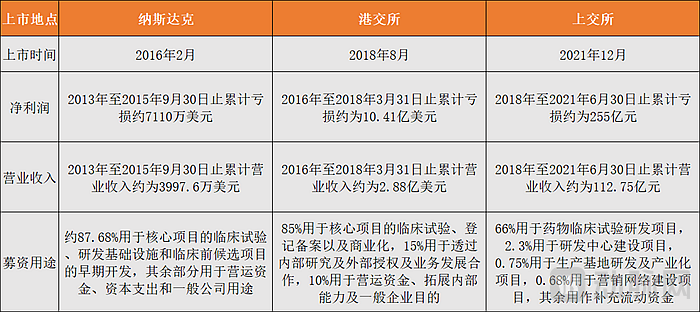
Compiled from the prospectuses of BeOne Medicines’ three public offerings
From a profitability perspective, BeOne Medicines did not achieve profitability during the reporting periods of its three IPOs, and with the increasing number of pipeline projects and the expansion of clinical trial scopes, it is expected to maintain losses for a certain period.
In terms of revenue, BeOne Medicines is experiencing exponential growth as an increasing number of its self-developed and in-licensed pipelines enter the commercialization stage.
In terms of the use of proceeds, the vast majority of funds raised by BeOne Medicines from its three public offerings were allocated to research and development, clinical trials, and commercialization.Of the funds raised in the first two IPOs, 85% or more were allocated to project development and commercialization. In contrast, a portion of the proceeds from this IPO is being used for the construction of manufacturing facilities and the expansion of its marketing network. This demonstrates that, over time, BeOne Medicines has long since transcended the biotech stage and entered the integrated pharma phase encompassing R&D, manufacturing, and sales.
It is evident that BeOne Medicines is steadily “scaling up and strengthening its market position.”
Although BeOne Medicines’ market capitalization of hundreds of billions of yuan still lags many times behind that of current global pharmaceutical giants, its listing on the STAR Market marks another milestone in the company’s growth and serves as a new starting point for further expanding its footprint and advancing toward becoming a global pharmaceutical powerhouse.
Amgen, Hillhouse, and other major institutions have placed significant bets,
Team Synergy and the Shifting Times
Returning to the company itself, BeOne Medicines was founded in 2010 and is a global, commercial-stage biotechnology company focused on the research, development, manufacturing, and commercialization of innovative anticancer drugs.
The founder and Chair of the Scientific Advisory Committee of BeOne Medicines isWang XiaodongXiaodong Wang previously served as an Investigator at the Howard Hughes Medical Institute and as the Distinguished Chair Professor of Biomedical Science at the University of Texas Southwestern Medical Center. In 2003, Dr. Wang was appointed as the first Co-Director and Senior Investigator of the National Institute of Biological Sciences, Beijing, and was designated as its Director in 2010. He was elected a Member of the U.S. National Academy of Sciences in 2004 and a Foreign Member of the Chinese Academy of Sciences in 2013.
Ou LeiqiangJohn V. Oyler is the Co-Founder, Executive Director, Chairman of the Board, and Chief Executive Officer of BeOne Medicines. Mr. Oyler began his career as a management consultant at McKinsey & Company. He has previously served as Chief Executive Officer of Genta (NASDAQ: GNTA) and Galenea, accumulating extensive experience in pharmaceutical company management. Mr. Oyler also founded Telephia, a telecommunications consumer research company (acquired by Nielsen), and BioDuro, a drug development outsourcing company (acquired by Pharmaceutical).
A scientist who is an academician of both the Chinese Academy of Sciences and the Chinese Academy of Engineering, plus a manager who understands scientists, this is an ideal combination for founding a pharmaceutical company. In 2010, the two joined forces to raise $32 million in startup capital and established BeOne Medicines.
A Chinese biotech company has officially come of age. Over the past decade-plus since its founding, BeOne Medicines has transformed from a newcomer into a pharmaceutical enterprise listed on three stock exchanges, mirroring ten years of intense consolidation and turbulent change in China’s pharmaceutical industry.
In 2010, when BeOne Medicines was founded, China’s pharmaceutical market was dominated by generic drugs, and most anticancer medications relied on imports. At that time, cancer was widely regarded as an incurable disease—a demon that could bankrupt entire families.
In 2016, when BeOne Medicines went public on the NASDAQ, it was precisely the period when China’s innovative pharmaceutical industry began to rapidly take root.We recognize that achieving independent innovation is essential to addressing the affordability and accessibility of medicines. Encouraged by supportive policies and fueled by active capital investment, domestic innovative biopharmaceutical companies have emerged in rapid succession.
Nowadays, innovation is paramount in China’s biopharmaceutical industry. Faced with intense market competition and the imperative of product commercialization and accessibility, biopharmaceutical companies cannot survive without distinct competitive advantages.
In this vibrant and highly competitive landscape, the BeOne Medicines team continues to expand, and the powerful synergy among its members naturally attracts strong, professional investment institutions.
As of June 30, 2021, Amgen, the largest shareholder of BeOne Medicines, held a 20.27% stake. Major institutions and corporations such as Hillhouse, Baker Bros, and Capital Research also held significant positions.
In addition, several well-known institutions, including the National Social Security Fund, China Insurance Investment Fund (Limited Partnership), Central State-Owned Enterprises Rural Industry Investment Fund Co., Ltd., and the Abu Dhabi Investment Authority, participated in the strategic placement of BeOne Medicines’ IPO on the STAR Market.
A large team and dispersed equity ownership align with the prerequisites for BeOne Medicines to evolve into a major pharmaceutical company in the future.After all, no single individual, company, or regulatory agency can succeed alone in the development of new anti-cancer drugs. The R&D of new drugs is by no means an easy task; only through multi-party coordination and diversified integration can acceleration be achieved.
Over 100 pipeline assets,
Over 20 Billion Yuan Burned in 3.5 Years
Under Diversified Integration and Coordination, BeOne MedicinesIt has gradually evolved into a fully integrated global biotechnology company with capabilities in early-stage drug discovery, clinical research, high-quality large-scale drug manufacturing, and science-driven commercialization.
BeOne Medicines’ core internal capabilities include independent R&D, global clinical development and operations, commercial platforms established in China and the United States—the world’s two largest pharmaceutical markets—and high-quality manufacturing capabilities at a globally advanced level.
It is worth noting that innovation and research and development (R&D) are the engines and core competencies driving BeOne Medicines’ long-term growth, and remain a key focus of its sustained investment.
In terms of product portfolio strategyBeOne Medicines currently has a pipeline of over 100 assets, including more than 50 ongoing preclinical projects and 48 commercialized products and clinical-stage drug candidates, among which several are research programs with the potential to become first-in-class therapies.
Currently, BeOne Medicines has 11 self-developed drugs in clinical trials or commercialization stages, including three products approved for market launch and eight clinical-stage candidate drugs, with favorable clinical data reported.
Three Self-Developed Products Approved for Market LaunchIt has entered the markets of multiple countries, including the United States, China, Canada, the United Arab Emirates, Israel, Chile, Brazil, Singapore, Australia, Russia, and France, covering more than 10 indications.
First is BeOne Medicines’ star product, Brukinsa (zanubrutinib capsules), a small-molecule Bruton’s tyrosine kinase (BTK) inhibitor. It is the first independently developed anti-cancer drug in China to receive U.S. FDA approval and the first to be granted Breakthrough Therapy designation.
Brukinsa has submitted more than 20 new drug and new indication marketing applications in over 40 countries and regions, including China, the United States, and the European Union.
In the Chinese market, Brukinsa’s three conditionally approved indications—adult mantle cell lymphoma (MCL), adult chronic lymphocytic leukemia (CLL)/small lymphocytic lymphoma (SLL), and adult Waldenström’s macroglobulinemia (WM)—have been included in the National Reimbursement Drug List. It is the only domestically produced BTK inhibitor with three approved indications, outpacing other domestic competitors. This facilitates hospital access, improves patient accessibility, and drives rapid sales volume growth.
In the U.S. market, Brukinsa is the third BTK inhibitor to be launched and marketed. Early market data have shown that more than two-thirds of new patients choose second-generation BTK inhibitors. Meanwhile, compared with IMBRUVICA and CALQUENCE, Brukinsa has a significant price advantage.
Next is the anti-PD-1 monoclonal antibody Baizean (tislelizumab injection), the collaboration between Baizean and Novartis represents the partnership with the highest upfront payment in China’s drug licensing deals to date. Baizean has submitted four new indication marketing applications in China and one in the United States, all of which have been accepted for review.
Next is the PARP inhibitor Baihuize (pamiparib capsules), it is the first poly(ADP-ribose) polymerase (PARP) inhibitor approved in China for the treatment of patients with recurrent ovarian cancer (OC), covering both platinum-sensitive and platinum-resistant cases with germline BRCA mutations.
In addition to its self-developed products, BeOne Medicines’ commercial portfolio includes a variety of third-party licensed drugs, such as Revlimid, Vidaza, and ABRAXANE, authorized by Bristol-Myers Squibb for sale in China, as well as Xgeva, authorized by Amgen for sale in China.
To date, BeOne Medicines has established extensive and in-depth licensing collaborations with companies including Bristol-Myers Squibb, Amgen, Novartis, Mirati, Leap Therapeutics, SpringWorks, Zymeworks, BioAtla, Seagen, EUSA Pharma, Assembly Biosciences, Bio-Thera Solutions, and Denovo Biopharma.
The advancement of numerous projects naturally requires substantial R&D investment.According to the prospectus, BeOne Medicines’ R&D expenses were RMB 4.597 billion, RMB 6.588 billion, RMB 8.943 billion, and RMB 4.151 billion in 2018, 2019, 2020, and the first half of 2021, respectively. Over this three-and-a-half-year period, BeOne Medicines invested a total of RMB 24.279 billion in research and development.
Substantial R&D investments have been fully translated into product progress. As a pharmaceutical company established eleven years ago, BeOne Medicines may still be considered a “youngster” compared to global pharma giants; however, relative to other innovative drug developers, it stands out as a leader, with 11 self-developed products entering clinical trials within ten years, three of which have received regulatory approval.
Bolstered by IPO proceeds, pipeline development will accelerate further. In the next decade, BeOne Medicines will expand beyond three products, experiencing a surge in launches and gradually capturing its market share.
Standing Firm as the Backstop:
R&D engine and dozens of technical platforms, with an R&D team of over 1,000 members
This extensive project pipeline is built upon BeOne Medicines’ comprehensive, proprietary R&D system in tumor biology.
BeOne Medicines has also established a preclinical research division encompassing medicinal chemistry, discovery biology, biologics, and translational sciences. The company possesses a diverse array of drug discovery technology platforms, including a compound screening platform, a small-molecule kinase inhibitor optimization platform, an analytical chemistry research platform, a proteolysis-targeting chimera (PROTAC) technology platform, a bispecific/multispecific antibody discovery platform, a single B-cell antibody screening platform, and an antibody-drug conjugate (ADC) development platform.
The R&D engine seamlessly integrates with manufacturing and clinical development, maximizing the creativity of the R&D platform and providing BeOne Medicines with a new product pipeline.
Certainly, the successful R&D, commercialization, and operation of the pipeline naturally rely on a professional team. Over the past nearly 11 years since its establishment, BeOne Medicines has built an efficient preclinical research team in China and established a global clinical development team across China, the United States, Australia, and Europe.
As of November 4, 2021, BeOne Medicines had more than 2,800 R&D personnel, with over 1,000 based in China and the remainder distributed across countries including the United States, Europe, and Australia. As of September 2021, the company was conducting more than 95 planned or ongoing clinical trials in over 40 countries and regions, including 38 Phase III or potentially registrable clinical trials. The total number of enrolled patients and healthy subjects exceeded 13,000, with nearly half enrolled overseas.

Number of Clinical Trials, Source: Prospectus
As its products continue to launch, BeOne Medicines has also established substantial commercial capabilities in China and the United States. To date, BeOne Medicines’ commercialization team in China comprises more than 3,100 employees, covering over 1,000 hospitals, while its U.S. commercialization team includes more than 150 personnel.
A solid foundation has naturally driven revenue growth for BeOne Medicines. In 2018, 2019, 2020, and the first half of 2021, BeOne Medicines reported operating revenues of RMB 1.31 billion, RMB 2.954 billion, RMB 2.12 billion, and RMB 4.891 billion, respectively. All such revenues were derived from its core business activities, comprising drug sales as well as income from technology licensing and research and development services.
BeOne Medicines’ drug sales revenue comprises revenue from both self-developed products and licensed products. As commercialization activities for BeOne Medicines’ self-developed products expand and sales revenue from licensed products grows, the company’s overall drug sales revenue is expected to trend upward.
With a robust combination of multi-platform capabilities, a diverse product portfolio, cross-functional teams, and secured funding, BeOne Medicines is well-positioned for rapid expansion.
As products continue to be commercialized, production demand will inevitably expand. BeOne Medicines is also strategically positioning itself in this direction, with a portion of the funds raised from this IPO allocated to the construction of manufacturing facilities and the establishment of marketing networks.
In terms of self-owned production and construction, BeOne Medicines has established a comprehensive layout in China and overseas., including the establishment of a multi-functional industrialization base in Suzhou, China, designed in accordance with U.S., EU, and Chinese regulatory standards. The facility covers a total area of over 13,000 square meters and includes a small-molecule drug production base with an annual capacity of approximately 100 million tablets/capsules, as well as a pilot-scale biologics production facility with a 500-liter capacity.
Furthermore, BeOne Medicines is constructing a world-class large-molecule biologics manufacturing facility in Guangzhou, with a total area exceeding 100,000 square meters. In the future, the production capacity of the Guangzhou facility is expected to exceed 120,000 liters, with a maximum capacity of up to 200,000 liters.
Overseas, BeOne Medicines is planning to construct a new facility in Hopewell, New Jersey, USA, encompassing commercial biologics manufacturing, clinical R&D centers, and a pharmacovigilance innovation hub. The facility is expected to be completed by mid-2023.
Rooted in China, Strategized for the Global Market;
Applied Sciences, Going Global
Going forward, we look to BeOne Medicines, as a pioneer among Chinese biotechnology companies in global clinical development and operations, to establish strategic collaborations with leading international pharmaceutical companies and advance the global development and commercialization of its independently developed products through out-licensing.
By leveraging partnerships with pharmaceutical and biotechnology companies, BeOne Medicines introduces external commercial-stage products and drug candidates, thereby continuously enriching its product pipeline and creating complementary advantages alongside its internally developed candidate pipeline.
Leveraging its leading clinical development and commercialization capabilities, as well as strong collaborations with other pharmaceutical and biotechnology companies, BeOne Medicines is well-positioned to capitalize on potential growth opportunities in the Chinese and global markets.
Returning to the question raised at the beginning of this article: with listings in three markets over six years, hundreds of billions invested over three years, eleven projects entering clinical trials and three gaining approval over a decade, and R&D, clinical centers, and teams distributed globally, has BeOne Medicines truly grown into a pharmaceutical giant?
It can only be said that it has begun to take on the shape of a major pharmaceutical company, but there is still some way to go.
With ample funding, it is only a matter of time before BeOne Medicines grows into a global pharmaceutical giant. Clearly, BeOne Medicines has both the capital and the time. We look forward to its breakout growth in the next decade, and even more so to the emergence of a Chinese pharmaceutical giant.