

China's Clinical Trial Landscape: The Explosive Growth Has Just Begun
In late November 2021, Informa Pharma Intelligence, a global provider of pharmaceutical information consulting and conference services, released a white paper titled “The Landscape of Clinical Trials in China,” which highlighted an intriguing set of data.
Since 2016, the number of new clinical trials initiated in China has shown an upward trend annually, with an accelerating growth rate. The total number of Phase I–IV trials launched increased rapidly from 1,785 in 2016 to 3,641 in 2020. During this period, the annual growth rate fluctuated significantly, slowing from over 30% in 2017 and 2018 to single-digit figures in 2019 and 2020. The compound annual growth rate (CAGR) over these five years was 20%, marking a substantial increase compared to the 12% CAGR observed from 2007 to 2016.
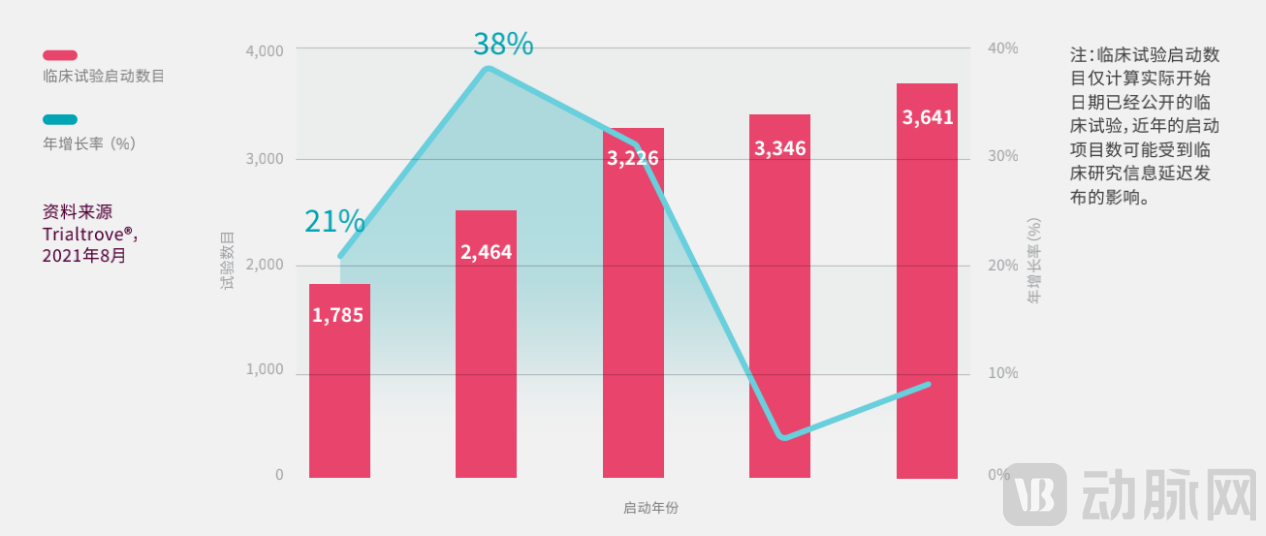
Phase I–IV Clinical Trials Initiated in China from 2016 to 2020 (Data Source: “Landscape of Clinical Trials in China”)
For a long time, Europe and the United States, home to numerous century-old pharmaceutical companies, have been the primary locations for clinical trials. However, since the 21st century, the number of clinical trials in China has shown a year-on-year increase, tripling from 2007 to 2016. In other words, China’s pharmaceutical industry is rising at an unimaginable pace.
What are the drivers behind the rapid growth? What is its significance? What changes lie ahead for China’s clinical trial landscape? In a recent webinar, Informa delved into two white papers it released: “The Landscape of Clinical Trials in China” and “2020 Clinical Trial Overview: The Impact on the Trial Landscape.” Through this exploration, we may uncover more hidden insights behind the data.
2016–2020 was not only a five-year period of rapid economic growth in China, but also a boom period for the Chinese clinical trial market, with the industry referring to this time as the “golden age” of clinical trial development.
During this period, China first joined the ICH (International Council for Harmonisation of Technical Requirements for Pharmaceuticals for Human Use), strengthening collaboration with leading international institutions in clinical trials. Subsequently, with support from the State Council, a series of policies were introduced to deepen pharmaceutical reforms and encourage innovation, including the “Opinions of the State Council on Reforming the Review and Approval System for Drugs and Medical Devices” and the “Administrative Provisions for Drug Clinical Trial Institutions.” Furthermore, there was a surge in innovative drug development, leading to a sharp increase in demand for clinical trials. All these factors have collectively driven profound structural reforms on both the supply and demand sides of China’s clinical trial market.
The white paper provides more detailed evidence with data: the number of clinical studies initiated in China increased significantly between 2016 and 2020, coinciding with the period when the then China Food and Drug Administration (CFDA), later renamed the National Medical Products Administration (NMPA), began implementing large-scale reforms.
According to Dr. Zhou Shuhua, Senior Manager at Informa Pharma Intelligence, the National Medical Products Administration (NMPA) has implemented a series of measures to ensure the authenticity, reliability, and integrity of clinical trial data, enhance regulatory transparency, and encourage the research and development (R&D) of innovative drugs, thereby attracting multinational corporations (MNCs) to conduct international multi-center clinical trials in China. These efforts are underpinned by robust compliance oversight, Good Clinical Practice (GCP) standards for drug clinical trials, and high-quality data. This reform has ushered in a new era for clinical research in China and driven a transformation in the domestic pharmaceutical industry, shifting from a primary focus on the production of generic drugs and active pharmaceutical ingredients (APIs) to a high-tech R&D model. Many companies have begun developing innovative drugs and biologics, gradually establishing China as a hub for the creation of novel therapeutics.
Overall, the dual drivers of policy and demand are propelling China’s clinical trial sector forward. Coupled with continuous optimization and improvement in regulatory frameworks, clinical trial processes, and data management practices, the value domestic enterprises derive from clinical trials is rising year by year, thereby driving rapid growth in China’s clinical trial market.
Bioequivalence (BE) studies are another key factor driving the increase in clinical trials. Over the past five years, the number of BE trials has more than tripled, primarily due to the implementation of China’s policy on quality and efficacy consistency evaluation for generic drugs. As consistency evaluation is linked with volume-based procurement (VBP), and VBP has become the new norm, the number of BE trials is expected to continue growing.
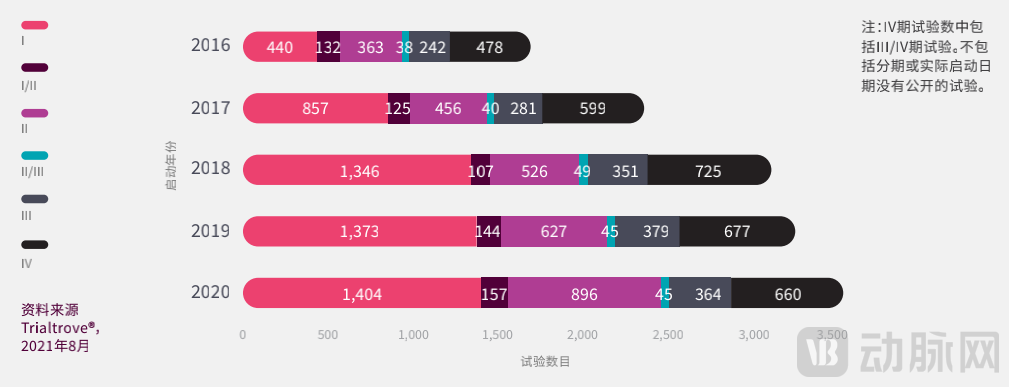
Phases of Clinical Trials Initiated from 2016 to 2020 (Data Source: "Landscape of Clinical Trials in China")
Even after excluding the impact of Phase I bioequivalence (BE) studies, focusing solely on Phase I clinical trials for new drugs still reveals substantial growth, with an overall increase of 136%. Notably, the number of Phase I trials (non-BE) sponsored by Chinese pharmaceutical companies surged by 156%, reflecting the industry’s shift toward innovative drug development.
In terms of therapeutic areas, data from Trialtrove’s analysis report on the primary therapeutic areas (TAs) of clinical trials initiated in China (2016–2020) show that China significantly leads in the number of oncology clinical trials, accounting for 40% of all trials (grouped by TA), compared to 27% in non-China regions.
Cardiovascular disease is another major therapeutic area of focus in China, with related trials accounting for 13% of the total, slightly higher than the 9% observed in non-Chinese regions.
In other therapeutic areas, such as infectious diseases, metabolism/endocrinology, and autoimmunity/inflammation, China’s figures are on par with or slightly lower than those in non-Chinese regions. The most significant gap lies in the central nervous system (CNS) therapeutic area, where the ratio of China to non-China is 12% to 20%. The white paper suggests that this discrepancy may be attributed to the currently smaller market for related drugs in China. However, as China places greater emphasis on the prevention and treatment of neurodegenerative diseases such as Alzheimer’s disease and Parkinson’s disease, subsequent clinical trials are likely to increase alongside policy changes.
A careful analysis of anticancer drugs under development in China reveals a substantial number of tumor immunotherapies in the pipeline. Between 2016 and 2020, the number of clinical trials for PD-1/PD-L1 targeted therapies was also striking, accounting for 20% of all oncology trials. Such excessive competition may not be beneficial.
The white paper posits that, given the relatively high prices of imported drugs in China such as Keytruda (pembrolizumab) and Opdivo (nivolumab), Chinese pharmaceutical companies are seizing the opportunity to develop novel PD-1 inhibitors with competitive pricing advantages.
In August 2021, the fifth domestically developed PD-1/PD-L1 inhibitor was approved in China; it remains uncertain how many additional competing products will gain marketing approval.
The “Black Swan” COVID-19 pandemic swept across the globe, exerting a disruptive impact on the landscape of global clinical trials. Impeded patient recruitment and suspended trials have eroded trial data and compromised trial integrity… Global participation in clinical trials has largely fluctuated in tandem with the trajectory of the pandemic, while also being constrained by factors such as economic conditions and healthcare resource availability.
Another white paper from Informa Pharma Intelligence, “2020 Clinical Trials Review: Impact on the Trial Landscape,” describes changes in clinical trial data during the COVID-19 pandemic. Although the global clinical trial sector faced significant challenges due to the pandemic, Phase I–III trials increased by 26% year-on-year as of June 14, 2021. However, the majority of these were trials evaluating COVID-19 treatments and preventive interventions; the number of non-COVID-19 trials declined until showing a slight increase toward the end of 2020.
Based on full-year data, cancer remains a key focus for the industry. In 2020, the only other therapeutic area (TA) to experience growth was cardiovascular disease, which increased by 12%. The number of trials in all other TAs decreased by 3–8%.
During this test, the number of clinical trials in China approached that of the United States, with the gap narrowing significantly compared to 2019. Explaining the underlying reasons, Dr. Annie Siu, Asia-Pacific Content Director at Informa Pharma Intelligence MBA, stated at the conference: “China’s effective management of the pandemic helped its economic and social life return to normal rapidly, thereby effectively promoting pharmaceutical companies to conduct clinical trials in therapeutic areas (TAs) such as cardiovascular diseases and oncology. Furthermore, although China did not have a large number of COVID-19 patients, its collaborative model with other countries enabled it to rank among the leaders in the number of infectious disease clinical trials, yielding a series of COVID-19-related achievements, including drugs and vaccines.”
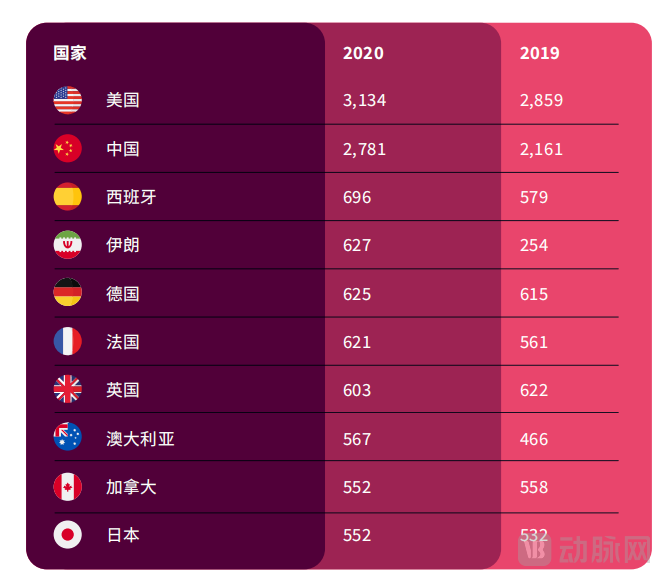 Number of Clinical Trials Conducted by Country (Data Source: "2020 Overview of Clinical Trials: The Impact on the Trial Landscape")
Over the past five years, the majority of clinical trials conducted in China have been sponsored by companies headquartered in China. The white paper shows that eight of the top ten sponsors are Chinese pharmaceutical companies, indicating that Chinese pharmaceutical firms are placing increasing emphasis on clinical trials.
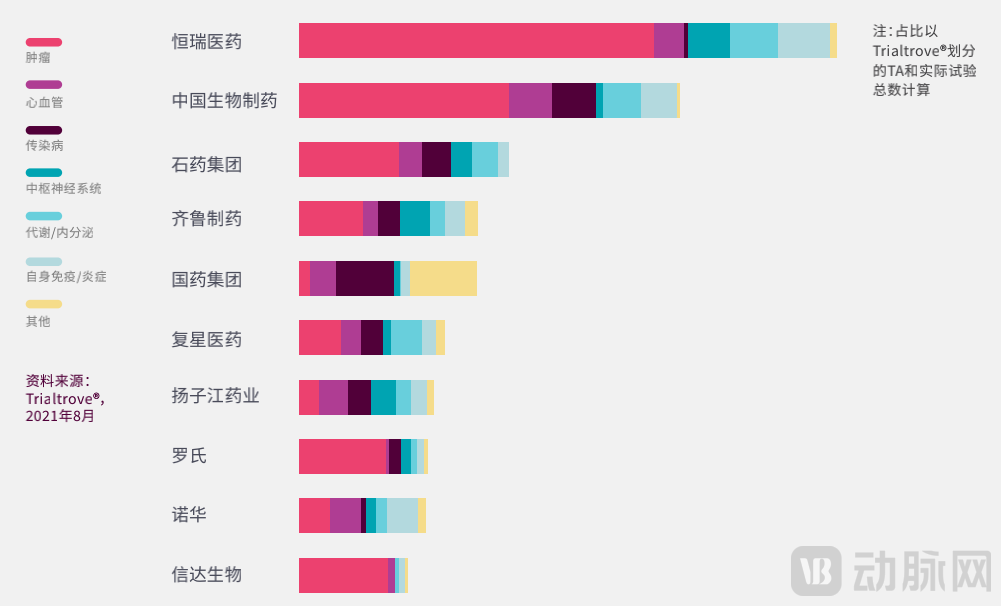
Therapeutic Areas of Clinical Trials Sponsored by the Top 10 Sponsors in China, 2016–2020(Image Source:"The Landscape of Clinical Trials in China")
Meanwhile, Chinese pharmaceutical companies are continuously strengthening their efforts by following the upgrade path of “imitation–follow–surpass,” accelerating their transformation from a major producer of generic drugs to a leading innovator in novel therapeutics, thereby steadily enhancing their competitiveness in the international market.
Although Chinese pharmaceutical companies currently lag behind the industry giants, with the maturation of domestic technologies and robust support from extensive clinical data, it may only be a matter of time before they catch up with these global leaders and take their place on the international stage.
However, in this sector characterized by high barriers to entry, long development cycles, and substantial R&D costs, as China’s pharmaceutical innovation enters a more complex and challenging phase, the market will impose higher and more nuanced evaluation criteria on latecomers. Chinese pharmaceutical companies must carefully address details such as efficacy, safety, and pricing.
The challenges accompanying entry into the global market are equally evident. The external environment is complex and volatile; overseas clinical trials are not only several times more expensive than domestic ones, but also significantly more difficult to conduct. For instance, since participants in clinical trials conducted in China are generally drawn from the domestic population, foreign regulatory authorities may require data such as racial sensitivity analyses during their review process. The white paper predicts that an increasing number of Chinese pharmaceutical companies will independently conduct multi-regional clinical trials (MRCTs) or collaborate with overseas partners to carry out global clinical trials.
So, when will China catch up with the pharmaceutical giants and take its place on the international stage?
So, based on the analysis of this update, has this prediction become a reality? The white paper’s answer is “partially realized.”
Data show that the number of newly initiated clinical trials in China grew rapidly between 2016 and 2020, with an average annual growth rate of up to 20%. Although the growth rate appears to have slowed somewhat recently, the total number of trials initiated remains at a historic high.
Analysis of Trialtrove’s global data further reveals that the proportion of clinical trials conducted in China doubled over the past five years, rising from 13% of the global total in 2016 to 26% in 2020, although the growth rate has begun to slow this year. Compared with other major regions, China has managed the COVID-19 pandemic effectively, avoiding prolonged disruptions to social activities. As a result, China has entered a “post-pandemic normalization” phase earlier, which is expected to facilitate the conduct of clinical trials.
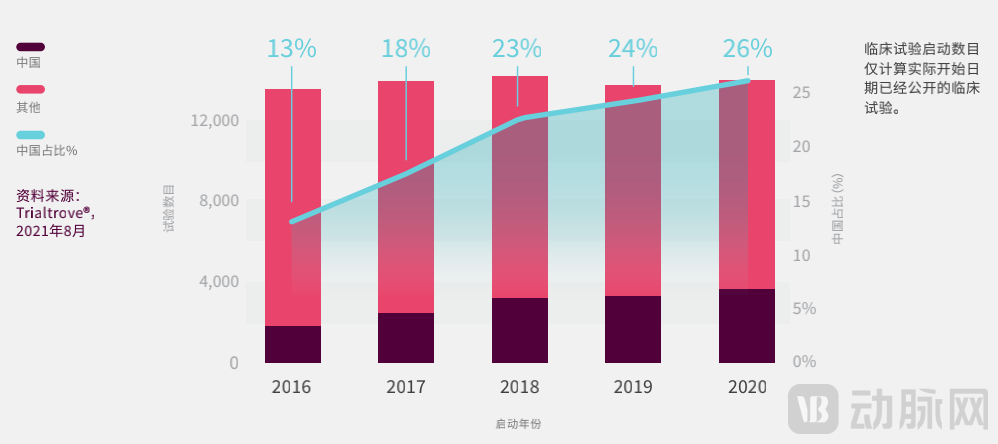
Growth in China’s Share of Global Clinical Trial Volume, 2016–2020(Image Source:"The Landscape of Clinical Trials in China")
If the Chinese pharmaceutical market continues to grow as expected, China’s clinical and regulatory environment will become increasingly attractive to both Chinese pharmaceutical companies and multinational corporations (MNCs). Although the growth rate has slowed, China’s share of global clinical trials is expected to further increase over the next three years. Moreover, China itself will emerge as an indispensable force in the global biopharmaceutical landscape.