

Who Will Pay for Orphan Drug R&D? Spotlight on Nusinersen and the Economics of Rare Disease Therapeutics
Following the national medical insurance negotiations, known as"Orphan Drugs"Nusinersen sodium injection became an overnight sensation.
Two factors contributed to its “viral popularity”: one was joy, and the other was surprise. The “joy” stemmed from the fact that nusinersen sodium, a prohibitively expensive drug priced at RMB 700,000 per injection, finally became affordably priced after being included in China’s national medical insurance system. This willBringing Hope for Life to More People。
On the other hand, the inclusion of rare disease drugs such as nusinersen sodium signifies that the long-standing calls from various stakeholders to incorporate high-cost rare disease medications into the national medical insurance scheme have been realized.Breakthrough from Zero, which sends a positive signal for more rare disease drugs to be included in the national medical insurance system in the future.
"Surprise" is becauseThe price of this drug is actually 700,000 yuan per injection., which has greatly upended public perception of drug pricing, with many netizens even remarking,“The cost of this single injection exceeds my lifetime earnings!”. What is even more suffocating is that,Nusinersen sodium requires lifelong medication., with six injections in the first year, followed by one injection every four months thereafter; the treatment is effective only when administered and loses efficacy if discontinued.
This is truly cruel for patients and their families. On one side are exorbitant medical costs; on the other, death within reach. Amidst this profound imbalance, a particular emotion begins to emerge, namelyHostility Toward Pharmaceutical Companies, and so we saw top-rated comments such as these:“With such high pricing, how much profit do pharmaceutical companies actually intend to make? Can’t they consider the patients’ perspective?” “If such a substantial price reduction is still acceptable, it proves that pharmaceutical companies remain profitable; they must have been earning exorbitant profits before!” “Aren’t drugs developed for patient use? With prices set so high, who can afford them? Pharmaceutical companies are truly making money in bad conscience.”
But is that really the case? Yes, but not entirely.
“Orphan Drugs”: A Thankless and Laborious Endeavor
How to define “orphan drugs”? The authorities have provided three keywords, namelySmall Patient Population, Limited Market DemandandHigh R&D Costs, do not underestimate these three words, as they almost fully capture the hardships of orphan drug development.
As is well known, new drug development is a labor-intensive endeavor; in addition to core technologies, it also requiresSufficient Time and Capital. According to current research findings, the R&D cost of a “First-in-class” new drug (including the average cost of failed R&D pipelines) is approximatelyBetween $1 billion and $2 billion。
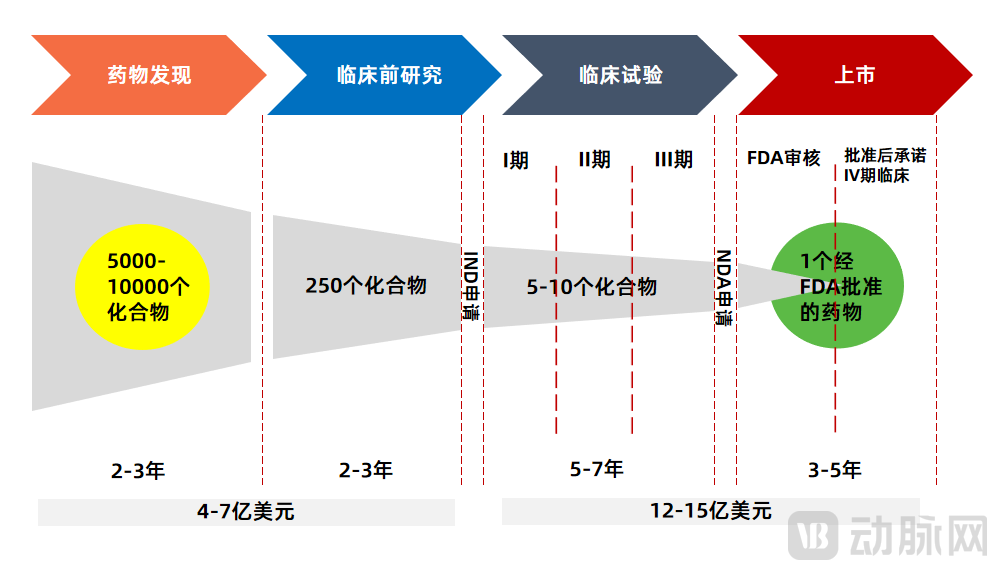
“Nine Deaths, One Life”: The Drug R&D Phase, Mapped by VCBeat
In terms of R&D timeline, it typically takes 10 to 15 years, primarily undergoingDrug Discovery, Preclinical Research, Clinical Trials, Market LaunchFour Key Stages. Among Them, the Third Stage"Clinical Trials"It is the most time-consuming, generally taking 5 to 7 years.
This scenario assumes the successful development of the drug; if it fails, all efforts will come to naught. According to statistical data, the average success rates for Phase I, II, and III clinical trials in global new drug development are 63.2%, 30.7%, and 58.1%, respectively. Based on these figures,From Phase I to market launch, the success rate of clinical trials for innovative drugs is less than 10%.
If innovative drugs face such challenges, the development of “orphan drugs,” which are already less favored, will be even more difficult.
First, from a technical standpoint, clinical research and patient enrollment for “orphan drugs” face significant challenges.Patient data serves as the foundation for targeted disease research; however, orphan drugs face significant constraints in this regard. On one hand, research into therapeutic targets is hindered by an inadequate understanding of the pathogenesis of rare diseases and insufficient sample sizes, leading to prolonged clinical trials and considerable challenges in defining trial endpoints. On the other hand, the small patient population makes recruitment and enrollment for clinical trials particularly difficult.
These “stringent requirements” nearly extinguished researchers’ enthusiasm for orphan drugs at the very outset. A medical professor revealed to VCBeat’s Orange Bureau,“Physicians are fundamentally unwilling to participate in research on orphan drugs, as they may encounter only one or two such patients per year. The clinical data are simply insufficient to support meaningful research; it is a more prudent use of their time to focus on cancer or other conditions with greater funding.”
Secondly, in terms of investment, the protracted timeline and substantial costs are sufficient to deter many individuals.“Orphan drugs” incur higher overall development costs than conventional innovative drugs due to factors such as small patient populations, limited research data, difficulties in recruiting trial participants, and complex disease mechanisms.
The “miracle drug” for leukemia featured in the film *Dying to Survive*Gleevecas an example,Novartis PharmaceuticalsIt took a full 41 years and a total investment of $1.4 billion to achieve successful development; another example is the exorbitantly priced drugs that have just been included in the national medical insurance coverage.Nusinersen Sodium, this drug is manufactured by a U.S. pharmaceutical companyBiogenDeveloped over more than a decade at a cost of over ten billion U.S. dollars.
Finally, in terms of returns, the patent protection period imposes a time limit on pharmaceutical companies' profitability.. For pharmaceutical companies,When developing an orphan drug, don’t even think about making a profit; it’s hard enough to recoup costs.On one hand, there is the issue of pricing: if set too low, costs cannot be recovered; if set too high, it becomes difficult to find payers, easily leading to disputes. On the other hand, there is the issue of market size: the number of patients with rare diseases is limited, and due to the high cost of medications, very few can actually afford them without a robust payment system.
However, the most critical issue remains the patent protection period.If it were possible to lock in all current and future patients to use only the drugs developed by this pharmaceutical company, recouping the costs would merely be a matter of time. However,Once the patent has been disclosed and the protection period expires, other pharmaceutical companies can freely leverage this innovation and rapidly capture market share by offering lower prices.. By that time, originator pharmaceutical companies will have no competitiveness, and their revenues will inevitably experience a “cliff-like” decline.
Therefore, to some extent,Developing “orphan drugs” is truly a thankless task.On one hand, pharmaceutical companies expend considerable effort on undertaking tasks that others are unwilling to pursue, which in itself poses a significant challenge. On the other hand, after achieving success, they must strike a balance in the market: if pricing is set too high, they risk being labeled as “unscrupulous enterprises”; if priced too low, it becomes difficult to recoup costs during the patent protection period, ultimately resulting in losses despite generating market buzz.
“Orphan Drugs” Need Positive Incentives
Developing orphan drugs is challenging, making it even more crucial for stakeholders to step forward.
However, at this point, we should maintain a rational understanding:Pharmaceutical companies are not charities; they need to be profitable., because only in this way can they sustain the normal development of their enterprises and devote more energy to innovation,After all, no “orphan drug” falls from the sky; rather, it is the result of substantial R&D costs and time invested by pharmaceutical companies.。
Therefore, the challenge we currently need to address is how to encourage more pharmaceutical companies to “step up” and develop “orphan drugs.”
In recent years, with continuous technological advancements and an improved overall R&D environment, a growing number of pharmaceutical companies worldwide have begun to invest in the development of “orphan drugs.”
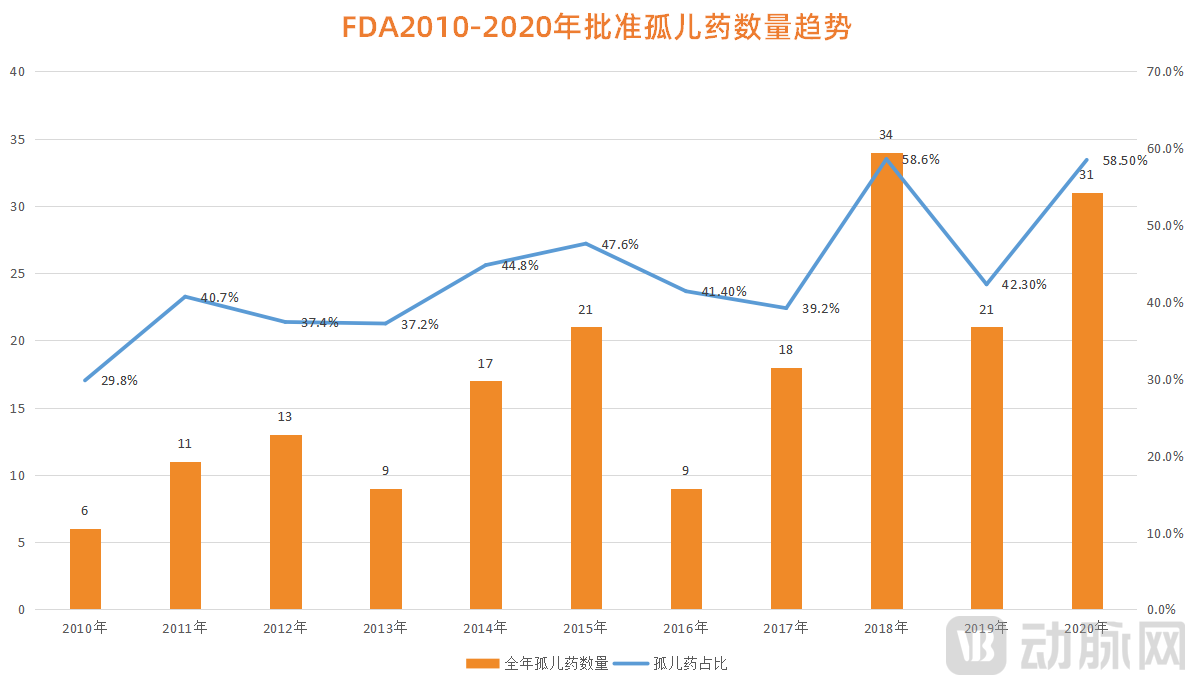
Data source: FDA; graphic by VCBeat Orange Bureau
This has been validated by new drugs approved by the U.S. Food and Drug Administration (FDA). Statistics show that the number of “orphan drugs” approved by the FDA exhibited a steady upward trend from 2010 to 2020. In 2010, the FDA approved only six orphan drugs, a figure that rose to 34 by 2018.In 2020, the FDA approved 31 orphan drugs, accounting for 58.5% of all new drugs approved that year, marking a ten-year high.
In addition to the surge in quantity, R&D success rates are also rising rapidly.. According to a recently released report on the success rates of clinical drug development, from 2011 to 2020,The average success rate for orphan drugs (excluding oncology indications) from Phase I clinical trials to U.S. FDA approval is 17%., which is higher than the overall average drug development success rate of 7.9%.
But these joys belong to others, because so far,China’s R&D achievements in “orphan drugs” are virtually nonexistent.。
There are many and complex reasons for this, such asTechnical challenges, R&D costs, drug approval, patent protection, market pricing, and drug reimbursementWait, these pain points have gradually converged over time into a combined force, tying a “dead knot” in China’s orphan drug market.
However, this does not mean that there are no solutions.The most effective way to promote the research and development of orphan drugs is to establish a mature and effective incentive policy framework.。
Take the United States as an example. Prior to 1983, there were only 38 orphan drugs marketed in the United States, but since 1983“Orphan Drug Act”Since its enactment, more than 500 orphan drugs have been newly approved for market launch.《Orphan Drug Act》The promulgation of the Act has injected new vitality and vigor into the previously stagnant field of orphan drug research and development in the United States.
Why has the “Orphan Drug Act” been so effective? This is primarily attributable to the four major economic incentives included in the act.
First, once an orphan drug receives FDA designation, it canObtain 7 years of market exclusivityDuring this seven-year period, the FDA will not approve any new drug for the same indication unless it is proven to be more effective than the previously approved one. In the absence of competitors and under a monopoly position, pharmaceutical companies can reap substantial economic returns; this exclusivity is regarded as the most powerful incentive.
The other three are respectivelySpecial tax and fee incentives for orphan drugs, development grants and research funding for orphan drug companies, and FDA consultation and assistance for clinical trials. These measures not only reduce R&D costs for pharmaceutical companies but also address various challenges encountered during the R&D process, significantly improving the success rate of drug development.
A senior executive at a domestic pharmaceutical company told VCBeat in an interview, “It is not that we are unwilling to develop orphan drugs; rather, the main challenges lie in the significant difficulties of conducting clinical trials and the high costs involved,”Without financial and policy support, no enterprise would have the courage or capability to undertake such initiatives.。”
This is entirely understandable. After all, pharmaceutical companies ultimately need to be profitable. No matter how much humanistic care they demonstrate, they cannot rely solely on altruism (“powering operations with love”) in the face of immense financial pressure; relying exclusively on sentiment is simply not sustainable.
From another perspective,The positive development of any entity requires the establishment of a balanced system., if one party bears too much or too little weight, collaboration becomes difficult to sustain. Therefore, in the research and development of orphan drugs,Pharmaceutical companies should not be subjected to one-sided hostility, but rather require genuine incentives.。
We Cannot Rely on Imports for “Orphan Drugs” Forever
Currently, China’s orphan drugs rely heavily on imports, but this is not a sustainable long-term strategy.
On the one hand, in the pharmaceutical and medical field,No Core Technology Means No Say, patients with “rare diseases” in China are in a highly passive position; on the other hand, the number of patients with “rare diseases” in our country is surging, as data show,China currently has approximately 20 million patients with rare diseases, 50% of whom are children, with over 200,000 new cases diagnosed each year.。
Therefore, we need to achieve “domestic substitution” for “orphan drugs.” Toward this goal, some positive signals are emerging.
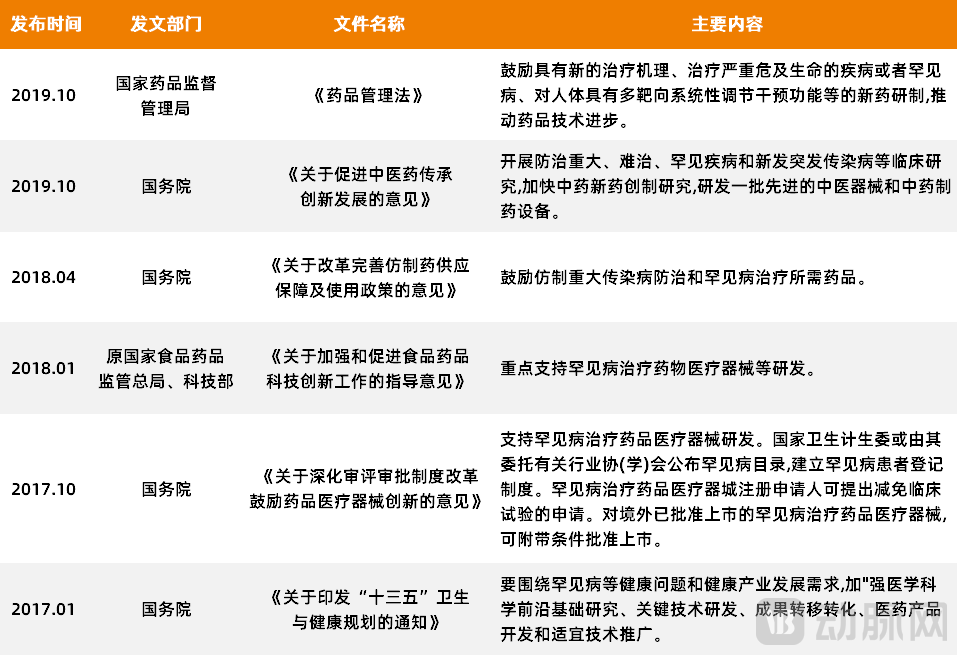
First, on the policy front, relevant government departments have introduced a series of favorable policies for "orphan diseases," includingOptimizing Review and Approval Processes, Clinical Trial Data, and Intellectual Property ProtectionThe implementation of these and other policies has not only cleared regulatory hurdles for domestic pharmaceutical companies but also bolstered their confidence in increasing R&D investment in orphan drugs.
Secondly, on the payment side, the coverage options available to patients with “orphan diseases” are becoming increasingly diversified. In the recently concluded national medical insurance negotiations,Seven orphan disease drugs have been included in the National Reimbursement Drug List. It is particularly worth mentioning that,This Marks the First Inclusion of High-Cost “Orphan Drugs” in China’s National Medical Insurance System。
In addition,Localities are also actively exploring different coverage models for "orphan diseases"Including products such as “Huirongbao” and “Suisuikang,” many regions have successively launched “Huiminbao,” a type of inclusive commercial supplementary medical insurance, which covers medications for certain rare diseases, thereby providing a degree of protection for patients with rare diseases.
Finally, on the enterprise side, Currently, the market has seen the emergence of companies such asCanHelp Biologics, InnoCare Pharma, Beijing Kexin BichengState-owned R&D enterprises focusing on orphan drugs, among which are the pioneers of orphan drugs in ChinaCanbridgeIts listing on the Hong Kong Stock Exchange on December 10 this year has demonstrated to pharmaceutical companies and investors alike a viable pathway and promising market prospects for orphan drug development in China.
According to the data, China“Orphan Drug” Market Size Expected to Surpass $10 Billion Within 5 to 10 Years, this is undoubtedly a vast blue-ocean market. However, to successfully capitalize on it, every participant in this innovation ecosystem must contribute. Pharmaceutical companies, as the originators of innovation, should shoulder greater responsibility while also receiving returns commensurate with their efforts—a win-win outcome.
Only in this way can more orphan drugs be brought to market, offering hope for survival to more people and truly realizing the commitment to “leave no small population behind.”