

How to Break Through the IVD Industry's Intense Competition? A Deep Dive into Kaypu Bio's Differentiation Strategy

Hybribio
Developer, Manufacturer, and Distributor of Nucleic Acid Molecular Diagnostic Products
Chaozhou is the easternmost city in Guangdong Province, bordering Fujian. Chaozhou people are adept at business, and the warmth and sincerity characteristic of the Chaoshan people tend to inspire favorable impressions.
In mid-December, Chaozhou had not yet entered meteorological winter. On the 12th floor of Hybribio’s headquarters in Chaozhou, a grand conference on the biotechnology industry chain was held, bringing together star enterprises and investment institutions specializing in cutting-edge clinical diagnostic technologies such as clinical mass spectrometry, NGS, and digital PCR. The company aimed to make a significant impact in the domestic IVD industry at a time when competition had become most intense.
Hybribio was founded in 2003, building its foundation on a patented technology transferred from the University of Hong Kong. Although it has broken the monopoly held by European and American companies with its proprietary HPV genotyping assays and captured a substantial share of the domestic market, it only truly entered the public spotlight and attracted significant market attention during the COVID-19 pandemic. While its role in the fight against the epidemic will undoubtedly be a prominent chapter in its history, the twists and turns of Hybribio’s corporate journey had long been foreshadowed.
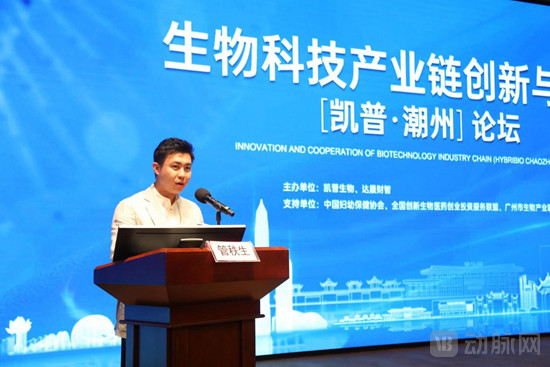
Guan Zhisheng, Director and Deputy General Manager of Hybribio
At the Forum on Innovation and Cooperation in the Biotechnology Industry Chain, Guan Zhisheng, Director and Deputy General Manager of Hybribio, shared his visions for the future. From rapidly detecting the SARS virus within just 15 minutes using its flow-through hybridization technology platform in 2003, to developing a nucleic acid test kit for the novel coronavirus in only nine days in early 2020, Hybribio has been among the few companies capable of maintaining steadiness and adaptability in the face of major epidemics. Such resilience often leads to unexpected commercial success born out of crisis. This pattern was evident in the booming growth of mobile internet enterprises in the aftermath of the SARS outbreak, and similarly observed in the rapid scale-up of in vitro diagnostics (IVD) companies during the COVID-19 pandemic.
In a sense, the COVID-19 pandemic accelerated the maturation of China’s in vitro diagnostics (IVD) industry. Although Hybribio has set its sights on becoming the leading player in molecular diagnostics in China, it appears to have stayed out of the fierce competition characterized by mergers and acquisitions and talent poaching, opting instead for a different strategy. As of press time, 27 of the 50 medical testing laboratories planned by Hybribio across China have officially begun operations, a number that exceeds that of some established third-party independent clinical testing institutions. While aggressively expanding its network of medical testing labs, Hybribio has also invested in companies such as Ameson and Youzhe Technology, gradually making early-stage investments in biotech startups. It may be premature to call this a transformation, but thanks to the robust cash flow generated during the pandemic, Hybribio has clearly directed its capital toward areas with less speculative bubble.
Hybribio is a pioneer in HPV molecular diagnostics for cervical cancer in China.
In 2009, at the 20th International HPV Conference, Hybribio researchers delivered China’s first academic presentation, formally showcasing to the global community the significant advancements brought to the industry by Hybribio’s HPV genotyping technology. This achievement received high praise from TOM BROKER, President of the International HPV Conference, who stated, “For HPV genotyping testing, the world looks to China, and China looks to Hybribio.” Subsequently, Hybribio began promoting the concept of prevention and control of reproductive tract infections among primary care physicians across China, hosting more than 600 training sessions. Meanwhile, Hybribio provided testing support for government-led cervical cancer screening public welfare programs in Guangdong, Qinghai, Shanghai, Shandong, Tianjin, Hunan, and other regions, rapidly capturing a market long dominated by overseas giants.
At that time, cervical cancer screening suffered from significant methodological limitations. The only available options were the conventional Pap smear and cytology testing, along with HPV quantitative detection technologies prevalent in Europe and the United States. However, the former involved time-consuming hybridization processes and was prone to sample contamination, while the latter could not determine HPV genotypes, thereby failing to distinguish between high-risk and low-risk populations among those infected. Consequently, Hybribio’s HPV genotyping test kit rapidly penetrated market segments with unmet needs upon its launch. Nevertheless, for Hybribio, the journey from the inception of HPV genotyping technology to its application in large-scale cervical cancer screening represented a long and arduous path of translating innovative technology into clinical practice.
In 2000, Hybribio’s parent company, Hong Kong Technology Venture Company Limited (hereinafter referred to as “Hong Kong TechVenture”), was established. Three years later, Chaozhou Hybribio Biological Instruments Co., Ltd. was founded, with the parent company injecting innovative technology transferred from The University of Hong Kong the previous year—namely, the flow-through hybridization technology that would later enable Hybribio to deliver a wide range of innovative diagnostic products.
At the outset of technological commercialization, PCR laboratories in China primarily focused on blood sample testing for hepatitis B, hepatitis C, and HIV/AIDS, as well as respiratory sample testing for influenza A and tuberculosis, while reproductive tract testing remained a relatively underdeveloped segment. Instead of entering this saturated “red ocean” market, Hybribio strategically and innovatively positioned itself in reproductive tract testing. This decision was driven by three factors. First, Hybribio believed that with social progress, women’s health would garner increasing attention, creating strong market demand for products dedicated to maintaining women’s health. Second, although outpatient visits related to lower reproductive tract testing exceeded 200 million nationwide, the molecular diagnostics market was still very small, making it easier for Hybribio, then a startup, to gain entry. Finally, among common viruses affecting the reproductive tract, HPV is unique: it is both a pathogen and has an exclusive causal link to cervical cancer. Subsequent market success has validated Hybribio’s initial strategic choice.
When outlining its ambition to become the leading molecular diagnostics company in China, Xie Longxu, Chief Scientific Officer of Hybribio, placed particular emphasis on innovation, stating, “You cannot become an industry leader by merely following others; continuous innovation is essential.” According to Guan Zhisheng, Hybribio invests tens of millions of yuan annually in research and development, allocating these funds across products, platforms, and technological principles in a 7:2:1 ratio.
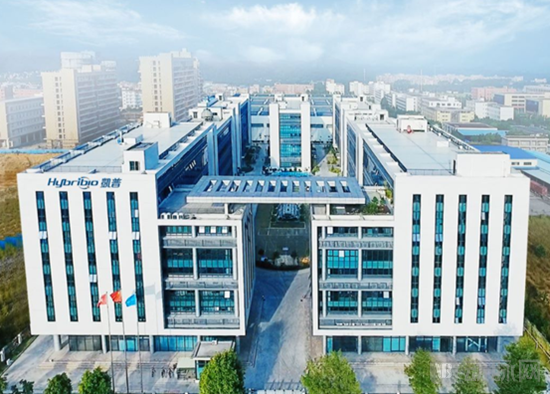
Hybribio Guangzhou Headquarters Building
Specifically, Hybribio will allocate 70% of its R&D budget to product development based on its existing flow-through hybridization and fluorescence detection platforms. By rapidly iterating new diagnostic kits to cover emerging disease areas, the company aims to maintain its competitive edge in maternal and child health diagnostics while continuously expanding into new markets such as genetic disorders and rare diseases.
Currently, Hybribio’s thalassemia genetic testing kit and deafness susceptibility gene testing kit, both developed based on its flow-through hybridization platform, have been included in the disease screening catalogs of multiple regions. Furthermore, 20% of R&D funding is allocated to platform innovation. Guan Zhisheng told VCBeat that Hybribio has successively introduced platforms such as time-of-flight mass spectrometry, digital PCR, and next-generation sequencing, and jointly developed a new microfluidic cell sorter with the Shenzhen Institutes of Advanced Technology, Chinese Academy of Sciences. “We continue to maintain close collaboration with universities. However, innovation in fundamental principles is a lengthy process. We adopt a controlled, sustained investment strategy, allocating 10% of our annual R&D budget to this area.”
Although the technology development led by Hybribio later became a notable achievement in the history of industrial research translation at the University of Hong Kong, it itself went through numerous near-death experiences.
Guan Zhisheng told VCBeat that flow-guided hybridization technology is not the only technology transferred from universities to Hong Kong Sci-Tech Innovation. “Many failed projects were absorbed by the parent company.” In Guan Zhisheng’s view, innovation in technical principles makes product innovation possible, but market positioning, product design, process optimization, and commercial operations remain critical choices that determine success or failure.
Summarizing Hybribio’s decade-long dedication, Guan Zhisheng believes that three key elements are essential for the successful translation of scientific and technological achievements. First, sustained risk tolerance is crucial; in the early stages when external funding sources are relatively scarce, founding shareholders should possess sufficient financial strength and be mentally prepared to bear risks over the long term. Second, once a product is developed, persistence is vital. “Healthcare is a lengthy process; product optimization and the dissemination of concepts both require time and patience,” stated Guan Zhisheng. Finally, continuous innovation is imperative, which explains why Hybribio has maintained ongoing research collaborations with universities. Furthermore, Hybribio has established an internal research team to continuously refine its innovative outcomes. Technology translation is not a one-time event; it requires multi-stage optimizations nearly every year.
Therefore, for Hybribio, innovation is more like a baseline. Built upon this foundation is a comprehensive system encompassing risk control, operations, and promotion, which collectively drive the translation of new technologies from the laboratory to clinical practice.
In recent years, Guan Qiaozhong, founder and president of Hybribio, has proposed three strategic pillars for the company, centered on products, services, and unmet needs, respectively, to continuously expand Hybribio’s capabilities. Specifically, the Hybribio business module, focusing on reagent and instrument development, will continuously track innovative technologies and real-world demands in clinical diagnostics to develop and iterate testing products. Meanwhile, modules such as Hybribio Medical Laboratory and Hybribio Forensic Science will leverage their ongoing establishment of a nationwide network of medical institutions to provide service solutions for users. The third pillar represents an innovative business module dedicated to delivering products and services that address users’ growing demands for health management.
“I hope that when the three Hybribio entities operate independently, each demonstrates strong viability, but when integrated, they exhibit even greater competitive strength,” stated Guan Zhisheng.
Prior to 2020, Hybribio had not ventured into the field of respiratory disease testing. The sudden onset of the COVID-19 pandemic served as a critical test for the three entities within the Hybribio group working in concert. The Hybribio R&D team successfully developed a nucleic acid detection kit for SARS-CoV-2 in just nine days. The kit subsequently received CE certification from the European Union, ANVISA certification from Brazil, was officially included on the World Health Organization’s (WHO) Emergency Use Listing, and obtained registration approval from the National Medical Products Administration (NMPA). Since the outbreak of the pandemic, numerous medical laboratories across China have been designated by the National Health Commission as institutions authorized to conduct SARS-CoV-2 nucleic acid testing, fully engaging in the fight against the epidemic. This rapid entry into a new disease area did not compromise the detection performance of Hybribio’s products. According to statistics, by December 2021, Hybribio had provided COVID-19 testing services to over 46 million people, achieving a 100% accuracy rate in the re-testing of positive samples.
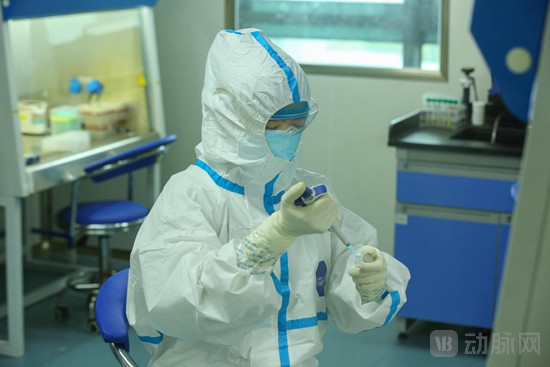
Hybribio Staff Conducting Experiments
“We maintain high standards for product professionalism and quality,” stated Guan Zhisheng. “The three ‘Hybribio’ entities operate in synergy but must not become mutually dependent.” Taking reagent procurement at Hybribio Medical Laboratory as an example, Guan explicitly required that, when technical specifications and pricing are equivalent, Hybribio Medical Laboratory should purchase products from other manufacturers. This approach is intended to stimulate Hybribio Medical Laboratory to enhance its supplier management capabilities and, in turn, sustain Hybribio’s capacity for original innovation.
Although the test menu and revenue streams are still being expanded, as of now, Hybribio Medical Laboratory Group ranks among the top three in China in terms of the number of medical laboratories established nationwide. This represents a critical milestone for Hybribio’s boundary expansion.
In 2012, Hybribio established the Hybribio Hong Kong Molecular Pathology Testing Center in Hong Kong. In retrospect, this was a significant decision made after Hybribio carefully considered its strategic positioning. For Hybribio, product development is not the ultimate goal; rather, the company aims to address health issues in the field of public health. Focusing solely on product development would limit its capabilities. This is because solving clinical problems often requires the integration of multi-omics and multi-platform approaches, for which third-party medical testing platforms serve as a powerful tool.
“Therefore, our entry into the third-party clinical laboratory testing sector is not aimed at carving out a share of the market pie,” pointed out Guan Zhisheng. He highlighted that a key feature of Hybribio’s third-party clinical lab business model is its synergy with the company’s own products. By establishing molecular diagnostic services as its foundation, the strategy ultimately facilitates the introduction of Hybribio’s instruments and reagents into hospitals. In other words, while traditional third-party clinical lab testing often serves as an end in itself, Hybribio’s clinical lab division functions both as an objective and as a strategic tool.
Specifically, as a classic step in operating third-party medical testing laboratories, Hybribio Medical Laboratory primarily focused on receiving outsourced samples at the beginning of its collaborations. The testing portfolio included routine tests listed in the clinical testing catalog as well as specialized clinical tests. Building on the trust established through this initial phase and its understanding of the specific clinical needs of medical institutions, Hybribio Medical Laboratory further promoted the co-construction of hospital laboratories. It also introduced discipline development and research collaboration resources from Hybribio, fostering deep engagement with its hospital client base.
It is understood that Hybribio’s operational model has been successively implemented in Hong Kong, Guangdong, Shanghai, and other regions. “There are simply too many tests required in clinical practice. As a professional third-party testing institution, we will remain in constant demand as long as we stay ahead of hospitals in terms of testing capabilities and products.” Guan Zhisheng expressed strong confidence and continues to drive capability building within the Hybribio Group.
At this Biotech Industry Chain Innovation and Cooperation Forum, Hybribio brought together nearly the entire clinical special testing industry chain, ranging from upstream instrument leaders such as Shimadzu and BD to midstream service providers in specialized segments including digital PCR, clinical mass spectrometry, next-generation sequencing (NGS), and nanopore sequencing. Although Guan Zhisheng stated in his concluding remarks that Hybribio’s intention was merely to provide an industry exchange platform rather than to build an industrial alliance, Hybribio has nonetheless taken the most challenging step toward establishing specialized third-party medical laboratory services. The influx of innovative test items into its testing menu is clearly becoming a trend.