

Robin Healthcare Secures $50M Series B Funding to Expand AI-Powered Electronic Health Record System Saving Physicians 90 Minutes Daily

Meridian Street Capital
Early-Stage Venture Capital Firms

Scale Venture Partners
Venture Capital Firms

IA Ventures
Early-stage Venture Capital Firms

Robin Healthcare
Health Technology Solutions Provider

Khosla Ventures
Venture Capital Firms

Social Leverage
Institutions Investing in Partnerships with Specialized Entrepreneurs

Norwest Venture Partners
Venture Capital Firms
Recently, U.S. health technology company Robin Healthcare (“Robin”) announced the completion of a $50 million Series B financing round, led by Scale Venture Partners, with participation from Khosla Ventures, Norwest Venture Partners, Social Leverage, Meridian Street Capital, and IA Ventures. With this funding, Robin will expand its electronic health record services into new markets and invest in its engineering, product, and sales teams to further create value for physicians across China.
Robin Healthcare was founded in 2017 and is headquartered in Berkeley, California, USA.Dedicated to integrating clinical expertise with artificial intelligence technology, we provide cost-effective electronic health record (EHR) solutions for physicians and high-quality care for patients.
This marks the second time Robin has secured backing from multiple prominent investment firms, following its completion of Series A financing in September 2019. Why has Robin consistently attracted investor interest? And how does it plan to address the challenges facing the healthcare industry? This article provides an overview.
Complex Electronic Health Records Increase Physician Burden
In 2009, the U.S. federal government passed the HITECH Act (Health Information Technology for Economic and Clinical Health Act),Vigorously advance the digital transformation of medical records.
In 2010, President Obama signed the “Patient Protection and Affordable Care Act” (hereinafter referred to as PPACA orACA), which strengthened the HITECH Act. The Office of the National Coordinator for Health Information Technology (ONC) and the Centers for Medicare & Medicaid Services (CMS) subsequently established, in accordance with the law, the EHR Incentive Programs for Medicare and Medicaid, known as the Meaningful Use of Certified EHRs (MU) program. This initiative provides incentives for adoption while imposing penalties on physicians or hospitals that fail to implement EHRs.
In October 2011, the final rule for Accountable Care Organizations (ACOs) was issued. This regulation strengthens the requirement for robust Electronic Health Records (EHRs), provides additional financial incentives for rural physicians and hospitals, emphasizes the digital collection of data for 33 performance metrics, and reinforces the role of EHRs as a tool for measuring healthcare quality. The use of EHRs will become a basic condition for healthcare institutions or physicians to join ACOs. “Failure to accurately, completely, and timely report clinical quality metric data will result in the termination of the ACO or other penalties.”
From 2008 to 2019, in just 10 years, the proportion of U.S. hospitals using electronic health record (EHR) systems rose from 9% to 96%.However, the widespread adoption of electronic health records (EHRs) has not made healthcare safer or more affordable; instead, excessive administrative burdens have consumed a disproportionate amount of physicians’ time, diverting them from direct patient care and reducing communication between doctors and patients.
In terms of time, electronic medical records consume an excessive amount of physicians’ time, with doctors spending more time on electronic medical records than on patients.Physicians are required not only to spend their entire consultation hours typing medical records into computers, but also often dedicate several additional hours afterward to completing documentation and addressing electronic health record (EHR)-related tasks, such as submitting referrals, responding to patient messages, and resolving coding issues. A 2017 study published in the Annals of Family Medicine found that during an average 11.4-hour workday, physicians spent 5.9 hours on EHR-related activities, compared with 5.1 hours in direct patient care.
In clinical practice, it is difficult for physicians to engage in effective interactions with patients.Each patient consultation lasts approximately 7–11 minutes. During this time, physicians must both document medical records and inquire about the patient’s condition, making it difficult to attend to the patient’s emotional needs. Consequently, they are often perceived by patients as cold and impersonal.
World-Class AI Clinical Expert Team
The team is the core of an enterprise; a professional team handles professional tasks. Emilio Galán, CEO of Robin Healthcare, holds a Master’s degree in Health and Medical Sciences from the University of California, Berkeley, and has over ten years of experience in the healthcare sector, with a focus on healthcare data, analytics, and systems measurement.
As Chief Medical Officer of Robin, Kathleen Myers holds an M.D. from Oregon Health & Science University, completed her emergency medicine residency at the University of California, Los Angeles (UCLA), and brings 20 years of clinical experience.
Robin’s leadership team received clinical training and specialized instruction in informatics, machine learning, and natural language processing at the University of California (UC), the University of California, San Francisco (UCSF), the University of California, Los Angeles (UCLA), and the University of California, Berkeley (UCB).
In addition, Robin appointed Tom Gruber, co-founder and former CTO of Siri, as an official advisor, thereby gaining substantial guidance in the fields of AI and intelligent assistants.
Saves doctors an average of 90 minutes per day, enhancing doctor-patient communication
“For years, we have seen administrative complexity consume physicians’ time—and deprive patients of adequate visit time. We have witnessed physician burnout and declining patient satisfaction. We kept asking ourselves: How can we address the entrenched problems of poor data quality and siloed systems in healthcare? So in 2017, we founded Robin with the goal of eliminating barriers to health,” said Emilio Galán, CEO of Robin.
Robin’s core product, known as Robin Assistant, is an AI-powered voice assistant.By simply placing Robin Assistant in the examination room, the device can directly generate high-quality clinical notes and electronic medical records based on audio or video recordings of doctor-patient interactions. Robin then employs a virtual medical scribe to validate the data and ensure the structural integrity of the records, leaving physicians to merely review and sign the documents generated by the device. Robin Assistant helps physicians save time and improve work efficiency.
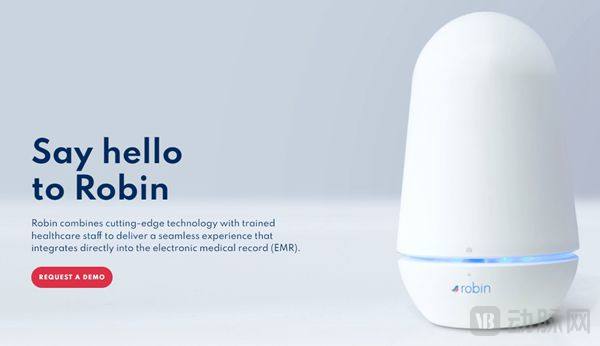
(Robin Assistant from the official Robin Healthcare website)
Robin Assistant devices combine the power of artificial intelligence (AI), speech recognition, virtual medical scribes, and care coordinators, and employ military-grade encryption to protect patient privacy data.
Kathleen Myers, Chief Medical Officer at Robin Healthcare, stated that during consultations, doctors spend nearly the entire time staring at their computers, typing while speaking, and rarely make eye contact with patients. This can easily leave patients feeling neglected. Robin Assistant enables physicians to break free from being tethered to their screens, fostering more friendly and engaging interactions with patients.
Robin claims that, with the assistance of Robin Assistant,, doctors can save an average of 90 minutes per day previously spent on manual data collection, enabling them to truly focus on what matters most—caring for patients.
Utilizes military-grade 265-bit encryption to ensure patient data security.
In accordance with the SOC 2 certification program, Robin adheres to rigorous audit procedures and best practices.The device uses military-grade 256-bit encryption for data at rest and in transit to ensure robust data protection, fully compliant with HIPAA.
From solo practitioners to large hospital systems, Robin stores each clinic’s data in an isolated environment, effectively safeguarding against system failures and malicious attacks. All records containing protected health information (PHI) are permanently deleted after a 30-day quality assurance period. All partners are covered by Business Associate Agreements (BAAs).
Robin’s security protocols ensure that all PHI is secure across every aspect of its operations. Robin’s engineers possess specialized expertise in cybersecurity and PCI compliance within large multinational organizations, along with in-depth knowledge of enterprise-grade key management and device authentication. Every team member is required to complete HIPAA training and undergo background checks.
Robin implements policies for all users and systems, including encrypted hard drives, minimum password requirements, remote wipe, IP-based access control, device authentication, and two-factor authentication. Robin maintains centralized auditing capabilities for all users and devices through encrypted password storage and ensures the security of Robin Assistant, applications, and infrastructure through multiple third-party penetration tests conducted annually.
Robin has established partnerships with multiple leading academic and private medical institutions in the United States, such as the Duke Private Diagnostic Clinic, UCSF Health, and the Central Coast Orthopedic Medical Group. Furthermore, over 1,000 Robin Assistants have been deployed, supporting more than one million physicians across China in conducting consultations without interruption.
“Documentation should not be the driving force behind patient care. With Robin, I can practice medicine and give my patients the attention they deserve, without worrying about dictation, charting, or coding,” said Mark Moulion, an orthopedic spine surgeon at Orthopaedic Associates of Muskegon.
Voice-based electronic medical record entry has not yet achieved large-scale adoption in China.
Driven by national policies, the adoption rate of electronic medical records (EMRs) in China continues to rise, and the informatization of healthcare infrastructure, with EMRs at its core, is developing rapidly.The “Report on the Survey of Hospital Informatization in China (2019–2020)” indicates that as many as 86.14% of hospitals regard electronic medical record (EMR) systems as their most critical application information system. According to an IDC research report, the market size of EMR system solutions in China reached RMB 1.74 billion in 2020, representing a year-on-year growth of 19.2%. The market is expected to maintain robust growth in the coming years.
In 2020, the top five vendors in China’s electronic medical record (EMR) market were Jiahua Meikang, Winning Health, Haitai Medical, Neusoft Corporation, and B-Soft, holding market shares of 18.6%, 12.0%, 11.4%, 9.3%, and 7.2%, respectively. Their combined market share totaled 58.5%, indicating a relatively high level of market concentration.
Meanwhile, emerging technologies such as big data and artificial intelligence have also become important drivers for the development of electronic medical records. Among them, the demand for voice entry systems for electronic medical records is accelerating.However, at present, there are not many enterprises in China developing voice input products for electronic medical records, among which the well-known ones are iFlytek and Unisound.
iFlytek’s electronic medical record (EMR) system integrates speech recognition, natural language understanding, and speech synthesis technologies, and leverages professionally customized noise-canceling microphones and smart mice for coordinated voice-based data entry. Furthermore, the EMR system offers functionalities such as medical record entry, management, and advanced search, thereby significantly enhancing physicians’ work efficiency. Currently, iFlytek’s speech AI solutions have been deployed in more than 200 hospitals.
Unisound’s voice-enabled electronic medical record (EMR) system can automatically recognize doctors’ dictations via microphone, transcribe them into text, and input the content in real time at the current cursor position on the computer, thereby replacing traditional keyboard-and-mouse entry. On November 4, 2020, Unisound’s application for listing on the STAR Market was accepted. According to its prospectus, its self-developed voice-enabled EMR system has been adopted by nearly 100 Grade IIIA hospitals, including Peking Union Medical College Hospital.
The intelligent development of electronic medical records (EMRs) has become an inevitable trend. As major hospitals progressively implement EMR systems and strive to achieve higher ratings in EMR application maturity assessments, the technical barriers to entry in the EMR market will gradually rise. Therefore, enhancing their own intelligent technological capabilities may well become a key factor for enterprises to seize market opportunities.