

The $100B+ Aesthetic Medicine Long-Tail Market: Is 'Medicalization' the Ultimate Direction?
2021 was a year in which the medical aesthetics industry returned to calmness and rationality, and also a year in which the industry endured the growing pains of transitioning from extensive growth to refined development.
In 2013, vertical internet medical aesthetics platforms such as New Oxygen entered the public eye as disruptors, introducing the concept of medical aesthetics. Following the impact of internet culture and industry education, public acceptance of medical aesthetics has increased significantly. A joint survey by New Oxygen Data Yanjiuyuan and Yicai Weekly revealed that over 80% of the general population now have a high level of acceptance for medical aesthetics, with zero respondents indicating complete unwillingness to accept it.
The medical aesthetics market size has consequently risen year by year.
Yet, as the industry’s prospects brighten and its market potential expands, more players rush to claim a share of the pie. Amid intensifying competition, the sector has fallen into a trap of unchecked, wildcat growth. Lapses in industrial development have inflicted harm on consumers and triggered backlash against the industry itself. The year-on-year growth rate of the medical aesthetics market has declined for consecutive years. With the release in May of the Special Rectification Work Plan for Cracking Down on Illegal Medical Aesthetic Services, the industry is now subject to stringent regulatory oversight.
The implementation of regulatory policies has led people to question whether the value of this market is at risk of evaporating. The answer, of course, is no.
On one hand, stringent regulatory policies have sounded an alarm for the extensive growth model of the medical aesthetics industry. On the other hand, they have laid a solid foundation for the industry’s sustainable development.The medical aesthetics industry is transitioning from an era of unbridled growth to one of refined development. Meanwhile, policy-driven restructuring and consolidation of the medical aesthetics market are guiding the industry back toward rationality.
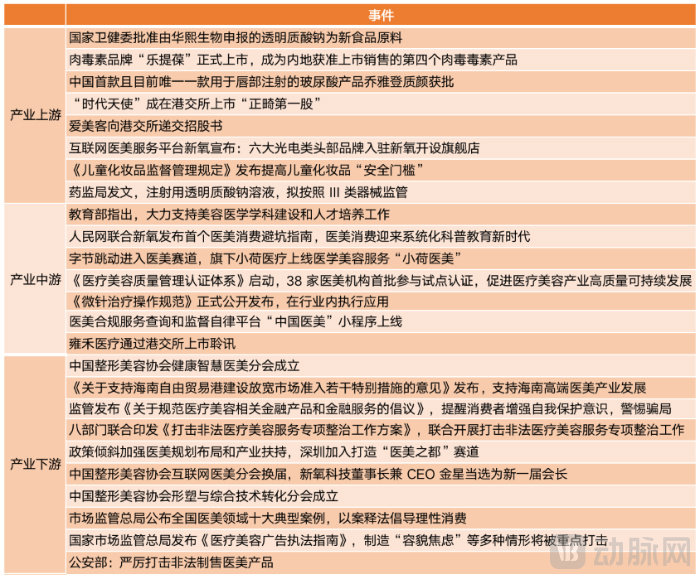
2021 Medical Aesthetics Industry Milestones
This is undoubtedly a significant step forward in the upgrading of the medical aesthetics market.
According to relevant data, the medical aesthetics market has returned to a 20% growth trajectory this year, resuming rapid expansion.China's medical aesthetics industry is projected to reach a scale of RMB 184.6 billion in 2021, representing a year-on-year growth of 21.6%, the fastest annual growth rate in the past three years.
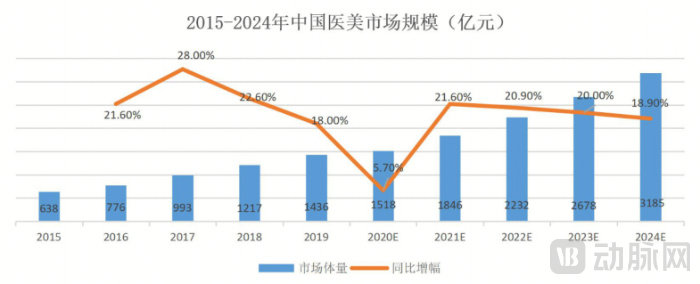
Market Size of China's Medical Aesthetics Industry, 2015–2024
Data source: New Oxygen Data Yanjiuyuan, Frost & Sullivan
As with the development trajectory of any emerging industry, the accelerated growth of the medical aesthetics sector has pushed it to a critical juncture of adjustment and transformation. The entire industry faces numerous challenges, including technological innovation, brand building, information transparency, and supply chain restructuring. Although the industry must endure the growing pains of this transition, these challenges are driving the medical aesthetics industry toward a new direction.
The most critical issue currently facing industry participants is how to position themselves in the face of “changing dynamics” during this pivotal period of industrial transformation, so as to further build their own sustainable development capabilities.This issue still requires patient observation, starting from subtle changes, to grasp the development trajectory of the market.
On December 14, the SoYoung Data Research Institute released the “2021 White Paper on the Medical Aesthetics Industry,” providing valuable data and insights for industry development and highlighting new growth drivers in the medical aesthetics market: the male consumer segment and second-tier cities.
Subjectively, women have long been considered the absolute main force in medical aesthetics consumption, and are the consumer group that businesses compete for. However, this year, New Oxygen Data Yanjiuyuan has extracted a highly valuable piece of information through relevant data statistics—The number of male aesthetic medicine consumers is steadily increasing, with a growth rate six times that of females, and their growth speed has surpassed that of female consumers for three consecutive years.
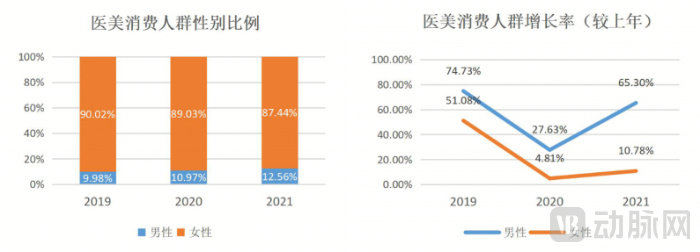
Gender Ratio and Growth Rate of Medical Aesthetics Consumers, 2019–2021
Data Source: New Oxygen Data Research Institute
The New Oxygen White Paper shows that in 2021, male and female consumers accounted for 12.56% and 87.44% of the total, with growth rates of 65.30% and 10.78%, respectively. The number of male medical aesthetic consumers increased by over 65% year-on-year.
Driven by various factors, including social ideologies and mainstream perceptions, men are rarely viewed as typical consumers of medical aesthetics. Consequently, their consumption potential in the medical aesthetics market is easily overlooked.
The New Oxygen White Paper uses a series of data to reveal the fact that the number of male medical aesthetics users is continuously increasing.Undeniably, the latent market value of men has become a “value depression” awaiting exploitation by practitioners.
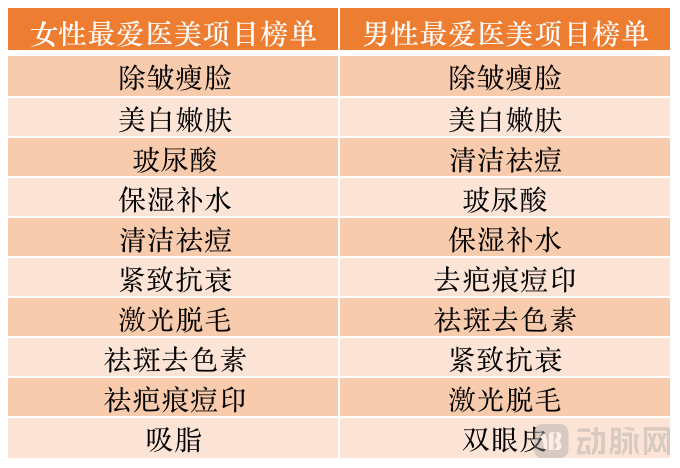
Ranking of Aesthetic Medicine Procedures Preferred by Men and Women
Data Source: SoYoung Data Research Institute
On the other hand, the white paper shows that “the consumer population in second-tier cities has grown for three consecutive years.”
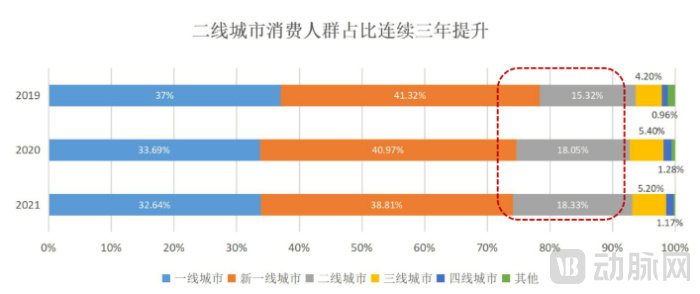
Urban Consumer Proportion
Data Source: SoYoung Data Research Institute
Tier-1 and new tier-1 cities are naturally the primary “drivers” of medical aesthetics consumption, accounting for over 70% of the consumer base.However, as opportunities in first-tier and new first-tier cities become increasingly saturated and the proportion of consumers declines year by year, where should new opportunities be seized?
Another highly valuable statistic from the white paper released by New Oxygen is that the proportion of consumers in second-tier cities was 15.32%, 18.05%, and 18.33% respectively from 2019 to 2020.
Second-tier cities are experiencing a surge in growth rates, making the sustained growth of first-tier and new first-tier cities appear as if their "growth is slowing down."
In the future, second-tier cities are poised to become a new growth pole for the medical aesthetics market, and the opportunities therein cannot be overlooked.
As market competition intensifies and the industry undergoes restructuring and consolidation, it is certain that while industry participants align with policy directives to drive transformation and upgrading, identifying new value curves and seizing first-mover advantages are particularly critical.
In 1995, Amazon boasted a collection of one million books. This vast supply enabled it to meet the demands of the “long tail” market, gain market share, and overcome supply bottlenecks, thereby creating more opportunities. It was this advantage that allowed Amazon to decisively surpass Barnes & Noble, which had annual sales of approximately $2 billion, in that same year.
The Amazon case reveals the potential of the “long tail market.”
The medical aesthetics industry is no exception.The current medical aesthetics market is not lacking in new consumer forces; significant market opportunities are emerging among male consumers and in second-tier cities. By adopting a long-term perspective and embracing the “long-tail market,” practitioners may unlock greater development opportunities.
From the perspective of segmented scenarios, “light medical aesthetics” (non-surgical aesthetic procedures), which possess dual attributes of both medical care and consumer consumption, offer broad room for growth.
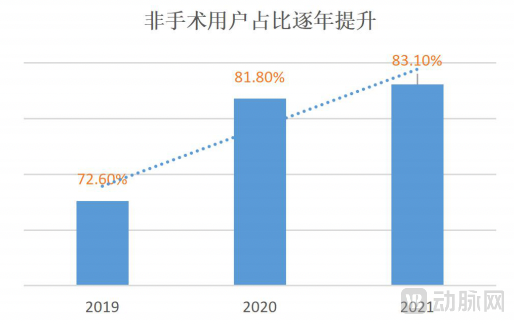
Proportion of Non-Surgical Users
Data Source: New Oxygen Data Yanjiuyuan
The New Oxygen White Paper shows that the proportion of consumers undergoing surgical procedures decreased from 34.2% in 2019 to 21.3% this year, while the proportion of consumers opting for non-surgical treatments increased from 72.6% in 2019 to 83.1%.The proportion of consumers opting for surgical procedures has declined year by year, while spending on non-surgical treatments surged in 2020. This growth momentum remains strong this year, with the sector evolving toward greater depth and precision.
The rise of medical aesthetics e-commerce platforms was once considered a key milestone in the digital transformation of the medical aesthetics industry.Around 2015, the rise of online medical aesthetics platforms provided consumers with transparent industry information and lowered the marketing barriers for medical aesthetics institutions. This internet technology helped bring the concept of “non-surgical medical aesthetics” into the public eye, and coupled with factors such as the pandemic, “non-surgical medical aesthetics” subsequently entered a period of rapid growth.
Amid the prevailing trend, photoelectric devices, botulinum toxin, and hyaluronic acid are accelerating the entry of medical aesthetics consumption into the mass market.
Data from New Oxygen’s Yanjiuyuan (Aesthetics Research Institute) shows that,Skin-tightening and anti-aging treatments primarily involving photoelectric devices emerged as the category with the highest total annual consumer spending. Meanwhile, wrinkle-reduction and face-slimming procedures centered on botulinum toxin injections recorded the largest number of orders this year. In 2021, botulinum toxin-based aesthetic treatments accounted for 52.9% of all injection-based medical aesthetic consumption (ranking first), making them one of the most significant categories in the non-surgical medical aesthetics market. Hyaluronic acid–based treatments consistently ranked third in both consumption scale and number of orders.
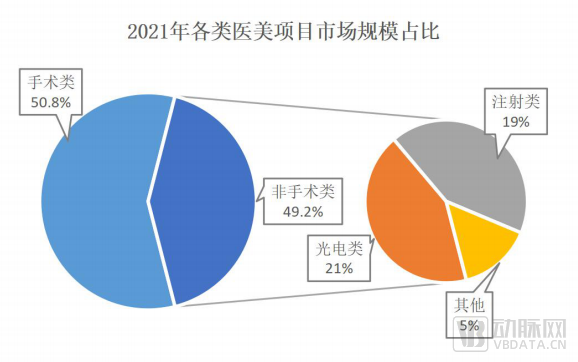
Market Share by Category of Medical Aesthetic Procedures in 2021
Data Source: New Oxygen Data Research Institute
It is fair to say that the booming “light medical aesthetics” market, and indeed the broader modern medical aesthetics industry, relies heavily on the support of energy-based device technologies, botulinum toxin, hyaluronic acid, and medical aesthetics e-commerce platforms.These four key factors are driving the medical aesthetics industry forward to a certain extent and exerting a significant impact on its modern development.
The significance of the invention of botulinum toxin goes without saying. Its contribution underpins the fact that “wrinkle reduction and facial slimming” consistently rank as the most popular medical aesthetic procedures among both women and men. In the field of medical aesthetics, botulinum toxin is akin to papermaking; this innovation has not only gained approval for more than 20 indications across 83 countries worldwide, but also spearheads the non-surgical medical aesthetics market thanks to its broad applications. Relevant data show that in 2020, the size of China’s regulated botulinum toxin market reached RMB 4.5 billion, representing a year-on-year increase of 25%.
Pharmaceutical-grade hyaluronic acid end products are rapidly capturing the market, driven by advantages such as safety and efficacy, high cost-effectiveness, and short recovery times, thereby offering substantial growth potential. Hyaluronic acid-based dermal fillers, skin boosters, and similar products are being widely applied in the medical aesthetics sector. According to a report by Frost & Sullivan, the market size of hyaluronic acid end products for medical aesthetics in China reached RMB 5.77 billion in 2020. Hyaluronic acid is emerging as a “golden track” for medical aesthetics companies to focus on.
Radiofrequency (RF) technology (Thermage), plasma skin regeneration technology (Plasma Pen), high-intensity focused ultrasound (HIFU) facelift (Ultherapy), and laser hair removal are all application scenarios of optoelectronic technologies in the medical aesthetics market. With the growing popularity of optoelectronic procedures in medical aesthetics, this technology is gradually becoming an “essential tool” for aesthetic physicians. According to data from Zhiyan Consulting, the market size of China’s optoelectronic medical aesthetics sector was expected to exceed RMB 30 billion in 2021, representing a year-on-year growth of 58.0%. For the optoelectronic medical aesthetics device industry, Chinese enterprises also have numerous opportunities to break through.
Medical aesthetics e-commerce platforms are to the medical aesthetics industry what fish are to water. The development of these platforms has driven the “internetization” of the medical aesthetics sector, significantly boosting the penetration rate of medical aesthetics services and unlocking entirely new business models for the industry.
Third-party internet platforms for medical aesthetics, represented by New Oxygen, enhance industry information transparency, drive price corrections for related products, effectively match user demands, and provide intuitive presentations of medical aesthetic knowledge, among other benefits, by helping users screen medical aesthetic institutions, doctors, and procedures, as well as providing communication channels for individuals seeking medical aesthetic services.
Subsequently, the medical aesthetics market gradually entered an explosive growth phase, ushering in a period of rapid development. The value of medical aesthetics e-commerce platforms in driving industry growth, addressing the pain points of the traditional medical aesthetics sector, reducing customer acquisition challenges, and enabling refined operational management is undeniable.
Breakthroughs in network technology, such as high bandwidth and large capacity, have brought about innovations in a series of communication methods, including audio and video. The rapid upgrading of streaming media and mobile internet technologies has shifted content production toward dynamic visuals. In this trend, social perception has become particularly sensory-driven, giving rise to the new wave of the digital economy—the medical aesthetics market.
This is a microcosm of the era of visual media, and an irreversible torrent under the backdrop of our times.
As the clarion call of policy sounds and industry supervision intensifies, the medical aesthetics sector is entering a new trajectory and phase, with “the return of medical aesthetics to medicine” likely being the ultimate direction for market development.
This marks the industry’s transition from an era of unbridled growth to one of refined development, representing a reshaping of the medical aesthetics market and, more importantly, policy-driven guidance toward the sector’s rational development.At this juncture, practitioners navigating a landscape of change should maintain composure, seize opportunities, and align with emerging trends.
Lewis Mumford once remarked in *Technics and Civilization* that technology is merely one element of human culture, and that all technological advancements and achievements of human civilization stem from humanity’s conscious or unconscious choices and struggles.
Rational leadership always precedes radical technological optimism. As the industry bids farewell to extensive growth and faces the growing pains of transformation, practitioners should view this with hope, recognizing it as a critical period for the market’s upward trajectory.