

How to Access a Personal Mental Health Counselor in China's Trillion-Yuan Mental Wellness Market?
The mental health industry has rarely garnered as widespread public attention as it does today.
From a market perspective, capital interest in the mental health industry remains strong, with an increasing number of investment institutions turning their attention to this sector.
From a policy perspective, there has been a surge in policies related to mental health since the beginning of this year. Whether it is the "Guangdong Province Basic Medical Insurance, Work-Related Injury Insurance, and Maternity Insurance Diagnosis and Treatment Project Catalog (2021)" and the "Guangdong Province Basic Medical Insurance, Work-Related Injury Insurance, and Maternity Insurance Medical Consumables Catalog (2021)" jointly issued by the Guangdong Provincial Healthcare Security Administration and the Provincial Department of Human Resources and Social Security, which stipulates that "psychotherapy" be included in the scope of medical insurance fund payments, or the recent response from the Ministry of Education to the proposal on further implementing measures for the prevention and control of depression among adolescents, explicitly including depression screening as part of student health examinations, all have sparked widespread public discussion about mental health.
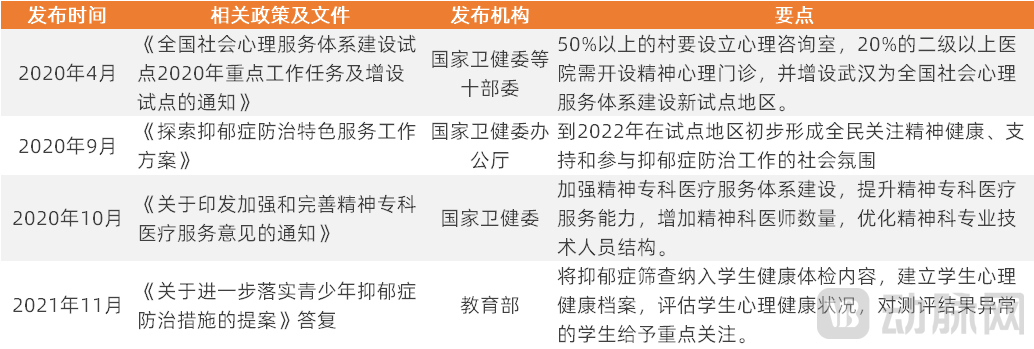
Relevant Policies on the Construction of Mental Health Service Systems in the Past Two Years
Furthermore, policy documents such as the “Opinions on Implementing the Healthy China Action” and the “Healthy China Action (2019–2030)” issued by the Steering Committee for the Healthy China Action explicitly set forth the requirements to “improve mental health levels” and “strengthen the development of a social psychological service system.”
Policy prioritization, an ever-expanding market size, and the rapid influx of capital all point to one conclusion: China’s mental health industry is ushering in new development opportunities. Meanwhile, various forms of mental health services have entered the public eye, with “mental health + digital healthcare,” empowered by technology, emerging as a new direction for industry growth. AI-powered mental health service robots represent a typical application scenario in this trend.
Coincidentally, in China’s first TV series dedicated to the theme of psychological counseling and the mental health industry, “The Female Psychologist,” which recently premiered, AI-enhanced psychological counseling services were mentioned multiple times. This underscores the current surge in interest surrounding AI-driven mental health services.
As a comprehensive mental health service provider powered by AI and big data, Beijing BrainFuture Health Management Co., Ltd. (hereinafter referred to as “BrainFuture”), in collaboration with a team of experts from Peking University, has jointly launched “Ruyi Teacher,” a psychological service robot integrating big data, AI, and other advanced technologies. With features such as intelligent mental health assessment, personalized training recommendations, and empathetic listening support, the robot is capable of performing tasks typically handled by entry-level psychological counselors, thereby delivering holistic mental health services to schools, communities, enterprises, and public institutions.
Big Data and AI Empowerment: Solving Industry Challenges
According to statistics from the National Health Commission, the prevalence of depression in China is 2.1%, and the prevalence of anxiety disorders is 4.98%. In addition, approximately 30 million children and adolescents under the age of 17 in China are affected by various emotional disorders and behavioral problems, with mental health issues increasingly affecting younger populations.
It is evident that public mental health issues have become increasingly prominent. Correspondingly, the demand for mental health services among the general population continues to rise, and the industry as a whole is demonstrating positive growth momentum.
However, given the current state of industry development, China’s mental health sector still faces multifaceted gaps.
First, there is a scarcity of high-quality psychological counselors. According to the World Health Organization’s recommendation that “one psychological counselor per 1,000 people represents the equilibrium point for a healthy society,” China requires at least 1.4 million psychological counselors. Currently, although there are over one million certified psychological counselors in China, fewer than 100,000 are engaged in full-time or part-time roles within the psychological counseling industry. With the cancellation of the national certification examination for psychological counselors, the shortage of qualified professionals is expected to continue widening.
Second, the industry faces issues such as non-standardized psychological counseling services and low levels of content standardization, resulting in high trial-and-error costs for users. Furthermore, stigma rooted in traditional culture also limits public acceptance of mental health services to a certain extent.
Driven by multiple pain points, the industry is in urgent need of more valuable innovative solutions. The integration of technologies such as big data and AI with mental health care to create psychological service robots is undoubtedly one viable direction.
On one hand, unlike clinical medical approaches, psychological counseling places greater emphasis on the quality of dialogue and communication. With the continuous advancement and updates in speech recognition and semantic understanding technologies, the difficulty of achieving natural conversation and interaction between humans and machines has been significantly reduced.
On the other hand, the multidimensional big data formed by integrating psychological big data with natural language processing can also provide data support for psychological counseling and assessment, thereby achieving a closed-loop system optimization.
Therefore, whether from the perspective of demand or feasibility, using psychological service robots to assist counselors has become a new trend in industry development. The "Ruyi Teacher" psychological service robot was born in response to this background.
AI-Powered Mental Health Services: Beyond Psychological Counseling
As the lead organizer of the “Ruyi Teacher” project, ZhiNao Future provided a comprehensive suite of support services for the product launch, including algorithms, system development, and hardware-software integration. Designed with an open-platform architecture, the system incorporates fully self-developed core technologies such as speech recognition, speech synthesis, natural language understanding, domain-specific knowledge systems, and multimodal interaction. These capabilities enable seamless human-computer interaction, empowering the system with the core ability to engage in sustained communication and structured dialogue with users.
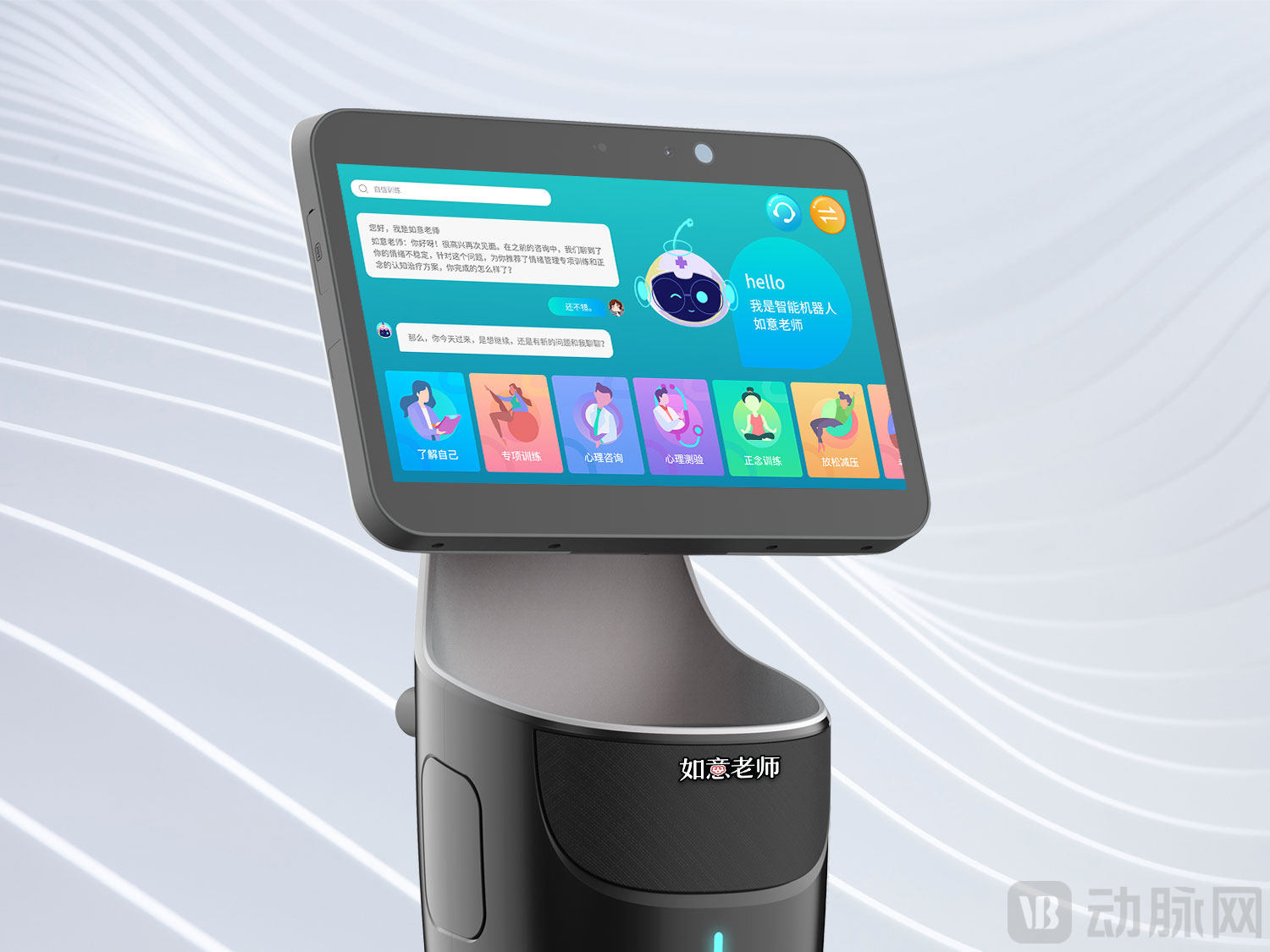
In fact, there is no shortage of psychological service robots on the market at this stage. However, most products are still limited to scale-based assessments or computer-led, one-way guidance for completing psychological exercises. They lack human-computer interaction and provide insufficient emotional support, failing to develop personalized service plans based on the individual needs of clients.
In response to this situation, the R&D team behind “Ruyi Teacher” has consistently adhered to the principles of mental health and evidence-based medicine. The platform analyzes users’ psychological issues across five key dimensions: interpersonal relationships, emotions, cognition, behavior, and quality of life. Based on this analysis, it provides targeted psychological service plans, including Cognitive Behavioral Therapy for Anxiety (CBT-A), Mindfulness-Based Cognitive Therapy (MBCT), Cognitive Behavioral Therapy for Insomnia (CBT-I), and standardized individual psychological counseling.
Directly targeting the core, it overturns conventional understandings of psychological service models, which constitutes Teacher Ruyi’s core advantage. When the system detects that a user is experiencing relatively severe psychological issues, its emergency intervention function is activated to reduce the incidence of potential adverse events.
Furthermore, Ruyi Teacher has meticulously replicated the authentic pathways of psychological counseling and the logical frameworks employed by counselors in its research and design, thereby maximizing the simulation of real-world counseling experiences, such as linguistic interactions between the AI agent and clients, as well as supportive, accepting, and active listening techniques. To ensure system responsiveness and algorithmic accuracy, ZhiNao Future has aggregated extensive psychological counseling data to establish a comprehensive psychological big database and multi-dimensional data models. Additionally, it has developed specialized algorithm libraries for empathetic language, problem assessment, and psychological training, enabling self-learning and continuous updates.
In terms of application scenarios, the product “Ruyi Teacher” primarily provides services directly to B-side institutions such as educational entities, enterprises and public institutions, training schools, and specialized organizations, thereby indirectly reaching C-end users. It is understood that “Ruyi Teacher” has already been deployed in certain junior high schools, senior high schools, children’s educational institutions, enterprises, and judicial and police-related organizations in Beijing. In the future, it aims to deliver comprehensive psychological services for all populations, establish a model for adolescent psychological services, and formulate standardized service norms.
In terms of product user experience, from the perspective of consumer-end users, the emergence of psychological service robots like “Ruyi Teacher” can enhance the accessibility of high-quality, standardized psychological care solutions, reduce the trial-and-error costs for users seeking services, and, as a service interface, help alleviate user stigma associated with mental health conditions to some extent. Should users require one-on-one consultations with licensed human psychologists, they can also schedule appointments directly through “Ruyi Teacher.”
From the perspective of B-side users, the advantage of mental health service robots being able to work 24 hours a day can reduce labor costs while ensuring that counselors are on duty around the clock. It also avoids common occupational burnout and countertransference among counselors, effectively guaranteeing the stability of service quality. As the saying goes, “Psychological counseling is an art.” The emergence of Teacher Ruyi has integrated science into this art, enabling it to serve the general public.
In terms of application performance, Ruyi Teacher demonstrates robust data processing and analytical capabilities, with an assessment accuracy consistency rate of over 85% compared to the expert panel, and a consultation plan recommendation accuracy consistency rate of over 89% with the expert panel.
Achieving this outcome clearly relies on the team’s R&D capabilities. It is understood that ZhiNao Future’s R&D team includes not only PhDs in computer science, but also supervisors from the Oxford Mindfulness Centre for Cognitive Therapy and serial entrepreneurs in the field of mental health, thereby ensuring product development as well as subsequent marketing and operations. Furthermore, the involvement of an expert team from Peking University guarantees the product’s professionalism.
Innovation Trilogy: Achieving “High-Quality Mental Health Services for All”
Since its inception, ZhiNao Future has been committed to the mission of making “high-quality psychological services accessible to all,” enhancing both the quality and accessibility of mental health care through a dual-drive strategy leveraging products and technology. From this perspective, the launch of Teacher Ruyi represents merely one component of ZhiNao Future’s comprehensive mental health service ecosystem. Specifically, ZhiNao Future’s product roadmap comprises three strategic steps.
First, the product is endowed with emotional feedback to achieve true intelligence. The ZhiNao Future team believes that mental health services integrating technology, if functional but devoid of emotion, cannot effectively intervene in psychological states. Therefore, by leveraging technologies such as speech recognition, semantic understanding, and multimodal interaction, the ZhiNao Future team has equipped the “Ruyi Teacher” product with a continuously improvable emotional feedback mechanism.
Second, it aggregates industry resources to create a closed-loop service ecosystem for online and offline psychological spaces, while simultaneously advancing the metaverse initiative of “VR + Psychology.” In terms of target audience, the consumer (C-end) market will also be a key focus for ZhiNao’s future development. It is understood that ZhiNao Future is currently planning the integration of AR applications, VR headsets, and other products with psychological counseling services. This approach not only aligns more closely with C-end users’ habits but also delivers a more immersive psychological service experience, making access to services more convenient.
As VR technology serves as the gateway to the metaverse, its integration will enable ZhiNao Future to evolve its “Mind Space” into a “Metaverse Mind Space,” granting each user a personalized, exclusive mental sanctuary. By positioning itself as a psychological service provider entering the metaverse, ZhiNao is making a bold strategic move for its future development.
In terms of design, the Heart Space platform aggregates both the supply and demand sides of mental health services, thereby fostering resonance among user groups and enhancing stickiness to the platform.
In terms of service offerings, Xin Kongjian is committed to enhancing the accessibility, inclusiveness, and efficiency of its services, aiming to provide the public with “modernized psychological fast-food services.”
Furthermore, the Xin Kongjian platform can also serve as a support system for Zhi Nao’s future referral and coordination services for complex offline cases, while providing safeguards for psychological counselors’ entrepreneurial ventures in mental health, thereby facilitating their professional development.
Third, gradually introduce psychological insurance. The design of this product primarily takes into account that, due to factors such as motivation and adherence, the quality and efficiency of services may decline when users access them entirely on an individual basis. The introduction of psychological insurance can, to some extent, encourage users to adhere to their psychological counseling processes and enhance the effectiveness of behavioral interventions.
Furthermore, ZhiNao plans to establish an offline network of consultants through multi-point urban deployments to handle referrals for complex cases, thereby creating a closed-loop service ecosystem that integrates online and offline communities.
Empowered by modern technology, the mental health industry is continuously unlocking its potential. As an innovator in this field, ZhiNao Future has developed Ruyi Teacher, an innovative tech product closely aligned with market demands, to fulfill its mission through in-depth research on mental health and a thorough understanding of user pain points across various segments. The company is also poised to usher in a new era of wellness within the metaverse.
As the market continues to evolve, we hope to see more innovative enterprises like ZhiNao Future emerge, delivering higher-value services and products to the industry and jointly driving its advancement.