

LuLutong Expands Internet Hospital Service Boundaries with 'Physician-Patient Broker + Digital Marketing' Model, Achieving 40% Monthly Sales Growth
“The healthcare and wellness industry is the one where I can truly realize my social value. I have grown deeply passionate about this field, and I am committed to dedicating the next two to three decades to it, striving to contribute my full value to the industry.”
“This marks the most significant shift since entering the healthcare and wellness industry,” remarked Xie Wen, an investor at Lutong with a background in engineering from Tsinghua University. With over a decade of entrepreneurial experience, Xie transitioned from founding startups in the internet sector to working in investment, and has now moved into the healthcare and wellness industry, where he intends to stay for the long haul.
Lutong may well be the vehicle through which Xie Wen realizes the social value he seeks to achieve.In 2018, Tianjin Lutong Health Technology Co., Ltd. was established, dedicated to “becoming a trusted digital healthcare ecosystem service provider,” and offering services for applying for internet hospital qualifications, building internet healthcare platforms, and providing enterprise digital marketing and operational solutions.
VCBeat interviewed Xie Wen, an investor in Lutong and a participant in the “Huijiu Ivy” Digital Health Accelerator Program, to learn about the entrepreneurial journeys of Lutong and Xie Wen.
Served 30+ leading enterprises across various sub-sectors of the healthcare and wellness industry
New forms of medical services continue to emerge, with “Internet + Healthcare” standing out as a prominent model that has made significant explorations in appointment registration and payment, remote diagnosis and treatment, and consultation services. In 2018, the General Office of the State Council issued the Opinions on Promoting the Development of “Internet + Medical Health,” which allowed medical institutions to provide certain internet-based medical services, such as follow-up visits for common and chronic diseases. This policy clarified the development direction for “Internet + Medical Health” and was followed by the release of regulatory documents, including the Interim Measures for the Administration of Internet Diagnosis and Treatment, the Interim Measures for the Administration of Internet Hospitals, and the Interim Specifications for the Management of Remote Medical Services, thereby providing institutional safeguards. As a result, internet hospitals have transitioned from a phase of unregulated growth to one of standardized development, reaching a peak period in their expansion.
November 2020, at the "Internet + Healthcare" Innovation and Development Forum hosted by Ban Yue Tan Magazine of Xinhua News Agency, Guo Yanhong, Inspector of the Medical Administration Bureau of the National Health Commission, revealed thatThere are now over 900 internet hospitals across China, and the National Health Commission has stated that it will promote the standardized and balanced development of internet-based medical services in all regions.; refine regulatory standards for internet-based medical services, clarify regulatory content and methods, and evaluate the operational status and effectiveness of regulatory functions of local internet medical service regulatory platforms.
“By 2020, policies began to tighten, with Hainan being a particularly notable example. Currently, Chengdu and Tianjin are the most active cities in applying for internet hospital qualifications.” Xie Wen spoke eloquently when discussing the policy landscape for internet hospital licensure.Lutong’s Internet Hospital Qualification Application Service, rooted primarily in Tianjin and Chengdu, leverages extensive government resources and expertise in public hospital informatization accumulated over time. Xie Wen further revealed that it takes approximately 3–4 months for Lutong to obtain internet hospital licenses in both Tianjin and Chengdu.
On October 27, 2021, the National Health Commission released the "Detailed Rules for the Supervision of Internet-based Diagnosis and Treatment (Draft for Comments)," signaling that the era of "unregulated growth" in internet healthcare is coming to an end, with the industry gradually moving toward standardization.Under the detailed regulatory framework, internet healthcare platforms with already well-established online hospital networks have gained a head start, while online hospitals lacking digital infrastructure and operational capabilities will face rectification or even removal, leading to a significant increase in industry concentration.
“Lutong’s goal is not merely to help enterprises build internet hospitals; it will devote greater effort to effective operations, addressing the ‘zombie status’—built but unused—that plagues most internet hospitals in the industry today,” Xie Wen told VCBeat with confidence.
Nowadays, Lutong relies on its abundant internetHospital construction capabilities and digital marketing capabilities,Has served over 30 leading enterprises across various sub-sectors of the healthcare and wellness industry, covering fields such as pharmaceuticals and medical devices, insurtech, biotechnology, and healthcare services.
“In the long run, companies operating internet hospitals aim to aggregate doctors and patients onto their platforms to generate greater network effects. To achieve this, two indispensable components are management and operations.“Xie Wen delved into the short-, medium-, and long-term needs of service enterprises establishing internet hospitals. Based on these corporate needs, he collaborated with the team at Tianjin Lutong Health Technology Co., Ltd. to develop two core business segments: internet healthcare platform construction services and digital marketing services.”
The service system construction of the Lutong Internet Healthcare Platform mainly includes a digital marketing system, an internet hospital system, a remote testing submission system, a remote diagnosis and treatment system, and a cloud HIS system.
Among these, the digital marketing system provides functions such as product campaign operations, intelligent marketing assistance, and data-driven decision-making. Based on the physician-patient brokerage model, this system differs from traditional medical assistants or physician brokers, effectively addressing the challenges of physicians lacking the time to manage patients and the capacity for refined patient engagement.; It provides the foundation for refined operations, including online profile creation, patient tagging, patient segmentation, bulk messaging, and comprehensive patient data management. Additionally, it offers intelligent auxiliary marketing features such as smart filtering, intelligent triage, automated follow-ups, and personalized recommendations, all driven by data analytics.
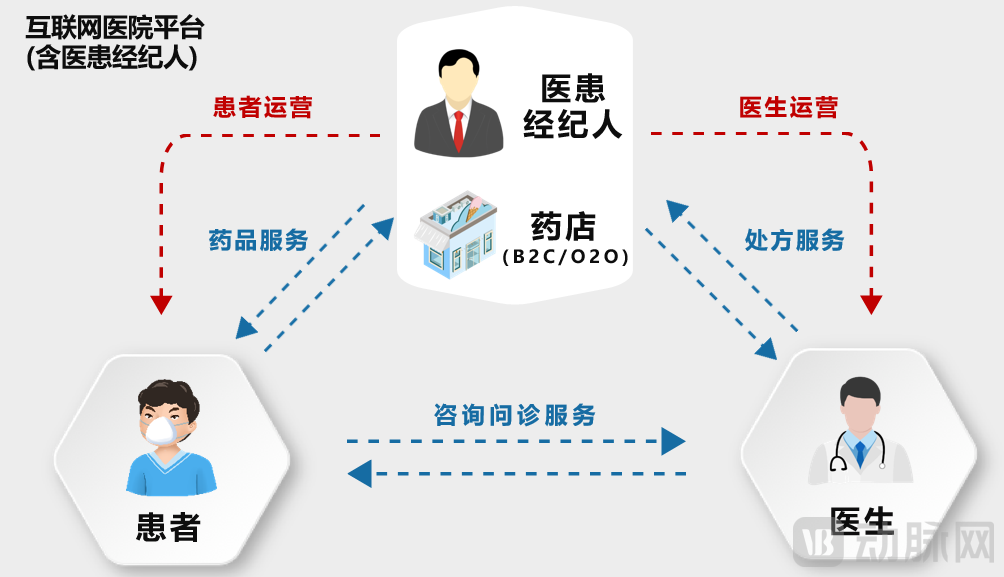
Doctor-Patient Broker Model
The Internet Hospital System provides online consultations, patient management, and intelligent follow-up.Doctors and patients communicate online via mobile devices. Under the internet regulatory framework, physicians issue electronic prescriptions, enabling patients to purchase medications online with home delivery services. Patient information is centrally managed to facilitate data sharing, allowing for cloud-based publication of laboratory and examination reports and access to comprehensive medical imaging, thereby supporting medical collaboration through telemedicine. In accordance with clinical pathways, hospitals and physicians can customize follow-up systems and design intelligent follow-up plans tailored to specific diseases and patient types. A unified appointment system integrates online follow-ups with offline medical visits, creating a closed-loop healthcare service.
The remote specimen submission system primarily provides testing services for categories including immunology, molecular biology, flow cytometry, genetics, and genomics.Primarily, third-party laboratories provide superior testing resources. Partner medical institutions issue test requisitions online, allowing patients to pay for the tests directly through the platform. Sample collection is performed by partner medical institutions, enabling patients to have their samples collected without visiting the hospital. The samples are then delivered to the third-party laboratory via logistics, with end-to-end visual monitoring throughout the delivery process. Upon completion of testing, the reports are automatically uploaded to the cloud, accessible online by both physicians and patients. The test reports also feature digital signatures, ensuring security and verifiability.
Xie Wen revealed, “Generally speaking, (remote specimen delivery services) are relatively mid-to-high-end testing services, as the average transaction value is quite high. We do not provide basic tests such as complete blood count (CBC). Typically, the remote specimen delivery services offered by Lutong involve items that are more difficult for local hospitals to perform.”
The telemedicine system provides remote outpatient consultations, remote specialist consultations, medical record sharing, and data interoperability. The cloud-based Hospital Information System (HIS) covers the entire internet hospital platform, encompassing departments such as outpatient care, laboratory testing, diagnostic imaging, pharmacy, finance, administration, and statistics, thereby fully supporting the digital operations of the internet hospital.
Xie Wen also stated that Lutong is further developing its digital marketing SaaS platform, which has already shown initial results.“We aim to continuously optimize and refine our digital marketing SaaS platform through practical applications across various scenarios, ensuring it meets the diverse needs of enterprises in different contexts and better serves the new ecosystem of digital healthcare,” Xie Wen told VCBeat, adding that the platform currently requires approximately six more months of optimization.
Unlike other internet hospital service providers, Lutong has made significant efforts in its operations.
In terms of public-domain traffic development, Lutong has obtained certification from MCN agencies across the entire internet and established its own in-house MCN team. The core members of this team are seasoned professionals with extensive experience and innovative insights in new media operations. Leveraging this capability, the Lutong team specializes in building medical expert IP on platforms such as Douyin, Kuaishou, WeChat Channels, Bilibili, and Toutiao, and facilitates effective conversion from public to private domain traffic through its internet hospital platform.
Xie Wen shared several figures with VCBeat,Over the course of one month, a medical expert’s account saw its follower count rise from 289,000 to 365,000, average views increase from 72,000 to 85,000, and total platform revenue grow from RMB 141,000 to RMB 197,400, representing a 40% increase.
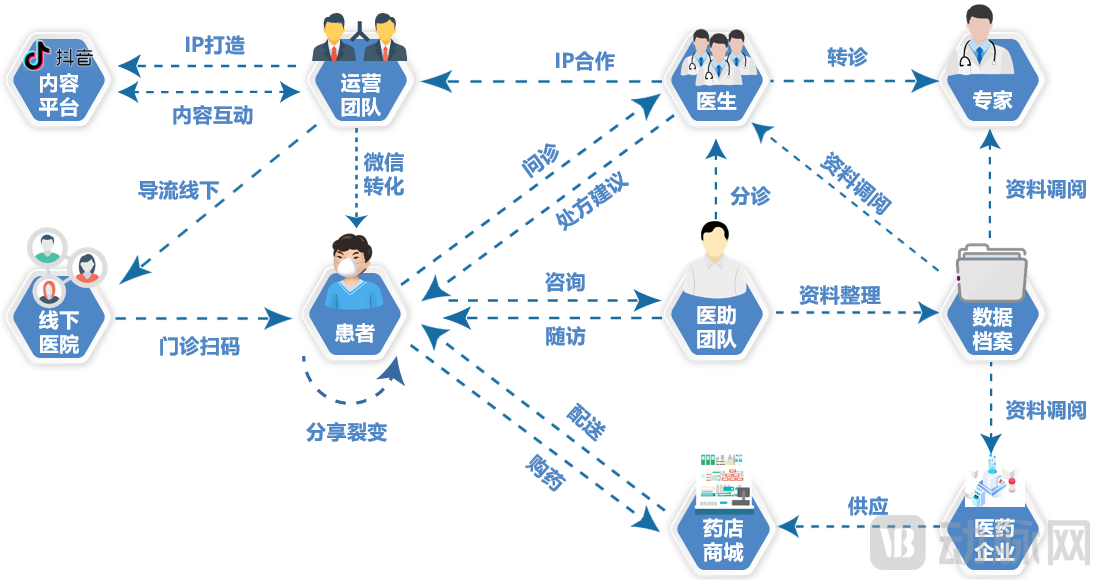
Medical Expert IP + Internet Hospital
In the realm of private domain traffic operations, continuous practice by Tianjin Lutong Health Technology Co., Ltd. has revealed that the effectiveness of an enterprise’s internet hospital operations does not hinge on physicians, but rather on whether the enterprise employs the role of a “physician-patient broker.” Distinct from medical assistants or physician agents, physician-patient brokers do more than merely provide auxiliary support to physicians; they also help physicians address issues related to private domain traffic acquisition and management, as well as patient management and follow-up.
Xie Wen revealed,Lutong practices a digital marketing model based on physician-patient brokers, assisting enterprises in activating operational efficiency both online and offline, which can increase the monthly sales of partner enterprises' internet hospital platforms by more than 40%. One enterprise cooperating with Lutong has already achieved an annual GMV exceeding 100 million yuan by applying this model.
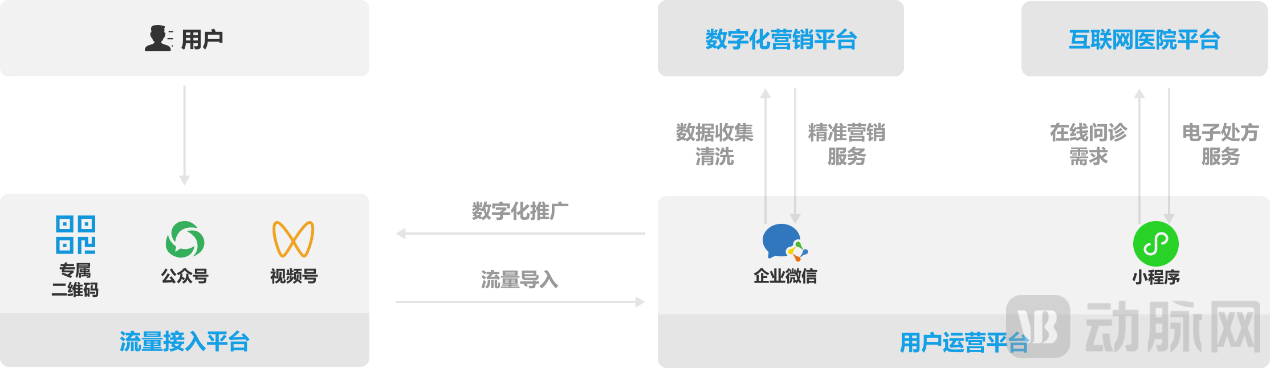
Digital Marketing Model
In addition, Lutong has made significant efforts in supply chain aggregation. Its digital marketing SaaS platform can integrate pharmaceutical supply chains, testing supply chains, and other medical services or products, helping partner enterprises rapidly establish a closed-loop operational system for internet hospitals and achieve sales revenue. Xie Wen also highlighted Lutong’s collaboration with Yide Haokang, a precision internet healthcare supply chain service provider, which has enabled medical diagnosis and clinical laboratory service enterprises to deliver end-to-end service capabilities spanning from in-hospital to out-of-hospital settings and from offline to online channels.
Looking ahead, Tianjin Lutong Health Technology Co., Ltd. has clear objectives.Xie Wen stated that Lutong will continue to provide internet hospital license application, system construction, and operational services to enterprises in the fields of pharmaceuticals and medical devices, insurance, life sciences, and biotechnology. The company plans to partner with 50 enterprises by 2022 and achieve a GMV target of RMB 500 million through a digital marketing model based on patient-physician brokers.Through in-depth exchanges with health-tech entrepreneurs, Xie Wen gained a more precise understanding of the needs of medical and healthcare enterprises, enabling him to help clients achieve business success more effectively. This was precisely his original motivation for joining the “Huijiu Boston Ivy” Health & Wellness Accelerator Program.
“Huijiu Boston Ivy” Accelerator Camp
“Huijiu Ivy” Accelerator Program, jointly launched by Huijiu Grand Lecture Hall, Ivy Society, and AstraZeneca, is operated by a team that has been a pioneer and practitioner of domestic health entrepreneurship services for six years, specializing in running startup accelerator programs. Targeting CEOs of growth-stage startups in the medical and healthcare sector, the program builds an open and supportive entrepreneurial “community,” integrating core startup elements such as industry resources, financing, and talent, thereby ensuring entrepreneurs are not alone and can avoid unnecessary detours.
The first cohort completed the screening of 60 high-quality participants within one and a half months, with both the quality and quantity of trainees gaining industry recognition.
Recruitment for the Second Cohort Is About to Begin: We Welcome Outstanding Entrepreneurs to Join Us.