

How Huorong Security Built a Robust Terminal Defense for Thousands of Medical Institutions Amid Digital Transformation
With Policies Being Issued Intensively, Is It Difficult to Safeguard Security at Medical Terminals?
Technological advancements—including the application of big data and artificial intelligence, the widespread adoption of information systems, the digitalization of clinical diagnostics, the “Internet + Healthcare” model, and integration with social security systems—have brought significant benefits to the healthcare industry, becoming a major driving force in its upgrading and iterative development.
What few people see, however, are the security issues exposed within the healthcare system after the hospital walls were broken down.
First, unlike traditional medical devices, emerging medical devices require network connectivity for operation; however, once connected to a network, they become vulnerable to cyberattacks.
Second, the failure to timely unify and upgrade healthcare information systems poses cybersecurity risks;
Thirdly, asset management in healthcare settings is chaotic and fraught with complex issues, including weak passwords in medical information systems, inadequate network security architectures, unsound data backup mechanisms, and a lack of encryption measures during data storage and transmission.
The 2019 Health and Medical Industry Observation Report believes thatThe healthcare industry is generally at a "high risk" level, facing various cybersecurity threats such as malicious programs (including zombies, Trojans, and worms), exposure of application service ports to the public internet, and website tampering, along with numerous exploitable security vulnerabilities, indicating weak security protection capabilities.
However, hospitals still lack adequate awareness, methodologies, technical capabilities, and professional expertise in endpoint security construction.
Accordingly, the state has issued a series of policies to further advance the resolution of endpoint security issues in the healthcare industry.This year, the legislative process for cyber-related security has accelerated even further, with the mid-year release of laws and regulations such as the Data Security Law, the Personal Information Protection Law, the Provisions on the Management of Security Vulnerabilities in Network Products, and the Measures for Cybersecurity Review (Revised Draft).
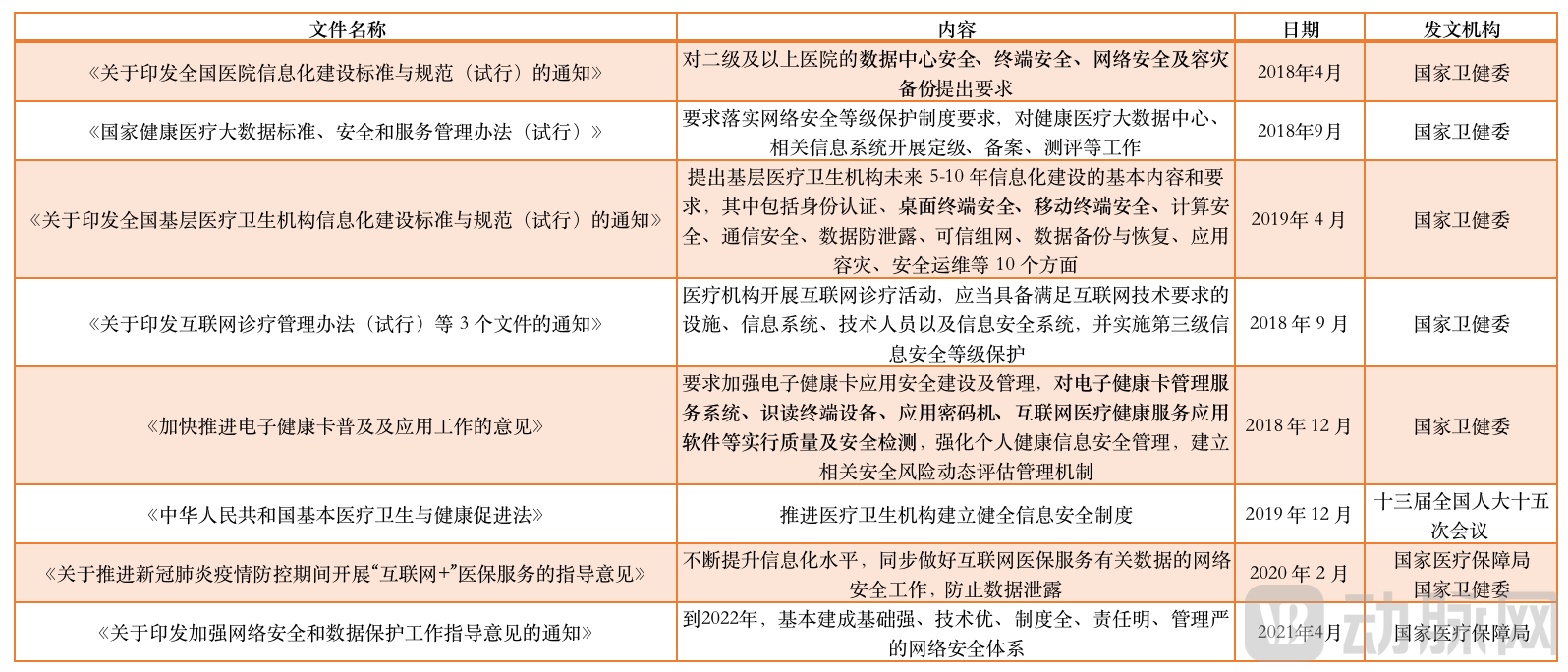
Policies Related to Healthcare Cybersecurity
The intensive rollout of policies underscores the state’s strong commitment to cybersecurity in the healthcare sector.
On the other hand, the market has also demonstrated a clear demand for safety-related products.
The “2021 China Cybersecurity Industry Analysis Report” shows that,In 2020, the market size of China's cybersecurity industry was approximately RMB 53.2 billion. Due to the impact of the pandemic, the growth rate of the cybersecurity market slowed down in 2020, with a year-on-year growth rate of 11.3%.
However, in the face of numerous endpoint security challenges in the market—such as a fragmented and heterogeneous landscape of cybersecurity devices, lack of holistic planning, and low levels of security technology—it is not only necessary for the healthcare industry to further streamline the overall architecture of hospital cybersecurity and rethink security infrastructure development, but also imperative for practitioners to provide solutions tailored to the industry’s actual needs.
Beijing Huorong Network Technology Co., Ltd. (hereinafter referred to as “Huorong Security”), a company deeply committed to network endpoint security, stands out for its sophisticated technology, reliable products, and professional services.
Huorong Security holds its own beliefs and perspectives on the endpoint security industry.
The company’s founding team embarked on their entrepreneurial journey in 2011, maintaining a steadfast focus on the endpoint security sector. They firmly believed that Huorong Security still held significant promise within this industry, which was widely regarded as a “red ocean” at the time.
Subsequently, in 2012, it launched “Huorong Security Software,” a free product targeting the individual consumer market, which gained widespread popularity for its “professional, clean, and lightweight” features, earning a large fan base and strong reputation.
In 2018, Huorong officially launched the “Huorong Endpoint Security Management System” for enterprise users. Over the past three years, it has served tens of thousands of enterprise clients, covering a wide range of sectors including government and public institutions, healthcare, manufacturing, finance, IT and internet, energy, and transportation.
Notably,Its independently developed next-generation antivirus engine is not only applied to its own products but also empowers a wide range of partners in the security sector through technology enablement, thereby expanding and extending endpoint protection capabilities via product and technology output.
And yet, behind Huorong Security’s seemingly smooth sailing, it has in fact struggled between lofty ideals and harsh realities.
In 2018, while internet security software companies were reaping the benefits of massive traffic, this company, deeply committed to endpoint security technology, decided to go against the tide—Shut down “traffic-based services” and forgo traffic-related revenue.
Although an annual revenue of several hundred thousand yuan is not a large sum, it represents a significant income for a startup. In pursuit of the true security value of its software, Huorong Security has remained steadfastly committed to the belief that profitability can be achieved through product sales and customer service. This step was taken with both ease and determination.
In the subsequent years,Huorong Security has successively gained recognition from numerous major clients, including State Grid Corporation of China, China Telecom, China Railway Construction Corporation, China National Aviation Holding, the BeiDou Navigation Satellite System, Zhejiang University, Beijing Subway, Beijing Hospital, and Shandong Cancer Hospital. Its enterprise-level business is experiencing rapid growth, maintaining a steady annual upward trajectory.
Looking back at Huorong Security’s dedication and in-depth research in the field of endpoint security, we can clearly sense its persistence and firm belief in technological advancement. It is precisely this commitment that has earned Huorong Security recognition from both competitors and customers in a security landscape where technology reigns supreme.
Today, Huorong Security provides endpoint security products and services to thousands of medical-related institutions and enterprises, including Grade A tertiary hospitals, regional health centers, medical research institutions, healthcare administrative agencies at all levels, pharmaceutical companies, and physical examination centers. The healthcare industry has become a key service sector for Huorong Security.
“Huorong Endpoint Security Management System,” which serves enterprise-level users without industry-specific customization, why has it repeatedly gained favor in the healthcare sector?
The key lies inThe healthcare industry itself faces numerous challenges in endpoint security and management, which Huorong Security is well-equipped to understand and resolve.
In recent years, healthcare institutions have been frequently subjected to malicious attacks and outbreaks of high-risk viruses. Continuously introduced policies and regulations have also imposed higher requirements on the construction of information security systems in these institutions.
“Huorong Endpoint Security Management System” is equipped with a self-developed next-generation antivirus engine that not only penetrates any “disguise” employed by viruses but also identifies new variants of known viruses and unknown viruses, effectively detecting and removing ransomware, worms, and cryptomining malware commonly encountered in healthcare institutions.
Furthermore, as hospital departments rely on computer terminals and information systems to facilitate administrative work, they typically operate hundreds of computers. In actual practice, however, there are widespread issues such as aging computers and servers, disorganized medical asset management, difficulties in locating terminals, and a heavy burden of IT operations and maintenance.
To address these challenges, the "Huorong Endpoint Security Management System" adapts to diverse deployment environments, enabling rapid remediation of legacy vulnerabilities and virus interception. It provides real-time management and comprehensive protection for medical device assets, integrating healthcare institution networks into a rigorous prevention and control framework. This ensures that every endpoint and security point is under centralized control, allowing operations and maintenance personnel to maintain clear visibility into the security posture of all endpoints.
According to industry experts, hospital cybersecurity construction is currently entering a golden period, yet significant challenges persist in areas such as awareness, methodologies, technology, and personnel deployment. Few hospitals genuinely approach cybersecurity from a holistic architectural perspective; instead, the prevailing focus remains on compliance with the Classified Protection of Cybersecurity (MLPS) assessments. This results in fragmented implementation efforts that fail to generate synergistic effects. Meanwhile, intense competition among specialized security vendors means that so-called solutions are often merely footnotes to their own proprietary products.
As the healthcare industry embraces digital transformation and pioneers innovative business models, it is imperative to promptly integrate cybersecurity into the core of overall risk management. Hospitals must construct a comprehensive, institution-wide security architecture. Meanwhile, security firms must maintain a profound reverence for technology to excel in the field of cybersecurity.
In the future, the healthcare industry will require more enterprises to provide solutions that address its genuine needs. With its “focused and pure” approach to security, Huorong Security is well-positioned to create greater value for endpoint security infrastructure in the healthcare sector.