

Zhong Nanshan Team and Tencent Publish New Research on COVID-19: Swift and Precise Prevention Is Key
Since the outbreak of the COVID-19 pandemic, countries around the world have implemented a series of epidemic control policies, such as closing schools and factories, restricting transportation, and canceling public events. These measures have been effective in curbing the spread of the virus, but they have also caused inconvenience to people’s daily lives and had a certain impact on the socio-economic landscape. Are strict containment measures truly necessary, and which interventions are more effective? Recent research findings jointly published by Academician Zhong Nanshan’s team and Tencent Inc. have provided more definitive answers to these questions.
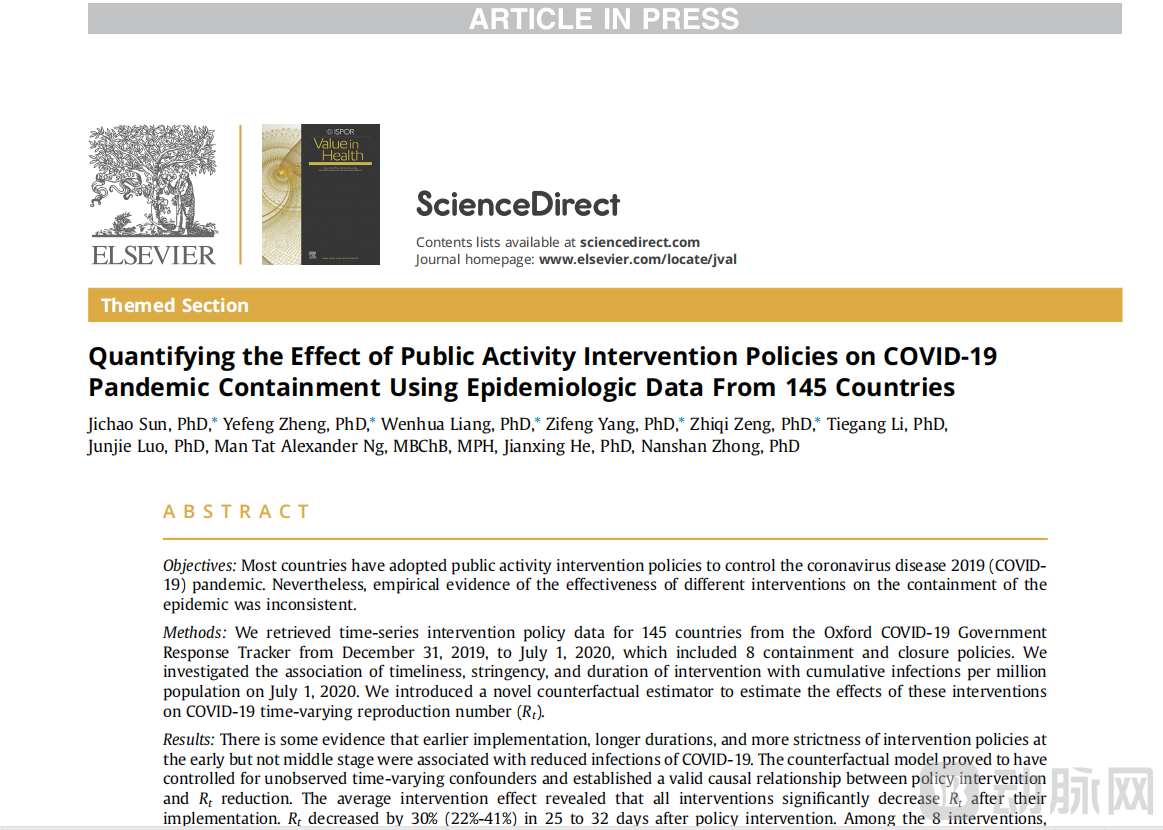
The research findings have been published in the internationally renowned medical journal *Value in Health*, under the title “Quantifying the Effect of Public Activity Intervention Policies on COVID-19 Pandemic Containment Using Epidemiologic Data From 145 Countries.” Leveraging big data and artificial intelligence technologies, the research team analyzed data on eight major pandemic control measures across 145 countries and regions during the first wave of the COVID-19 pandemic (the first half of 2020). They constructed a novel counterfactual reasoning model that maximally eliminated various confounding factors influencing the trajectory of the epidemic, thereby accurately quantifying the suppressive effects of different policies on viral transmission. The study found that the time-varying reproduction number (Rt), an indicator of viral transmissibility, declined rapidly within 7 to 14 days after the implementation of control measures. Among these, the cancellation of public events, school closures, and workplace closures demonstrated the most significant effects. The research indicates that only by implementing prevention and control measures more swiftly and precisely can the COVID-19 pandemic be effectively contained.
He Jianxing, Dean of the Guangzhou Institute of Respiratory Health, and Wu Wenda, Vice President of Tencent Health, served as co-corresponding authors. Academician Zhong Nanshan acted as the supervising author. Professor Liang Wenhua, Professor Yang Zifeng, and Dr. Zeng Zhiqi from the Guangzhou Institute of Respiratory Health, along with Dr. Sun Jichao and Dr. Zheng Yefeng from Tencent’s Tianyan Laboratory, were the co-first authors of this new study. This represents the latest research achievement by Academician Zhong Nanshan’s team and Tencent in combating the COVID-19 pandemic, following the establishment of their Joint Laboratory for Big Data and Artificial Intelligence in February last year. Previously, the two parties jointly developed an AI prediction model for severe COVID-19 cases, enabling rational early triage of patients.
Leveraging big data analytics, researchers conducted an in-depth computational analysis of the impact of intervention duration and timing on epidemic control. The results indicated that most epidemic prevention and control measures began to take effect approximately 7 to 14 days after implementation, as evidenced by a rapid decline in the effective reproduction number (Rt), a metric reflecting viral transmissibility. An Rt value of 1 signifies that each primary case generates, on average, one secondary case. Furthermore, the effectiveness of these interventions increased over time, peaking between 25 and 32 days with an approximate 30% reduction in Rt, after which the effect gradually waned.
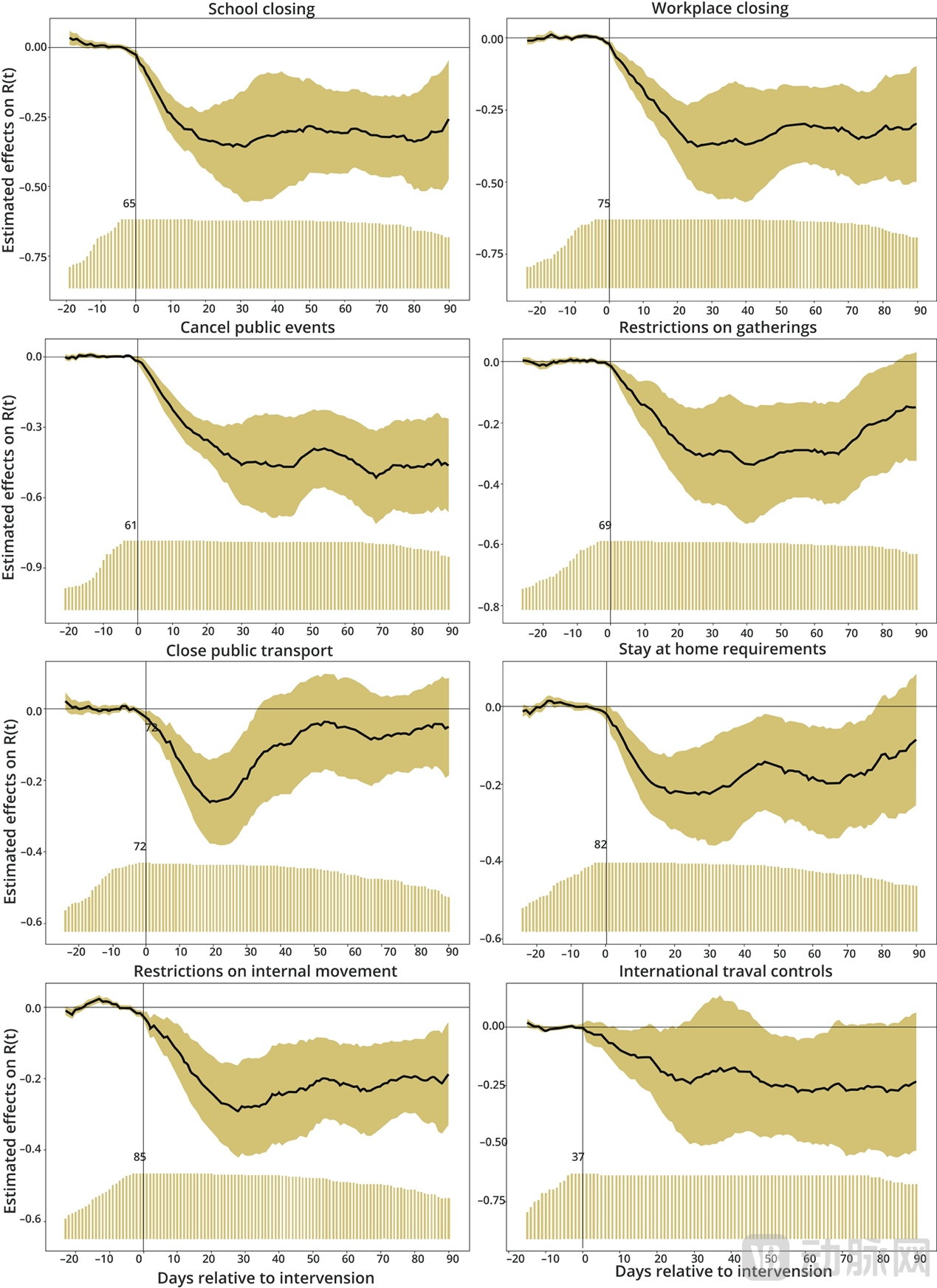
The counterfactual inference model calculated the suppressive effects on Rt (effective reproduction number) at different time intervals following the implementation of eight prevention and control measures.
The study further indicates that during the early stages of an outbreak (the period of slow infection growth), stricter and longer-lasting control measures result in fewer total infections. However, if control measures are implemented during the middle to late stages of the epidemic (the period of rapid infection growth), the outcome is precisely the opposite: stricter and more prolonged interventions lead to an increase in the final number of infections. Dr. Sun Jichao, the paper’s first author, points out that this outcome is not due to the ineffectiveness of pandemic control measures, but rather stems from reverse causality: strict containment policies were only formulated when infections were already surging, by which time their impact was minimal. This implies that “locking the barn door after the horse has bolted” is too late; maximum effectiveness can only be achieved by taking prompt action at the earliest signs of an outbreak.
Furthermore, researchers employed counterfactual reasoning models to individually evaluate the effectiveness of eight common mitigation measures, aiming to identify the most effective precise interventions for suppressing viral transmission. These eight measures included school closures, workplace closures, cancellation of public events, restrictions on mass gatherings, public transport controls, stay-at-home recommendations, restrictions on domestic movement, and restrictions on international travel.
 Quantitative Evaluation of the Effectiveness of Eight Control Measures Using a Counterfactual Reasoning Model
The results indicate that among the containment measures widely adopted by governments worldwide, the cancellation of large public events, school closures, and workplace closures had the most significant suppressive effect on the virus’s effective reproduction number (Rt). Researchers speculate that these three measures are all mandatory interventions with higher feasibility of implementation and compliance, making them more likely to be effective in curbing the epidemic.
Research leveraging big data analytics has identified more robust evidence, corroborating the quantitative impact of epidemic prevention and control measures on curbing the COVID-19 outbreak. It recommends implementing stricter containment measures in the early stages of an epidemic to better suppress disease spread. Currently, Academician Zhong Nanshan’s team and Tencent Health are continuing their in-depth scientific collaboration, utilizing internet-based technologies such as big data and artificial intelligence. Their joint efforts focus on areas including early warning and prediction for COVID-19 and the prevention and control of infectious diseases, thereby providing stronger evidentiary support for epidemic response strategies.