

Medical Knowledge Middle Platform White Paper Unveiled: Powering the Next Generation of Smart Healthcare
The COVID-19 pandemic has imposed new demands on social and public health systems, while also presenting fresh challenges to the global economic landscape. Currently, the healthcare industry has reached a new consensus on intelligent upgrading, with the medical knowledge middle platform serving as a key enabler.
On December 17, at the Knowledge Intelligence Special Session of Baidu AI Cloud’s “Cloud-Intelligence Technology Forum,” Baidu Lingyi Zhihui, in collaboration with KPMG, released the White Paper on Medical Knowledge Middle Platform (hereinafter referred to as the “White Paper”). The document shares Baidu’s experience in building knowledge middle platforms for the healthcare industry, covering interpretations of national policy trends, challenges in intelligent industry upgrades, core capabilities of medical knowledge middle platforms, implementation pathways, and ecosystem layout.

At the launch event, Liu Junwei, General Manager of Baidu Smart Healthcare; Shen Xibin, Director of the New Media Department of the Chinese Medical Association Journal House; and Yao Feng’e, Managing Partner of KPMG China’s Healthcare Industry Practice, jointly witnessed the release of the white paper. Liu Junwei stated that Lingyi Zhihui continues to leverage its technological advantages in artificial intelligence fields such as natural language understanding and knowledge graphs, while investing substantial resources in the medical knowledge domain to build a Medical Knowledge Middle Platform. This platform is capable of deeply processing medical knowledge, enabling healthcare institutions, medical professionals, and healthcare industry organizations to access authoritative and professional medical knowledge, thereby meeting the need for rapid development of scenario-based applications.

Launch Ceremony Photos
To effectively address the social challenges of difficult and costly access to medical care, the state has successively issued several important documents, including the Outline of the “Healthy China 2030” Plan, the Opinions on Promoting the Development of “Internet + Healthcare,” and the Opinions on Implementing the Healthy China Action. These documents explicitly call for leveraging new technologies to accelerate the digital transformation of the healthcare industry and to establish a comprehensive healthcare service system, thereby providing the public with all-around, full-lifecycle health services.
The White Paper points out that prominent issues in the healthcare industry include an average shortage of medical personnel, excessive concentration of high-quality medical resources, and the difficulty of significantly improving the quality of medical resources in the short term. The imbalance between supply and demand for medical service resources will remain a severe long-term challenge. In this context, the Medical Knowledge Middle Platform—an intelligent open platform adhering to medical logic—is emerging as a breakthrough solution to this problem.
The White Paper emphasizes that the Medical Knowledge Middle Platform, serving as a critical foundation for promoting the intelligent upgrade of applications in the healthcare industry, possesses two core capabilities: medical knowledge processing and medical knowledge services. Specifically, the Medical Knowledge Middle Platform utilizes a standardized AI toolset—the “Basic Toolset”—to preprocess knowledge and data sources such as medical textbooks, clinical practice guidelines, and electronic medical records, converting them into data formats suitable for knowledge processing. Meanwhile, “Medical Knowledge Processing” follows the general process of knowledge discovery and construction to achieve one-stop building and organization of medical knowledge. During this process, the “Medical Knowledge Base” categorizes and stores medical knowledge by theme, thereby providing external medical knowledge services.
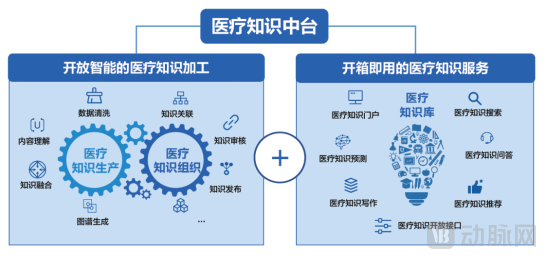
Basic Positioning of the Medical Knowledge Middle Platform
Throughout the process, the “Middle-Platform Core,” serving as the central brain of the medical knowledge middle platform, will govern the processing of medical knowledge in accordance with unified medical terminologies, knowledge systems, and standard specifications, thereby ensuring adherence to medical logic. Finally, “General Medical Knowledge Applications” will meet end-users’ medical knowledge needs through channels such as the medical knowledge portal, knowledge search, and knowledge Q&A.
It is worth noting that, leveraging its medical knowledge middle platform, Lingyi Zhihui empowers a broad range of participants in the healthcare industry with professional medical knowledge services. The White Paper primarily conducts analysis from three perspectives: healthcare institutions, regional medical centers/medical consortia, and healthcare IT companies.
 Industry Users Supported by the Medical Knowledge Middle Platform
Targeting healthcare institutions, Lingyi Zhihui embeds its years of accumulated medical expertise into a centralized medical knowledge platform. It delivers intelligent services through AI-powered triage and online pre-consultation scenarios, enables smart healthcare by leveraging clinical decision support systems (CDSS) and rational drug use applications, and aggregates knowledge data from clinical practice, teaching, and research to facilitate intelligent hospital management, thereby driving the intelligent transformation of healthcare institutions.
Targeting regional medical centers and medical consortia, Lingyi Zhihui systematically standardizes and scales the accumulation of medical knowledge from high-quality healthcare institutions. By delivering precise and in-depth knowledge services, it empowers healthcare institutions in need, thereby enhancing primary care diagnostic and treatment capabilities, improving the quality of care, and supporting the expansion of overall service capacity within China’s healthcare system, thus facilitating the development of regional medical centers and medical consortia.
Targeting healthcare IT companies, the Healthcare Knowledge Middle Platform significantly reduces the complexity of developing scenario-based applications by continuously accumulating and optimizing medical knowledge within computer systems. This approach eliminates the need to rebuild foundational knowledge from scratch, thereby fostering an iterative development model across the entire ecosystem.
Currently, as the nation intensifies its efforts during the 14th Five-Year Plan period to build regional medical centers and expand and decentralize high-quality provincial medical resources, the need for cross-hospital and cross-regional sharing of medical knowledge will become increasingly urgent.
In fact, by leveraging the medical and technical thinking embedded in its Medical Knowledge Middle Platform, Lingyi Zhihui has successfully implemented a series of tangible outcomes. For instance, through collaborations with authoritative medical knowledge service institutions such as the People’s Medical Publishing House and the Chinese Medical Association Journal House, it has accumulated and consolidated industry-specific medical knowledge to build an authoritative, professional, and evidence-based Medical Knowledge Middle Platform. Serving as a “Medical Knowledge Brain,” this platform has already delivered medical knowledge services to more than 400 healthcare institutions and over 15 million patients.
Reviewing the development journey of the medical knowledge middle platform, Liu Junwei stated that the release of the White Paper signifies that Lingyi Zhihui is opening its accumulated capabilities to partners and simultaneously beginning to undergo market validation.
The White Paper outlines the future development of the healthcare knowledge middle platform, recommending that its construction proceed through four phases: healthcare knowledge modeling, healthcare knowledge classification and organization, healthcare knowledge processing and construction, and healthcare knowledge application development. In the future, Lingyi Zhihui will center its medical innovations around the entire healthcare industry ecosystem. Upholding the philosophy of “open services, co-construction and shared usage, and diverse scenarios,” it will collaborate with partners—including healthcare service providers, healthcare regulators, and healthcare IT companies—to deliver high-quality medical services to users and support the development of a healthy healthcare industry ecosystem.