

China Advances DRG/DIP Payment Reform: Achievements from Pilot Programs and the Three-Year Action Plan
Recently, Diagnosis-Related Groups (DRG), which had been quiet for a long time, have once again become a hot topic in the industry. First, on November 26, the National Healthcare Security Administration issued the "Notice of the National Healthcare Security Administration on Printing and Distributing the Three-Year Action Plan for Payment Method Reform of DRG/DIP," requiring that by the end of 2025, DRG/DIP payment methods should cover all eligible medical institutions providing inpatient services, basically achieving full coverage of disease types and medical insurance funds.
On December 17, the National Healthcare Security Administration swiftly issued the “Notice of the General Office of the National Healthcare Security Administration on Printing and Distributing the List of DRG/DIP Payment Demonstration Sites,” designating 18 DRG pilot cities, 12 DIP pilot cities, and 2 comprehensive (DRG/DIP) demonstration sites.
On December 18, the following day, the “1st China CHS-DRG/DIP Payment Reform Conference,” hosted by the National Healthcare Security Administration, was held in Beijing. This officially backed conference established 101 branch venues across all 31 provincial-level administrative regions of China, with more than 4 million participants joining via online connectivity, drawing widespread attention from the industry.
What achievements have the DRG/DIP pilot programs made so far? VCBeat (WeChat ID: VCBeat) provides an interpretation based on available data.
In fact, the reform of DRG/DIP payment methods did not start today. This long-standing reform can even be traced back to 1988 - the newly established Beijing Hospital Management Research Institute took DRG as its research goal and produced China's first batch of DRG research results in 1994, laying the technical foundation for developing localized DRG systems domestically.
Unfortunately, related research had to be suspended because China had not yet established a medical record front-page system at that time, hospital informatization levels were relatively backward, and there was no clear application direction. It was not until 2004, seizing the opportunity presented by the need for scientific payment management methods in establishing a national social medical security system, that Beijing resumed research projects on DRG-based payment under medical insurance. Over the following decade, various regions across China successively initiated similar explorations and achieved substantial results.
In 2015, the “Opinions of the General Office of the State Council on Fully Implementing Critical Illness Insurance for Urban and Rural Residents” explicitly proposed the coordinated promotion of payment method reforms, including diagnosis-related group (DRG)-based payment. In June 2017, the “Guiding Opinions on Further Deepening the Reform of Basic Medical Insurance Payment Methods” further clarified that, starting from 2017, a diversified and composite medical insurance payment system dominated by DRG-based payment would be fully implemented nationwide; it required that by 2020, such a diversified and composite payment system adapted to different diseases and service characteristics would be widely adopted across China, with a significant reduction in the proportion of fee-for-service payments.
In the same month, the former National Health and Family Planning Commission designated Shenzhen, Karamay, and Sanming as three pilot cities to trial DRG-based payment reforms. This initiative was also one of the 70 key healthcare reform tasks for 2017.
In 2018, the National Healthcare Security Administration was established. It bears the critical responsibility of ensuring the sustainable development of healthcare security funds, with payment reform being one of the most significant measures in this endeavor. At that time, multiple versions of Diagnosis-Related Groups (DRG) were implemented across China, each with different focuses and lacking interoperability. From a national perspective, there was a need for a unified DRG system to be promoted through robust mechanisms. Against this backdrop, CHS-DRG (CHS stands for China Healthcare Security) was introduced.
CHS-DRG Pilot Program Results—Gradually Gaining Momentum Over Three Years
In May 2019, the National Healthcare Security Administration (NHSA) launched pilot programs for Diagnosis-Related Group (DRG)-based payment systems and announced a list of 30 pilot cities—marking the commencement of NHSA-led reforms in DRG-based payment methods. Apart from a few pilot cities with prior experience in DRG implementation, most lacked relevant expertise. Meanwhile, to facilitate comprehensive experience accumulation across all aspects, the selected pilot cities encompassed megacities, large cities, medium-sized cities, and remote county-level cities.
Based on data from 62 million cases over three years across 30 pilot cities, the expert panel of the National Healthcare Security Administration validated the differential grouping to finalize the A-DRG grouping and subgroups. On October 16, 2019, it officially released two technical standards: the Technical Specifications for DRG Grouping and Payment under the National Healthcare Security System and the National Healthcare Security DRG (CHS-DRG) Grouping Scheme.
CHS-DRG, which integrates the core elements of BJ-DRG, CN-DRG, and CR-DRG, comprises 376 ADRG groups (ADRG 1.0), essentially covering all critical and severe conditions within a 60-day period. On June 18, 2020, the National Healthcare Security Administration released Version 1.0 of the CHS-DRG Subgrouping Scheme, further dividing the 376 ADRG groups into 618 subgroups.
In 2021, the National Healthcare Security Administration (NHSA) issued Version 1.1 of the CHS-DRG Subgrouping Scheme, incorporating updates based on actual payment data from 30 pilot cities. This version represents a more refined framework and has been highly acclaimed as “a solid step toward the localization in China of this foreign technology, making it better aligned with clinical practice in our country.”
On the first day of the “Reform Conference,” the National Healthcare Security Administration announced the achievements of the CHS-DRG pilot program. As of October 2021, actual DRG-based payments had been implemented in 807 medical institutions across 30 pilot cities, with a coverage rate of 43.49% among tertiary hospitals. The consistency of ADRG grouping improved significantly: when comparing the actual case grouping results from the 30 pilot cities with the national ADRG standards, 27 cities achieved a consistency rate of over 80% in the 2021 test samples, a substantial increase from only 7 cities in 2020.
Regarding subgroups, the number of subgroups in each city ranged from 429 to 935. It should be noted that a greater number of subgroups is not necessarily better. If the number of cases assigned to a specific subgroup in a local area is too low, accounting for less than three per 100,000 of the total cases, it indicates that the subgroup lacks representativeness and can effectively be merged into other subgroups. Among the 30 pilot cities, 22 had less than 10% of their DRG groups with case volumes below this threshold (three per 100,000 of the total) in the 2021 test sample, representing a significant increase from the nine cities reported in 2020.
Over the three years since the pilot implementation of CHS-DRG, medical practices in healthcare institutions across pilot cities have become increasingly standardized. The proportion of surgical and procedural groups, which reflect technical complexity, has shown an upward trend, while the proportion of internal medicine groups, representing conservative pharmacological treatment, has declined. Furthermore, unnecessary hospitalizations in pilot cities have decreased, alleviating the issue of “over-treatment for minor ailments.” Taking Beijing as an example, the average proportion of pharmaceutical costs in total medical expenses at healthcare institutions dropped from 38.8% to 24.2%, whereas the proportion of medical service fees increased from 30.6% to 36%.
Consequently, the financial burden on insured individuals has been reduced. Compared with the average cost per visit, which is significantly influenced by the Consumer Price Index (CPI), the implementation of Diagnosis-Related Groups (DRG) has provided a more scientifically robust metric: cost per weight unit. After standardizing the disease group structure, the cost per weight unit showed a downward trend across the 30 pilot cities. Over the ten years since Beijing implemented DRG, while the CPI rose by 28.4%, the inpatient cost per weight unit increased by only 17.8%, and the out-of-pocket share for insured patients decreased from 33% to 28%.
Furthermore, in alignment with the centralized volume-based procurement policies for pharmaceuticals and medical devices, CHS-DRG has eliminated artificially inflated costs by standardizing clinical practices, thereby realizing true clinical value. Taking Beijing as an example, the DRG payment system for the FM19 coronary stent implantation group was introduced following the implementation of the centralized volume-based procurement policy for coronary stents, achieving a synergistic effect where “1+1>2.”
Following the implementation of Diagnosis-Related Group (DRG) payment for this disease group in 2021, the average cost per case dropped significantly from RMB 68,008 during January–August 2020 (prior to DRG implementation) to RMB 39,307 during the same period in 2021. The average length of stay decreased from 7.1 days to 6.2 days. Driven by the reduction in prices, the number of surgical cases increased from 14,107 during January–August 2020 to 16,977 in the same period of 2021, representing a 20% year-on-year growth. Consequently, the hospital shifted from a loss of RMB 120.26 million during January–August 2020 to a profit of RMB 343.67 million in the corresponding period of 2021.
On the one hand, this indicates that there is room for standardization in current clinical practice; on the other hand, after eliminating inflated costs, the National Healthcare Security Administration has returned the corresponding surplus to hospitals through a “resource reallocation” strategy, thereby gaining their support.
According to the summary by the National Healthcare Security Administration, Wuzhou City in Guangxi Zhuang Autonomous Region has made comprehensive efforts and achieved remarkable results in its healthcare reform. Compared with other pilot cities, Wuzhou has explored and innovated in six key areas: data quality control, implementation of settlement lists, uniform pricing for the same disease within the city, dual-channel payment for negotiated drugs, TCM-specific payment standards, and innovative regulatory models.
In January 2021, Wuzhou City initiated actual payment implementation. By September, the participating pilot medical institutions achieved a “three increases and one decrease” in key metrics: the average length of stay, average hospitalization cost per admission, and patients’ out-of-pocket proportion decreased year-on-year by 10.3%, 6.1%, and 4.7%, respectively; while the Case Mix Index (CMI), reflecting the complexity of treated cases, increased by 11% year-on-year.
Shenyang City, Liaoning Province, has further subdivided its DRG groups into two categories, assigning common and frequently occurring diseases to 20 target-based global budget control groups, such as uncomplicated upper respiratory tract infections and hypertension. Shenyang has implemented stricter cost-containment measures for this subset of disease groups, aiming to divert these common conditions to primary care institutions, thereby enabling tertiary hospitals to reallocate resources toward the diagnosis and treatment of complex and rare diseases.
Through the implementation of “dual-control management,” Shenyang City effectively addressed the escalating issue of disordered hospitalizations for minor conditions. The hospitalization rates in 2018, 2019, and 2020 were 26%, 22%, and 16%, respectively, showing a year-on-year decline. This “dual-control management” model, which facilitates tiered diagnosis and treatment, has received commendation from the National Healthcare Security Administration. It also represents an exploratory shift in future healthcare insurance management, moving from mere cost containment to the rational allocation of resources.
Due to the drawback of DRG being “price-controlling but not volume-controlling,” if it is not complemented by other measures, it will lead to an increase in overall service volume, thereby causing a sharp surge in health insurance expenditures. In the United States, Medicare’s failure to incorporate global budgeting led healthcare institutions to increase service volumes, ultimately resulting in unchecked growth of health insurance costs.
In terms of overall control of the medical insurance fund, Wuxi City in Jiangsu Province and Beijing have also made corresponding explorations. The former adopted a flexible DRG floating rate mechanism under a global budget, with the rate at the beginning of the year serving as a guide, and adjustments and allocations made again at the end of the year based on actual service volume and budget to ensure that the overall fund remains under control.
Beijing has adopted a multidimensional management model combining GBI (Global Budget and Hospital Quality Assessment Index) with DRG. In short, GBI targets hospital directors, focusing on enhancing hospital management, while DRG targets physicians, focusing on standardizing clinical practices.
The two approaches are complementary. At the beginning of the year, the GBI model is used to predict cost trends for each hospital; throughout the year, medical insurance payments are made based on Diagnosis-Related Groups (DRGs); and at the end of the year, the GBI quality assessment indicator system is employed to quantitatively evaluate the quality of hospitals’ medical insurance management and to settle payments. Taking special circumstances into account, Beijing has also refined payment mechanisms for exceptional cases, such as outlier cases, and established an exclusion mechanism for innovative drugs and technologies.

Summary of the Pilot Implementation Effects of CHS-DRG (Screenshot from Online Live Broadcast)
Overall, since the pilot implementation of CHS-DRG, participating cities have witnessed a significant improvement in hospital management efficiency, gradual standardization of clinical practices, reduced financial burden on insured individuals, and realization of clinical value. In accordance with the Three-Year Action Plan, the National Healthcare Security Administration will release Version 1.2 of the CHS-DRG classification scheme in the fourth quarter of 2022. The classification scheme will be upgraded regularly on an annual basis to better align with China’s current clinical landscape.
DIP Pilot Outcomes——Historical Data Quality Was Suboptimal, Yet Pilot Results Were Significant
Compared with DRG, DIP is a payment method originally developed in China, with Guangzhou being the first to initiate pilot explorations starting January 1, 2018. The most significant difference between DIP and traditional DRG lies in the absence of a manually designed grouper; instead, patient groups are generated entirely through big data analytics.
Taking Guangzhou as an example, the full sample of cases across the city was categorized into 1,688 similar disease diagnoses. When combined with different treatment modalities, this resulted in approximately 12,000 disease-treatment combinations. Under the premise of global budget control for medical insurance, each disease-treatment combination is assigned a specific point value. The annual medical insurance payment to each hospital is calculated by multiplying the hospital’s total points by the conversion factor.
On November 4, 2020, the National Healthcare Security Administration (NHSA) issued the "Notice on Printing and Distributing the List of Pilot Cities for Regional Point-Based Global Budgeting and Diagnosis-Intervention Packet (DIP) Payment," including 71 cities across 21 provincial-level administrative regions in the pilot program. By the end of November, the technical specifications for DIP and the disease category database were also released successively. This marks a new step forward in the reform of China’s healthcare payment methods, establishing at the national level a reform strategy that simultaneously advances parallel pilots for both DRG and DIP payment systems.
Compared with DRG, DIP grouping is accomplished through big data. The principle that “existence implies rationality” means that DIP has relatively lower requirements for the quality of medical institution data. Therefore, DIP is more friendly to regions with a relatively weak foundation in medical informatics, which is also a key reason why DIP pilot programs were launched in parallel after the implementation of CHS-DRG.
The National Healthcare Security Administration also aims to establish a modern data governance mechanism through the Diagnosis-Intervention Packet (DIP) system, forming standardized norms for data collection, storage, and usage. Furthermore, it seeks to develop replicable and scalable best practices that can serve as a reference, thereby laying a solid foundation for broader implementation in the next phase.
The 71 pilot cities for the Diagnosis-Intervention Packet (DIP) payment system collectively covered 319 million basic medical insurance enrollees, accounting for 23.4% of the national total; they also covered RMB 443.5 billion in pooled fund revenue and RMB 397.7 billion in pooled fund expenditures, representing 24.2% and 24.7% of the national pooled fund revenue and expenditures, respectively.
Currently, all 71 pilot cities have conducted DIP grouping using historical data based on the national pre-grouping framework and in accordance with national technical specifications. By soliciting feedback from pilot medical institutions and incorporating valid suggestions for correction and refinement, these cities have established their local disease category databases.
According to statistics, there was significant variation in the enrollment rates for core disease categories among historical cases in pilot cities from 2017 to 2019. The highest rate was observed in Putian at 92.58%, while the lowest was in Ordos at only 14.84%. The average enrollment rate for core disease categories across pilot cities was 67.29%, with a median of 70.69%. Only 10 cities achieved an enrollment rate exceeding 85%.
The number of core disease groups in each pilot city ranged from 626 to 12,966, with a median of 2,838 groups. Among these, 50% of the pilot cities had their core disease group counts within the normal range of 1,701 to 3,432 groups.
There were also substantial variations in the comprehensive disease category enrollment rates across pilot cities, ranging from 0.78% (Zibo) to 44.69% (Shenzhen), with a mean of 7.4% and a median of 3.88%. According to the DIP technical specifications, the comprehensive disease category enrollment rates in 61 cities were below 15%. Regarding the number of comprehensive disease categories, 50% of the pilot cities fell within the normal range of 357–1,083 categories.
The threshold for the number of cases in core DIP disease categories refers to the minimum number of cases required to form an independent group, which also serves as an indicator of the scientific validity of the grouping. Under current DIP specifications, this threshold is set at 5 cases, with 53 out of 71 pilot cities adhering to this standard. The remaining cities have adopted alternative thresholds, ranging from a minimum of 5 cases to a maximum of 50 cases. The National Healthcare Security Administration will also make timely adjustments to the specifications based on actual conditions in the future.
Overall, there is significant variation in the quality of historical data among DIP pilot cities, with conditions in some areas being less than optimistic. On one hand, it has been only one year since the launch of the DIP pilots, and participating cities have not yet fully mastered the technical aspects. A similar situation was observed during the early stages of the CHS-DRG pilots—just one year ago, performance indicators for CHS-DRG pilot cities were also subpar. On the other hand, the level of informatization and intrinsic data quality in DIP pilot cities remain considerably inadequate.
In 2021, the National Healthcare Security Administration conducted two rounds of cross-jurisdictional surveys and evaluations to assess the progress of national-level pilot cities implementing DRG/DIP payment reforms. The overall results for the 30 CHS-DRG pilot cities were favorable: in both evaluation rounds, 29 cities were rated as “excellent” and one city was rated as “good.”
Assessment of DIP Payment Pilot Cities Has Seen Corresponding Changes. In the first round of assessments, 36 cities were rated as excellent, 26 as good, 5 as qualified, and 4 as unqualified. The second round of cross-assessment surveys showed significant improvement, with 63 cities rated as excellent and 8 as good.
This also indicates that, as the pilot programs are progressively deepened, overall data quality will gradually improve.
With Shigatse transitioning to actual payment on December 15, the phased target of having 71 pilot cities implement actual payment by the end of 2021 has been fully achieved. Experience from earlier-adopting pilot cities indicates that the DIP pilot program has yielded initial positive results.
First, the growth rate of medical expenses has slowed down, alleviating the pressure on fund expenditures. In pilot cities across provinces such as Jiangsu, Anhui, Fujian, Shandong, and Hubei, the growth rates of both overall medical costs and average inpatient costs per visit have declined significantly, remaining within 4%, with year-on-year decreases reaching up to 7.3%. The growth rate of health insurance payments for inpatient care dropped by as much as 4.8 percentage points, substantially reducing the expenditure pressure on the insurance fund.
Secondly, the proportion of patients visiting primary healthcare institutions has increased. In some pilot cities in provinces such as Jiangsu, Anhui, and Yunnan, the proportion of patients visiting primary healthcare institutions has risen, with an average increase of over 5%, reaching a maximum of 8.1%.
Furthermore, the quality of medical services in pilot cities has improved. According to a comparison of data from Guangzhou before and after the implementation of DIP, the local 30-day readmission rate decreased significantly from 69.6% to 22.5%.
Finally, the out-of-pocket payment ratio for patients in pilot cities has remained stable with a slight decline; the unit price per DIP point is also relatively stable at present, thereby ensuring hospital development. Overall, after one year of piloting, the foundational conditions for DIP reform have gradually been put in place, technical specifications have been effectively implemented, key mechanisms have been preliminarily established, and the phased target of commencing actual payments by year-end has been fully achieved, laying a solid foundation for future development.
Based on an assessment of the outcomes from existing pilot programs, the National Healthcare Security Administration has proposed a “4×4 Task Framework” in its Three-Year Action Plan. This framework focuses on four key areas: expanding coverage, establishing mechanisms, strengthening foundations, and promoting coordination. It aims to advance reforms in a phased, priority-driven, and stepwise manner, accelerate the expansion of coverage, establish robust mechanisms, emphasize quality improvement and efficiency enhancement, and ensure the high-quality completion of all tasks related to payment method reform.
This arrangement requires that by the end of 2025, all medical insurance pooling areas implement DRG/DIP payment method reforms and make actual payments; DRG/DIP payments from the pooled medical insurance fund shall account for 70% of inpatient medical insurance fund expenditures within each pooling area; medical institutions providing inpatient services within the pooling area that meet the criteria for DRG/DIP payment implementation shall achieve full coverage of DRG/DIP payments; for disease types/groups included in DRG/DIP payment, medical institutions must fully implement DRG/DIP payment, with an encouraged case-mix index (grouping) rate of over 90%.
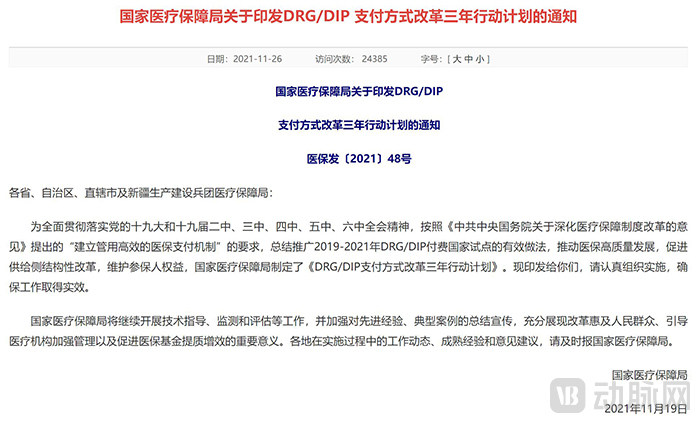
Screenshot from the official website of the National Healthcare Security Administration
Moreover, the Three-Year Action Plan further breaks down and refines annual task targets to guide local implementation. For instance, regarding full coverage of pooling areas, the Plan stipulates a three-year rollout schedule for 2022, 2023, and 2024, building upon the pilot programs conducted from 2019 to 2021. Specifically, each province (autonomous region, or municipality directly under the Central Government) is required to initiate DRG/DIP payment method reforms and implement actual payments in no less than 40%, 30%, and 30% of its pooling areas in 2022, 2023, and 2024, respectively.
Nevertheless, this task remains highly challenging and requires robust support from standardized health information systems. In 2019, the National Healthcare Security Administration completed the development of 15 sets of standard codes for healthcare security information services, established a code standard database along with a dynamic maintenance mechanism, thereby finalizing the standardization framework.
Meanwhile, the National Healthcare Security Administration has established a unified national healthcare security information system, centralizing data at the national and provincial levels and cleansing historical data to create a cohesive nationwide framework. This initiative aims to address longstanding challenges in healthcare security informatization, such as inconsistent standards, lack of mutual data recognition, fragmented systems hindering data sharing, and pronounced regional silos.
In October 2020, the main construction of the National Healthcare Security Administration’s healthcare security information platform was completed. In November, this nationwide unified healthcare security information platform was first implemented in Guangdong Province. By December 2021, the nationwide unified healthcare security information platform had gone live in more than 300 prefecture-level cities across 30 provinces and the Xinjiang Production and Construction Corps, with full-scale deployment completed in 24 provinces and the Xinjiang Production and Construction Corps.
During the DRG pilot program, the National Healthcare Security Administration also identified issues of inconsistency and non-standardization in the construction and application of DRG payment systems across different regions: inconsistent data sources, non-standardized data transmission, substandard data quality, and varying levels of completeness in basic functionalities.
The Three-Year Action Plan states that the National Healthcare Security Administration will release a national unified basic version of the DRG/DIP functional modules. In accordance with national standards, specifications, and the basic version, all regions are required to establish rules and parameters for the DRG/DIP functional modules based on local conditions, and ensure proper integration, data transmission, utilization, and security safeguards in connection with the national platform. This aims to achieve the goals of unifying data sources, data quality standards, and grouping specifications.
At the “Conference,” the National Healthcare Security Administration also introduced the nationally unified DRG payment management module, which primarily comprises the standards management module, local operational support module, and monitoring and evaluation module.
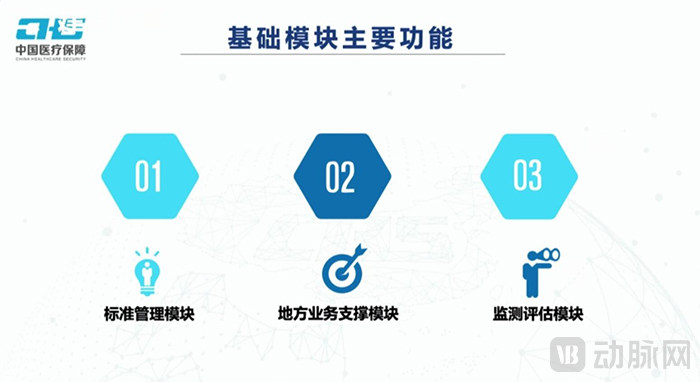
The National Healthcare Security Administration will establish a nationally unified DRG payment management module (screenshot from online live broadcast)
The Standard Management Module is primarily used for distributing national grouping standards and grouping services. Local cities can query the national grouping standards and invoke the national standard grouping services to promote standardized implementation of Diagnosis-Related Groups (DRG). The Local Business Support Module mainly provides DRG quality control services, weight and rate management services, and payment calculation services to various regions, thereby offering business support for DRG. The Monitoring and Evaluation Module facilitates national oversight of local DRG policy standards and their application status.
With the introduction of the concept of a nationally unified DRG payment management module, the competitive landscape of existing DRG information systems will undergo changes. Companies that fail to provide additional services beyond the standard management module to achieve differentiated competition will gradually be phased out in the future.
DRGs are closely linked to data, with the medical insurance settlement list serving as the sole data source for China Healthcare Security Diagnosis-Related Groups (CHS-DRG). The data in the medical insurance settlement list are primarily derived from inpatient diagnosis and treatment information and patient demographics recorded on the front page of the medical record, as well as relevant information from medical fee invoices. Among these, data quality issues mainly originate from the front page of the medical record. Therefore, improving the quality of the front page of the medical record is key.
In contrast, while the Big Data Diagnosis-Intervention Packet (DIP) has lower data requirements than Diagnosis-Related Groups (DRG), this does not imply that data quality is unnecessary. Pilot evaluations indicate that DIP also imposes high standards for data quality.
Currently, mainstream hospital-side DRG/DIP information systems, including those from Guoxin Health and Huoshu Technology, have made significant efforts in the intelligent completion and quality control of medical record front pages. These systems also provide multi-stage audit mechanisms for medical record front pages, covering pre-event, in-process, and post-event stages. This has resulted in an intelligent medical record verification system that encompasses the entire workflow of “medical record validation – medical record audit – medical record correction.”
One of the most distinctive features of this intelligent management system for medical record quality control is proactive oversight, which shifts the quality control of medical record face sheets to the physician’s end. By assisting physicians in completing these face sheets, the system enhances data quality at the “source,” thereby achieving the goals of reducing losses (for hospitals), improving efficiency (for medical records departments), and strengthening management (for quality control).
Furthermore, similar point-of-care assistance services have yielded positive outcomes in multi-departmental collaboration. Prior to the incurrence of medical insurance expenses, physicians’ prescriptions are subject to real-time review and proactive alerts based on factors such as the insured individual’s prior medical history, medical insurance payment policies, and relevant audit rules, thereby reducing unreasonable medical practices at their source.
During the care process, the DRG/DIP grouping prediction and early warning system can configure benchmark values for disease group management and issue alerts for high-risk medical records based on the hospital’s or department’s management requirements and objectives. Without interfering with clinical workflows or increasing the workload of clinicians, it provides reference data and early warnings to optimize resource allocation.
The DRG/DIP Hospital Intelligent Management System for Post-hoc Comprehensive Analysis is designed to meet the needs of various management roles by providing analytical dimensions such as pooling areas and case types, thereby achieving comprehensive monitoring of in-hospital DRG/DIP management and cost structures. Furthermore, building upon the hospital’s existing performance management model, it offers performance management and evaluation based on DRG/DIP assessments.
These features may appear simple, but they impose stringent requirements on an enterprise’s data governance and mining capabilities. Clearly, future DRG systems will need to compete more intensely on their underlying core competencies.
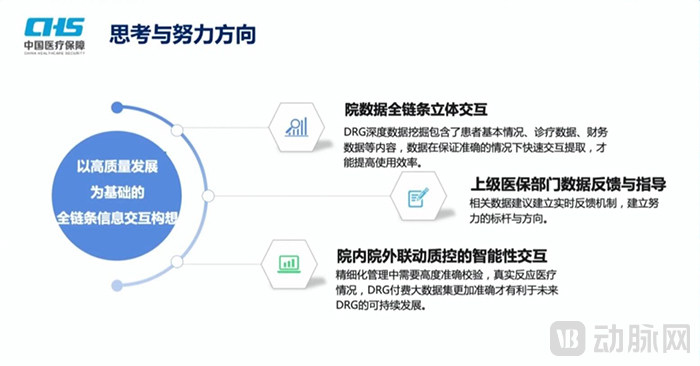
Hospital Perspectives on Hospital-Side DRG Systems (Screenshot from Online Livestream)
Furthermore, at the “Reform Conference,” the hospital also articulated its expectations for hospital-side systems. Features such as enabling comprehensive, multi-dimensional data interaction across the entire institutional chain, facilitating data feedback and guidance from higher-level authorities, and achieving intelligent interactions for coordinated quality control both within and outside the hospital may also represent potential differentiators in competitive positioning.
Implementing the DRG payment system is a large-scale government initiative that requires close collaboration among multiple sectors, including government decision-making bodies, legal departments, research centers, and professional associations. Taking Germany as an example, since the legislation in 2000 that incorporated DRGs into the statutory payment methods, it went through four stages: preparation, budget neutrality, base rate integration, and full implementation. It took nine years to stabilize and promote the system until its full implementation began in 2010.
Meanwhile, DRG is not a panacea and applies only to short-term inpatient stays. Drawing on international experience, China may further advance payment reforms across multiple domains, including outpatient care, day surgery, emergency services, nursing, rehabilitation, long-term care, and home-based services. For health IT companies, conducting early research and strategic positioning in these areas may help secure a competitive advantage in the future.
It is evident that the reform of medical insurance payment will be a long-term process. Currently, China’s three-year pilot programs for DRG/DIP have laid a preliminary foundation with initial results. The introduction of the "Three-Year Action Plan" signifies that China’s DRG/DIP payment reform has entered a new phase. VCBeat will continue to closely monitor the progress of medical insurance payment reforms and provide readers with the latest insights.
References:
China Medical Insurance: "Millions of Participants, This Payment Method Reform Conference Is of Great Significance!"
Jindou Data: "In-Depth Analysis | Five Key Issues in the Three-Year Action Plan for DRG/DIP"