

Genecast Enters the Era of Fully Automated Tumor NGS with End-to-End Integrated Solution

Genecast
Innovative Molecular Diagnostics and Testing Technologies, Products, and Services Provider for Oncology
If 2018 marked the inaugural year of compliant commercialization for clinical oncology NGS testing, then the true penetration of this complex technology into various clinically applicable scenarios may begin in 2021.
Good news keeps coming. As the year’s blockbuster new products, Thermo Fisher Scientific and Roche Diagnostics—two industry giants—coincidentally unveiled their respective NGS automation solutions at the China International Import Expo (CIIE) in November. Thermo Fisher stated that its newly launched Ion Torrent™ Genexus™ high-throughput sequencing system is the first fully integrated NGS platform to automate the entire workflow from sample to report. Representing a perfect fusion of high-precision industrial manufacturing and advanced life sciences, the system features seamless integration, a high degree of automation, minimal manual operation, rapid detection speed, and exceptional result accuracy. Meanwhile, Roche Diagnostics announced its AVENIO Edge System, an automated NGS library preparation workstation that integrates library preparation, targeted probe capture, and library quality control into a single platform, thereby overcoming key bottlenecks in high-throughput sequencing workflows.
In China, leading tumor NGS manufacturers are also actively expanding their layouts, with automation successively achieved in key steps such as NGS nucleic acid extraction, library preparation, bioinformatics analysis, and report interpretation. In mid-December, Genecast announced the launch of its “Fully Integrated Automated NGS Testing System” during the opening ceremony of its Wuhan Medical Laboratory. It is reported that since obtaining China’s first NGS test kit registration certificate specifically for colorectal cancer in early 2021, Genecast has sequentially launched products including fully automated library preparation instruments and all-in-one automated analysis systems. This further upgrade of its overall IVD solution truly realizes the transition of in-hospital NGS testing from distributed modular systems to complete end-to-end integration across the entire workflow, positioning Genecast as the first among domestic peers to enter the era of full automation.
Today, the feasibility of implementing tumor NGS technology in clinical practice has been validated to a certain extent.
On one hand, ten companies in the industry have obtained Class III medical device registration certificates for NGS oncology testing kits. Upstream equipment, testing reagents, and supporting software for NGS technology in tumor medication have all received product registration approval, achieving full-process clinical application. On the other hand, NGS technology is gradually being incorporated into global clinical guideline systems for cancer diagnosis and treatment. In May 2021, the European Society for Medical Oncology (ESMO) officially released guidelines for NGS in patients with metastatic cancer. As the first NGS usage guideline in the medical community, it clarified the interrelationships between the development and progression of high-incidence cancers such as lung cancer, breast cancer, and colorectal cancer, and mutations in popular gene loci including EGFR, BRCA, and BRAF. It also emphasized the use of multi-gene next-generation sequencing for tumors in NSCLC, cholangiocarcinoma, prostate cancer, and ovarian cancer.
However, tumor NGS technology has encountered new challenges in terms of clinical accessibility. Overall, the implementation of this cutting-edge technology in clinical practice is more complex than anticipated. Typical dilemmas include cumbersome procedures, high experimental difficulty, stringent personnel requirements, insufficient laboratory space, and low throughput per run. The heterogeneity of clinical samples introduces diversity and complexity into clinical testing, while factors such as environmental conditions, equipment, and staffing contribute to experimental instability. Consequently, in many scenarios where there was previously a demand, NGS technology cannot be effectively integrated into clinical workflows, resulting in slow overall penetration.
“Furthermore, the expansion of clinical applications has increased the complexity of NGS testing itself, involving a wider array of testing products and protocols. This has led to greater diversification in experimental workflows and operational details, thereby raising the learning and execution costs for physicians,” said Mr. Zheng Shan, Senior Director of IVD Operations at Genecast. “This necessitates that NGS solutions adopted by hospitals feature minimal manual intervention, low cost, time efficiency, and accurate, stable results.”
In other words, for NGS technology to be widely adopted in clinical settings, the “last mile” of ensuring accessibility must still be traversed by further reducing the cost of its clinical application—a challenge that may prove even more daunting than validating its clinical feasibility itself.
According to reports, Genecast’s fully integrated, automated NGS testing system systematically integrates wet-lab processes—including sample pre-processing, nucleic acid extraction, library preparation, hybridization capture, and high-throughput sequencing—with dry-lab workflows such as bioinformatics data analysis, medical annotation and interpretation, and report generation, along with comprehensive quality control across the entire workflow. This integration enables a one-click, intelligent, and fully automated end-to-end NGS testing process from sample to report.
During operation, process equipment involved in NGS testing—including nucleic acid extractors, PCR instruments, liquid handling workstations, fragmentation devices, concentrators, and sequencers—along with quality control instruments such as microplate readers and nucleic acid fragment analyzers, and sample storage facilities such as refrigerators and plate stacks, are integrated and coordinated via robotic arms. “NGS testing procedures are intricate and complex. We do not pursue automation for its own sake; instead, we emphasize the integrity of experimental and quality control workflows, systematically combining steps that can be performed simultaneously to enhance testing efficiency,” pointed out Mr. Zheng Shan. “In practice, the sensitivity and accuracy of results generated by automated systems are often higher than those achieved by manual operations under comparable conditions, as they eliminate errors potentially introduced by human handling.”
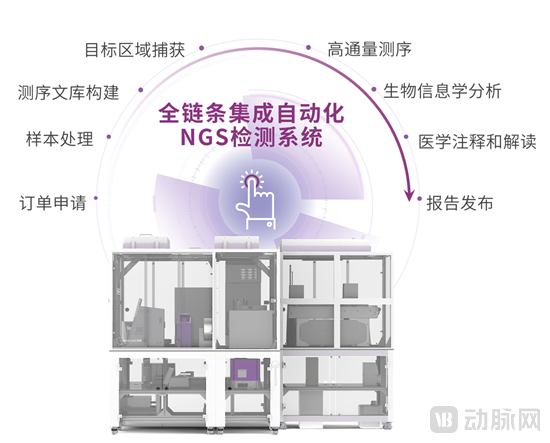
Genecast’s Fully Integrated Automated NGS Testing System (Image source: Genecast)
Notably, Genecast has integrated and developed in-hospital medical big data, including genetic data, to ensure the accuracy of testing. Specifically, Genecast has embedded a precision medicine knowledge base—powered by artificial intelligence and integrating bioinformatics with clinical phenotypic information—into its fully automated, end-to-end NGS testing system. Supported by a comprehensive and timely updated clinical medical knowledge base, the system aggregates complete data flows across the entire NGS workflow, including patient information, clinical data, sample details, experimental results, and quality control systems. This enables automatic collection, storage, dynamic analysis, and visual presentation of data throughout the NGS process, thereby achieving deep integration of in-hospital genetic testing big data. In this sense, the system establishes a data platform for in-house NGS laboratories based on real-world data, facilitating the comprehensive accumulation and efficient utilization of in-hospital tumor genetic testing data.
Furthermore, the fully integrated automated NGS testing system is governed by a sequential software architecture that organically integrates interfaces across all instruments, enabling real-time equipment status tracking and sample traceability. It comprehensively records sample testing progress, status, laboratory instruments, and quality control parameters, while providing timely feedback on instrument performance. “Hospitals frequently handle multiple samples in parallel,” emphasized Mr. Zheng Shan. “This software system can simultaneously manage complex multi-task workflows, significantly improving sample throughput efficiency, further reducing turnaround time (TAT), and enhancing the user experience for clinicians.” By adopting the fully integrated automated NGS testing system, hospitals can flexibly select the number of samples per run and customize testing workflows.
“With this integrated system, we have minimized manual operations in the in-house testing process. By simply creating experimental protocols and loading consumables, clinical test reports can be obtained within 2–3 days of truly unattended operation, significantly improving the efficiency of clinical NGS testing,” said Mr. Zheng Shan.
Currently, the fully integrated, end-to-end automated NGS testing system has completed the design of its engineering prototype and has begun clinical validation at large and medium-sized hospitals while exploring models for commercial collaboration. On the opening day of Wuhan Genecast Medical Laboratory, the robot quietly demonstrating pipetting operations attracted many attendees to stop and watch.
Wuhan Genecast Medical Laboratory is located in the Gaoke Medical Device Park within Wuhan Optics Valley, adjacent to leading life sciences companies such as MGI Tech, Abclonal, HopeBio, and FutureOmics. Situated in Wuhan, a major transportation hub connecting nine provinces, this medical laboratory represents a strategic milestone for Genecast’s expansion in Central China.
According to Mr. Du Bo, Founder and CEO of Genecast, the Wuhan Genecast Medical Laboratory will focus on achieving two key functions. First, it will support the group’s strategic layout in IVD R&D by establishing an IVD Product R&D Center, providing technical and market support for the nationwide promotion of fully integrated, automated NGS testing systems. Second, serving as the headquarters base for collaborative precision medicine laboratories with hospitals across China, the Wuhan Medical Laboratory will provide medical and technical support for in-hospital testing.
In recent years, the adoption of next-generation sequencing (NGS) technology has continued to increase across hospitals at all levels. However, the implementation pathways for providing high-throughput gene sequencing services vary significantly among different institutions. For instance, large tertiary Grade A hospitals, which typically have a higher concentration of oncology patients and abundant medical resources, are well-positioned to deploy NGS equipment in-house, thereby substantially improving testing efficiency. In contrast, many other hospitals, constrained by limited throughput or inadequate infrastructure, still rely on third-party clinical laboratories for technical support when conducting NGS tests. According to industry practitioners speaking to VCBeat, the volume of patient demand for NGS testing has maintained a relatively rapid growth rate across hospitals at all levels.
“To provide NGS testing services to hospitals, it is essential to comprehensively consider the disparities in software and hardware capabilities among hospitals at different levels under the current tiered healthcare system,” pointed out Mr. Du Bo. “The parallel operation of third-party and in-house testing may persist for a period during the clinical popularization of NGS testing. We will maintain our clinical innovation and service capabilities through the synergistic integration of our services and products.”
As one of the earliest providers in China to offer tumor NGS testing services for clinical use, Genecast has established what is arguably the most comprehensive portfolio of tumor NGS products. Specifically, Genecast has developed a multi-dimensional molecular biomarker detection platform that leverages high-throughput next-generation sequencing (NGS) to provide panel tests ranging from hundreds of cancer-related genes to whole exome sequencing. This platform can simultaneously detect single nucleotide variants (SNVs), insertions and deletions (Indels), copy number variations (CNVs), tumor mutational burden (TMB), microsatellite instability (MSI), gene fusions and rearrangements, minimal residual disease (MRD), homologous recombination deficiency (HRD), and human leukocyte antigens (HLA). It delivers diagnostic reports aligned with advanced international standards to support precision oncology diagnosis and treatment.
In addition to the colorectal cancer NGS testing kit mentioned at the beginning of the article, Genecast has also developed a full-cycle precision diagnostics portfolio covering targeted drug sensitivity testing, multi-dimensional assessment for immunotherapy selection, evaluation of chemotherapy efficacy and adverse effects, companion monitoring during tumor treatment, early tumor screening, and postoperative recurrence risk assessment. These solutions are applicable to solid tumors such as lung cancer, colorectal cancer, breast cancer, and glioma, with pan-cancer related products gradually being commercialized.
“Our layout in Wuhan actually consists of one clinical laboratory and two technical centers (an IVD R&D Center and an IVD Technical Support Center),” said Mr. Du Bo. “These three segments can organically work together to support the overall development of our IVD business, forming a complete value chain that ranges from providing basic testing services to advancing product development, and leveraging the Technical Support Center for product demonstrations and user training.”
According to Genecast’s vision, the synergy among its three major business segments will enable NGS technology to exit the laboratory more efficiently, facilitating its widespread and convenient implementation in hospitals, thereby bridging the “last mile” of clinical integration. Indeed, tumor NGS testing will ultimately become a routine option when clinically indicated for patients, and automation may well accelerate the arrival of this milestone.
Writing Reference:
“Guidelines for Next-Generation Sequencing in Patients with Metastatic Cancer”
The Future Is Here—No Need to Wait | Thermo Fisher Scientific’s Automated NGS System Makes a Major Debut
Redefining End-to-End Automation in Sequencing! Roche Diagnostics’ Next-Generation Fully Automated NGS Library Preparation Workstation Launches in China