

Hudian Data Files IPO Prospectus: Pioneering Home-Based Rehabilitation with Sensor and IoT Solutions
The market potential of rehabilitation medicine is beyond doubt.
According to KPMG analysis, total expenditure in the rehabilitation medical market amounted to RMB 58.3 billion in 2018. Based on a compound annual growth rate (CAGR) of 20.9% from 2014 to 2018, the market size for rehabilitation medical services is estimated to have reached RMB 103.2 billion in 2021. With economic development and heightened public awareness of rehabilitation, the rehabilitation medical market is poised for accelerated growth, with its size projected to reach RMB 220.7 billion by 2025, underscoring the substantial untapped potential of this multi-billion-yuan market.
With the “cake” in place, there are many different perspectives on how to slice this market.
For tech companies, leveraging the unique features and advantages of smart hardware and internet-based healthcare to address the pain point of home-based rehabilitation—where physicians have limited reach—represents one of the key growth opportunities in the future rehabilitation industry.
Recently, VCBeat conducted an exclusive interview with Cheng Zuwei, founder of Hudian Data Technology Co., Ltd. (hereinafter referred to as “Hudian Data”), a smart rehabilitation company, to explore how he is tapping into this hundred-billion-yuan market using sensors and the Internet of Things (IoT).
Hudian Data, founded in Shanghai in 2019, is a technology company focused on the home-based rehabilitation market, providing customers with intelligent hardware for rehabilitation.
Cheng Zuwei explained, “If in-vehicle navigation systems and dashcams represent the digital upgrade of traditional automobiles, then the intelligent system we are developing is akin to the in-vehicle navigation systems and dashcams of traditional rehabilitation products, leveraging sensors and the Internet of Things (IoT) to achieve our objectives.”
After leaving the hospital, Cheng Zuwei worked in product management and R&D at orthopedic medical device companies such as Stryker-Trauson. Over the past three years, he has participated in projects with medical AI and wearable technology companies, building momentum for his subsequent entrepreneurial ventures.
Currently, Hudian Data has two full-time employees and a core team of five members.
“We didn’t spend heavily to build a lavish team and kick off R&D, as traditional startups do.” Cheng Zuwei paused. “We built our human resources based on the actual needs of product development. Our current team is fully capable of driving the project and R&D forward.”
The company currently has two core products, BraceCoreMini and BraceCore, which are scheduled to be launched sequentially from March to June 2022.
These two products integrate advanced communication and sensor technologies, making them suitable for home-based rehabilitation scenarios for a variety of common diseases. Furthermore, the system enables objective follow-up assessments, providing real-world data that is both objective and authentic for clinical medical research.
Let’s now take a look at these two products.
Scoliosis is a physical deformity that severely impairs the normal skeletal development of children. As it predominantly affects adolescents, it is also referred to as adolescent scoliosis.
Scoliosis is classified into congenital and idiopathic types based on etiology. The global research consortium DISCO, led by Peking Union Medical College Hospital, has found that approximately 15% of scoliosis cases are congenital, 65% are idiopathic, and about 10% are secondary to neuromuscular disorders. Congenital scoliosis is less common clinically and typically requires surgical correction. Idiopathic scoliosis is often caused by long-term poor posture or unhealthy lifestyle habits, and most cases can achieve favorable outcomes with conservative treatment.
According to data from the website of Beijing Chaoyang Hospital, Capital Medical University, the prevalence of scoliosis in China ranges from 1.5% to 3%. Currently, there are over 3 million patients with scoliosis in China, with an annual increase of 300,000 cases. More than half of these patients are adolescents, with the condition being most common among those aged 8 to 14 years.
Scoliosis not only imposes a physical burden on pediatric patients but also adversely affects the psychological well-being of adolescents due to bodily deformity and impaired body image.
Rehabilitation for adolescent idiopathic scoliosis is a typical application scenario for BraceCore.
This product incorporates an IoT chip, enabling real-time direct data transmission to the backend, allowing patients to view their data via a mini-program or mobile app.
BraceCore is equipped with a variety of sensors that can sensitively detect pressure, temperature, movement, and posture on the body surface.
This product features a simple structure, supports various wearing or mounting options, and is equipped with a 450mAh lithium battery for extended battery life. It also includes a Type-C interface to accommodate additional sensor accessories.
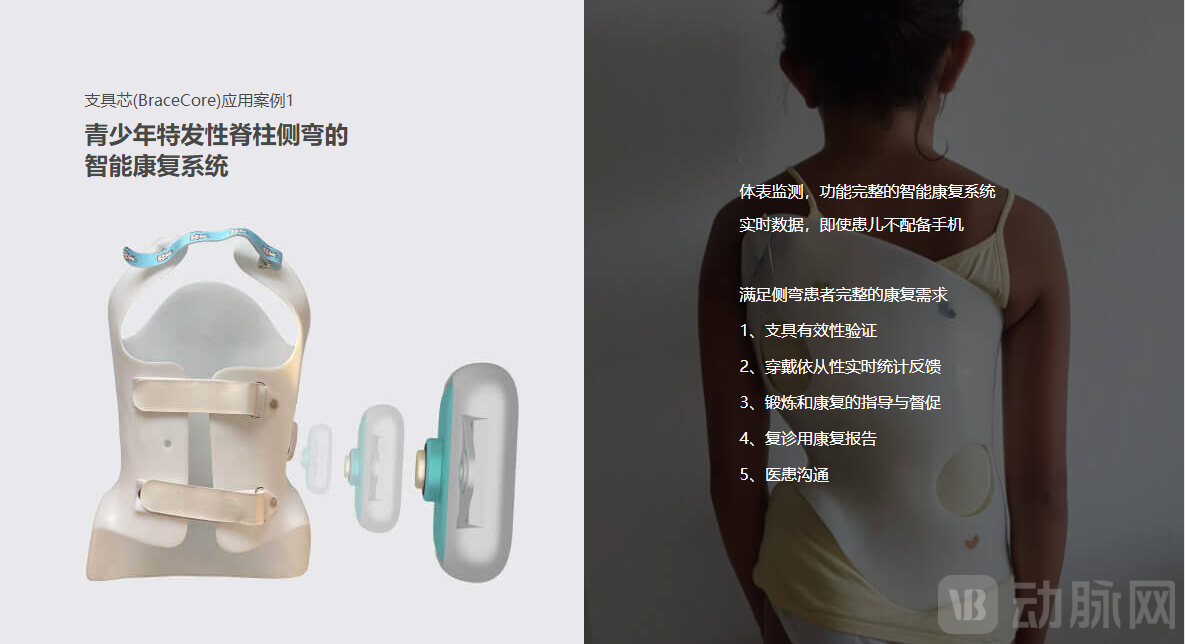
Image source: Hudian Data official website
BraceCore meets the rehabilitation needs of scoliosis patients, offering features such as brace efficacy validation, real-time statistical feedback on wearing compliance, guidance and monitoring for exercises and rehabilitation, and doctor-patient communication.
Rehabilitation management following anterior cruciate ligament reconstruction is a typical application scenario for BraceCoreMini.
Anterior cruciate ligament injuries are mostly caused by trauma, violence, and other factors. They are commonly seen in non-contact sports injuries, traffic accidents, and falls from heights.
Patients with acute injuries typically present with symptoms such as an audible tearing sound in the knee, pain, swelling, and even limited range of motion. Chronic cases are often characterized by joint instability during sudden stops or pivoting movements, commonly manifesting as knee buckling or a sensation of joint shifting.
According to the NCBI, there are approximately 100,000 to 200,000 ACL ruptures annually in the United States, with an annual incidence rate of about 1 in 3,500. ACL injuries account for approximately $500 million in healthcare costs. In China, data from 2017 on anterior cruciate ligament reconstruction therapy indicated that the annual number of ACL reconstruction surgeries reached 100,000.
According to data from the 11th International Congress of Arthroscopy in 2017, China’s annual volume of anterior cruciate ligament (ACL) reconstruction surgeries has ranked second worldwide, reaching approximately 100,000 cases.
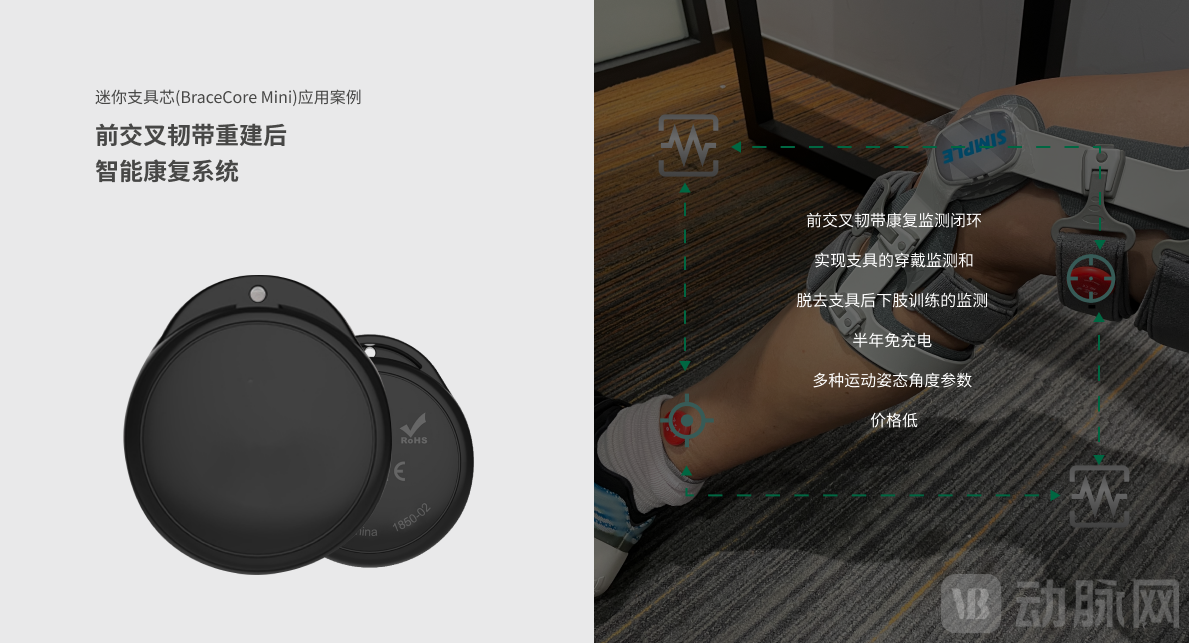
Image source: Hudian Data official website
BraceCoreMini is an intelligent device developed based on sensor and IoT communication technologies, integrated with disease-specific rehabilitation knowledge.
This product enables a closed-loop home-based rehabilitation system for anterior cruciate ligament (ACL) injuries, providing monitoring of brace wear and lower-limb exercises after brace removal. It detects patient movement and posture, offering an affordable solution.
Traditional doctor-patient communication is conducted face-to-face. The lack of standardized dialogue, low efficiency of one-on-one services, and poor patient adherence during actual rehabilitation are critical pain points in rehabilitation that urgently need to be addressed.
Hudian Data aims to make this process more intelligent and automated. Cheng Zuwei explained that this essentially involves addressing three issues: reminders, education, and recording. Patients should be reminded when they forget to perform a task or do it improperly; they should be taught how to do it correctly when they are unsure; and the data generated in daily routines should be recorded. All of these can be addressed through digital solutions, which is precisely what Hudian Data is currently doing.
Samples of BraceCore Mini and BraceCore have been released and are currently being piloted in partner hospitals.
Hudian Data seeks to collaborate with pharmaceutical manufacturers, medical device companies, brace manufacturers, or brace distributors to realize intelligent rehabilitation.
Cheng Zuwei added that, given the discrepancies between in-hospital and out-of-hospital data, much pharmaceutical R&D needs to be based on data collected from patients’ real-world home settings. This is precisely what Hudian Data’s products do; therefore, Hudian Data can provide substantial support in the realm of real-world data.
Regarding future plans, Cheng Zuwei stated that more products and applications will be developed over the next three to five years, potentially expanding into neurological rehabilitation or other rehabilitation fields, while still maintaining an overall focus on home-based rehabilitation.
Hudian Data is currently conducting its first round of financing. The company plans to raise RMB 5 million, with the funds primarily allocated to team building, product development, and mass production.