

EFIT Announces IPO Filing Following G-MARK Award-Winning Fiber Annulus Suture Technology with Over 20,000 Clinical Applications Nationwide
There is a disease that, while not fatal, makes its presence known through excruciating pain.
Lumbar disc herniation is the most common spinal degenerative disease in clinical practice. According to statistics from the National Health Commission, the number of patients with lumbar spine disorders in China has exceeded 200 million, with those suffering from lumbar disc herniation accounting for 15.2% of the total population. Moreover, in recent years, the incidence of disc herniation has gradually shifted from middle-aged and elderly individuals to adolescents and young adults, predominantly affecting those between the ages of 20 and 50.
Most patients with lumbar disc herniation can achieve symptom relief through conservative treatment, while a minority require surgical intervention. Historically, the two primary surgical approaches were nucleotomy and spinal fusion. Among these, nucleotomy is the most direct and effective surgical method, as it alleviates nerve root compression by removing the herniated nucleus pulposus from the affected lumbar intervertebral disc. However, the annular defect remaining after nucleotomy does not heal spontaneously; if not addressed promptly, residual nucleus pulposus may re-herniate.
Before the advent of annulus fibrosus suturing devices, surgeons aimed to thoroughly remove the nucleus pulposus to minimize the risk of recurrent lumbar disc herniation. However, complete evacuation of the nucleus pulposus from the intervertebral space often led to vertebral body collapse over an extended period. The intervertebral discs normally maintain a certain height between adjacent vertebrae; once the nucleus pulposus is removed, the resulting loss of disc height causes the vertebrae to approximate each other, leading to nerve compression and accelerated degeneration of the intervertebral disc.
Annulus fibrosus repair is the simplest method for addressing recurrent disc herniation, and annular closure devices are essential tools in this repair process. Currently, those used in clinical practice include the Xclose annular closure device from the United States and the EFIT annular closure device from 2020 (Beijing) Medical Technology Co., Ltd. (hereinafter referred to as “2020 MedTech”).
Compared with the former,2020 Medical Technology’s annulus fibrosus suturing device is simple and quick to operate, leaves no foreign bodies in the patient’s body, and avoids the risks of rejection and dislodgement.
Leveraging the world’s first annulus fibrosus repair technology,2020 Medical Technology’s annulus suture device won the world’s top design award—the G-MARK Global Design Gold Award—in 2017 and has been granted patents in multiple countries.. This is an affirmation of the originality of domestic brands, and also the technical confidence for the company's future overseas expansion.
As the founder of 2020 Medical Technology, Wang Daiwen seems to carry an innate gene for innovation.
During his early graduate studies, he independently conducted R&D, designing products, sourcing manufacturers for production, and performing animal experiments. The cumbersome R&D process and the day-to-day repetitive testing and refinement did not deter him; rather, they strengthened his resolve to overcome challenges.
After earning his bachelor’s degree, he became an orthopedic surgeon and immersed himself in frontline clinical practice to gain a deep understanding of unmet needs. In the hospital setting, he observed the challenge of recurrent lumbar disc herniation following minimally invasive surgery, which led him to focus his research and development efforts on annulus fibrosus suturing devices.
Later at Medtronic, Wang Daiwen transitioned from a physician to a sales and marketing executive. Leveraging the extensive platform of this multinational giant, he began to examine the development of spinal repair technologies and the future direction of minimally invasive procedures from a market-oriented perspective.
“For enterprises to develop, they need not only to address technical issues but also to resolve challenges related to future market promotion and strategic direction.”
Early experiences enabled Wang Daiwen to accumulate professional medical knowledge and clinical expertise, while also developing his market management capabilities and global perspective. He realized that the time had come to launch his own venture. His two identity transitions—from clinician to marketing professional, and then to entrepreneur—served as the “armor” he forged for his entrepreneurial journey.
In 2010, 2020 Medical Technology was officially established. The name “2020” represents the ten-year goal set by Wang Daiwen to complete product development and initiate the market launch process within a decade.Over the first decade, 2020 Medical focused on one strategic direction, one core technology, and one flagship product: centering on minimally invasive spine surgery, it achieved a breakthrough in annulus fibrosus repair technology and developed an annulus fibrosus suturing device.
In 2009, the company obtained a patent for a disposable annulus fibrosus suturing device and spent five years developing a tangible, clinically effective product. Over the subsequent five years, the company launched academic promotion campaigns across China. As a domestically developed, original annulus fibrosus suturing device, it initially lacked industry recognition; however, as of now,2020 Medical Technology has promoted more than 20,000 surgeries nationwide, with the longest follow-up period exceeding five years.
“For patients undergoing lumbar discectomy, if the damaged annulus fibrosus is not addressed, the recurrence rate of disc herniation is approximately 10–20%. We have now reduced this recurrence rate to 1%. Each percentage point decrease may prevent tens of thousands of patients from experiencing recurrent disc herniation.”
As time flies, 11 years have passed, and 2020 Medical Technology has entered 2021.The Company Has Over 20 Models of Disposable Annulus Fibrosus Suturing Devices and More Than 20 Patents. The product portfolio has evolved from an initial focus on annulus fibrosus suturing devices to a specialized emphasis on the minimally invasive spine and sports medicine markets. The team has also grown from a handful of R&D personnel into a lean, integrated workforce encompassing R&D, production, sales, and marketing departments.
“We have offices and dedicated sales personnel in virtually every province across China. Our primary focus is on channel sales, and we currently have over 200 signed distributors nationwide.”
“A car tire with a tear can be simply repaired by gluing or stitching it directly. However, if the tire were placed at the bottom of a deep well, the repair technician’s arms would not be long enough to reach it, necessitating the use of an elongated instrument for the repair. Similarly, our intervertebral discs are like tires, situated in a deep and narrow space. Moreover, the area adjacent to tears in the annulus fibrosus is obscured by the spinal cord, nerves, and bones.”
Annulus fibrosus suturing requires the entire process of needle insertion and suture passage to be performed within a confined space. Two puncture needles are inserted simultaneously from both sides of the annular tear, achieving precise apposition, followed by knot tying using a guide wire.Even a 0.1 mm error in one of the movements can affect the completeness of the entire sequence.
Meanwhile, nerve injury must be avoided during annulus fibrosus suturing, requiring the suture device to operate with high precision. Therefore, the selection of materials for the annulus fibrosus suture device, the design of suturing maneuvers, and the assembly process all require rigorous and repeated testing.
While ensuring adequate suture strength, the suture must not be excessively thick to minimize mechanical irritation to the nerve. After screening multiple suture options,In 2020, Yier Medical Technology selected a suture from an imported manufacturer, with a diameter of only 0.18 mm and no more than 0.3 mm after knotting.。
Moreover, during the early stages of research and development, the company devoted significant efforts to partnering with a defense industry enterprise. After prolonged and iterative processing and testing, they successfully developed a guidewire with superior performance, meeting the clinical requirement for “not too stiff, yet not too soft.”
“Don’t let the small size of the annulus fibrosus suturing device fool you; many of its components and materials are original, requiring rigorous testing after assembly. If you modify even a single component, the entire design must be reworked from scratch. The greatest challenge is that no such product exists globally, leaving us without any benchmarks or clear expectations for the final product. We had to forge our own path through trial and error.”
In 2012, the first-generation disposable annulus fibrosus suturing device was introduced, but its clinical trial success rate was not high. Reflecting on this failure, Wang Daiwen summarized: “The first-generation product lacked sufficient stability, resulting in inadequate precision during puncture and apposition; the intended needle-passing and thread-guiding maneuvers could not be completed within the human body.”
To address the issues encountered during the trials, 2020 Medical Technology identified two breakthroughs. First,Enhancing the Strength of Puncture Needles, improve the raw materials and molds of puncture needles. Second,Integrated Design of the Improved Cannula, allowing two puncture needles to enter and exit through a single channel. The puncture needle is a flexible needle with a diameter of only 1.4 mm, requiring an outer cannula for stabilization. Previously, the company’s R&D team adopted a separable design for the cannula, whereby the two puncture needles would merge after individually penetrating the annulus fibrosus; however, this alignment process resulted in reduced accuracy.
Thus,2020 Medical Technology Increases the Accuracy of Annulus Fibrosus Suturing Devices to Over 95%Guided by a research and development spirit that grows stronger with each setback, the company has rapidly iterated its annulus fibrosus suturing device, which is now in its sixth generation.
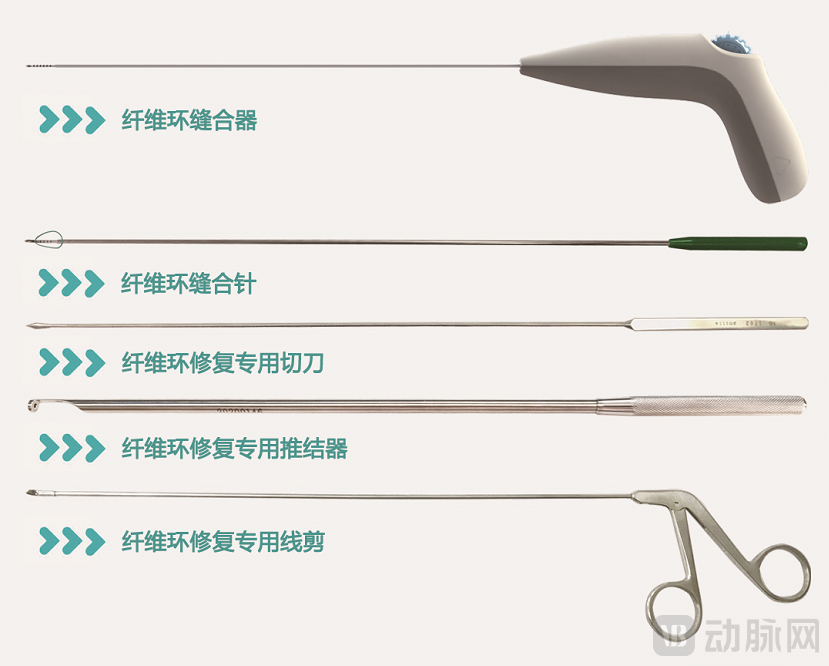
2020 Medical Technology Annulus Fibrosus Repair System
The 6th-generation product isDisposable Annulus Fibrosus Suturing Device for Use Under Transforaminal EndoscopyCurrently, the most widely applied minimally invasive spinal procedure is transforaminal endoscopic surgery, with over 90% of physicians adopting this technique. In 2020, Medical Technology shifted from the traditional two-needle puncture method to a single-needle approach: the first needle insertion creates an entry point for suturing one side, while a second separate incision is made to suture the other side.
The company leverages its proprietary single-needle puncture T-bar technology to thicken and stiffen the suture, forming a T-shaped bar that anchors the suture within the annulus fibrosus.
“Our first product registration certificate was obtained at the end of 2018. To date, we have registered 14 models, each indicated for different intervertebral disc surgeries. At the time of initial approval, our visibility in the field of minimally invasive spine surgery was relatively low; however, the company has prioritized academic promotion and technology dissemination, participating in over 200 academic conferences on intervertebral disc repair techniques, and successively promoting annulus fibrosus repair technology in countries such as Germany and Italy.”
As of 2021,2020 Medical Technology’s intervertebral disc suturing device has been adopted by nearly 180 hospitals across China, with over 20,000 clinical procedures performed to date, including nearly 10,000 procedures in 2021 alone.。
Building on its annulus fibrosus repair technologies and products, 2020 Medical Technology has gradually evolved into a comprehensive spinal repair ecosystem.The company has developed a minimally invasive spinal surgery system centered on electronic endoscopy, which includes an annulus fibrosus suturing device, a pulse lavage system specifically designed for spinal procedures, a low-temperature plasma knife tip operating in an air medium, and a range of complementary minimally invasive surgical instruments.
From a clinical perspective, after the bulk of the nucleus pulposus is removed, small fragments often remain in the intervertebral disc space, making thorough clearance challenging for surgeons. The pulsed lavage system can effectively flush out these residual fragments, much like using a vacuum cleaner to clean a room, thereby reducing the recurrence rate of lumbar disc herniation.
Meanwhile, previous low-temperature plasma electrodes operated in an aqueous medium; however, most surgical procedures are actually performed via open incision. Open surgeries require a product capable of hemostasis and ablation. Therefore, 2020 Medical Technology has launched a low-temperature plasma electrode designed for use in an air medium.
With the advancement of minimally invasive techniques, endoscopic discectomy may gradually replace traditional discectomy. In 2020, a medical technology company developed a system that simplifies minimally invasive procedures and shortens the learning curve for physicians. Furthermore, this system can also be utilized in open spinal surgeries.
Furthermore, while developing its minimally invasive spinal surgery system, 2020 Medical Technology is also expanding into the sports medicine market. This is not a blind “expansion,” but rather a strategy formed based on the alignment between clinical needs and the company’s core technologies.
“Traditional meniscal suturing devices leave foreign bodies in the human body, potentially causing rejection reactions in patients. The most significant advantage of our annulus fibrosus suturing device is that it leaves no foreign material behind. Furthermore, suture braiding represents a core technology in sports medicine; we have procured dedicated braiding machines and polyethylene raw materials, and have mastered novel braiding techniques. Additionally, the team at 2020 Medical Technology maintains close collaboration with physicians, enabling timely responses to their needs.”
In terms of academic promotion, in 2020, Yierling Medical Technology facilitated the establishment of the Professional Group on Disc Repair and Reconstruction under the Chinese Medical Doctor Association, the China Association of Integrative Medicine, and the Chinese Research Hospital Association. Meanwhile, the company has accumulated substantial expert resources and collaborated with numerous renowned Grade A tertiary hospitals and spinal specialists across China. It launched two nationwide multicenter research projects in 2016 and 2021, respectively, with participation from over 70 hospitals, thereby generating extensive clinical data.
Furthermore, during its development, 2020 Medical Technology secured tens of millions in investments from Northern Light Venture Capital and Yizhuang State-owned Capital Investment. The company is currently undertaking its third round of financing.
“Over the next five years, 2020 Medical Technology will continue to refine its existing spinal repair technologies, comprehensively promote market adoption and academic outreach in the minimally invasive spine sector, and strive to increase product sales. Meanwhile, the company will work to establish a strong foothold in the field of sports medicine, building a premier brand for spinal and joint repair and reconstruction technologies.”