

Ping An Healthcare Technology's 'Changzhou Model' Honored as a 2021 Healthy China Innovative Practice Case
Recently, the First People’s Health Conference and the 2021 Healthy China Innovative Practice Case Summary Conference, hosted by People’s Daily Online, organized by People’s Health, and academically supported by the Chinese Preventive Medicine Association, was held in Beijing. At the conference, the “2021 Annual Excellent Cases of Innovative Practices for Healthy China” were officially released. The “Jiangsu Changzhou Medical Insurance Payment (DRGs)” project, submitted by Pingan Medical Health Management Co., Ltd. (hereinafter referred to as “Pingan Medical Insurance Technology”), was honored as an excellent case in the “Diversified Integration” category, owing to its adherence to fundamental principles while innovating, its outstanding application results, and its replicability.
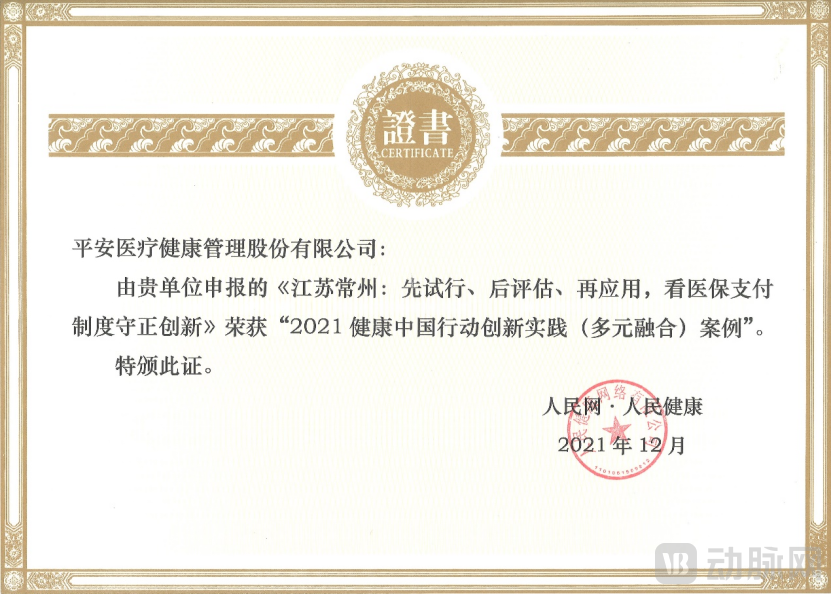
It is reported that in April this year, People’s Daily Online launched the call for entries and exhibition of “2021 Healthy China Innovative Practice Cases” to encourage broad societal participation in the Healthy China initiative, mobilize the enthusiasm and creativity of all stakeholders, and help foster a multi-level, diversified pattern of collaborative social governance. A total of 357 cases were submitted from across China. Based on a comprehensive evaluation considering actual outcomes, replicability, degree of innovation, and contribution to promoting the Healthy China Action, the “2021 Excellent Innovative Practice Cases for Healthy China” were selected and commended.
Reforming healthcare payment methods is one of the most effective measures to promote cost management reform in hospitals. As China’s healthcare system reform continues to deepen, pilot initiatives for prospective payment systems, such as Diagnosis-Related Groups (DRGs), are advancing rapidly. As a DRG pilot city in Jiangsu Province, Changzhou launched its DRG reform pilot in May 2019. Following the work arrangement of “top-level design, simulated operation, and actual payment,” and aiming to build a framework of “one core, two wings, and six systems,” Changzhou has steadily advanced DRG-based payment reform in coordination with broader healthcare system reforms. In September of the same year, the Changzhou Healthcare Security Administration signed an agreement with Ping An Health Insurance Technology to jointly promote DRG reform in Changzhou. After 15 months of collaborative efforts, both parties successfully completed all system modifications and trial operations. They also completed three specialized expert reviews: clinical validation of disease grouping results, expert review of Traditional Chinese Medicine (TCM) support items, and national expert review of the payment scheme and overall project operation. Formal implementation for payment began in January 2021. The system has operated smoothly since then, with settlement results aligning with simulation expectations. Pilot hospitals have reported positive feedback, and the payment process has remained stable, marking the preliminary completion of Changzhou’s payment system reform.
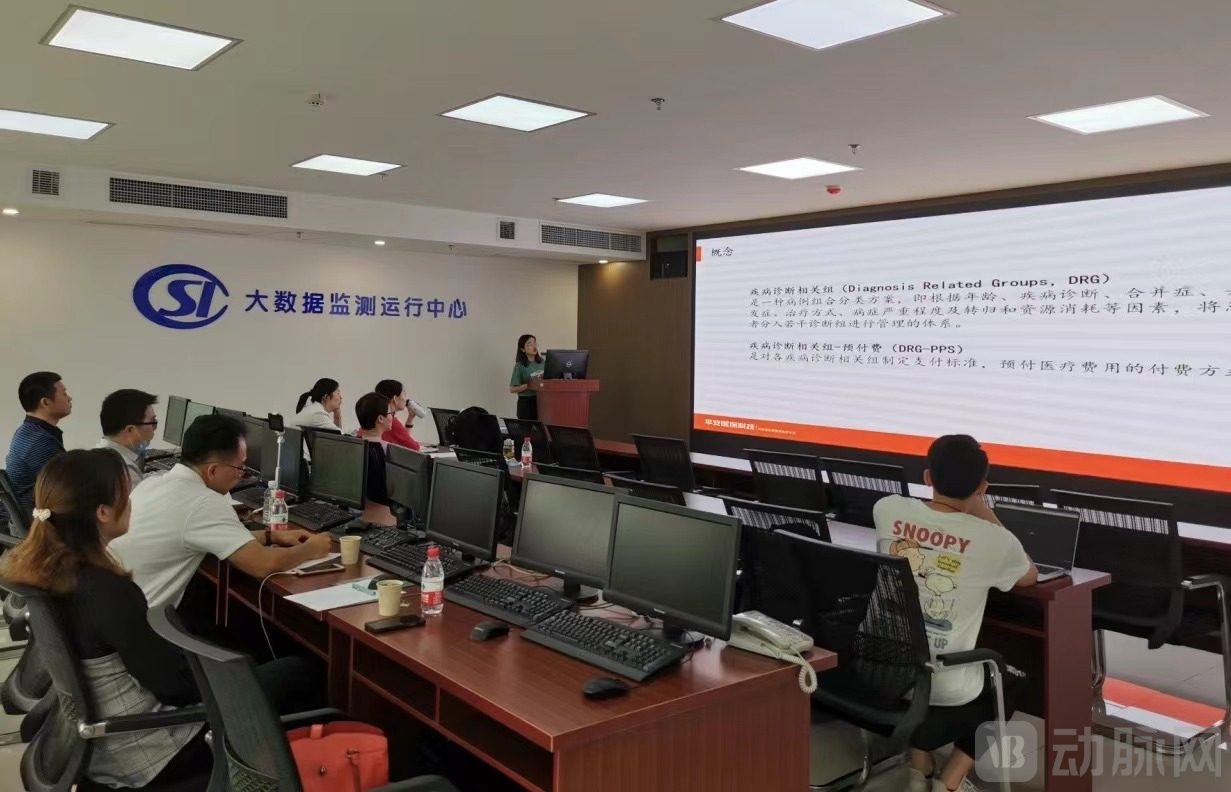
On-Site Demonstration Meeting for the Localization of CHS-DRG Grouping in Changzhou City
Changzhou City has attached great importance to the pilot program for Diagnosis-Related Groups (DRG) payment reform, implementing a variety of measures throughout the process. These include establishing a multidisciplinary expert team to provide technical support; fostering unified understanding and building consensus on reform; strengthening organizational communication and training; ensuring a gradual and smooth transition of the payment system; developing a comprehensive supporting framework for DRG-based payments; and exploring refined prospective payment tools. As the technical support provider for Changzhou’s DRG pilot program, Ping An Health Insurance Technology has delivered high-quality, highly responsive services throughout the entire process and accelerated system deployment and implementation through multiple innovations, notably including:
Innovation in Information Systems: Achieving comprehensive medical record data collection through full-scope data acquisition and end-to-end data quality control, thereby enabling robust quality assurance and facilitating online regulatory audits. In terms of usability, the system adopts a user-friendly design combined with configurable personalized applications, ensuring rapid response to business needs while allowing users to get started easily, which objectively accelerates the pilot implementation of Diagnosis-Related Groups (DRG).
Innovation in Business Standards: By leveraging the dual expertise of local and industry specialists as a foundational guarantee, the development of the grouper ultimately achieved a localized DRG grouping system that “complies with national construction standards and aligns with Changzhou’s actual conditions,” comprising 366 ADRG groups and 735 DRG subgroups. This grouper has also become one of the most rapidly implemented CHS-DRG groupers.
Innovative Project Model: Adopting a collaborative implementation approach between health bureaus and hospitals, with synchronized promotion to ensure effective execution. This model optimizes medical record quality management at the source, enhances patient enrollment and settlement efficiency, facilitates refined internal hospital management, strengthens cost and quality control, and promotes operational refinement within hospitals.
DRG Regulatory Innovation: This initiative incorporates intelligent regulatory technologies, utilizing 1,041 big data models to screen reimbursed cases individually. It automatically identifies common fraudulent practices in DRG payments, such as upcoding, non-compliance with hospitalization criteria, and cost shifting. By integrating a clinical knowledge base with Natural Language Processing (NLP) and big data mining models, the solution achieves dual control over medical insurance fund risks and healthcare service quality under bundled payment systems. With a precision rate of up to 95%, it effectively alleviates operational pressures on medical insurance administration.
People’s Daily Online’s call for submissions of “2021 Healthy China Initiative Innovative Practices” cases, targeted at the grassroots level, presents a valuable opportunity to promote the Healthy China Initiative and an important avenue for identifying innovative practices at the grassroots level. Since launching the DRG (Diagnosis-Related Groups) pilot program, Changzhou City has seen a significant improvement in hospital management and service efficiency. The “Changzhou Model” has been fully affirmed by the Jiangsu Provincial Healthcare Security Administration and its expert panel, and is gradually establishing a regional demonstration effect within Jiangsu Province. As healthcare insurance constitutes an essential component of economic and social development, and in light of the National Healthcare Security Administration’s directive to nationwide rollout of healthcare payment method reforms by the end of 2021, Changzhou’s experience in payment reform is sure to provide new insights and approaches to healthcare reform for more cities.