

Bamboo Health Emerges from $500M Merger of Appriss Health and PatientPing to Transform Care Coordination

Appriss Health
Healthcare Company
This March, Appriss Health acquired PatientPing.
Neither party has disclosed the specific amount of the transaction to the public.
According to Medcity News, although the specific terms of the transaction were not disclosed, insiders revealed that the deal was valued at approximately $500 million.
In fact, since 2015, PatientPing has completed three rounds of financing, totaling over $100 million. Notably, in June 2020, when the pandemic was severely impacting the United States, it closed a new round of Series C financing amounting to $60 million. According to media reports from Privco, its valuation at that time was already between $100 million and $500 million.
Why did PatientPing choose to be acquired by Appriss Health this year? What differences will the Bamboo Health brand, introduced following the acquisition and subsequent rebranding, bring? Is this M&A deal an isolated case in the industry, or does it serve as a footnote signaling an accelerated pace of consolidation in the digital health sector?
We attempt to gain some insights from the emergence of the new brand, Bamboo Health.
 Image source: PatientPing official on LinkedIn
Currently, there are limited Chinese-language resources available domestically on PatientPing. We primarily collected, organized, and summarized data from sources such as Crunchbase, the official PatientPing website, YouTube, LinkedIn, and selected results from Google Search. Our approach to Appriss Health was similar, with the only difference being that we interviewed a former PatientPing employee.
Origin
In an interview with X, a former employee of PatientPing who wished to remain anonymous, he pointed out that “PatientPing’s core business is essentially helping healthcare systems know when and where patients seek care.” “Previously, the only way to track patient visits was through insurance claims data, but this approach was not only cumbersome but also relatively lagged in terms of timeliness.”
X noted that the decision to approach the matter from this angle was closely tied to the career trajectory of PatientPing’s founder.
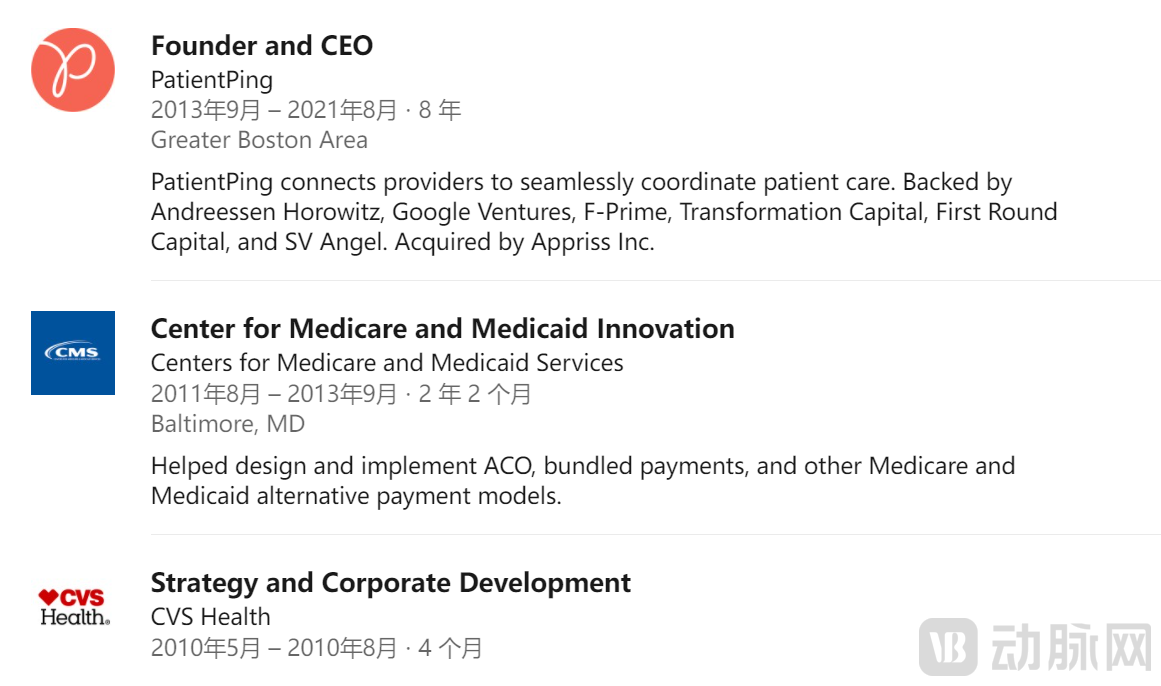 Partial Work History of PatientPing Founder Jay Desai, Source: LinkedIn
According to LinkedIn data, Jay Desai, the founder of PatientPing, previously worked at CMMI (Center for Medicare and Medicaid Innovation) under the U.S. CMS (Centers for Medicare & Medicaid Services).
The establishment of this agency stems from the Affordable Care Act (ACA) implemented during the Obama administration. The agency aims to foster innovation among healthcare providers and payers, with the goal of improving care quality, enhancing population health, and further reducing healthcare costs.
From August 2011 to September 2013, Jay Desai spent two years here. “Helped design and implement ACO, bundled payments, and other Medicare and Medicaid alternative payment models,” he wrote of this phase of his career.
However, the implementation of innovative healthcare payment models has faced significant challenges in practice. This led him to leave CMMI and promote payment model innovation through commercialization—leveraging the system built by PatientPing to help healthcare providers stay informed about patients’ latest conditions and better achieve management across the entire patient lifecycle.
Why has it become so important for healthcare providers to know when and where patients receive care?
We may need to mention Jay Desai’s work at CMMI. At CMMI, he helped design and implement ACOs, bundled payments, and more.
Let’s start with bundled payments. Bundled payments refer to a model in which hospitals receive the full treatment reimbursement only after the patient’s entire course of care is completed, including inpatient hospitalization and the three-month post-discharge rehabilitation period.
The so-called ACO refers to the Accountable Care Organization, which is also one of the core components of the Affordable Care Act (Obamacare). The organization was established with the goal of ensuring healthcare quality while reducing medical costs. Its model adopts a voluntary approach for healthcare institutions to organize and participate, starting with government-led demonstration projects under Medicare, followed by autonomous adoption by commercial insurers to achieve broader implementation.
To use an imperfect yet understandable analogy, Accountable Care Organizations (ACOs) are similar to tightly integrated medical consortia. They provide healthcare services to patients and can receive additional financial incentives from previously contracted managing entities (including but not limited to insurance organizations) if the overall medical costs fall below a predetermined benchmark.
However, patients are constantly on the move. According to a survey by PatientPing, patients often travel back and forth between different healthcare institutions multiple times. Hospitals are unable to know in real time where patients are receiving care, which leads to fragmented care services. Due to delays in information transmission and waste of medical resources, this results in hundreds of billions of dollars in losses annually in the United States.
For these same reasons, PatientPing, founded in Boston in 2013, has built a care coordination network that connects healthcare professionals and provides real-time information to providers, enabling them to know which medical facility is currently caring for a patient. Even when patients consult physicians across multiple healthcare institutions, the care process remains orderly.
Development
Why did they build this system? And how do they keep it running smoothly?
We may need to elaborate slightly on aspects such as team composition, financing history, and system functionality.
Jay Desai, the founder and CEO of PatientPing, is a graduate of the University of Michigan. He earned an MBA from the Wharton School of the University of Pennsylvania with a degree in Health Care Management.
Prior to founding PatientPing, he held a position at CMMI. He also worked in investment analysis and business development at firms such as Lehman Brothers, Parthenon Capital, and Triad Isotopes. Although he briefly served at CVS Health, his tenure lasted only four months. His experience in investment analysis and business development, combined with his grasp of policy gained during his job search at CMMI, may have ultimately led to the creation of PatientPing.
According to Crunchbase, other members of PatientPing’s team include David Berkowicz. He joined PatientPing as an engineer in March 2014 and became the head of the data security department in October 2017. Prior to joining PatientPing, he gained professional experience at multiple healthcare institutions. Other team members include Brian Manning, who joined PatientPing in October 2015 to oversee business growth initiatives.
With the completion of successive funding rounds, the company has also onboarded personnel from its investor base and gradually recruited a cohort of renowned corporate management talents. These include Sean Cavanaugh, head of Medicare; Dr. Joe Kimura, Chief Medical Officer of Atrius Health; John D. Halamka, MD, MS, President of Mayo Clinic Platform; and Kevin Hutchinson, founding CEO of Surescripts, among others. These seasoned professionals have further propelled the development of PatientPing.

Data sourced from Crunchbase and other news reports
Over the past eight years, PatientPing has completed three rounds of financing, cumulatively raising over $100 million. The investor roster includes prominent firms such as F-Prime Capital, GV (formerly Google Ventures), and Andreessen Horowitz.
When PatientPing completed its first round of financing in November 2015, it stated that the funds would be used to expand the geographic coverage of its products and increase headcount across sales, marketing, engineering, operations, product development, and community outreach. By 2015, PatientPing had already covered facilities in states such as Pennsylvania, Michigan, Connecticut, and Massachusetts, reaching nearly seven of the eight largest healthcare systems.
In December 2016, when PatientPing closed its Series B financing round led by Andreessen Horowitz, the company stated that it was accelerating its nationwide expansion to establish a care coordination network across China.
For PatientPing, a significant event in 2017 was its partnership with the Houston Methodist Care Coordination Organization (HMCC). This collaboration means that healthcare providers across Houston, surrounding communities, and the state will receive notifications whenever their patients are admitted to, discharged from, or transferred into or out of any of the eight hospitals under the Houston Methodist system, thereby enabling timely interventions and delivering overall higher-quality care outcomes.
It is worth noting that when the company completed its Series C financing in 2020, new CMS regulations were about to take effect. These new rules require the sharing of Admission, Discharge, and Transfer (ADT) data when patients are admitted to or visit other healthcare providers.
The implementation of this regulation, from another perspective, also signifies that PatientPing’s efforts have finally gained legal recognition.
In fact, for decades, healthcare systems capable of sharing data have remained a challenge. A large number of companies are eager to enter this field, and tools that provide patients with shared records are becoming increasingly popular. Even digital product providers like Apple are engaging in the interconnection and sharing of health data. In 2018, Apple developed the Apple Health Records service. If users are patients at participating hospitals, this record will aggregate existing patient data from their Health app with data from hospital EHRs.
Although these companies are gradually attracting significant attention, PatientPing undoubtedly remains a noteworthy player. Within the network built by PatientPing, healthcare providers receive instant “Ping” notifications whenever a patient receives care at a medical institution that has adopted the PatientPing solution. Furthermore, the providers delivering care can access other critical information from the patient’s care team, including care summaries, medical history, and enrolled care plans. This sharing of information enables seamless coordination of patient care.
To better assist physicians and patients, PatientPing also offers a variety of tools. Tools such as Care, Route, and Spotlights help healthcare providers access real-time patient trends, thereby facilitating more informed clinical decision-making. The recently launched Callouts feature further helps patients in the United States, where universal health coverage has not been achieved, enroll in available care programs or supplemental benefits.
As we have mentioned, its primary customers include hospitals, ACOs and POs, post-acute care providers, health plans, and behavioral health providers.
Julie Yoo, General Partner at Andreessen Horowitz, commented on PatientPing’s mission: “It is exciting to see PatientPing steadily expand its geographic reach and technological capabilities, positively impacting millions of patients across China. Their platform plays a critical role in transitions between sites of patient care, eliminating major blind spots in our fragmented healthcare system by longitudinally tracking patients’ entire care journeys. With favorable regulatory initiatives and the post-pandemic demand for more resilient digital infrastructure in care delivery, PatientPing is well-positioned to continue leading the market in exploring better ways to coordinate care.”
PatientPing’s network currently covers more than 1,000 hospitals and 5,000 post-acute care facilities, enabling up to 135 million patient ADT events for 43 million insured patients.
When mentioning Appriss Health, the lead party in this merger, it is inevitable to also mention another company, Appriss. Founded in 1994, Appriss was acquired by Insight Partners in 2014. As a data analytics firm, Appriss provides services to enterprises, governments, healthcare institutions, and commercial businesses across more than 25 countries on four continents.
The establishment of Appriss Health can be said to have directly benefited from the robust data capabilities of APPRISS INC.
Krishnan Sastry was virtually the sole architect of Appriss Health. He joined Appriss in 2013 and assumed a leadership role within the company. During his tenure at Appriss, he was primarily responsible for leading product strategy and capital investment decisions. Subsequently, he founded Appriss Health in 2013, focusing on the prevention of substance use disorders (SUD) and providing care for patients with SUD and behavioral health conditions.
From January 2013 to August 2016, a period of three years and eight months, he served as Executive Vice President and General Manager at Appriss Health. Regarding this experience, he has accurately recorded: “I founded Appriss Health and grew the business into a market leader by providing health IT platforms to address substance use disorders,” and “expanded the prescription drug monitoring program from serving one state to serving more than 40 states within three years.”
During his tenure at Appriss Health, he further leveraged the capabilities and potential of Prescription Drug Monitoring Programs (PDMPs), accelerating their integration into physician and pharmacy workflows. By enhancing Appriss Health’s analytical capabilities, the company can identify risks for existing patients with Substance Use Disorders (SUD) as well as for new cases of substance abuse, thereby supporting physicians and pharmacists in delivering appropriate patient care.
By expanding its product portfolio to include patient risk analytics and integration with clinical workflows, Appriss Health has significantly enhanced its capabilities, earning multiple “first-in-the-nation” accolades in areas such as interstate data sharing, patient risk analytics, and the integration of Prescription Drug Monitoring Program (PDMP) data into clinical workflows.
Acquisition of OpenBeds
During the development of Appriss Health, its two acquisitions are noteworthy, as they further solidified Appriss Health’s position in prescription drug monitoring.
The first acquisition, completed in October 2019. Appriss Health acquired OpenBeds.
OpenBeds is a cloud-based behavioral health platform. It primarily serves healthcare providers, helping them locate treatment facilities for their patients. Previously, healthcare providers might spend an excessive amount of time searching for treatment facilities; however, by adopting the system provided by OpenBeds, they can rapidly assess whether treatment facilities have sufficient bed capacity to accommodate patients in urgent need of behavioral health care, with relevant data available within minutes.
OpenBeds has deployed its platform statewide in Indiana and Delaware, with ongoing deployments in other states to further strengthen the platform’s infrastructure. In Delaware, more than half of all referrals are confirmed within 30 minutes. The system has helped the state maintain its strengths in care delivery and ensure that patients have adequate access to appropriate treatment.
Regarding this acquisition, Nishi Rawat, MD, Co-Founder of OpenBeds, stated, “We are in the midst of a public health crisis,” and noted that “it is widely recognized that one of the primary barriers to addressing the opioid crisis is access to treatment.” He added, “As a critical care provider, I frequently see patients being sent home after an opioid overdose rather than receiving treatment.” This very issue was the impetus for founding OpenBeds. The founders of OpenBeds firmly believe that, by leveraging technology, they can rapidly connect patients with appropriate, high-quality treatment and improve ultimate clinical outcomes.
The completion of Appriss Health’s acquisition signifies that OpenBeds can further expand its reach, with the system being more widely adopted across additional states and healthcare provider networks. This will enable more patients with substance use disorders (SUD) and mental health conditions to access the care they need through a trusted network of treatment centers and referral entities.
Rob Cohen, President of Appriss Health, stated, “OpenBeds shares the same DNA as Appriss Health. Clinicians can significantly improve patient care and safety by having timely access to critical health information and clinical tools.” He added, “With OpenBeds, providers no longer need to spend hours manually searching for treatment facilities for their patients—data is made available to them within minutes via a secure network, allowing them more time to focus on patient care. Furthermore, patients benefit from faster digital referrals and initiation of treatment, ensuring they receive the necessary care in a timely manner before adverse medical events occur.”
From another perspective, the acquisition of OpenBeds also means that Appriss Health has acquired a proven patient management and treatment solution. This acquisition also benefits Appriss Health in further addressing the complex and evolving opioid crisis plaguing American communities. Appriss Health’s PMP Gateway hosted solution is widely deployed nationwide, enabling the integration of a powerful opioid management platform into clinical workflows.
Appriss Health, which integrates Prescription Drug Monitoring Program (PDMP) information, data visualization and analytics, the OpenBeds platform, and many other features and resources, can help healthcare providers and patients make appropriate prescribing, pain management, and clinical treatment decisions.
As a SaaS platform for behavioral healthcare coordination, Appriss Health is a recognized leader in providing software and data analytics solutions to identify and mitigate substance abuse. Appriss Health’s cloud-based software effectively connects nearly 1 million healthcare professionals across 500 clinical software systems, including more than 140 electronic health record (EHR) systems.
Acquisition of PatientPing
As an innovative care collaboration platform, PatientPing enables healthcare providers to collaborate through its comprehensive suite of solutions, allowing healthcare provider organizations, health plans, governments, individuals, and their supporting organizations to leverage real-time patient data to achieve shared goals and thereby enhance the efficiency of the healthcare system.
Appriss Health, which was already monitoring prescription abuse, has acquired OpenBeds and subsequently integrated PatientPing, thereby building a more comprehensive ecosystem. This enables the company to provide software and analytics solutions to various stakeholders within the healthcare ecosystem, delivering better patient care across both physical and behavioral health domains.
The merged Appriss Health and PatientPing platform (now branded as Bamboo Health) has become the largest provider of comprehensive delivery system solutions in the United States, reaching 2,500 hospitals, 7,500 post-acute care facilities, and 25,000 pharmacies. Bamboo Health’s integrated software and analytics solutions provide access to high-integrity clinical information and applications that enhance care delivery while ensuring accuracy.
Why Did the Two Parties Come Together? What Can Be Done After the Merger?
From X’s perspective, following the integration, the combined solutions of both parties effectively empower payers—such as insurance companies and state governments—at a higher strategic level. Substance abuse, a persistent societal challenge in the United States, is one of the key issues that the government is committed to addressing. Appriss Health has previously made significant explorations in business areas closely aligned with government entities. Upon completion of the merger, Bamboo Health will achieve enhanced business synergies.
As previously mentioned, Appriss Health did not only acquire and integrate PatientPing; it had also acquired OpenBeds prior to that. Leveraging its strong foundational capabilities, Appriss Health has built a substantial network of healthcare providers following the integration of these two companies.
In fact, this is not an isolated case. Shifting our focus back to China, a global perspective reveals that consolidation in the digital health sector is accelerating further: according to incomplete statistics, as of November 29, 2021, there were a total of 52 mergers and acquisitions in China’s pharmaceutical and healthcare sector, with a total transaction value of RMB 21.9 billion.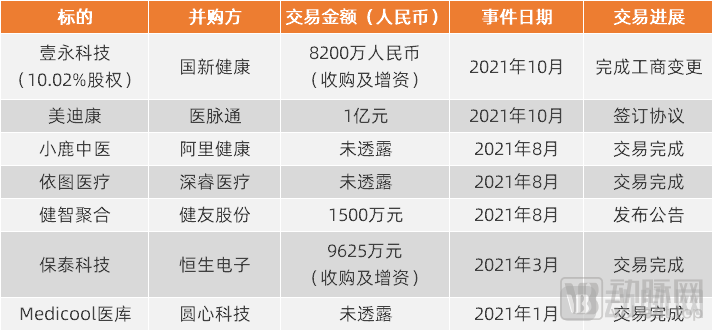
M&A Deals in the Digital Health Sector in 2021. Data sources: Dongmai Cheng, Qichacha, and announcements from listed companies; chart compiled by VCBeat.
Integration is largely driven by policy adjustments and changes. In recent years, as the country has accelerated reforms in the pharmaceutical sector—adjusting the structure of medical insurance payments, implementing consistency evaluations for generic drugs, and launching centralized procurement—the entire health industry has been seeking innovation and transformation. Companies are attempting to further integrate and enrich their product portfolios through mergers and acquisitions, while also enhancing their competitiveness by extending their industrial chains.
Abroad, the situation is similar. Integration has been driven in part by the impact of new policies and regulations introduced by the Centers for Medicare & Medicaid Services (CMS), as well as by the ability of integration to maximize its own effectiveness.
As industry insiders are optimistic about the development of digital health, this sector has attracted substantial capital, enabling promising companies to secure sufficient funds for further mergers and acquisitions (M&A) to update their application scenarios and data assets. Companies like Appriss Health, backed by APPRISS INC with ample financial resources, are well-positioned to lead such M&A activities.
In the realm of digital health M&A integration, three distinct trends are evident:
One is the consolidation of small and medium-sized, vertical-sector companies by large platforms;
One approach is cross-industry integration, such as traditional pharmaceutical distribution companies acquiring digital health firms to further enhance operational efficiency.
Another type consists of small and medium-sized innovative companies that achieve complementary advantages through mergers, acquisitions, and restructuring.
The integration of Appriss Health and PatientPing can be regarded as a complementary synergy, whereby both parties have established stronger competitive moats following the completion of the deal. With the integration finalized, their combined service networks will undoubtedly expand further, ultimately enhancing their ability to compete in the market. This may well explain why Appriss Health ultimately pursued and completed the acquisition of PatientPing.
But as we have noted, with the development of the digital health sector, mergers and acquisitions in the industry are unlikely to cease. In the future, we may see more such cases emerge.