

MedAI Imaging Secures Dual Regulatory Approvals in China and the U.S. for Its AI-Powered Radiotherapy Contouring Software
Beijing Yizhiying Technology Co., Ltd.
Medical Imaging Analysis Technology Service Provider
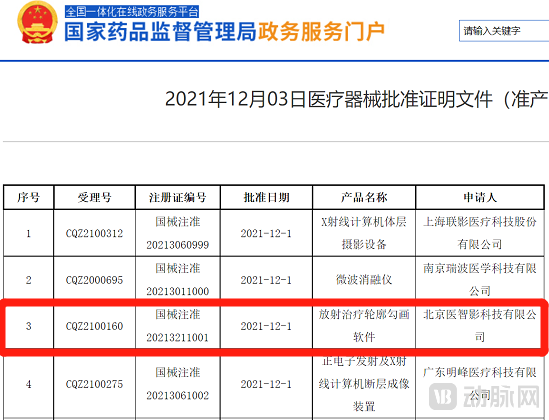
In December 2021, it was announced on the official website of the National Medical Products Administration (NMPA) that the “Radiotherapy Contouring Software,” independently developed by Beijing Yizhiying Technology Co., Ltd. (hereinafter referred to as “Yizhiying”), obtained Class III medical device registration certification. In the same month, the product also received a Substantial Equivalence Letter for premarket notification from the U.S. Food and Drug Administration (FDA).
Notably, the product went from FDA acceptance in late September to approval in mid-December, completing the entire process in just 78 days. Furthermore, the FDA raised no requests for additional information during either the substantive review or the interactive review phase—a rarity among 510(k) submissions.
Double Recognition: This radiation therapy contouring software, which has obtained “dual certifications,” is designed for delineating tumors and related organs and tissues prior to radiotherapy planning. As the developer behind this product, Beijing Yizhiying Technology Co., Ltd., established in 2019, is an innovative company in the field of AI-driven healthcare. Leveraging its independently developed core technologies in deep learning and holographic image analysis, the company provides intelligent analysis of big data from medical imaging.
The company focuses on the core clinical target volume (CTV) delineation in oncology treatment. It has independently developed CTV delineation solutions for various cancers, including breast cancer, rectal cancer, cervical cancer, and esophageal cancer, as well as RT-Mind, a product capable of delineating nearly 100 organs at risk throughout the body. Research achievements have been published in international journals such as Radiology, Medical Physics, and Radiotherapy and Oncology, and multiple projects funded by the Ministry of Science and Technology and the National Natural Science Foundation of China have been applied for. Meanwhile, the company has established a portfolio of surgical planning and navigation products covering multiple anatomical sites and diseases involving the lungs, heart, and liver, which are applied in thoracic surgery, cardiology, and hepatobiliary surgery.
When asked why the company’s positioning focuses on the field of precision treatment in oncology medical imaging, Wang Shaobin, founder of Yizhiying, gave an exclusive interview to VCBeat. He discussed the company’s original entrepreneurial vision, product portfolio strategy, and future plans. This article presents a brief summary for our readers.
Wang Shaobin, founder of Beijing Yizhiying Technology Co., Ltd., was among the earliest researchers in artificial intelligence in China. He pursued graduate studies in pattern recognition at the University of Science and Technology Beijing, focusing on AI-based recognition of handwritten Chinese characters, which laid the foundation for his later entrepreneurial ventures in medical image recognition and analysis. Later, Wang enrolled in the Innovation Leadership Engineering Doctoral Program at Tsinghua University, studying under Professor Liao Hong’en, Deputy Dean of the School of Medicine. Leveraging Tsinghua University’s interdisciplinary platform integrating medicine and engineering, he received substantial support that significantly facilitated his startup endeavors.
Dr. Wang Shaobin has been deeply engaged in the medical industry for 15 years, holding key positions at medical technology companies such as Canon Medical Systems Japan and Toshiba Medical Systems. He has managed teams across research, development, product management, and scientific research, leading his teams to successfully develop multiple clinically applied products and securing over ten global patents. During his tenure at Toshiba Medical Systems Japan, Dr. Wang also pursued an MBA program at Case Western Reserve University in Cleveland, USA, while serving as the Head of the China R&D Center.
VCBeat: After years of AI research, why did you choose to launch a startup in the healthcare sector?
Wang Shaobin:Our team has long been engaged in research on computer vision, but we have found that the healthcare industry is actually the best fit for our technical strengths. First, the healthcare industry is closely related to human health and is an evergreen sector. Second, medical imaging demands higher precision in visual recognition compared to other fields. Therefore, I believe that the most suitable application track for the development of computer vision is medical image analysis.
VCBeat: After choosing the medical imaging sector, why did we apply AI to “tumor adjuvant therapy” instead of other popular areas such as “screening and diagnosis”?
Wang Shaobin:Medical devices are friends of time; medical products must first address urgent clinical needs and pain points. We can start by becoming the biggest fish in a small pond, before moving on to rivers and oceans.
Clinically, radiotherapy—a complex process combining “radiation” and “treatment”—varies significantly in quality across hospitals, resulting in substantial heterogeneity. After conducting clinical technical assessments with Director Zhang Fuquan, Director Qiu Jie, and their teams at Peking Union Medical College Hospital (PUMCH), we decided to develop and refine a product aimed at standardizing and improving the quality of radiotherapy within the PUMCH Department of Radiation Oncology laboratory. Much like Apple and Google were born in garages, Beijing Yizhiying Technology Co., Ltd. was incubated in a radiation oncology laboratory, developing products on-site for frontline clinical use.
While other companies prioritize the automatic delineation of organs at risk (OARs), we chose to tackle the most technically challenging yet clinically valuable task from the outset: fully automated delineation of the clinical target volume (CTV). We are committed to quality control in radiotherapy at its source, aiming to achieve standardized treatment across hospitals of all sizes within individual institutions, across regions, and throughout China.
VCBeat: After choosing this niche market, what is our vision for establishing Yizhiying?
Wang Shaobin:We aim to make high-quality medical resources as accessible as sunlight and air, ensuring that patients with serious illnesses can receive treatment within their local counties. Leveraging over a decade of expertise in image processing and artificial intelligence, we translate the clinical experience of oncologists and medical physicists into deep learning models and products. This empowers the automation and intelligent optimization of complex cancer treatment workflows, facilitating the development of smart oncology departments.
Yizhiying remains focused on clinical and physical workflows in radiation therapy, offering a flexible portfolio of products that integrate seamlessly with existing processes. These include fully automated contouring, feature-rich radiation therapy workstations, and cloud-based remote radiotherapy systems. This approach truly realizes the vision proposed by experts at Peking Union Medical College Hospital—“contouring target volumes even while sitting on the toilet”—thereby enhancing the work efficiency of radiation oncologists and medical physicists.
VCBeat: Could you introduce the product advantages of our newly approved “Radiotherapy Contouring Software”?
Wang Shaobin:In the development of this product, our team conducted a comprehensive survey of classic TPS systems on the market, including the advantages of mainstream domestic and international software—what do doctors prefer? What are the pain points frequently complained about by Chinese doctors that foreign vendors cannot localize or modify? Based on these insights, we fully considered the needs of clinical physicians and medical physicists, ultimately developing a radiotherapy contouring system that satisfies both groups.
Meanwhile, we have received strong support from the team led by Director Ge Hong of the Department of Radiation Oncology at Henan Cancer Hospital in the research and development and validation of our product’s featured cancer indications. As the largest oncology hospital in Central China, Henan Cancer Hospital has contributed the largest volume of data for product testing.
Based on our investigation and comparison with FDA-approved products, our product, leveraging patented technology, offers the most comprehensive range of fully automated segmentation capabilities and demonstrates superior accuracy in automatic delineation. Furthermore, we have implemented localized development and designed features that better reflect the value of software services, specifically tailored to the needs of U.S. users.
VCBeat: What is the current status of clinical implementation for this product?
Wang Shaobin:Within one year of our product reaching maturity, it was installed in over 120 hospitals across 25 provinces and municipalities directly under the central government in China, enabling multi-center validation. The majority of these installations were in tertiary hospitals. As our in-house marketing team remains relatively small, a significant portion of this growth was driven by word-of-mouth referrals among users, with some department heads even proactively reaching out to request installation for trial use.
Meanwhile, we have established project collaborations with more than half of the top ten oncology specialty hospitals in China. These collaborations focus on two main areas: first, partnering on specific cancer types to jointly publish high-impact SCI papers and apply for grants and research projects; second, conducting multicenter analysis and research on the statistics and standardization of clinical target volume delineation.
VCBeat: In addition to the field of radiotherapy target delineation (CTV), in what other areas does Yizhiying have a reserve product layout?
Wang Shaobin:We have also developed AI-enabled products for high-difficulty, complex treatment procedures in the cardiovascular and cerebrovascular fields. Leveraging the brand and channel advantages of Lepu Medical Group, we are jointly building a comprehensive preoperative planning system and related products for complex cardiovascular cases, which are currently under analysis and development.
VCBeat: What is Yizhiying's business model? And what is its financing status?
Wang Shaobin:Our company currently operates primarily under three models: 1. Traditional workstation deployment to meet departmental needs for informatization and intelligent solutions; 2. A cloud computing-based remote radiotherapy collaboration system that connects regional medical consortia or hospitals in remote areas with top-tier tertiary hospitals in provincial capitals or major cities such as Beijing, Shanghai, and Guangzhou, enabling remote target volume delineation, plan verification, and quality control; 3. Collaboration with upstream and downstream industry partners to achieve complementary technological and product advantages, thereby creating a closed-loop ecosystem for precision oncology treatment.
Regarding financing, we have currently initiated a new round of funding plans, aiming to increase R&D investment and enrich and improve the product pipeline; secondly, following the dual-certification approval of our radiotherapy target delineation product, we will ramp up investments in domestic and international markets and marketing efforts.