

Newly Revised Science and Technology Progress Law to Take Effect on January 1, Signaling Major Shifts in China's Research Ecosystem
On December 24, the 32nd Session of the Standing Committee of the 13th National People's Congress completed its review ofLaw on the Progress of Science and Technology(hereinafter referred to as the “Law on Progress of Science and Technology”)
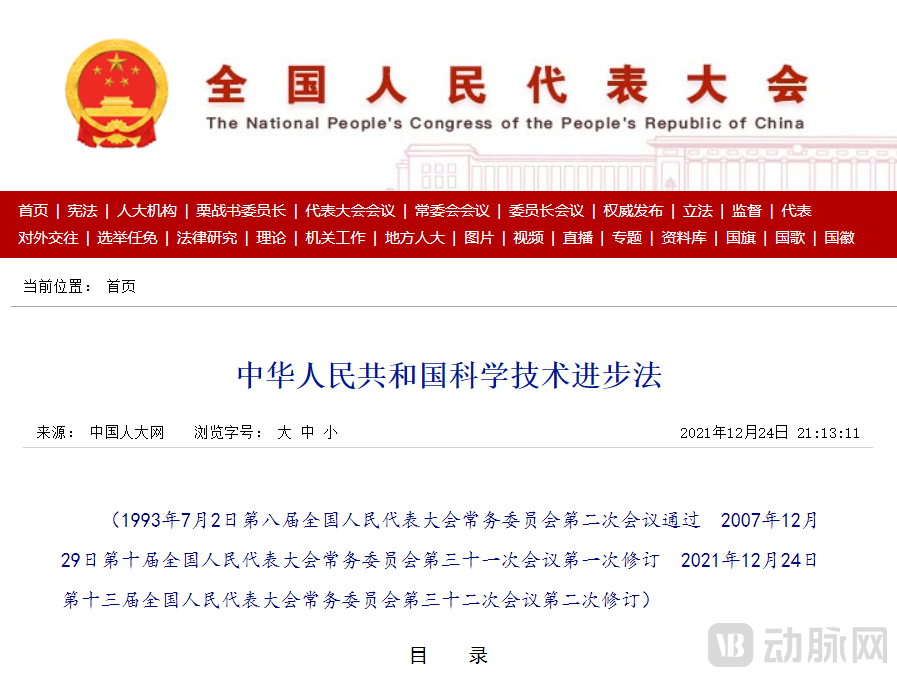
As a law with the nature of a basic law in China's science and technology sector,Law on the Progress of Science and TechnologyIt has played a significant role in promoting substantial progress in scientific and technological endeavors and advancing the application of science and technology to serve economic and social development. Reportedly, the law was officially promulgated and implemented in 1993, underwent its first revision in 2007, and this current amendment marks the second revision.The newly revised Law on Progress of Science and Technology will officially come into effect on January 1, 2022.。
What new trends does the revised Law on Progress of Science and Technology, updated after 14 years, convey? How will it promote the development of medical innovation in China? To uncover the answers to these questions,VBInsight Orange BureauFor the newly revisedLaw on Progress of Science and TechnologyA deep analysis was conducted.
Putting in the “Hard Work” on Talent
Talent shortages have long been a critical constraint on China’s innovation endeavors, with their scarcity being particularly pronounced in high-end, cutting-edge technological fields such as healthcare.
Therefore, among the numerous policies related to scientific research and innovation,Prioritize the Cultivation of Innovative Talent. The newly revisedLaw on the Progress of Science and Technologyis no exception, except for the separate establishment of “Scientific and Technical Personnel"Beyond this core chapter, explicit emphasis has also been placed on cultivating scientific and technological talent across other levels."
Its key areas of focus are primarily reflected in three aspects:
First, in terms of incentives, direct rewards are primarily provided to researchers through the establishment of science and technology funds.. For example, Article 18 states that “the State shall establish and improve the system of science and technology awards,”Establishment of the State Preeminent Science and Technology Award and Other Awards, and awards shall be conferred upon organizations and individuals that have made significant contributions to scientific and technological advancement.”
Second, in terms of talent development, the focus is primarily on other key talents within the innovation ecosystem chain, excluding scientific researchers.. On one hand,Basic Research Talent, in Article 23, it is stated that “The Nation Intensifies Efforts to Cultivate Talent in Basic Research, strengthen stable support for talent in basic research, and improve the quality and caliber of the workforce in this field.”
On the other hand,Technology Transfer Professionals, Article 30 states that “scientific and technological R&D institutions and higher education institutions established with fiscal funds shall actively promote the transformation of scientific and technological achievements,”Strengthening the Development of Technology Transfer Institutions and Talent Teams, establish and improve systems to promote the transformation of scientific and technological achievements.”
Third, in terms of empowerment, on one hand, researchers are granted greater autonomy over their patents; on the other hand, they are encouraged to generate profits from these patents.. Article 33 states that “the State shall implement a distribution policy oriented toward increasing the value of knowledge, and advance reforms in the mechanisms for determining intellectual property ownership and allocating rights and interests in accordance with relevant national regulations,”Exploring the System of Granting Ownership or Long-Term Usage Rights of Job-Related Scientific and Technological Achievements to Scientific and Technical Personnel。”
Besides “granting authority,” there is also “providing funding.”. Article 32 stipulates that “for scientific and technological achievements resulting from science and technology program projects established with fiscal funds, the project undertakers shall be authorized to obtain relevant intellectual property rights in accordance with the law, provided that national security, national interests, and major social public interests are not compromised,”Project undertakers may, in accordance with the law, independently invest in and implement the commercialization of their achievements, transfer them to others, jointly implement commercialization with others, license others to use them, or use them as equity contributions for investment.。”
In addition, to unlock greater innovation potential, the newly revised Law on Progress of Science and TechnologyFor the first time, the door to innovation has been opened to “minority groups”. In Article 66, it is stated that “Young scientific and technical personnel, ethnic minority scientific and technical personnel, female scientific and technical personnelThey shall enjoy equal rights in applying for professional and technical positions, participating in scientific and technological evaluations, undertaking research and development projects, and receiving continuing education. EncourageElderly Science and Technology Personnel"Play an active role in the advancement of science and technology."
Integrating More Elements into the Innovation Ecosystem Chain
Scientific research may appear "lonely," but in essence, it places great emphasis on teamwork,Every link in the innovation ecosystem must be deeply engaged.。
This is primarily related to the nature of scientific research. On one hand,Interdisciplinary Integration of TechnologyCurrently, China’s healthcare industry is experiencing robust growth and is in a transitional phase characterized by the rapid evolution and convergence of digitalization, automation, and intelligence. Therefore, innovation requires the continuous integration of emerging technologies from other fields to identify strategic “leverage points” that align with organizational capabilities amidst industry changes, thereby achieving leapfrog development in research.
On the other hand,"Division of Labor and Collaboration in Scientific Research". The translation of scientific research achievements is roughly divided intoProposing the original concept, achieving preliminary results, possessing mature technology, developing initial products, and reaching market-ready productsThe five stages involve different types of “work,” thus requiring different individuals or institutions to carry them out.
In this newly revisedLaw on the Progress of Science and TechnologyIn China, more refined deployments have been made at this level.
First, in terms of functional division. Taking enterprises as an example, Article 39 points out that “the State shall establish a system with enterprises as the main body and market orientation as the guide,”A technological innovation system featuring close collaboration between enterprises and scientific and technological R&D institutions as well as higher education institutions, guide and support enterprises in their technological innovation activities, support enterprises in leading national key scientific and technological research tasks, bring into full play the principal role of enterprises in technological innovation, promote enterprises to become the main bodies in decision-making on technological innovation, R&D investment, organization of scientific research, and achievement transformation, facilitate the aggregation of various innovation factors towards enterprises, and enhance enterprises’ technological innovation capabilities.”
Secondly, in terms of collaborative cooperation. Article 6 states that "the State encourages the integration of scientific and technological research and development with higher education and industrial development,Encourage interdisciplinary integration and mutual promotion”; in Article 31, it is stated that “the State encourages enterprises, scientific and technological research and development institutions, institutions of higher learning, and other organizationsEstablish a collaborative mechanism featuring complementary advantages, clear division of labor, shared outcomes, and joint risk assumption., establish joint R&D platforms, technological innovation alliances, and innovation consortia in accordance with market mechanisms, collaboratively promote R&D and the commercialization of scientific and technological achievements, and enhance the effectiveness of technology transfer and commercialization.”
Finally, in the allocation of other core components. Taking financial institutions as an example, Article 92 states that “the State encourages financial institutions to engage in intellectual property pledge financing business,”Encourage and guide financial institutions to support the application of science and technology and the development of high-tech industries through credit, investment, and other means., encourage insurance institutions to develop insurance products in line with the needs of high-tech industry development, and promote the application of new technologies.”
Currently, China is witnessing a surge in medical innovation, attracting an increasing number of “elements” to participate. However, this is not simply reliant on “Many hands make light work.", how“Positioning” Yourself Correctly, correctly recognizing one's importance in the innovation ecosystem and fully leveraging one's professional advantages are key issues that need to be addressed in China's current medical innovation endeavors, as well as core areas where each element must achieve breakthroughs.
Innovation on the Shoulders of Giants
On the path of innovation, we are seeing some positive signals in China.
withNumber of Patentsas an example. According to the latest data released by the World Intellectual Property Organization (WIPO) of the United Nations, China filed a total of applications through the Patent Cooperation Treaty in 202068,720 international patents, topping the global rankings for the second consecutive year, representing a 16.1% increase from 2019.
However, we must face the reality that, compared to the approximately 40% conversion rate of scientific and technological achievements in developed countries in Europe and America,In China, this figure stands at less than 10%, indicating a remarkably low overall conversion rate.
Therefore, in addition to continuously refining ourselves, we also need toDrawing on Advanced Overseas Innovations and Best Practices. In the newly revised Law on Progress in Science and Technology, provisions are included on how to utilize “External Innovation Forces” provided a multi-dimensional explanation.
On one hand, in terms of external cooperation, scientific and technological cooperation and exchanges with foreign governments and international organizations are encouraged. Article 80 states that “the State encourages various innovation entities, including scientific and technological research and development institutions, higher education institutions, scientific and technological social organizations, enterprises, and scientific and technological personnel, to carry out international scientific and technological cooperation and exchanges and actively participate in scientific research activities,”Promote the Openness and Flow of International Scientific and Technological Resources, thereby establishing a high-level framework for open scientific and technological cooperation and promoting global progress in science and technology.”
Additionally, Article 82 states that “the State shall adopt multiple measuresSupports collaborative R&D by outstanding scientific and technological talents from both domestic and international sources., address the common challenges facing humanity, and explore the frontiers of science.”
On the other hand, efforts are being made to attract talent by “paving the way” for overseas professionals in science and technology. First, at the level of technological research, Article 83 states that “the State shall expand the opening-up and cooperation of science and technology programs to the outside world,”Encourage foreign-funded enterprises in China and foreign scientific and technical personnel to undertake and participate in science and technology plan projects, and improve the mechanisms for overseas scientific and technological personnel to participate in national science and technology plan projects.”
Secondly, at the level of incentive policies, Article 84 stipulates that “science and technology research and development institutions and higher education institutions established with fiscal funds shall facilitate the work and daily life of overseas scientific and technical personnel employed to engage in scientific and technological research and development. Foreign outstanding scientific and technical personnel who come to China to engage in scientific and technological research and development shall, in accordance with relevant national regulations,”May be granted priority for permanent residence in China or acquire Chinese nationality.。”
Finally, at the level of practical implementation, in Article 49, it is stated that “Overseas organizations or individuals may independently establish scientific and technological research and development institutions within China in accordance with the law., may also jointly establish scientific and technological research and development institutions with organizations or individuals within China.”
It is undeniable that China is still in the nascent stage of innovation and commercial translation, lagging significantly behind developed countries in Europe and the United States. However, if we can fully leverage these advanced overseas innovation experiences and boldly innovate by standing on the shoulders of giants, we are confident that we willAvoiding Detours on the Path to Innovation, thereby enabling the incubation of more innovative projects in a short period of time.
# Final Thoughts
To Break the Ice, Policy Must Lead.
From1985Since the national level began to support the transformation of scientific and technological achievements through legislation and tax policies, China’s relevant functional departments have been making various attempts to better promote innovation. According to statistics from VCBeat Orange Fruit Bureau, as of now,Over the past 37 years, China has issued a total of 434 policies on the translation of scientific and technological achievements.
Especially in the past year or two, as the pace of innovation has gradually accelerated, a large number of related policies are poised to be introduced. However, just as with patents, we cannot in terms of policy“Winning by Volume”: The Policy’s Aim Is to Address the Pain Points Currently Facing the Industry. Therefore, accurately identifying needs and addressing them through targeted policies is of paramount importance.
In this newly revisedLaw on the Progress of Science and TechnologyIn China, we have clearly felt the state’s “Precision" and "Professionalism”, I believe that in the future, this brand-newLaw on Progress of Science and TechnologyBringing many new changes to China's innovation endeavors.