

Shanghai Model Organisms Becomes First Gene-Edited Animal Model Company Listed on STAR Market, Signaling Surge in Industry IPOs
In the howling winds of Siberia, there stands a unique mouse statue. With glasses perched on its cute snout and knitting needles and yarn in hand, it appears focused and scholarly as it “knits” a double-helix DNA strand. This monument was created by the Institute of Cytology and Genetics of the Russian Academy of Sciences to commemorate the millions of laboratory animals that have sacrificed their lives in the name of science.
Model organisms are the key to unlocking the treasure trove of the human genome and represent a critical necessity for research into human gene function and the development of precision therapeutics in the post-genomic era.
On December 28, 2021, Shanghai Model Organisms Center, Inc. (stock code: 688265), a provider of genetically engineered animal models and related technical services, rang the listing bell on the STAR Market of the Shanghai Stock Exchange, becoming the first publicly listed model organism company in China. In this IPO, the company offered 19.4909 million shares to the public at an issue price of RMB 84.62 per share, with expected proceeds of RMB 1.649 billion.
Just prior to the listing of Shanghai Model Organisms Center, Inc., GemPharmatech, another leading enterprise in China’s model organism sector, had already passed its IPO review. The high-barrier model organism sector is poised for a wave of initial public offerings.Let’s examine how model organism companies have successfully achieved domestic substitution in China in recent years amid the booming wave of biotechnology.
In this IPO, Shanghai Model Organisms Center, Inc. will primarily use the net proceeds, after deducting issuance expenses, for the following purposes: the biological R&D base project of Shanghai Dishishi Biotechnology Co., Ltd.; the construction of a gene-modified model resource bank; replenishment of working capital; the R&D of humanized antibody mouse models; and the development of an efficacy evaluation platform based on gene-modified animal models.
As of now, the controlling shareholder of Shanghai Model Organisms Center, Inc. is Dishi Consulting, and the actual controllers are Fei Jian and Wang Mingjun.
Dr. Fei Jian is a professor at Tongji University. From 1988 to 2007, he held positions at the Shanghai Institutes for Biological Sciences (SIBS) and its affiliated institutions, including the Shanghai Institute of Cell Biology, Chinese Academy of Sciences; the Institute of Biochemistry and Cell Biology, Chinese Academy of Sciences; and the Research Center for Model Organisms, Shanghai Institutes for Biological Sciences, Chinese Academy of Sciences.
Meanwhile, Dr. Fei Jian served as Deputy Director of the Model Organisms Center from July 2002 to June 2016; as Deputy Manager of Shanghai Model Organisms Co., Ltd. from September 2000 to May 2004; and as General Manager of Shanghai Model Organisms Co., Ltd. from 2004 to 2016. Since June 2016, he has served as Chairman of the Board and Manager of the Science and Technology Research Department at Shanghai Model Organisms Center, Inc. Since July 2019, he has also served as Executive Director at Dishi Biotechnology.
Overlapping timelines indicate that Dr. Fei Jian had already joined Shanghai Model Organisms Center, Inc. during his tenure at the Chinese Academy of Sciences. In its responses to inquiries regarding this matter, Shanghai Model Organisms Center, Inc. stated:
Dr. Fei Jian’s research at institutions affiliated with the Chinese Academy of Sciences and at Tongji University has primarily focused on fundamental studies of gene function, with scientific outputs consisting mainly of publications that present novel knowledge discoveries or potential methods for disease diagnosis and treatment. At Shanghai Model Organisms Center, Inc., Dr. Fei’s R&D efforts have centered on the development of genetically modified animal models, yielding outcomes in the form of patents, non-patented technologies, and academic papers, which cover genetically modified animal model strains and their preparation methods.
Therefore, there are significant differences between the intellectual property or technological achievements formed by Dr. Fei Jian at institutions affiliated with the Chinese Academy of Sciences and Tongji University, and those formed at Shanghai Model Organisms Center, Inc., in terms of research direction, research objectives, scientific outcomes, and their forms of expression. In May 2021, the Human Resources Office of Tongji University also issued a written statement confirming that Dr. Fei Jian’s part-time work outside the university had been reviewed, approved, and filed by his respective school.
In addition to the founding team’s strong academic background, the customers that have supported Shanghai Model Organisms Center, Inc. throughout its journey also exhibit a pronounced academic character. In recent years, with the advancement of pharmaceutical innovation in China, the company’s accumulated expertise in model organisms has begun to demonstrate unique advantages in drug development.
From 2018 to 2021, and for the first half of 2021, the revenue from scientific research institution clients accounted for 82.06%, 73.00%, 66.29%, and 58.32% of Shanghai Model Organisms Center, Inc.'s total operating income, respectively. As the development of resources from scientific research clients gradually reached saturation, innovative pharmaceutical companies have become a new growth driver for the company's revenue.
In addition, according to the prospectus, the combined sales to the top five customers of Shanghai Model Organisms Center, Inc. accounted for 37.03%, 35.41%, 29.92%, and 24.79% of its total sales in 2018, 2019, 2020, and the first six months of 2021, respectively.As Shanghai Model Organisms Center, Inc. broadens its customer base, its customer concentration continues to decline, reflecting the widespread industry demand for model organisms.
In terms of technical capabilities, Shanghai Model Organisms Center, Inc., backed by the Chinese Academy of Sciences, possesses core independently developed technologies, including CRISPR/Cas-based gene editing, embryonic stem (ES) cell targeting, gene expression regulation, and assisted reproductive technologies.
Meanwhile, Shanghai Model Organisms Center, Inc. has six technological reserves: large-fragment DNA assembly system development technology, site-specific high-expression CHO cell system development technology, tumor immunotherapy target screening system development technology, site-specific large-fragment DNA insertion system development technology, murine tumor xenograft model resource library system development technology, and humanized antibody mouse development technology.
Based on this, Shanghai Model Organisms Center, Inc. has undertaken more than ten National Science and Technology Major Projects and other major research projects related to animal model development.
As business demands increase, the R&D costs of Shanghai Model Organisms Center, Inc. are also rising day by day. In 2018, 2019, 2020, and the first half of 2021, its R&D investments were RMB 10.3912 million, RMB 17.6026 million, RMB 28.6859 million, and RMB 16.5095 million, respectively.
To date, Shanghai Model Organisms Center, Inc. has been engaged in gene function research and drug development in the fields of oncology, neurodegenerative diseases, psychiatric disorders, metabolic diseases, inflammation, and rare diseases,More than 10,000 types of genetically modified animal models have been developed to date.Among these, Shanghai Model Organisms Center has independently developed over 5,000 models. It has established humanized mouse models and corresponding disease models particularly in key frontier research areas, including immune checkpoints such as PD-1, PD-L1, CTLA-4, CD47, and TIGIT, as well as APOE4-associated Alzheimer’s disease and hemophilia A and B.
Currently, Shanghai Model Organisms Center, Inc. primarily provides genetically modified animal model products and technical services. The model products are mainly applied in basic scientific research and drug development, while the technical services are primarily used for gene function phenotypic analysis, target validation, drug discovery, and evaluation. The model organisms utilized by Shanghai Model Organisms Center, Inc. include rats, mice, zebrafish, and nematodes, among others. Notably, mice serve as the primary vehicle for its model products and technical services.
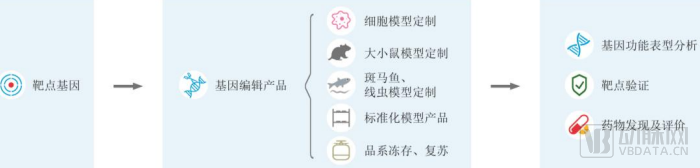
Relationship Between Products and Technical Services, Source: Prospectus
Currently, Shanghai Model Organisms Center, Inc. primarily focuses on developing products and providing services for genetically modified animal models.
1. Genetically Modified Animal Model Products:Based on the host organism, genetically modified animal models can be classified into genetically modified mouse models, genetically modified rat models, genetically modified nematode models, and genetically modified zebrafish models. In addition, Shanghai Model Organisms Center, Inc. also conducts R&D on a small number of genetically modified cell line models. According to the model construction method, they can be categorized into transgenic, conventional knockout, conditional knockout, gene point mutation, and gene knock-in models. Based on product business categories, they can be divided into customized models, standardized models, and model breeding products:
1) Customized Models:Based on the target gene information and strategic recommendations provided by clients, we design customized strategies and construct models according to their individualized needs, delivering genetically stable gene-modified animal models. Shanghai Model Organisms Center, Inc. has cumulatively provided over 5,000 customized models to its clients.
2) Standardized Model:Based on market demand and its own pioneering research, Shanghai Model Organisms Center, Inc. has independently developed and constructed a portfolio of over 5,000 genetically modified animal models available for customer selection. According to their intended applications, standardized model products are categorized into efficacy evaluation models, breeding stock models, and tool models. Efficacy evaluation models, used for target validation, drug safety testing, pharmacokinetic studies, and other purposes, have seen rising demand in recent years and constitute the primary category of standardized models. Breeding stock models mainly serve research clients in gene function studies and innovative drug discovery. Tool mouse models are primarily used for the mating and breeding of conditional knockout modified models.
3) Model Breeding:This refers to the business in which a company delivers model products with specific genotypes to customers within a specified period, using customer-commissioned custom gene-modified animal models or existing gene-modified animal models provided by customers, through natural breeding or assisted reproductive breeding. This business specifically includes natural breeding, assisted reproductive breeding, and SPF (Specific Pathogen Free) purification. Shanghai Model Organisms Center, Inc. can deliver a specified number of model strains with specific genotypes to customers either in one batch or in multiple batches through its model breeding business, thereby addressing technical or cost barriers that customers face in genotype identification, expansion cycles, animal quality, and operational management, thus improving their research efficiency.
2. Technical Services for Genetically Modified Animal Models:Mainly including services such as phenotypic analysis, efficacy analysis and evaluation, and breeding management.Unlike typical CRO companies, Shanghai Model Organisms Center, Inc. leverages its expertise in model development to provide targeted multi-category disease animal models and conduct precise pharmacodynamic testing services. Related pharmacodynamic analysis and evaluation services include: pharmacodynamic analysis and evaluation using multi-target humanized mouse models, and high-throughput in vivo screening of anti-tumor drugs.
Shanghai Model Organisms Center, Inc. has independently developed humanized mouse models for immune checkpoints such as PD-1, PD-L1, CTLA-4, and TIGIT, as well as syngeneic tumor cell lines with humanized target genes. These models are suitable for efficacy analysis and evaluation of immunomodulatory drugs, covering monoclonal antibodies, bispecific antibodies, combination therapies involving multiple biologics, oncolytic viruses, and cell therapies. Application areas include in vitro and in vivo pharmacological and efficacy studies, biomarker analysis, pharmacokinetic studies, and toxicity/safety testing.
Shanghai Model Organisms Center, Inc. also utilizes a transgenic zebrafish model with fluorescently labeled vasculature to study intersegmental vessel angiogenesis. This model enables rapid pharmacodynamic quantitative evaluation of anti-angiogenic drugs or investigation of the vascular biological functions of target genes, and has successfully facilitated high-throughput and high-content in vivo screening of novel anti-angiogenic agents or new drug targets in 96-well or 384-well plates.
Based on the aforementioned products and services, application areas include: research on human gene function, investigation of pathogenic mechanisms of human diseases, discovery of drug targets, and analysis and evaluation of drug efficacy. The customer base comprises universities, basic scientific research institutions, research-oriented medical institutions, pharmaceutical R&D and manufacturing enterprises, and CRO service companies engaged in life sciences and medical research.
1. Applications in Life Sciences and Medical Research:Shanghai Model Organisms Center, Inc. focuses on the field of genetically modified animal research models, supporting studies on human gene function and the pathogenesis of human diseases by providing genetically modified mouse and rat models along with phenotypic analysis services.
2. Applications in Drug Development and CRO Services:① Drug R&D: New drug development primarily includes stages such as lead (new) drug discovery, optimization of drug structure and formulation, preclinical studies, clinical trial application and approval, Phase I-III clinical trials, drug registration application, and post-marketing studies. Animal models are mainly applied from lead drug discovery to the preclinical research stage, facilitating new drug and new target discovery, as well as pharmacological, efficacy, toxicological, and pharmacokinetic studies during preclinical research. ② CRO Services: As a specialized pharmaceutical R&D outsourcing service, CRO services are currently experiencing rapid development in China. Genetically modified animal models are mainly applied in preclinical research and corresponding CRO stages, including biological research, drug screening, pharmacological and efficacy studies, pharmacokinetic studies, and safety evaluation studies.
3. Applications in Frontier Areas of Biomedicine:① Compared with traditional therapies, tumor antibody therapy offers the advantage of precision treatment. The development of immunotherapeutic drugs requires the construction of corresponding immune checkpoint models, which is generally achieved by chimerizing human immune checkpoint genes into murine genomes to enable the expression of human targets. Some mainstream tumor target models launched by Shanghai Model Organisms Center, Inc. include: PD-1 humanized mice, PD-L1 humanized mice, and CD47 humanized mice. ② For cell therapy, some models launched by Shanghai Model Organisms Center, Inc. for application in cell therapy include the M-NSG severe immunodeficient mouse model and the B2M-knockout M-NSG severe immunodeficient mouse model.
4. Gene Therapy for Rare Diseases:Although rare diseases have a low incidence rate, they encompass a wide variety of conditions. To address the growing demand for gene therapy research and development in this field, Shanghai Model Organisms Center, Inc. has developed a series of rare disease models, including commercially available F8 knockout mice and F9 knockout mice.
These products and services have indeed generated substantial revenue for Shanghai Model Organisms Center, Inc.In 2018, 2019, 2020, and January–June 2021, the revenue from Shanghai Model Organisms Center, Inc.’s main products amounted to RMB 121.4422 million, RMB 154.8029 million, RMB 196.1904 million, and RMB 121.8042 million, respectively, with total sales over the three-and-a-half-year period nearing RMB 600 million. From 2018 to 2020, the company’s compound annual growth rate (CAGR) of principal business revenue was approximately 27%.
Why Did Shanghai Model Organisms Center, Inc. Achieve Nearly RMB 600 Million in Revenue Within Three and a Half Years?
This growth is driven by the expanding market size and promising upward trajectory of the genetically engineered animal model services industry. The upstream sector of this industry comprises the life sciences tools industry, encompassing experimental animals, laboratory equipment, reagents, and bioinformatics. The downstream sector serves the life sciences and medical research industries, including end users such as research institutes, universities, pharmaceutical companies, and contract research organizations (CROs).
Benefiting from the booming pharmaceutical market, the global scale of the genetically modified animal model services industry has steadily grown in recent years.According to GMI data, the global market size for animal models was approximately $14.9 billion in 2019 and is projected to reach $20.9 billion by 2023, representing a compound annual growth rate (CAGR) of approximately 9.25% from 2015 to 2023.
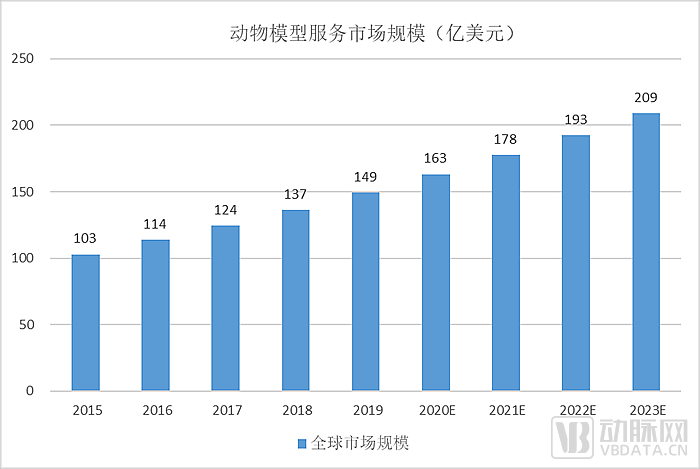
Data source: GMI, "Animal Model Market Report, 2026"
Based on the construction technology used,The animal model market primarily corresponds to technical categories such as CRISPR, ES cell targeting, microinjection, and nuclear transfer. Among these, the first three technologies are associated with genetically modified animal models. According to GMI estimates, the global market size for genetically modified animal model services was approximately USD 10 billion in 2019 and is projected to reach USD 14.1 billion by 2023, accounting for about 67% of the total animal model services market. The compound annual growth rate (CAGR) from 2015 to 2023 was approximately 9.34%, with a growth rate slightly higher than that of the overall animal model services market.
Shanghai Model Organisms Center, Inc. specializes in genetically modified animal model services, which represent the largest segment of the animal model services market and offer substantial growth potential with a sustained upward trend.

Data Source: GMI "Animal Model Market Report, 2026"
By animal category used,The global market size for mouse models was approximately $7.6 billion in 2019 and is projected to reach $10.5 billion by 2023, accounting for about 50% of the total market share, making mice the most widely used model organisms in animal modeling. In addition to mouse models, animal models using rats and monkeys as carriers also hold a certain market share, with each reaching a market size of around $1.2 billion in 2019.
The products and technical services provided by Shanghai Model Organisms Center, Inc. are mainly based on mice and rats as carriers, with a broad market capacity.
The United States is currently the largest market globally for animal models and mouse models. In 2019, its market size was approximately $8.1 billion and $6.1 billion, respectively, with mouse models accounting for about 80% of the global market share.
According to GMI data, the domestic market size for animal model services was approximately $1.1 billion in 2019 and is projected to reach around $1.5 billion by 2023; the market for genetically modified animal model services stood at approximately $800 million, with an expected increase to about $1 billion by 2023. A rough estimate indicates that Shanghai Model Organisms Center, Inc. holds a market share of approximately 3%. Compared with mature markets abroad, the animal model services industry in China remains relatively small, accounting for a low proportion of the global market, which suggests significant room for growth in both market size and share.
Currently, the major players in China’s genetically engineered animal model services industry include Shanghai Model Organisms Center, Inc. (South Model Biology), Biocytogen, Cyagen Biosciences, and GemPharmatech. The prospectus of Shanghai Model Organisms Center, Inc. lists the main products and services offered by its domestic peers as follows:
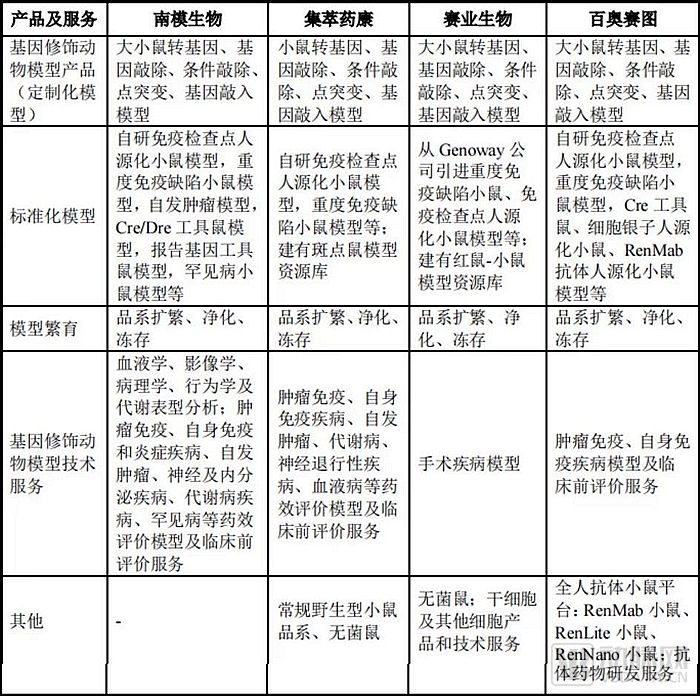
Source: Prospectus
Among them, Shanghai Model Organisms Center, Inc. has already listed on the STAR Market of the A-share today; Biocytogen submitted its IPO application to the Hong Kong Stock Exchange in August this year; and on December 24, the Listing Committee approved GemPharmatech’s IPO application, which had been submitted to the STAR Market of the Shanghai Stock Exchange in June this year.
Leading domestic companies in the model organism sector are choosing to go public at this stage, with their financial performance showing consecutive annual growth and remarkable profits; however, the three firms have adopted distinct development strategies.
Model OrganismsFocusing more on customized model services, this article provides a detailed description and will not be elaborated further.
GemPharmatechThe company has established a robust presence in the field of model animals, with particular strengths in ready-to-use mouse models. In 2020, its commercial sales of mouse models accounted for nearly 60% of GemPharmatech’s revenue. By the end of 2020, GemPharmatech had developed over 16,000 commercially available mouse models with independent intellectual property rights, covering virtually all research scenarios. This figure not only ranks among the top in China but is also highly competitive when compared to The Jackson Laboratory, the global leader in mouse model supply.
BioCytoit has chosen to develop in the direction of innovative drug R&D, with its revenue mainly coming from providing gene editing services, preclinical pharmacological and efficacy evaluation, sales of model animals, and antibody development. In 2019 and 2020, the company's revenue reached approximately RMB 170 million and RMB 254 million respectively, showing a significant increase; during the four months ended April 30, 2021, Biocytogen achieved revenue exceeding RMB 70 million, representing a year-on-year growth of 48.6%.
Historically, China’s animal model market has relied heavily on imports, with international companies such as The Jackson Laboratory, Charles River Laboratories, and Taconic Biosciences holding a near-monopoly. Today, driven by leading domestic enterprises, the field of model organisms is gradually achieving import substitution, boasting broad application prospects and significant growth potential.
As domestic investment in basic research, pharmaceutical R&D, and the scale of related CRO services expand rapidly, the importance of model organisms—particularly genetically engineered animal models—is increasingly recognized, and their market size is poised for continued growth. We look forward to Chinese model organism companies thriving in their respective areas of development, thereby supporting the rapid advancement of the pharmaceutical industry.