

49 Policies, ¥2.5 Billion, and 31 'Firsts': The Story of China's Medical Research Commercialization in 2021
Perhaps due to the pandemic, this year seems to have passed by quickly. Yet it is not only time that has accelerated; the development of China’s medical innovation sector has also surged forward.
This is not an attempt to ride the wave of popularity, but is backed by real data. First, from a policy perspective, in 2021, China issued49 Policies Related to Medical Innovation and Translation, and the social guidance and support for scientific research have been further strengthened.
Secondly, from a technical perspective, according to incomplete statistics, there have been a total of in China's healthcare sector this year31 Cutting-Edge Technologies Achieve Historic Breakthroughs, mainly focused onCOVID-19, Cancer, Rehabilitation, Reproductionand other sectors with high-intensity demand.
Finally, from the perspective of venture capital. According to statistics from VCBeat’s Orange Fruit Bureau, a total of healthcare and medical sector deals occurred in China in 202159 Early-Stage Investment and Financing Events, with total financing reaching a record high2.5 billion yuan, capital's enthusiasm for early-stage healthcare projects has reached an unprecedented high.
2021 was destined to be an extraordinary year, particularly for the rapidly advancing field of medical innovation. Yet, compelling stories are best told with care. So, within this highly watched spotlight sector, what “heart-stirring” new narratives unfolded over the course of the year?
49 Policies: Toppling the “Three Big Mountains” While Leveling Other “Small Hills”
To Break the Ice, Policy Must Lead.
Since the national-level introduction of legislation and tax policies to support the commercialization of scientific and technological achievements in 1985, China’s relevant functional departments have been making various attempts to better promote innovation. According to statistics from VCBeat Orange Fruit Bureau, ChinaOver the past 37 years, a total of 435 policies directly related to the translation of scientific and technological achievements have been issued.。
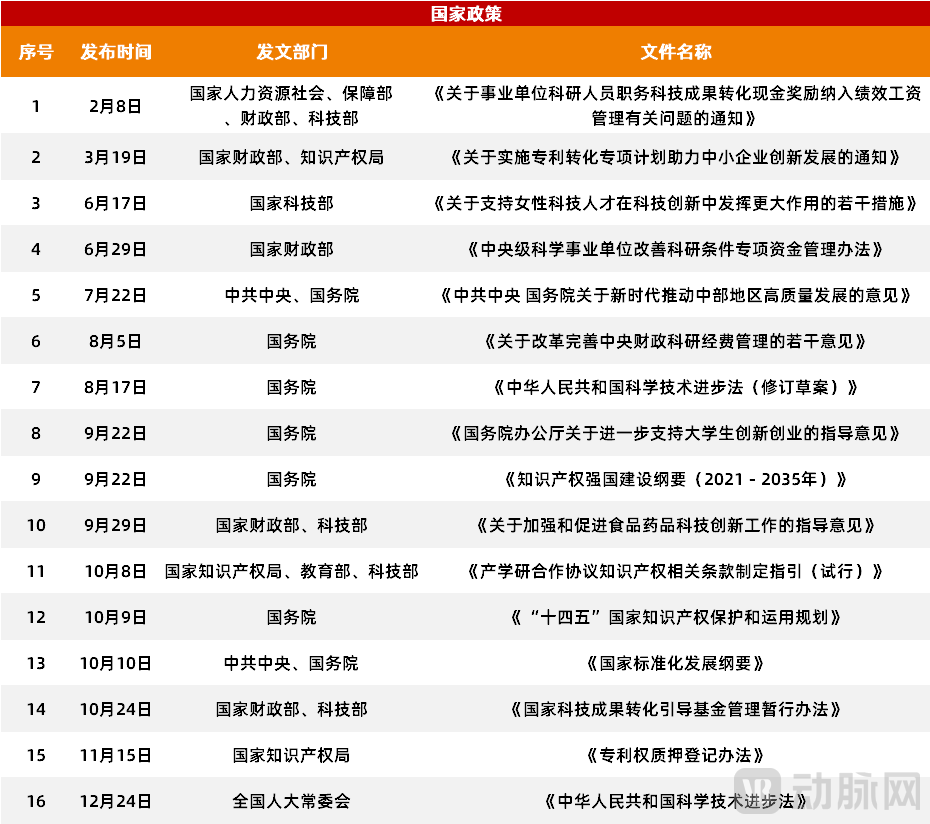
Especially in the past one to two years, as the pace of innovation has gradually accelerated, a large number of related policies have been on the verge of introduction. According to statistics, in 2021, China issued a total of49 Policies, wherein16 National Policies, 33 Local Policies, with its core content primarily focusing on“Intellectual Property, Talent Development, and Research Incentives”Three Key Focus Areas.
This is certainly for a reason, becauseThe purpose of introducing the policy is to address the pain points currently facing the industry.. Taking intellectual property rights as an example, China actually issued regulations as early as 2002“Several Provisions on the Management of Intellectual Property Rights in Research Achievements of National Scientific Research Programs”Efforts have already been made to delineate intellectual property rights, but they have consistently failed to achieve the desired outcomes. To this day, the ambiguous allocation of intellectual property rights remains a critical issue hindering the development of China’s medical innovation sector.
Therefore, among the 49 policies introduced in 2021, 15 of them“Intellectual Property”Listed as a key focus. Issued by the State Council“14th Five-Year” National Plan for Intellectual Property Protection and Utilizationas an example, the policy explicitly states that efforts will be focused on three core dimensions: “comprehensively strengthening intellectual property protection,” “building a convenient and people-oriented intellectual property service system,” and “promoting the development of intellectual property talent and culture,” thereby addressing the current challenges facing intellectual property.
In addition, another major challenge lying on the path to the translation of scientific and technological achievements isShortage of Technical Manager Talent. Compared with elite scientific researchers, professional technology transfer managers appear even more “precious” in China’s innovation and commercialization markets, primarily due to the substantial shortage of such technology brokerage talents in China at present.
To address this fundamental issue,Shanghai, Jiangsu, Chongqing, Guangzhou, Shenzhenand other regions have all issued relevant regulations this year to strengthen the training of technology transfer managers. In Shanghai, the released“Catalogue for the Development of Urgently Needed Talent in Key Fields (Science and Technology Innovation) of Shanghai During the 14th Five-Year Plan Period”Under this policy, professionals in technology transfer have been included in Shanghai’s “14th Five-Year Plan” Catalogue of Urgently Needed Talent for Development, signaling the local government’s strong demand for and high regard for technology managers as pioneers bridging the “last mile.”
The final link is the provision of positive incentives for researchers.Among the policies introduced this year, in terms of incentives, there is a major trend toward “delegation of authority” in addition to the traditional approach of “providing funding,” namelyEmpowering Researchers with Greater Autonomy Over Their Own Patents. Taking the newly revised Law on Progress of Science and Technology this year as an example, the policy clearly states that it aims to“Exploring the System of Granting Ownership or Long-Term Usage Rights of Job-Related Scientific and Technological Achievements to Scientific and Technical Personnel”。
Furthermore, the “Several Policies on Further Supporting Scientific and Technological Innovation” issued by the Sichuan Provincial People’s Government states that“Management personnel and researchers at public research institutions are permitted to hold equity in the form of ‘technology shares + cash shares.’”
Beyond these measures, policy efforts are also being made in other detailed areas. For instance, initiatives such as “optimizing the review and evaluation of provincial-level science and technology projects,” “supporting local governments in jointly establishing pilot-scale maturation platforms for scientific and technological achievements with leading enterprises, universities, and research institutes, and promoting the sharing and joint use of these platforms,” and “encouraging foreign-invested enterprises in China and foreign scientific and technical personnel to undertake and participate in science and technology program projects” are being implemented to address current shortcomings in the translation of scientific research outcomes into practical applications from various aspects.
RMB 2.5 Billion: A “Race” Between Investment Firms and a Group of Scientists
Currently, an increasing number of investment institutions are turning their attention to early-stage medical projects.
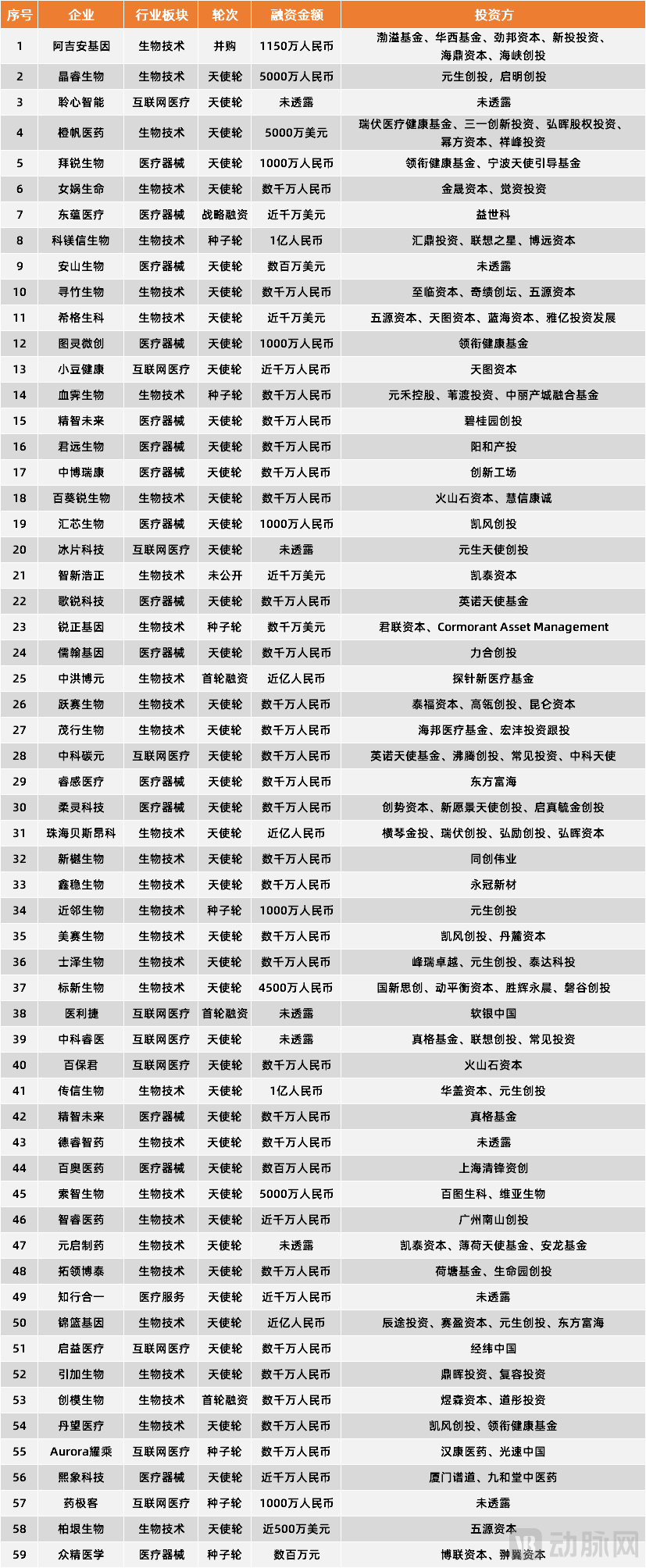
According to statistics from VCBeat, a total of occurred in China's healthcare sector in 202159 Early-Stage Investment and Financing Events, with Total Funding Reaching RMB 2.5 Billion. Behind this investment fervor, we have observed new trends emerging in early-stage medical projects.
First, the biomedical sector has become a hotspot for early-stage investment.According to statistics, among the 59 startups invested in this year,There are 32 biotechnology companies, exactly twice the number of medical device companies.
The reason why biopharmaceuticals are favored by investment institutions is, on the one hand, because theirThe Scarcity of Technology, a senior investor told Chengguo Bureau that for start-ups, possessing innovation capabilities and technology is an indispensable and crucial element, reflecting extremely high "value."
On the other hand, it is also due to the favorable market environment currently enjoyed by innovative drugs.In the past year or two, the state has successively introduced multiple key policies to support the development of innovative drugs, specifically in critical areas such as R&D investment, new drug approval, and platform construction. This has undoubtedly created numerous possibilities for the future development of innovative drugs and renewed investors’ expectations for this sector.
Second, early-stage projects are more focused on addressing immediate needs.Further analysis reveals that 59 startups are primarily focused on medical subsectors with substantial unmet needs, such as oncology, COVID-19, and reproductive health.
that completed a RMB 50 million angel financing round this yearJingrui BiotechFor example, this is an emerging enterprise specializing in on-site rapid nucleic acid testing for pathogens, leveraging innovative molecular enzyme cycling screening technology. Its product pipeline holds breakthrough significance for preventing and controlling the COVID-19 pandemic.
In addition, there are those newly established this yearNüwa Life, this is an independently controlled IVF technology service provider with full patent licensing, primarily focused on the research and application of assisted reproductive medicine. It aims to effectively address the current pain points of low overall efficiency in assisted reproduction and a high incidence of birth defects in the future.
Third, founders generally have a scientific background.Among these 59 startups, we found that the vast majority of founders had previously engaged in scientific research, and their educational backgrounds were primarily from world-class top-tier universities. This phenomenon is particularly pronounced in the biopharmaceutical sector.
For instance, those that have completed a seed financing round exceeding RMB 100 millionKemeixinCo-founderDr. Shi Jiahai, another example is the completion of an angel round of financing amounting to approximately RMB 60 millionXige Biotech, its founding team all come fromHarvard University's Dana-Farber Cancer Institute. In addition, there areDr. Wang Yongzhong, Founder of Ruizheng Gene、Dr. Chen Yuejun, Founder of Yuesai BiotechandDr. Xin Zhang, Founder of Xinwen Biotechetc.
This trend also aligns with the fundamental principles of entrepreneurship in the current healthcare sector. On one hand, research institutes and universities have been encouraging scientists to launch startups in recent years, creating a favorable entrepreneurial environment that has emboldened many researchers to step out of their laboratories. On the other hand, healthcare is inherently a high-tech, sophisticated field. Amid intensifying industry competition, startups are under greater pressure to possess cutting-edge technologies, thereby raising the bar for founders.
Fourth, investment institutions are “frantically” flocking to the early-stage healthcare market.According to statistics, in the 59 early-stage investment and financing transactions that occurred this year, a total of 107 investment institutions participated, mainly includingMatrix Partners China, Legend Capital, Mint Angel Fund, Sinovation Ventures, Genesis Capital, Kaifeng Venture Capitaland other well-known investment institutions.
Among these,Yuan Sheng Venture Capital was the most active, participating in a total of six early-stage investment and financing deals this year., the investing enterprises are respectivelyJingrui Biotech, Bingpian Tech, Jinlin Biotech, Shize Biotech, Chuanxin Biotech, and Jinlan Gene, with a total investment exceeding 300 million yuan.
Investment institutions have collectively shifted their focus to early-stage healthcare projects, a change driven largely by necessity. In recent years, the trend of younger companies going public has become increasingly pronounced. For example, in 2020, 27 out of 71 newly listed companies had been founded less than 10 years prior, marking a significant compression compared to the traditional 15–20 year IPO cycle in the healthcare industry.
As going public becomes increasingly “easy,” the overall pace of investment and financing is accelerating accordingly. According to statistics from VBInsight,In the first half of 2021, a total of 546 investment and financing transactions occurred in China's healthcare sector, with the total amount reaching RMB 92.7 billion, representing a year-on-year increase of nearly 70%.
In such a "rapid matching" investment environment, investment firms have no choice but to focus their attention on early-stage projects, primarily becauseAs the pace of initial public offerings accelerates, investment boundaries are becoming increasingly blurred. Investment institutions that previously focused exclusively on mid-to-late stages are finding it difficult to identify suitable entry points; consequently, they must now cultivate investments from the ground up.
Therefore, we have observedSequoia ChinaIn November of this year, we exclusively donated RMB 500 million to establish the “World Laureates Association Prize,” and we have also seenMatrix Partners ChinaIn December this year, it announced the launch of “Jingwei Sci-Tech Innovation Hub,” with the aim of gaining early access to more early-stage healthcare projects.
Historic Breakthroughs in Multiple Technologies: “Collaborative Partnerships” Are the True Key to Success
Technology is always the core, especially in the closed healthcare sector.
In recent years, with the continuous improvement of China’s overall research environment and the gradual enhancement of related scientific hardware infrastructure, an increasing number of research achievements have been transitioning from laboratories to practical applications. According to incomplete statistics, a total of 31 cutting-edge technologies in China’s medical field have achieved historic breakthroughs this year, all bearing the“First in China”or“World’s First”and similar phrases.
For example, in the field of COVID-19,China's First Specific Anti-COVID-19 Drugofficially approved for market launch this December; for instance, in the field of oncology, developed by the team at Harbin Institute of TechnologyMicro-Nano RobotsFirst active targeting of gliomas; for instance, in the field of rehabilitation, Beijing Jishuitan Hospital completed it this NovemberWorld's First Robot-Assisted Distal Radius Arthroplasty; for example, in the field of reproductive medicine, Beijing Obstetrics and Gynecology Hospital completed in March this yearChina’s First Case of Successful Natural Pregnancy Following Ovarian Tissue Cryopreservation and Transplantation
These technological breakthroughs would not have been possible without the research teams standing behind them. In recent years, we have found that in addition toHospitalApart from,Universities, EnterprisesandResearch InstitutionsThey are all extensively involved in technological research and development within the healthcare sector, with significantly increased investment and focus compared to the past.
However, hospitals remain the “main force” in research and development; according to statistics, among the 31 breakthrough technologies this year,18 technologies originated from the hospital.
There are indeed reasons for this. First, hospitals possess inherent R&D advantages, backed by extensive clinical resources that serve as a data foundation. Second, hospitals make substantial investments in R&D; data shows that in 2018, the value of scientific and technological achievements transferred per 100 health technical personnel reached RMB 13.0593 million, representing a year-on-year increase of 165.96%. Third, there is the pressure exerted by “hard targets.”In January 2019, the commercialization of scientific research achievements was officially incorporated into the performance evaluation metrics for tertiary hospitals., hospitals are shouldering a heavier burden of innovation pressure than ever before.
However, hospitals alone are not enough.Currently, China's healthcare industry is in the midst ofDigitalization, Automation, and IntelligenceIn this transitional phase characterized by cross-disciplinary integration and rapid evolution, research teams must identify the “convergence points” across different technological dimensions and fully integrate core competencies from multiple stakeholders to create truly valuable innovative projects.
Therefore“Integration of Medicine and Engineering”is becoming a consensus among researchers. WithDr. Li Kang, West China HospitalTaking the surgical robot research project under my responsibility as an example, the R&D team brings together 21 renowned experts from leading Chinese institutions—including West China Hospital of Sichuan University, the University of Science and Technology of China, Shanghai Jiao Tong University, and the University of Electronic Science and Technology of China—among whom are academicians. Specializing in diverse technical fields, they work side by side to achieve the development and industrialization of the first medical surgical robot in western China.
Actually, it’s like this."Partnership Collaboration"This arrangement is beneficial to all parties involved in R&D. Taking universities as an example, while they have made significant achievements in engineering, their limited access to clinical resources means that researchers often have to conceptualize clinical scenarios in a vacuum. This undoubtedly increases the difficulty of R&D and compromises the ultimate outcomes of scientific research.
However, this does not mean that “cooperation” ensures smooth sailing; challenges remain, specifically how to achieve better integration between the two. This is actually not as easy as one might imagine. On one hand,Hospitals and universities represent two entirely distinct research systems., each with its own operational standards and “performance targets”; on the other hand,Medicine and engineering are fundamentally distinct disciplines., there are also significant differences in their thinking patterns.
Therefore, we have observed that many hospitals and universities have established their ownInnovation Center, with the aim of better integrating its proprietary research system with external resources to truly build a bridge for communication with the outside world. Only in this way can we truly achieve a synergistic research effect where “1+1” is greater than 2, or even greater than 100, and drive more innovative projects to move from the laboratory to the market.
"The Road Is Long and Arduous: Persist in Doing What Is Difficult Yet Right"
After a period of consolidation, China’s medical innovation sector has reached an unprecedented height, with an industry inflection point imminent and innovative achievements blossoming across the board.
First, it is reflected in innovation capability. According to the "2021 Global Innovation Index Report" released by the World Intellectual Property Organization,China’s ranking has risen to 12th place, making it the fastest-improving country in the world.; secondly, in terms of the number of patents, according to the latest data released by the World Intellectual Property Organization (WIPO) of the United Nations,In 2020, China filed a total of 68,720 international patent applications under the Patent Cooperation Treaty (PCT), ranking first globally for the second consecutive year.
Finally, this is reflected in industry trends. Currently, every link in China’s innovation ecosystem chain is participating more deeply in medical innovation, striving to unlock greater innovative potential and deliver more tangible outcomes. Moreover, China is seeing steady improvements in both the policy-driven “software” and laboratory-based “hardware” of its innovation infrastructure, rapidly narrowing the gap with leading innovative nations such as the United States.
However, the problem remains evident.
First is the “superficial” medical innovation capability.It is undeniable that more people are currently participating in medical innovation, leading to a surge in patents and laboratory achievements. However, the proportion of these innovations that can truly be commercialized—or are practically viable—is minuscule. This is particularly evident in cutting-edge fields such as rare disease drug development, where successful outcomes are exceedingly rare.
There are many reasons for this. Take physicians, the “main force” of medical innovation, as an example. First and foremost, their primary responsibility in China remains clinical care. This is especially true for those capable of conducting research, who face even greater clinical pressures. As a result, they have very limited time and energy to devote to scientific research. However, due to performance evaluation requirements, they are compelled to take on certain research tasks, making the ultimate outcomes predictable.
In addition, there are cognitive challenges. The vast majority of doctors in China have long operated within a closed, hospital-centric ecosystem. Without external support, they struggle to access other market resources, making it easy for their R&D efforts to go astray. Most adopt a “technology-first, market-blind” approach, resulting in innovations that lack user-centricity and fail to gain traction in real-world market applications.
Second is the "low and unattainable" innovation conversion rate.Although we have ranked first in the number of patents for two consecutive years, with an ever-widening gap between us and the United States, which holds the second position, we still lag significantly behind in terms of the critical commercialization rate. Our current rate stands at less than 10%, far below the approximately 40% conversion rate achieved by developed countries in Europe and America.
Beyond the “lack of innovation” mentioned in the previous paragraph, contributing factors to this outcome include issues with R&D funding, patent protection, talent for commercialization, process design, and market awareness. Over time, these pain points have gradually converged into a combined force, creating a “deadlock” in China’s medical innovation and commercialization market.
Third, an innovation path that is “indefinitely distant.”Currently, enthusiasm for medical innovation is at an all-time high; however, stakeholders are still continuously exploring how to translate this passion into practical applications. Even though there are mature overseas experiences to draw upon, it is essential to closely integrate these “best practices” with localization, as differing needs inevitably lead to distinct markets and business models.
From this perspective, we need to establish a standardized pathway for translating medical innovations into clinical practice as soon as possible, because standardization can mitigate various risks encountered in scientific research and better ensure the success rate of final translation.
However, this pathway also has its requirements. First,This pathway must be clear., that is, clearly specify how to perform each step; secondly,This pathway contains nodes., i.e., each step completed yields phased outcomes; finally,This pathway is controllable., i.e., with a defined time frame and operational feasibility.
What is certain is that China’s medical innovation sector will experience a period of explosive growth over the next five years, but as the market becomes saturated, it will graduallyEntering a Period of Consolidation Marked by Survival of the Fittest, the scrutiny of research quality will become increasingly stringent.
Therefore, starting from this point, if stakeholders across the innovation ecosystem truly wish to capture the dividends of medical innovation, they need to settle down andFocus on core technological areas that currently have severe clinical needs or hold significant application potential in the future., and while ensuring quality, make every effort to translate these innovative achievements into practical applications, then leverage reasonable market access mechanisms to allow such innovations to benefit a broader population.
It Is the Right Time for Medical Innovation, and We Should Be More Focused Than Ever Before.