

Blackrock Neurotech Secures $10M Funding and FDA Breakthrough Device Designation for Pioneering MoveAgain Brain-Computer Interface System

re.Mind Capital
Mental Health Investment Firms

Blackrock Neurotech
Implantable Solutions Developer
May 19, 2021Blackrock Neurotech (hereinafter referred to as “Blackrock”), a global leading supplier of neuroengineering, neural prosthetics, and clinical neuroscience research tools, has completed a $10 million financing round, led by Re. Mind Capital, with participation from Peter Thiel, Co-Founder and Chairman of Palantir Technologies, German entrepreneur Tim Sievers, and Sorenson Impac. The funding will be used to further expand the number of projects on the Blackrock Neurotech platform—including clinical and cutting-edge research—and to continue developing its technology platform to maintain its market leadership.
Blackrock, founded in 2008 and headquartered in Salt Lake City, UT, is a global leader in providing tools for neural engineering, neuroprosthetics, and clinical neuroscience research. Blackrock supplies diagnostic and therapeutic tools and products for the nervous system to patients, clinical decision-makers, and medical device companies. Committed to enabling individuals with neurological disorders to regain the ability to walk, speak, see, hear, and feel, the company has established collaborations with more than 500 research and clinical institutions.
This marks Blackrock’s first funding round since its inception. What has the company accumulated over the past decade, and how did it outperform competitors to secure this financing? This article provides an overview.
Strong Historical Foundation, Long-Term Focus on the Brain-Computer Interface Field
Blackrock’s heritage of high-tech innovation dates back to 1997, with the spin-off of Bionic Technologies from the University of Utah. The company was founded by Brian Hatt and Richard A. Normann (inventor of the Utah Electrode Array) and was later taken over by Cyberkinetics Neurotechnology Systems, Inc. (CKI). After making significant progress in applying neuroscience research technologies to humans, Blackrock Microsystems acquired CKI’s research business in May 2008. In May 2021,To better reflect the company’s long-standing focus on neurotechnology and brain-computer interface technology, Blackrock Microsystems has been renamed Blackrock Neurotech.
Florian Solzbacher is the Co-founder, Chairman, and President of Blackrock Neurotech. He holds a Master’s degree in Electrical Engineering from the Technical University of Berlin and a Ph.D. from the Ilmenau University of Technology. In addition to his roles at Blackrock, he serves as the Director of the Engineering Innovation Center at the University of Utah and Co-Director of the Utah Nanotechnology Institute. He also teaches electrical and computer engineering, materials science, and bioengineering at the University of Utah. His research focuses on microsystems and materials for harsh environments, including implantable wireless microsystems for biomedical and healthcare applications, as well as microsensors capable of withstanding high temperatures and extreme conditions. Furthermore, he is the author of more than 190 journal and conference publications, five book chapters, and 22 invention disclosures, pending patents, or issued patents.
As Co-Founder, Chief Executive Officer, and Chief Financial Officer of Blackrock Neurotech, Marcus Gerhardt holds a Master’s degree in Philosophy from the University of Oxford and a Master’s degree in Management from the University of St Andrews in the United Kingdom. Prior to joining Blackrock Neurotech, Mr. Gerhardt co-founded multiple companies, including Mondus, a leading asset management firm specializing in frontier markets in the Middle East, and BBI, an international consulting firm that provides financing, commercialization, and growth strategy advisory services to technology companies.
Blackrock brings together PhD talent from renowned institutions such as the University of Michigan, the University of Utah, and New York University, boasting over 20 years of expertise in brain-computer interfaces. Its technical competencies span materials, implantable electronics, miniaturization, system integration, and regulatory compliance.The product portfolio encompasses eight major categories: electrodes, front-end probes, data acquisition systems, stimulators, wireless probes, behavioral systems, accessories, and adapters.。
Utah Array: The Gold-Standard Electrode for Recording and Stimulating the Brain
Blackrock has always placed great emphasis on the design and manufacturing of neural electrodes,Currently, various electrode arrays are available, including the Utah Array, Slant Array, and NeuroPort Array. Among these, the Utah Array is a patented microelectrode array product from Blackrock Neurotech, characterized by high density, high channel count, and compact size, enabling stable, long-term acquisition of brain action potentials, local field potentials, and peripheral nerve signals.With over 1,500 peer-reviewed citations, the Utah Array has become the gold-standard electrode for recording and stimulating the brain, with broad applications in small and large animal models, as well as in vivo and in vitro experiments.

In a study requiring microsimulations to record distinct feedforward and feedback effects and elucidate the neural mechanisms underlying texture segregation, Pieter Roelfsema, M.D., Ph.D., of the Netherlands Institute for Neuroscience, stated that the Utah Array provided the flexibility needed to achieve his research objectives. This enabled him to stimulate and record from more than 1,024 channels across both single and multiple arrays in the visual cortex.
NeuroPort: FDA- and CE-Certified Data Acquisition System
The NeuroPort System is a highly configurable, easy-to-use multichannel data acquisition system for recording and monitoring electrical brain activity. The NeuroPort System can perform various online processing algorithms on neural signals, including noise cancellation, adjustable digital filtering, simultaneous extraction of spikes and local field potentials, and automatic online spike sorting. Furthermore, the system’s neural signal processor provides real-time processing for 128 electrodes, 16 auxiliary analog channels, and independent TTL or gated experimental events.
The NeuroPort System features seven key highlights:
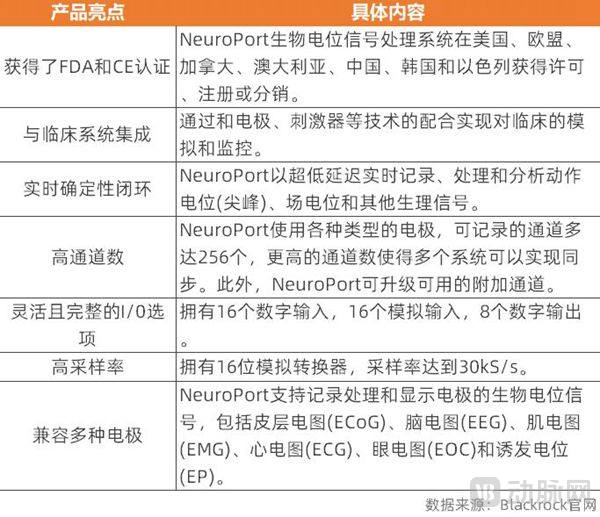
The NeuroPort system provides flexible visualization and processing capabilities, while its rich API enables researchers to access data online for real-time experimental control and brain-computer interface applications. Sydney Cash, Associate Professor of Neurology at Harvard Medical School, stated that the NeuroPort system allows him to access data more easily, visualize EEG data more effectively, and implement online closed-loop operations.
In addition, Blackrock’s data acquisition system includes CerePlex Direct and Cerebus.CerePlex Direct is better suited for small animal models, electrophysiologists with less intensive needs, and beginners in data acquisition, recording, and stimulation. Cerebus can capture, process, and analyze action potentials (spikes), field potentials, and other physiological signals related to experimental events in real time.
Actively pursued collaborations and obtained FDA Breakthrough Device Designation
Blackrock Neurotech has achieved many “firsts” in human brain-computer interface applications. For example, it was the first to enable patients with quadriplegia to directly control robotic limbs using their brains, and the first to allow patients with amyotrophic lateral sclerosis (ALS), including those with complete locked-in syndrome, to directly control an auditory speller through their thoughts, thereby restoring their ability to communicate.
According to the official website of Blackrock Neurotech,Currently, 34 people worldwide have been implanted with brain-computer interfaces, of whom 31 use Blackrock’s technology.. For example, Aaron Ulland suffered left-sided paralysis due to a stroke, and Blackrock Neurotech’s brain-computer interface technology enabled him to move his arm again; Dennis DeGrey sustained a spinal cord injury in 2007, and Blackrock Neurotech’s brain-computer interface technology allowed him to compose text using only his brain signals.
Blackrock currently has more than 500 research and clinical partners, and has established strategic partnerships with the University of Utah, Johns Hopkins Applied Physics Laboratory, Stanford University, Brown University, Massachusetts Institute of Technology, and the Defense Advanced Research Projects Agency (DARPA), to jointly develop and apply new brain-computer interface applications.
Based on 25 years of groundbreaking human clinical research conducted by many leading institutions,Blackrock pioneered the MoveAgain brain-computer interface system and received FDA Breakthrough Device designation in 2021.This system consists of an array implanted in the brain that decodes patient intent from neuronal activity and then wirelessly transmits these signals to external devices, such as cursors, keyboards, wheelchairs, and prosthetic limbs, potentially enabling patients with mobility impairments to control external devices through thought alone. The system is designed to improve patients’ mobility and independence, reduce their reliance on caregivers, and facilitate better social integration.
Securing Funding to Embark on a New Journey of Commercialization
Following a $10 million financing round, Blackrock Neurotech announced the launch of a commercial brain-computer interface (BCI) platform in 2022, designed to enhance communication with the external world for patients with physical disabilities resulting from conditions such as amyotrophic lateral sclerosis (ALS), paralysis, and spinal cord injury.
Blackrock’s brain-computer interface platform consists of implants, miniature electronic devices, software, and decoders. When patients think, electrodes implanted in the brain read the electrical firing patterns of neurons and transmit these signals through five patented machine-learning software decoders, ultimately enabling patients to directly control external devices such as screen cursors, wheelchairs, and robotic arms via their intent. The platform has been proven to convert thoughts into text input faster and more accurately than other brain-computer interface applications to date. With commercialization targeted for 2022, Blackrock will becomeThe first company to distribute a complete brain-computer interface system on the market.