

United Imaging Healthcare Files for STAR Market IPO with RMB 5.8 Billion Revenue, Cementing Its Position as the Leading Player in Medical Imaging Equipment

United Imaging
High-end Medical Device Developer
On December 31, 2021, Shanghai United Imaging Healthcare Co., Ltd. (“United Imaging”), a leading enterprise in high-end medical imaging equipment, filed its prospectus on the STAR Market. For this filing, CICC and CITIC Securities served as joint sponsors. The company planned to raise RMB 12.48 billion, with the proceeds to be used for the research and development of next-generation products, the construction of marketing and service networks, and the supplementation of working capital.
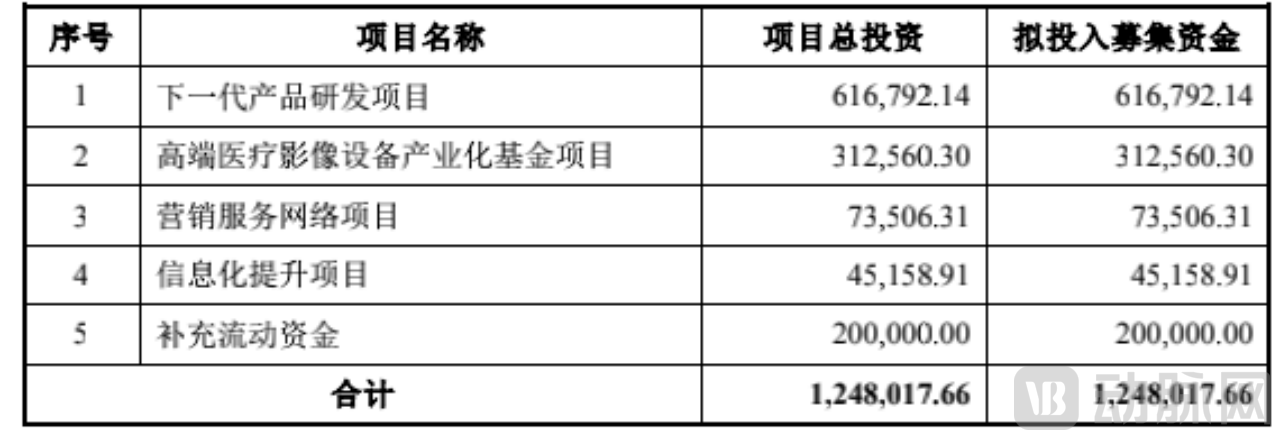
Use of Proceeds Disclosed in the Prospectus
Amid the wave of domestic substitution for medical devices, United Imaging has consistently been a leading force. Over its ten years since establishment, United Imaging has achieved numerous milestones. It has developed top-tier imaging equipment, including the world’s first total-body PET-CT (2-meter PET-CT), the “spatiotemporal integrated” ultra-high-definition TOF PET/MR, the world’s first 5.0T MRI scanner, and China’s first 3.0T MRI scanner. The company has led nearly 40 national and provincial-level R&D projects, including close to 20 major national science and technology special projects. It has also received many prestigious awards, such as the First Prize of the National Science and Technology Progress Award in 2020 and the First Prize of the Shanghai Science and Technology Progress Award in 2020. Furthermore, United Imaging has repeatedly ranked among the top positions on VB100’s Future Healthcare 100 list.
In terms of financing, United Imaging has always been “well-funded.” Over the past decade, it completed only one financing round—a Series A round of RMB 3.33 billion in 2017. During the reporting periods (2018, 2019, 2020, and the first half of 2021), its cash flow balances stood at RMB 1.878 billion, RMB 1.456 billion, RMB 3.124 billion, and RMB 1.118 billion, respectively.
However, the development level of high-end medical imaging to some extent reflects a country’s medical technology prowess, making competition particularly fierce. United Imaging faces external pressure from century-old giants such as GE Healthcare, Philips Healthcare, and Siemens Healthineers, as well as domestic competition from established players like Neusoft Medical and Mindray. If it successfully goes public, how will United Imaging, armed with tens of billions in capital, play its hand?
According to a research report by Frost & Sullivan, the compound annual growth rate (CAGR) of China’s medical imaging equipment market from 2015 to 2020 was 12.4%, with its size exceeding RMB 50 billion in 2020.
Although the “Healthy China” initiative has been elevated to a national strategy, and factors such as the rapid expansion of China’s general health market, increased support for the high-end medical imaging industry, and the normalization of COVID-19 prevention and control have all stimulated potential demand for medical imaging equipment, many domestic enterprises in China are often excluded from the market due to a lack of effective competitiveness. Leveraging their century-long accumulation, overseas companies have easily captured more than 90% of the Chinese market share.
Breaking the monopoly of foreign enterprises is no simple task. As a typical capital- and technology-intensive industry, the medical imaging sector features high R&D difficulty and substantial upfront investment, while establishing market share requires a considerable amount of time. Domestic companies are often limited to purchasing core components produced by foreign firms for assembly, thereby securing only a small share of the mid-to-low-end market.
United Imaging aims to become such a game-changer.
After a decade of trials and refinement, United Imaging has grown increasingly robust, commanding an ever more impressive market share. Data from the global market research firm Ipsos shows that in the first half of 2020, United Imaging, the leading domestic manufacturer, ranked first in sales volume of clinically practical CT and MRI systems in China. With its recent filing of the prospectus, United Imaging has presented a more intuitive picture of its development through concrete data.
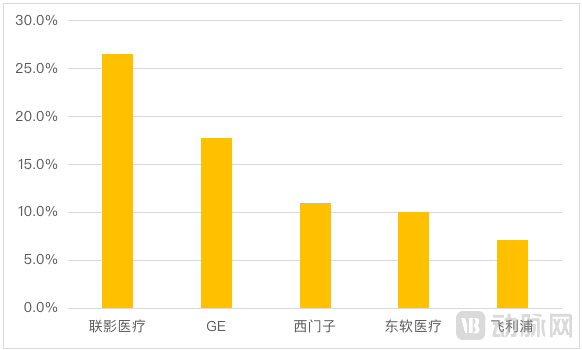
2020Top 5 Clinically Practical CT Sales in the First Half of the Year (Data SourceIpsos)
First, let's look at operating revenue. During the reporting period, United Imaging’s operating revenues were RMB 2.035 billion, RMB 2.979 billion, RMB 5.763 billion, and RMB 3.085 billion, respectively, with total revenue surpassing that of established domestic medical imaging manufacturers such as Neusoft Medical and Wandong Medical.
Notably, United Imaging, which capitalized on the development of the new public health medical system, saw its 2020 operating revenue increase by 93.39% year-on-year. It was also in this year that the company turned losses into profits, achieving a net profit of RMB 937 million.
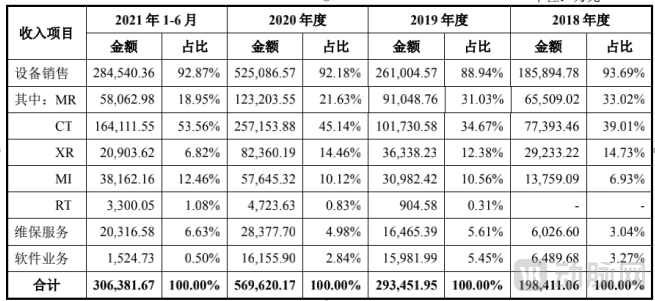
United Imaging Revenue Breakdown (Data sourced from the prospectus)
High gross profit margins are another key driver of United Imaging’s profitability. During the reporting period, the company’s gross profit margins from its core business were 39.11%, 42.06%, 48.81%, and 51.85%, respectively, demonstrating a steady increase. This indicates that United Imaging’s product portfolio has reached a mature stage, and the company has established a comprehensive and efficient distribution and direct sales model.
However, in the high-end medical equipment sector, technology reigns supreme. While market share is certainly important, technological capability is the key factor constraining United Imaging’s future growth. In this regard, United Imaging has not held back.
During the reporting period, the Company’s R&D expenditures amounted to RMB 666 million, RMB 690 million, RMB 850 million, and RMB 499 million, representing 32.73%, 23.17%, 14.76%, and 16.17% of its operating revenue, respectively. In recent years, United Imaging has maintained a trend of launching multiple new devices annually, with its R&D investments consistently yielding high returns at a rapid pace.
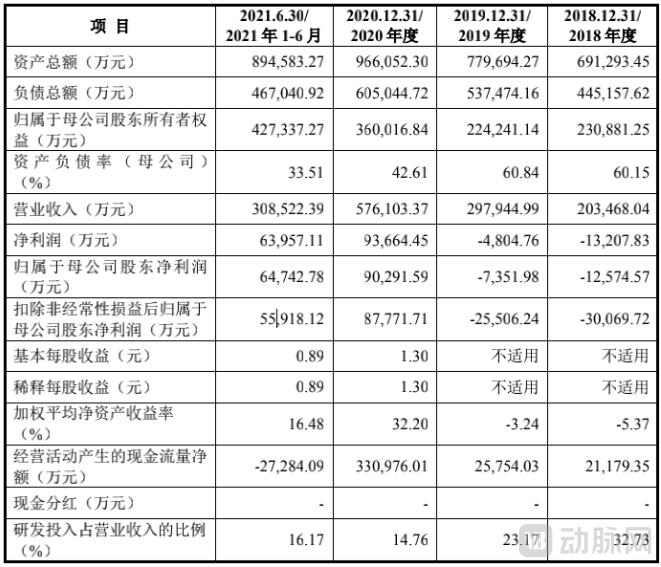
United Imaging Complete Financial Statement Data
Overall, United Imaging has delivered a strong performance. After more than a decade of development, the company has achieved remarkable results in building its engineering team, making breakthroughs in core technologies and components, and strategically structuring its product portfolio, establishing a unique position in China’s medical device industry.
VCBeat believes that, leveraging its technological moat built through sustained high-intensity R&D investment and an irreplicable team of engineering researchers, United Imaging has promising growth prospects. Its product line competitiveness is expected to strengthen continuously, positioning the company as one of the most likely candidates to evolve into a major global player in the medical device industry. Following its listing, United Imaging will possess significant scarcity value in the A-share market, and its valuation is anticipated to perform well.
According to the prospectus, United Imaging has established high barriers in R&D and operations. Through data compilation and analysis, VCBeat summarizes United Imaging’s advantages into the following four points.
1. A Comprehensive Product Line Rivaling GPS
United Imaging has developed a comprehensive product portfolio centered on high-end medical imaging equipment. Its offerings include diagnostic products such as MR, CT, XR, PET/CT, and PET/MR; radiotherapy products including conventional RT and CT-guided RT; and life science instruments such as animal MR and animal PET/CT systems. The company is also actively expanding its presence in the DSA segment within its XR product line and in its ultrasound product line, thereby meeting needs ranging from preclinical research to diagnosis and treatment.
United Imaging’s product portfolio features both breadth and depth. Across its MR, CT, XR, PET/CT, and PET/MR product lines, United Imaging offers a diverse range of products that span from clinical applications to research needs, effectively meeting the requirements of various customer segments.
Meanwhile, United Imaging is actively advancing a comprehensive strategy centered on multimodal integration of hardware products and software empowerment. Its devices are predominantly equipped with self-developed medical image processing software and advanced applications, enabling the organic integration of research, diagnosis, treatment, and planning, thereby providing a one-stop solution for precision diagnosis and therapy.
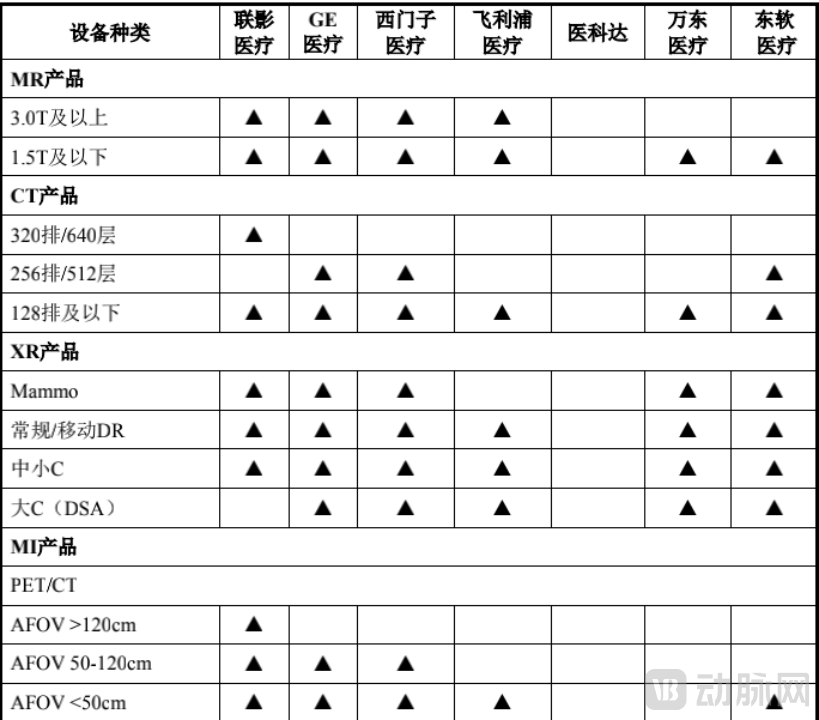
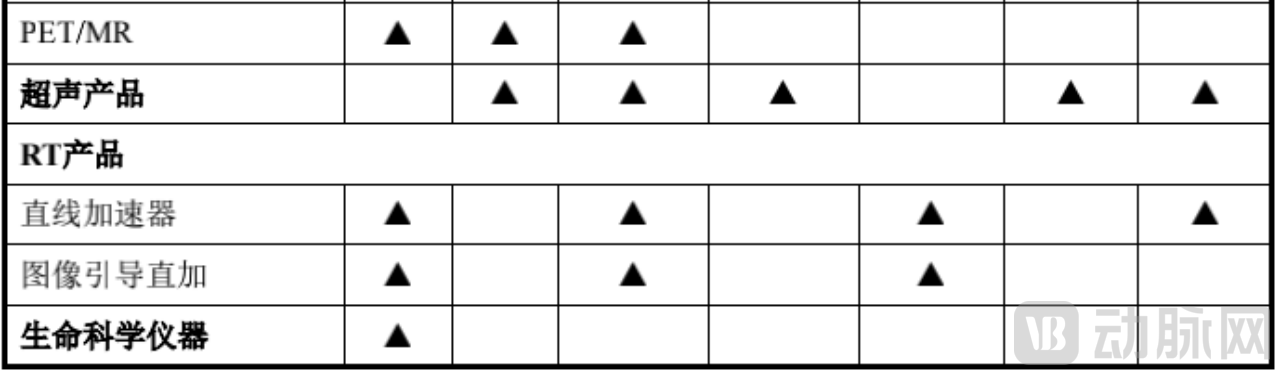
United Imaging and Its Competitors' Product Portfolios
As can be seen from the table above, in the field of high-end medical imaging and radiotherapy products, United Imaging’s product portfolio coverage is basically consistent with that of international manufacturers such as GE Healthcare, Siemens Healthineers, and Philips Healthcare, far exceeding the layout of domestic enterprises.
II. Leading Market Share in Four Major Markets
The long-standing dominance of domestic imaging equipment by companies such as GPS has also earned them a strong reputation and high user stickiness, making it no easy task to capture market share from this mature sector. However, in recent sales battles, United Imaging has gradually gained ground in the four key arenas of MR, CT, XR, and molecular imaging.
MR
Based on the number of newly sold units, United Imaging had become the largest MR equipment manufacturer in the Chinese market by 2020, capturing a 25.4% market share for 1.5T MR systems, significantly surpassing competitors such as GPS and Lianrun.
In the market for 3.0T MRI systems and above, United Imaging currently holds a 17.1% market share, ranking fourth and still trailing behind the "GPS" trio by a considerable margin.
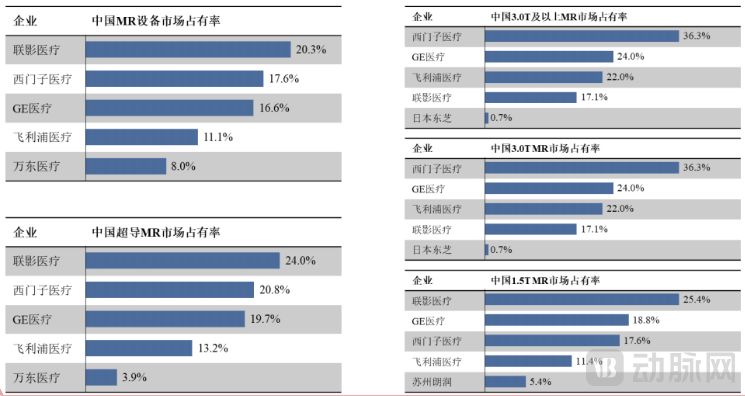
Competitive Landscape of China’s MR Equipment Market in 2020 (Source: Frost & Sullivan, by Number of New Installations)
CT
In terms of newly installed units, United Imaging was the largest CT equipment manufacturer in the Chinese market in 2020, outperforming international competitors. The localization rate for CT scanners with fewer than 64 slices has reached 65% in China, whereas that for 64-slice and above models stands at only 35%.
In the CT market with fewer than 64 slices, United Imaging ranks first in market share (by number of newly sold units); in the CT market with 64 slices or more, United Imaging ranks fourth in market share (by number of newly sold units).

2020 Competitive Landscape of the CT Equipment Market in China (Data Source: CIC Consulting, by Number of New Installations)
XR
Across various sub-segments of the XR industry, DR and mobile DR equipment have basically achieved domestic production in China. However, the localization rate for mammography systems and Digital Subtraction Angiography (DSA) devices remains low, with the DSA localization rate falling below 10%. In terms of newly sold units, United Imaging ranks first in market share for mobile DR, second in overall DR market share, and among the top five in the mammography system market.

2020 Competitive Landscape of China’s XR Device Market (Source: CIC Consulting; based on number of new units)
Molecular Imaging
Molecular imaging systems are high-end products in the field of medical imaging, with major market participants including Siemens Healthineers, GE Healthcare, and Philips Healthcare. In terms of new unit sales, United Imaging has ranked first in market share in China for four consecutive years since the launch of its PET/CT products.
Participants in China's PET/MR market include United Imaging, Siemens Healthineers, and GE Healthcare. United Imaging is the only domestic manufacturer of PET/MR systems and ranked first in market share in 2020.
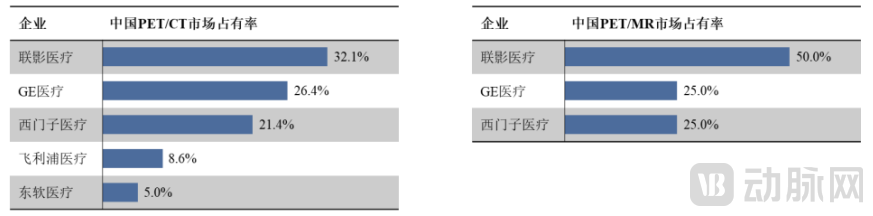
Competitive Landscape of China's Molecular Imaging Equipment Market in 2020 (Data Source: Frost & Sullivan, by Number of Newly Installed Units)
Intelligent equipment is the trend of industry development. In recent years, United Imaging has also actively promoted the integration of new software technologies with hardware to improve equipment operational efficiency. Taking magnetic resonance imaging (MRI) as an example, the company has developed software related to equipment workload and imaging based on general algorithms. In terms of imaging, this assists MRI systems in improving the signal-to-noise ratio, enhancing resolution, and shortening scan times. Regarding equipment operation, it enables optimization of examination workflows, automatic patient positioning, and reduced patient positioning time, thereby minimizing examination errors caused by human intervention. Recently, United Imaging launched the uAIFI brain-inspired platform to provide multifaceted assistance for MRI applications.
With the support of artificial intelligence, MRI equipment can not only improve efficiency but also simultaneously enhance the three core elements of signal-to-noise ratio, resolution, and scan time, thereby supporting applications in a wider range of scenarios. Therefore, the future development of MRI will involve not only hardware competition—such as achieving 10T, 15T, or even 20T field strengths—but also competition at the software level. This means that MRI systems will be able to provide images tailored to specific clinical needs based on particular clinical scenarios, and even undergo specialized transformation to achieve intelligent, precision imaging powered by artificial intelligence.
United Imaging is one of the Chinese companies with the most extensive overseas presence. It has established R&D centers, sales subsidiaries, and production capabilities in the United States, and set up sales subsidiaries in other countries such as Malaysia, the United Arab Emirates, and Poland, progressively building a global network for R&D, manufacturing, and services.
Due to the impact of the pandemic, United Imaging’s team building and sales velocity were affected to some extent. Therefore, in the short term, United Imaging’s sales focus will remain primarily on the domestic market. During the reporting period, the proportion of overseas sales revenue (calculated based on the installation location of end customers) to total operating revenue was 2.18%, 3.37%, 4.21%, and 5.89%, respectively.
In the long run, United Imaging’s technological advantages are poised to challenge the market barriers established by the “GPS” trio. If it can build substantial advantages in both cost and technology, United Imaging will effectively advance its global expansion strategy and is expected to create multiple new growth drivers.
Under United Imaging’s aggressive expansion, the Chinese medical imaging equipment market has undergone a dual reshuffling of market share and equipment pricing in recent years. From a value perspective, the rise of domestic manufacturers has effectively broken the high pricing previously maintained by GPS (GE Healthcare, Philips, and Siemens Healthineers) in the Chinese market, injecting vitality into a sector that historically lacked sufficient competition. This has driven down prices for products such as CT and MR scanners, facilitating the widespread adoption of imaging equipment across medical institutions at all levels in China, thereby benefiting a larger number of patients.
However, when viewed over a longer timeframe, the value of United Imaging’s rise extends beyond this.
Zheng Hairong, Vice President of the Shenzhen Institutes of Advanced Technology, Chinese Academy of Sciences, once stated: “For a comprehensive, modernized industrial manufacturing system, high-end medical imaging equipment is more than just a medical product. Its production and manufacturing can drive the development of a cluster of high-end industrial chains in China, spanning materials, chips, components, and electronics. This is not a challenge that can be resolved simply by purchasing from abroad, as might be feasible for a smaller nation.”
In other words, technological competition is not merely a struggle for product market share, but also a contest of cutting-edge medical capabilities between both sides. In the past, many top overseas medical institutions established partnerships with major imaging equipment manufacturers such as GPS (GE Healthcare, Philips, and Siemens Healthineers), enabling them to access the most advanced equipment immediately for pioneering research. By the time our hospitals acquired these devices, several years had often passed, limiting their research largely to validation studies and hindering exploration at the forefront of medical science.
United Imaging has broken through the technical barriers in imaging equipment, and its significance lies in reclaiming the “lost years.”
As we witness the installation of the world’s first 5T MRI scanner at Zhongshan Hospital, Fudan University, and the deployment of China’s first 9.4T ultra-high-field animal MRI system at Ruijin Hospital, the gap between domestic and international cutting-edge medical technologies may no longer seem so distant.