

JUNJO Pharma: Empowering Cell Therapy as a CDMO 'Water Supplier' with Integrated Viral Vector Platforms
Undoubtedly, cell therapy is one of the most talked-about and compelling fields in the current pharmaceutical and biotechnology industry.
Frequent approvals of new technologies and products, such as CAR-T therapy, immunotherapy, and stem cell therapy, have demonstrated favorable clinical outcomes, benefiting countless patients.
Within the cell therapy industry chain, the upstream segment comprises pharmaceutical R&D and manufacturing outsourcing services (CRO/CDMO), while the midstream and downstream segments encompass clinical trials and diagnostic and therapeutic services. In recent years, capital and technology have predominantly concentrated in the midstream and downstream sectors, accelerating the approval and clinical application of related products. However, it is important to recognize that significant opportunities remain untapped in the upstream segment of the cell therapy industry, specifically within R&D outsourcing and manufacturing services, such as viral vectors, non-viral vectors, and critical reagents.
Recently, VCBeat (WeChat: vcbeat) interviewed Junjo Pharmaceuticals, an upstream company in the cell therapy sector. The company primarily provides CDMO services for cell therapy vectors. Wang Jianxun, Co-founder and Chief Scientist of Junjo Pharmaceuticals, shared with VCBeat insights into the industrial landscape of the cell therapy industry and the company’s development trajectory.
According to Wang Jianxun, Dr. Shi Yuanyuan, Chairman of the Company, is a Distinguished Professor at Beijing University of Chinese Medicine and formerly served as Executive Vice Dean of the School of Life Sciences. He currently serves as Executive Director of the Shenzhen Institute of Beijing University of Chinese Medicine. A postdoctoral fellow at Harvard University in the United States, Dr. Shi completed his doctoral studies under the supervision of Academicians Zou Chenglu and Wang Zhizhen of the Chinese Academy of Sciences, as well as Bert L. Vallee, a member of the U.S. National Academy of Sciences. He is an expert in the field of protein structure and function research. His work primarily focuses on modifying CAR molecular structures to enhance the specificity of antigen recognition and cytotoxicity, thereby achieving greater precision in CAR-T cell therapy. During his time in the United States, he founded multiple biotechnology companies and held positions such as Board Director and President, accumulating extensive experience in business operations and administrative management.
Regarding the reasons for founding JUNJO Pharmaceuticals, Wang Jianxun stated, “During my tenure at Sorrento Therapeutics in the United States, I was involved in the establishment of CAR-T GMP manufacturing capabilities, including the construction of GMP facilities, production of viral vectors, preparation of Master Cell Banks (MCB), preparation of Virus Producer Cell Master Cell Banks (VPC MCB), and quality control testing of viral vectors. Additionally, I led the team in completing Investigational New Drug (IND) applications and conducting clinical trials. This experience provided me with a clearer and more comprehensive understanding of how to establish CAR-T GMP systems, while also allowing me to accumulate extensive expertise in the standardized industrial production of cellular immunotherapies and viral vectors. Against this knowledge background, Dean Shi Yuanyuan and I conducted in-depth market research on China’s cellular immunotherapy industry, ultimately deciding to establish a CDMO company specializing in viral vector production.”
In addition, the company’s core team includes Dr. Xiang Hua, Deputy General Manager and Chief Advisor, who brings extensive legal and management expertise and oversees corporate establishment and legal affairs. Also part of the team is Tang Xiaomeng, Executive CEO, who holds a bachelor’s degree in Microbiology from Liaoning University and a master’s degree in Microbiology from the Institute of Applied Ecology, Chinese Academy of Sciences. Previously, she served as Vice President at Biotang Inc., Director of the Office at Beijing Qianyuanhao Biological Co., Ltd. (a state-owned enterprise), and Senior Technician in Embryonic Stem Cells at the Transgenic Animal Center of Brigham and Women’s Hospital, Harvard Medical School. She is not only an expert in the field of embryonic stem cells but also possesses substantial business management experience.
The core team has been gradually assembled, with the company’s strategic focus firmly established on the viral vector platform. Wang Jianxun explained that the key technology in gene immunotherapy lies in the design of gene transduction vectors. Viruses possess the ability to deliver their genomes into other cells to initiate infection, making them suitable as vectors for introducing genetic material into cells. The role of viral vectors in gene immunotherapy is akin to that of an aircraft engine, providing the essential conditions required for the therapy to function.
Vectors, particularly viral vectors, are critical to immune cell therapies such as CAR-T and gene therapy, as exogenous genes must be delivered into cells via vectors to exert their functions. Large-scale GMP-grade production of viral vectors is a key step in manufacturing clinical-grade CAR-T cell products, playing an important role in enhancing the safety of clinical applications of cellular immunotherapies and achieving better therapeutic outcomes.
The greatest challenge facing the CAR-T and broader cell immunotherapy industry is the inability to achieve large-scale industrial manufacturing of cells and viral vectors. It is against this industry backdrop that JUNJO Pharmaceuticals was established.
By way of analogy, JUNJO Pharmaceuticals serves as the “water seller” in the cell therapy industry, providing a continuous stream of momentum to mid- and downstream companies seeking to strike gold.
Currently, due to a shortage of production talent, advanced technologies, and market experience, domestic enterprises’ capabilities in independent R&D innovation and manufacturing remain immature. In particular, their capacity for large-scale industrial production of viral vectors is very weak. Moreover, limited market investment and insufficient attention have resulted in the concentration of substantial capital and technical resources on cell factory construction and clinical trial execution. Consequently, viral vector production has become a bottleneck constraining the entire CAR-T cell manufacturing process.
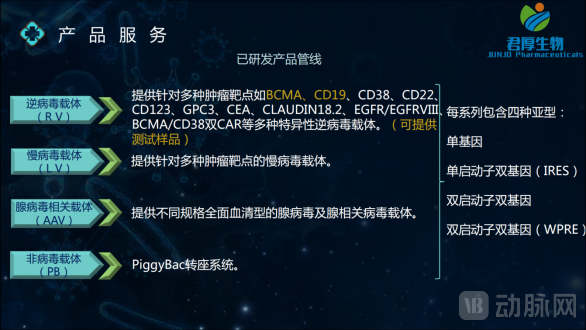
Currently, JUNJO Pharmaceuticals primarily focuses on four major technological pathways to provide vector CDMO services for cell therapy companies. The first is retroviral vectors (RV), which belong to the RNA virus family. Upon infecting cells, they undergo reverse transcription to generate a complementary DNA strand. This single-stranded DNA serves as a template for synthesizing a second DNA strand, which can then be integrated into the genomic DNA of dividing cells. The virus utilizes the host cell’s enzymes for self-transcription and replication; its RNA is translated into proteins that facilitate viral packaging. Subsequently, the RNA is released from the cell, forming infectious viral particles.
Along this development pathway, the company offers a range of specific retroviral vectors targeting multiple tumor antigens, including BCMA, CD19, CD38, CD22, CD123, GPC3, CEA, CLAUDIN18.2, and EGFR/EGFRvIII. These vectors are available in four subtypes: single-gene, single-promoter dual-gene (IRES), dual-promoter dual-gene, and dual-promoter dual-gene (WPRE). Test samples targeting BCMA, CD19, and CD38 are also available.
Next is the lentiviral vector (LV) pathway, a viral vector system engineered from HIV-1 that can effectively integrate exogenous genes or exogenous shRNA into host chromosomes, thereby achieving sustained expression of the target sequence. Lentiviruses have become one of the commonly used vectors for expressing exogenous genes or exogenous shRNA and are gaining increasingly widespread application. JUNJO Pharmaceuticals offers lentiviral vectors targeting various tumor antigens (such as CD19, CD38, etc.), including four subtypes: single-gene, single-promoter dual-gene (IRES), dual-promoter dual-gene, and dual-promoter dual-gene (WPRE).
The third major technical approach is adeno-associated virus (AAV) vectors, a class of simple-structured, non-enveloped, single-stranded DNA defective viruses capable of infecting both dividing and non-dividing cells, with a relatively large packaging capacity. They can accommodate larger genes, making them the preferred tool for gene overexpression. AAV vectors are characterized by high safety, a broad host cell range (including both dividing and non-dividing cells), low immunogenicity, and long-term expression of exogenous genes in vivo. JUNJO Pharmaceuticals provides AAV vectors covering comprehensive serotypes in various specifications, including four subtypes: single-gene, single-promoter dual-gene (IRES), dual-promoter dual-gene, and dual-promoter dual-gene (WPRE).
The fourth major technical approach involves non-viral vectors (PiggyBac), which primarily leverage the physicochemical properties of non-viral vector materials to mediate gene transfer. Under this technical framework, JUNJO Pharmaceuticals offers its proprietary non-viral genetic engineering technology (PiggyBac transposon modification), a core technology for CAR-T therapy development. PiggyBac can efficiently deliver large amounts of genetic material into T cells, generating CAR-T products with a high percentage of memory T cells. This platform includes four subtypes: single-gene, single-promoter dual-gene (IRES), dual-promoter dual-gene, and dual-promoter dual-gene (WPRE).
Figure: JUNJO Pharmaceuticals Products/Services
Source: Provided by the company
Wang Jianxun stated that by leveraging these four major technological pathways, JUNJO Pharmaceuticals has established advanced vector preparation technologies and safe, efficient production capabilities for genetically modified viral vectors. Through GMP-compliant laboratory management, the company has developed a comprehensive GMP production system for viral vectors.
According to Wang Jianxun, JUNJO Pharmaceuticals has already built and put into production a 1,000-square-meter GMP-grade workshop. While other gene-engineered cellular immunotherapy projects remain at the laboratory research stage, JUNJO Pharmaceuticals has established the capacity for standardized, clinical-grade manufacturing.
From a commercialization perspective, JUNJO Pharmaceuticals has established strategic partnerships or signed orders with multiple hospitals and pharmaceutical companies.
Meanwhile, JUNJO Pharmaceuticals has repeatedly won awards in innovation and entrepreneurship competitions and various evaluations. In the finals of the 8th China Innovation and Entrepreneurship Competition (Guangdong Zhongshan Division) and the 4th Zhongshan Science and Technology Innovation and Entrepreneurship Competition in 2019, JUNJO Pharmaceuticals stood out among participating enterprises with its solid project foundation and strong team strength, winning the first prize. In 2021, it was approved to establish a Guangdong Provincial Postdoctoral Workstation and a Guangdong Provincial Scientific and Technological Expert Workstation, and was honored as one of the Top 50 Biotechnology Innovation Enterprises (Emerging Companies) in the Greater Bay Area.
In terms of funding, while achieving self-sustainability, JUNJO Pharmaceuticals has also received support from the local government. The Zhongshan Municipal Government has provided approximately RMB 10 million in subsidies and granted special support by including JUNJO Pharmaceuticals as a key talent team introduction project in Zhongshan City.
Regarding future market development and the company’s prospects, Wang Jianxun stated that the CMO market size for genetically engineered cell-based immunotherapy will exceed RMB 10 billion annually over the next decade. Currently, there are no mature comparable companies in China. JUNJO Pharmaceuticals boasts a technological lead of more than three years and at least one generation of product advantage, and is expected to capture over 50% of the market in this field.
Selection of the Top 50 Biotech Innovation Enterprises in the Guangdong-Hong Kong-Macao Greater Bay Area
The “Top 50 Biotech Innovation Enterprises in the Guangdong-Hong Kong-Macao Greater Bay Area” selection campaign is hosted by the Zhongchuang Industry Research Institute and organized by Guangdong Medical Valley. The initiative aims to foster an integrated innovation ecosystem encompassing industry, academia, and research within the Greater Bay Area, promote the in-depth and coordinated development of biotechnology—a strategic emerging industry—across Guangdong, Hong Kong, and Macao, systematically document the evolution of biotech innovation in the region, and drive the advancement of the local biotechnology sector.
This selection covers three sectors: medical devices, biopharmaceuticals and technology, and healthcare services. It will comprehensively evaluate participating companies’ technological innovation and future development prospects from three dimensions: innovative technology, market application, and capital. A panel of expert judges, comprising representatives from government agencies, third-party research firms, professional investment firms, and medical institutions, will conduct in-depth on-site visits and investigations to compile an authoritative list of innovative enterprises. This initiative aims to identify future unicorns in the biotechnology sector within the Greater Bay Area and showcase the region’s urban clusters’ achievements in the development of the biotechnology industry.
“Top 50 Biotech Innovation Enterprises in the Guangdong-Hong Kong-Macao Greater Bay Area” has garnered extensive attention and coverage from government agencies, scholars and experts, media outlets, and biotechnology companies since its inaugural edition in 2018.