

Ruijie Biotech Secures RMB 100 Million in Series A Funding to Advance Innovative Multiplex Diagnostic Platform for Allergy and Autoimmune Diseases
Hongruitaijie Biotechnology (Xiamen) Co., Ltd. (hereinafter referred to as “Ruijie Bio”) announced today that it has recently completed aLed by Yinglian Health Fund, with participation from Dongpingheng Capital、Existing ShareholdersSunshine RonghuiCo-investment in the Series A financing, plus the previouslySunshine Ronghui Leads Investment,Taiyu InvestmentCo-invested in the Pre-A round of financing. Ruijie Biotechnology has completed two rounds of financing totaling RMB 100 million over the past 12 months,Fangyuan Capital(OptimasCapital)Serve as the exclusive financial advisor.
Immune response is the process by which the body recognizes "self" and "non-self," generates an immune response, clears foreign antigens or induces immune tolerance, thereby maintaining homeostasis. However, when the immune system overreacts or mistakenly identifies harmless proteins as threats, it can lead to allergic reactions or autoimmune diseases.
Allergic diseases include food allergy, atopic dermatitis, allergic rhinitis, and allergic asthma,Global Prevalence of Allergic Diseases Is 10%–40%, approximately 250 million people worldwide have food allergies, 300 million suffer from asthma, 400 million have rhinitis, and one-tenth of the global population experiences adverse drug reactions.Listed by the WHO as the sixth largest chronic disease globally.
The prevalence of allergic diseases in China exceeds 15%,Approximately 150 million people suffer from allergic rhinitis, 30 million from allergic asthma, and 50 million from food allergies, along with numerous patients experiencing skin conditions caused by various allergens. The total population afflicted by allergic diseases exceeds 300 million.
Autoimmune diseases are conditions caused by damage to the body's own tissues resulting from an immune response against its own components.Approximately 7.6% to 9.4% of the global population suffers from various types of autoimmune diseases.Approximately 50 million Americans, or 20% of the U.S. population, suffer from autoimmune diseases, with 75% (approximately 30 million) being women.China has more than 50 million patients with autoimmune diseases.
Over the past 30 years, the incidence of allergic diseases has at least tripled, with the current global prevalence reaching 22%. The World Health Organization (WHO) has listed it as the “third biggest killer” threatening human health. Currently,The global market for allergen and autoimmune testing has reached tens of billions of U.S. dollars.The global allergy diagnostics market was valued at USD 3.49 billion in 2017 and is projected to grow at a compound annual growth rate (CAGR) of 10.5%, reaching USD 5.74 billion by 2022.
In contrast, China’s allergy diagnostics market has reached RMB 1.54 billion, remaining in its early stages compared to foreign markets. Although the base for allergy and autoimmune testing in China is small, the market boasts substantial potential, rapid growth, and a low share of domestically produced products. The rising incidence of allergic and autoimmune diseases year by year, improved patient affordability and heightened health-conscious consumption, rapid growth in per capita healthcare expenditure, continued implementation of tiered diagnosis and treatment policies, an increasing number of registered allergen diagnostic reagent types, and expanded panels of autoantibody tests are collectively driving the continuous expansion of the allergy and autoimmune disease testing market.

However, at present, the allergy and autoimmune disease diagnostic products launched by foreign-funded enterprises are all based on traditional methodological platforms such as immunoblotting or fluorescence assays, which represent outdated technology.Against the backdrop of stringent health insurance cost containment, innovative technology platforms featuring multiplex testing and low costs hold tremendous future opportunities.
Allergen testing and autoimmune testing require the simultaneous measurement of multiple markers in clinical practice, with a single test panel potentially comprising more than 20 items.
In the allergen testing market, Thermo Fisher Scientific’s Phadia is the global leading brand, offering detection of over 600 allergens based on its fluorescence immunoassay platform. In addition, companies such as Euroimmun and Mediwiss are key participants. In the Chinese market, foreign enterprises still dominate, with Mediwiss and Euroimmun collectively holding more than half of the market share. The Chinese company HOB (Haooubo) accounts for approximately 15%, while domestically produced products collectively represent less than one-third of the market, primarily relying on traditional methodologies such as immunoblotting and ELISA.
In China’s autoimmune testing market, foreign companies hold an 80% market share. Euroimmun ranks first in domestic market occupancy due to its earliest market entry. Since 2010, with the successive launch of domestic autoimmune products and continuous improvement in product quality, Chinese manufacturers such as Shenzhen YHLO Biotech and Kexin Biology have developed rapidly and secured leading market positions.
The mainstream methods for allergen and autoimmune diagnostics are primarily based on immunoblotting and enzyme-linked immunosorbent assay (ELISA), with no disruptive innovations achieved over a long period.It suffers from drawbacks such as a high proportion of manual steps, complex procedures, slow detection speed, qualitative-only analysis, high risk of cross-contamination, and large blood sample volume requirements.
In recent years, some companies have attempted to apply technologies such as chemiluminescence and flow fluorescence to allergen and autoimmune testing. Although chemiluminescence is accurate, it is more suitable for single-item testing, and its high cost and susceptibility to cross-contamination remain significant drawbacks. Multiplex platforms based on flow fluorescence also face challenges such as high instrument costs and complex operations. Under China’s reimbursement system, these technologies are difficult to widely adopt in the fields of allergy and autoimmune diagnostics. Addressing clinical pain points,It is believed that testing platforms featuring multiplexed assays, low per-unit costs, high throughput, minimal sample volume requirements, and automation are poised to stand out in the future.
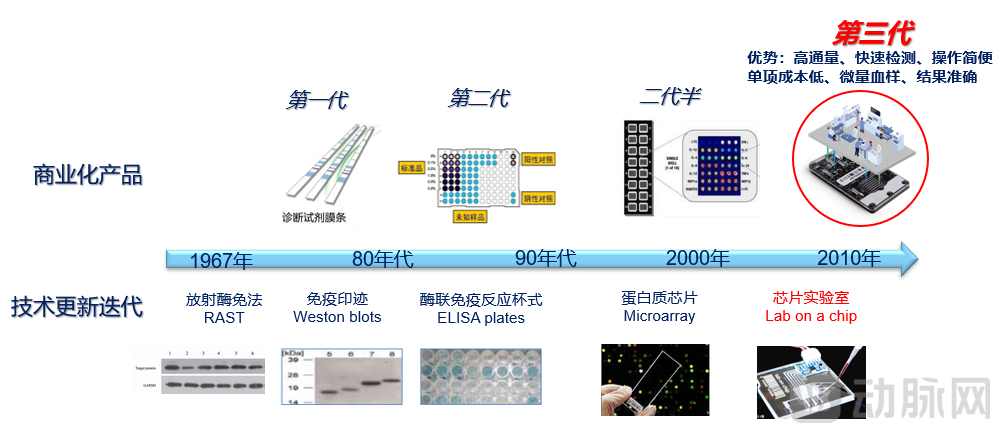
Ruijie Biology's independently developedNext-Generation Multiplex Microfluidic Chip Platform, efficiently integrating microarray protein chips, chemiluminescence detection, and high-quality allergen protein coating technology, miniaturizing the traditional enzyme-linked immunosorbent assay process to be completed within the microphase channels of the reaction zone, requiring only 100 µL of serum sample,The testing process, which traditionally takes 3–5 hours, can be completed within 35 minutes. It features multi-parameter analysis, high accuracy, low cost, automation, and reliable results.Possesses unique advantages within the multiplex testing technology platform.

Enrich Product Line Portfolio
Continuously Break Through the Company's Ceiling
In the fields of allergy and autoimmunity, Reagent has established a comprehensive product portfolio, building strong core competitiveness. Its offerings span instruments and reagents, as well as upstream raw materials and downstream applications.
In terms of testing instruments, the company has currently deployed various series of instruments, including multi-channel and single-channel models. Both multi-channel and single-channel instruments have obtained regulatory approval and are commercially available.Installed in over 250 hospitals,Most of them are Grade A tertiary hospitals.
The company’s 19-item allergen detection reagents have been on the market for many years, and registration applications have been submitted for its 39-item allergy testing reagents. Meanwhile, the company has also laid out a portfolio of products covering autoimmune diseases and food intolerances, with regulatory approval expected by mid-2022.
For high-volume scenarios such as health checkups and third-party testing centers, Reajet Biology has established an ultra-high-throughput testing platform. For the primary healthcare market, the company will deploy cost-effective rapid diagnostic products. In terms of reagent development, in addition to allergy and autoimmune testing, multi-analyte panels for maternal and child screening and cytokine storm assessment have entered the project initiation and R&D phase.
Leveraging the company’s robust R&D capabilities and its stable instrument-reagent platform,The company has entered into a deep collaboration with ALK, the global leader in allergen immunotherapy.In the coming years, ALK will launch multiple products in China. As ALK’s deeply partnered companion diagnostics platform for allergy treatment, Rejay Biotech is poised to drive significant incremental growth for ALK. Meanwhile, Rejay Biotech has established a collaboration with Academician Zhong Nanshan of the Guangzhou Institute of Respiratory Health, participating in the China Allergic Respiratory Diseases Epidemiology Study II (CARRAD II) and exclusively providing its serological allergen testing platform.
With the approval of a series of instruments and reagent products, Rayto Biotechnology will continuously enhance its competitiveness through advantages such as a comprehensive product portfolio and superior cost-effectiveness, thereby advancing the substitution of imported products and achieving sustained growth in product revenue. Meanwhile, the company will strengthen its academic capabilities and establish a robust marketing network both domestically and internationally, positioning itself as a leading enterprise in China within the niche fields of allergy and autoimmune diagnostics, with international competitiveness and a place among the global top-tier companies.
15+ Years of Deep Expertise in the IVD Industry
The team has extensive experience in marketing and R&D management.
Pan Hongbo, CEO of Ruijie Biotech, entered the IVD industry in 1995 and has over 20 years of experience in marketing and management. He previously held positions at Becton Dickinson (BD) and Alere in the United States, and later served as Marketing Director at YHLO, where he was fully responsible for product sales, market promotion, and after-sales service. He possesses a profound understanding of the IVD industry.
Zhang Kai, the company’s Chief Marketing Officer, holds a Master’s degree in Molecular Biology from Xiamen University and an MBA from the University of Minnesota. With over 16 years of marketing and sales experience at multinational publicly listed companies, he has previously held marketing roles at Nutricia Medical Nutrition and Denmark’s ALK-Abelló, possessing in-depth expertise in the field of allergic diseases.
Recently, Rejet Bio has once again attracted two heavyweight R&D executives to join its ranks—Dr. Gao and Dr. Huo from the Chinese Academy of Sciences. With an experienced and well-structured team, Rejet Bio is poised to make increasingly significant and solid strides on its path of innovation.
Pan Hongbo, CEO of Ruijie BiologyIt stated that since its inception, Ruijie Bio has established the corporate culture of “Pursuing Excellence, Safeguarding Health,” always taking “developing leading-edge technologies, driving technological innovation, serving medical users, and protecting public health” as its mission. All employees uphold the values of “Professionalism, Innovation, Perseverance, and Pragmatism,” striving to build Ruijie Bio into an enduring, century-old national brand. Over the next 3–5 years, the company will continue to deepen its presence in China’s rapidly growing niche markets for allergy and autoimmune diseases, continuously launching products that meet clinical needs, pursuing excellence, and striving for people’s healthy lives.
Yinglian Health Fund, Wang Ruolin"We have observed a rapid increase in the number of patients seeking care for allergies and autoimmune diseases in recent years, alongside a strong clinical demand for testing products that are versatile across multiple scenarios and offer rapid, convenient operation. Rayto Biotech’s microfluidic chemiluminescence technology platform not only enables ultra-multiplexed combined testing but also significantly reduces turnaround time while delivering more precise results. We are honored to collaborate with Mr. Pan and the company’s professional and efficient team, and we look forward to launching more high-quality products to provide physicians and patients with comprehensive solutions that are more convenient, time-saving, and accurate."
Xu Ze'an, VCBeat Capitalstated, “It is a great honor to participate in this round of investment in Hongrui Taijie. We believe that microfluidics technology will drive product enhancement and market transformation in fields such as allergy and autoimmune diagnostics. The team at Ruijie Bio possesses excellent marketing, sales, and organizational management capabilities, and has also assembled a dynamic and ambitious R&D team. We look forward to working hand in hand with the team to build a leading Chinese IVD brand.”
Guo Lifeng, Partner at Fangyuan CapitalHe stated that allergy and autoimmune diagnostics are among the few rapidly growing, relatively untapped segments within the in vitro diagnostics (IVD) industry. Driven by urbanization-related environmental changes and heightened public health awareness, demand for allergen testing is on the verge of explosive growth. Furthermore, the anticipated launch of domestic and international anti-allergy and autoimmune drugs, such as those from ALK, in the coming years will undoubtedly generate substantial market expansion. Having accompanied the company throughout its journey, he deeply admires Mr. Pan’s profound understanding of the IVD industry and his entrepreneurial spirit. He looks forward to collaborating with the company to create greater value together and is pleased to have made a modest contribution to the field of allergic diseases.
About Yinglian Health Fund
Yinglian Health Fund was established in early 2019, with cornerstone investors drawn from leading pharmaceutical companies in the industry. Research-driven, the fund deeply explores investment opportunities in cutting-edge innovative drugs, medical technologies, and devices on a global scale. It collaborates with top scientists, principal investigators (PIs), and clinical translation teams to incubate companies, addressing the challenge of transforming foundational innovations from concept to reality (the “0 to 1” stage).
On Dynamic Balance Capital
Dongpingheng Capital is a core enterprise of the Nanjing Jiangning Science and Technology Innovation Investment Group. It currently manages multiple government fund-of-funds, the Chinese Academy of Sciences’ Technology Transfer Fund, venture capital funds, and industry funds, covering all stages from angel investing to venture capital (VC) and private equity (PE). Adhering to the philosophy of “enhancing the value of what is already valuable,” the company vigorously promotes its corporate culture of “integrity, diligence, openness, and balance,” striving to serve entrepreneurs while remaining faithful to investors.
About Fangyuan Capital
Optimas Capital | Optimas Capital — Committed to being entrepreneurs alongside entrepreneurs. Specializing in financial advisory services within the healthcare sector, we adhere to the principles of early discovery, in-depth service, and long-term partnership, striving to be a trusted long-term strategic partner for founders. Our focus areas include high-value medical consumables, in vitro diagnostics (IVD), biotechnology, and other niche segments. Clients served include Silicon Based Bionics, Saiqiao Biotech, Ruijie Biotech, Pushikang, Zhongjing Pukang, and others.