

Edible Microbial Protein Pioneer Changjin Bio Secures RMB 55 Million in Pre-A Funding Round

Hillhouse
Long-Term Structural Value Investment Institution
VCBeat (WeChat: vcbeat) has learned that a new frontier in synthetic biology is rapidly emerging. Shanghai Changjin Biotechnology Co., Ltd., a pioneer in edible microbially synthesized proteins, announced the completion of its Pre-A round financing of RMB 55 million. The round was led by GL Ventures, with participation from Qingdao City Construction Investment Financial Holdings and Bits x Bites.
Luo Bin, founder of Changjin Bio, stated, “Changjin means ‘Changing.’ Our goal is to lead a revolution in human energy and nutrition sources by applying innovative biotechnologies, leveraging disruptive technological innovations to apply synthetic biology to the food industry.”
Protein is a fundamental component of dietary structures. Research by the Food and Agriculture Organization of the United Nations indicates that industrial livestock farming contributes more to climate change than the total direct emissions from the entire transportation sector.
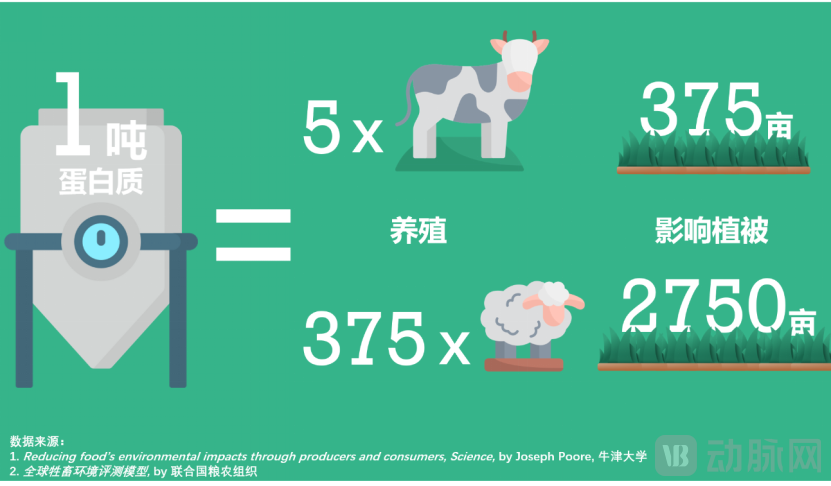
According to calculations based on academic papers in Science and the Global Livestock Environmental Assessment Model (GLEAM) of the Food and Agriculture Organization of the United Nations, providing 1 ton of protein for humans requires raising 375 sheep, causing negative impacts on 2,750 mu of vegetation; this is equivalent to the lifetime milk production of five dairy cows, causing negative impacts on 375 mu of vegetation.
Reducing overreliance on animal protein helps alleviate food security concerns. The alternative protein sector is ultimately projected to become a $290 billion market, with the Asia-Pacific region accounting for nearly two-thirds of total consumption.
Microbial-synthesized proteins and cellular proteins offer advantages such as low-carbon emission reduction, land conservation, high efficiency, and comprehensive nutrition. In 2020, global investment in this field reached $590 million, double the total investment in 2019, demonstrating rapid growth momentum. Global investment is projected to exceed $1 billion in 2021. Changjin Biology estimates that, in terms of carbon emission reduction, one bioreactor system (occupying approximately 600 square meters) can replace 10 million liters of milk protein. Based on a future deployment of 100 bioreactor systems, carbon emissions could be reduced by approximately 1.24 million tons. Regarding arable land conservation, the operation of 100 bioreactor systems would displace the need for approximately 2 million mu of farmland otherwise required for pea cultivation.
GFI Summary: The production of microbial proteins is primarily categorized into two fermentation systems: biomass fermentation and precision fermentation. Biomass fermentation leverages the rapid reproduction rate and high protein content of microorganisms to efficiently produce large quantities of protein. Precision fermentation, on the other hand, utilizes microorganisms as host "cell factories" to produce ingredients with specific functionalities; this technology enables the creation of dairy proteins that are nutritionally identical to those found in milk. It is reported that Changjin Biology possesses competitive capabilities in both biomass fermentation and precision fermentation sectors.

Changjin Biotech’s “milk” produced via “cell factories” can offer higher nutritional value and lower energy content than cow’s milk, while also resulting in reduced carbon emissions.
 Changjin Bio’s products can transform traditionally high-calorie desserts, such as cream puffs, into healthy food options.
Luo Bin, Founder of Changjin BiotechWhen introducing project progress, it was stated that we have secured full independent intellectual property rights, thereby gaining the initiative in both innovation and industrialization within this field. The biomass fermentation technology route has completed the development of proprietary microbial strains, a series of fermentation engineering technologies, and the design of product application scenarios. The products feature low carbon emissions, high protein content, high dietary fiber, zero carbohydrates, low calories, low fat, and the ability to improve gut microbiota. The precision fermentation technology route has achieved comprehensive modification of a novel CJ chassis cell, enabling the expression of bovine and caprine milk proteins. Compared with chassis cells widely used in biosynthesis, such as Escherichia coli and Trichoderma, this approach significantly enhances safety and offers advantages including high purity of expressed proteins, ease of separation and purification, and lower expected costs. The company has already completed the construction of key foundational technologies, shortening the development cycle for heterologously expressed proteins from an initial six months to 3.5 months, and further down to the current 7–9 days. R&D achievements in novel proteins are experiencing explosive growth, with initial industrialization expected to begin in 2022, at which point more surprising results will be unveiled.
Xu Zhihong, Academician of the Chinese Academy of Sciences and Professor at the School of Life Sciences, Peking UniversityIt has been indicated that while the total intake of animal protein among the Chinese population has increased significantly, the structure of protein sources requires improvement. This is primarily characterized by a disproportionately high consumption of meat and eggs, coupled with a relatively low intake of dairy products. In this regard, leveraging edible microorganisms as chassis cells and employing technologies such as synthetic biology, through industry-academia-research collaboration, to develop novel, fully nutritious food products and enhance dietary diversity holds substantial social significance.
Dr. Li Liao, Microbiology Expert at Changjin BiologicsIt is stated that the traditional human food chain is inefficient, imposing a significant burden in terms of land use, carbon emissions, and environmental pollution; our food system is awaiting a green transformation. As the oldest life forms on Earth, microorganisms offer new solutions to the growing population and food security pressures facing contemporary society, thanks to their rapid reproduction, minimal cultivation requirements, and highest energy conversion efficiency. The deep-sea hydrothermal vent tubeworm symbiotic system I studied at Harvard University serves as an excellent example of animals “cultivating” microorganisms in nature to provide them with a food source. Moreover, humans themselves host a vast and diverse community of gut microbiota and have a long history of consuming probiotics. Therefore, the concept of using microorganisms as a direct food source has long existed in both nature and human history. Drawing upon natural wisdom, embracing bold innovation, disrupting the traditional food chain, and reconstructing the future human food chain are endeavors we must explore, fulfilling our mission to serve the sustainable development of human society.
Li Liang, Founding Partner of HillhouseIt was stated that technological breakthroughs in alternative proteins will not only transform the supply and production of human dietary protein but also hold significant forward-looking implications for achieving carbon neutrality. Changjin Bio identifies microorganisms from nature that can serve as novel food sources for humans and has established unique cell factories through high-throughput screening, directed mutagenesis, and gene editing. These platforms enable the synthesis of essential nutrients such as proteins, providing safer and lower-carbon protein sources. We are delighted to witness Changjin Bio’s breakthrough innovations in food technology, achieved through the interdisciplinary integration of synthetic biology, microbial engineering, and food engineering. We look forward to Changjin Bio’s continued contributions of value in upgrading the industry of human energy and nutritional sources.
Zhou Huanda, Managing Partner of Bits x BitesShiXin Capital has long focused on the alternative protein sector, with a particular emphasis on identifying biotech enterprises that hold patents for microbial strains or fermentation production methods and are capable of low-cost, large-scale manufacturing of high-quality proteins. The Changjin team demonstrates international-level expertise in biological chassis construction, target protein processing performance and purity, biomass yield from fermented large-scale production, and downstream processing technologies. Furthermore, its microbial strains comply with Chinese regulatory standards, perfectly embodying our criteria for future food startups.