

Clarity Pharmaceuticals Completes Largest Pure Biotech IPO in ASX History Amid Booming Multi-Billion-Dollar Radiopharmaceutical Market and FDA Designations

Clarity Pharmaceuticals
Innovative Radiopharmaceuticals Developer
Clarity Pharmaceuticals is an innovative radiopharmaceutical research and development company founded in 2010 and headquartered in Sydney. It is dedicated to developing new targeted theranostic products for various cancer types through its SAR Technology Platform and Targeted Copper Theranostics (TCT), with the aim of improving cancer treatment outcomes.
On August 25, 2021, Clarity Pharmaceuticals (“Clarity”) listed on the Australian Securities Exchange under the ticker symbol CU6. Clarity’s initial public offering (IPO) raised US$92 million for the company,Achieved the largest pure-play biotechnology IPO in the history of the Australian Securities Exchange.
Prior to its IPO, Clarity had completed multiple rounds of financing, raising a cumulative total of nearly $35 million.
Why Clarity Has Frequently Attracted Investor Interest and Successfully Gone Public: An Overview
Team Empowering Radiopharmaceutical R&D and Commercialization
Clarity has two executive directors: Alan Taylor and Colin Biggin.
Alan Taylor joined the Board in November 2013 as Executive Chairman. Mr. Taylor holds a Bachelor of Applied Science from the University of Sydney, a Master of Applied Finance from the Securities Institute of Australia, and a Doctor of Medicine from the Garvan Institute of Medical Research. With approximately 15 years of experience in banking and investment, he possesses extensive expertise in financing, mergers and acquisitions, and corporate advisory. Prior to joining Clarity Pharmaceuticals, Mr. Taylor served as Executive Director at Inteq Limited, an Australian boutique investment bank.
Colin Biggin joined the Board in October 2019, serving as Managing Director and Chief Executive Officer. He holds a Bachelor of Science (Honours) degree and a Ph.D. from the University of Glasgow, and has over 15 years of experience in the development and commercialization of radiopharmaceuticals. He previously worked at Algeta ASA, a publicly listed Norwegian oncology pharmaceutical company, on Xofigo, a therapeutic product for metastatic prostate cancer.®(Radium-223 dichloride) development and commercialization efforts; the product received FDA approval in 2013.
Clarity’s core team brings together talent from prestigious institutions such as the Australian National University, the University of Sydney, and the University of New South Wales, offering extensive experience in the radiopharmaceutical market. Additionally, Clarity has established a Scientific Advisory Board composed of key opinion leaders with significant research and clinical expertise in the field of radiopharmaceuticals, including the former Chair of the U.S. Department of Defense Prostate Cancer Integrated Research Group, the Chair of the Department of Radiology at Washington University School of Medicine in St. Louis, and the Vice Chair for Research in the Department of Radiology at Memorial Sloan Kettering Cancer Center (MSK).
Novel Therapies and Technology Platforms Complement Each Other to Accelerate the Development of New Radiopharmaceuticals
Radiopharmaceuticals, also known as nuclear medicines, are a special class of drugs containing radioactive isotopes (radionuclides) for use in medical diagnosis and treatment.Radiopharmaceuticals can be divided into diagnostic radiopharmaceuticals and therapeutic radiopharmaceuticals.Diagnostic radiopharmaceuticals, also known as imaging agents or tracers, function by leveraging their radioactivity to track their distribution and dynamics within the human body, thereby enabling the acquisition of images or functional parameters of target organs or pathological tissues.. Therapeutic radiopharmaceuticals can highly selectively accumulate in diseased tissues, generating localized ionizing radiation-induced biological effects that inhibit or destroy the pathological tissue, thereby exerting a therapeutic effect.
According to Medraysintell data, the global nuclear medicine market was valued at approximately $6 billion in 2019, with diagnostic agents accounting for the majority of the market. However, the launch of an increasing number of therapeutic agents is expected to drive the global nuclear medicine market to reach around $30 billion by 2030.
Currently, more than 100 radioactive isotopes (nuclides) are used in the medical field worldwide, with over 30 medical isotopes employed for the precise diagnosis and treatment of diseases. Radioactive nuclides commonly used in clinical diagnosis and treatment include99mTc、125I、131I、14C、68Ga、177Lu、18F、90Y、89Sr, etc.
Distinct from radioisotopes previously used in clinical practice, Clarity has pioneered a novel radiopharmaceutical therapeutic approach—Targeted Copper Theranostics (TCT)—which leverages copper-64 (Cu-64) and copper-67 (Cu-67) for the diagnosis and treatment of cancer.
Both Cu-64 and Cu-67 are radioactive isotopes of copper. Cu-64 can be used for positron emission tomography (PET) and molecular radiotherapy, while Cu-67 tends to accumulate in cancer cells and emits beta radiation capable of killing them, making it suitable for cancer treatment.
TCT first utilizes Cu-64 and PET imaging to diagnose the drug's distribution within the body and confirm targeting; once it is verified that the drug has effectively entered the tumor and is safe, Cu-67 is employed to locally eradicate the cancer.
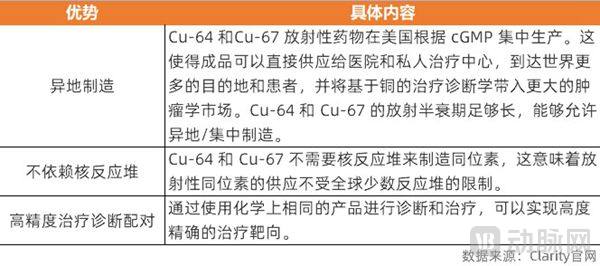
Pairing Cu-64 and Cu-67 offers three major advantages:
Historically, the use of the radioactive isotope copper has been hindered by the lack of suitable chelators (cage-like structures) capable of securely binding the isotope. In early attempts using other chelators, the copper isotope would dissociate from the chelator after injection into the body and be subsequently metabolized by the liver, thereby limiting its diagnostic potential and rendering it unsuitable for therapeutic applications.
To address the aforementioned issues, Clarity’s SAR technology platform has developed a chelator with high specificity and high stability suitable for copper isotopes, which can retain the copper isotopes and prevent their leakage into the body.The chelator is linked to a targeting molecule that can identify and bind to tumor-specific receptors on cancer cells. Once the targeting molecule locates the tumor, the radioisotope exerts its effect at that site, emitting radiation for tracking by imaging equipment (diagnostic radioisotope Cu-64) or destroying cancer cells (therapeutic radioisotope Cu-67).
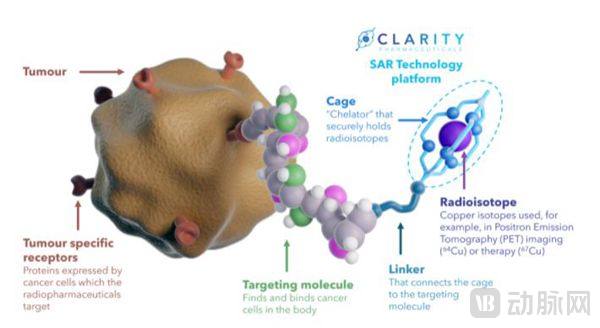
SAR Technology Platform Principle. Image source: Clarity Pharmaceuticals official website
By combining with targeting molecules and isotopes, Clarity’s proprietary SAR technology can be used to develop a series of theranostic radiopharmaceuticals for different types of cancer.
Three Core Products, Covering Multiple Cancer Types
Clarity currently has three main product lines, including SARTATE for neuroblastomaTMSAR-Bombesin for breast cancer and prostate cancer, and SAR-bisPSMA for prostate cancer.
SARTATETM
SARTATETMIt is Clarity’s first clinical product and its core offering, indicated for the diagnosis, staging, and subsequent treatment of cancers expressing somatostatin receptor type 2 (SSTR2), a receptor that is highly expressed in the vast majority of neuroendocrine tumors (NETs), neuroblastoma, and other pediatric cancers.
SARTATETMIt enables the direct delivery of copper isotopes to cancer lesions, utilizing Cu-64 and PET imaging to diagnose the drug's distribution within the body and confirm targeting. For therapeutic purposes, Cu-67 is employed to locally eradicate cancer cells, as seen with SARTATE.TMIts advantage lies in its ability to kill tumors locally without causing any collateral damage, thereby minimizing side effects and enhancing therapeutic efficacy.
In 2020,64Cu-SARTATTMand67Cu-SARTATTMGranted Orphan Drug Designation (ODD) and Rare Pediatric Disease Designation (RPDD) by the FDA for the treatment and clinical management of neuroblastoma.
Clarity is currently conducting SARTATETMNeuroblastoma Trial, Using64Cu-SARTATTMand67Cu-SARTATTMTo evaluate and treat pediatric patients with high-risk neuroblastoma. This is a multicenter, dose-escalation, open-label, non-randomized, Phase I/IIa theranostic clinical trial conducted in the United States.
SAR-Bombesin
SAR-Bombesin can deliver copper isotopes to tumors expressing the gastrin-releasing peptide receptor (GRPr) and can be used for the diagnosis and treatment of these tumors. GRPr has been shown to be expressed in 83% of estrogen receptor (ER)-positive breast cancers and 75%–100% of prostate cancers. SAR-Bombesin is currently used for the theranostics of breast and prostate cancer, with future plans to extend its application to imaging and therapy for other GRPr-positive cancers.
SAR-Bombesin Breast Cancer Trial (C-BOBCAT) used SAR-Bombesin to image seven patients with ER/PR-positive metastatic breast cancer, and imaged patients with breast and prostate cancer under the Therapeutic Goods Administration (TGA) Special Access Scheme (SAS). Alan Taylor, Executive Chairman of Clarity Pharmaceuticals, stated that high uptake and strong retention of the product observed on patient PET scans at 1, 3, and 24 hours post-administration indicated67Cu-SAR-Bombesin holds significant potential for therapeutic applications.
SAR-bisPSMA
SAR-bisPSMA is indicated for the diagnosis, staging, and subsequent treatment of cancers expressing prostate-specific membrane antigen (PSMA). PSMA is a protein expressed in all types of prostate tissue and serves as an excellent target for diagnosis and therapy.
The name SAR-bisPSMA is derived from the term “bis,” which links two PSMA-binding motifs to Clarity’s SAR chelator technology to enhance tumor uptake and retention in cancerous tissues. Preclinical data confirm that,64Cu-SAR-bisPSMA exhibits higher uptake and retention than the single PSMA-binding motif used in other radiopharmaceutical products on the market.
For SAR-bisPSMA, Clarity Pharmaceuticals has launched two clinical trials. One is a theranostic trial for Stage I/IIa prostate cancer (SECuRE), which uses TCT to identify and treat PSMA-expressing metastatic castration-resistant prostate cancer (mCRPC), with the aim of determining67Safety and Efficacy of Cu-SAR-bisPSMA as a Therapeutic Agent. Patient enrollment for this trial was completed in November 2021.
Another trial is the PET imaging study for Stage I prostate cancer (PROPELLER), which plans to enroll 30 patients with confirmed prostate cancer who have not yet undergone prostatectomy.67treatment with ⁶⁴Cu-SAR-bisPSMA. Currently, 15 participants have completed67Cu-SAR-bisPSMA Diagnosis. The diagnostic results show that,67Cu-SAR-bisPSMA possesses greater than68Ga-MA-11 demonstrated a higher maximum standardized uptake value (SUVmax). Professor Louise Emmett, the principal investigator of the trial, stated that higher tumor uptake makes lesions more conspicuous on PET scans, thereby increasing the likelihood of detection.
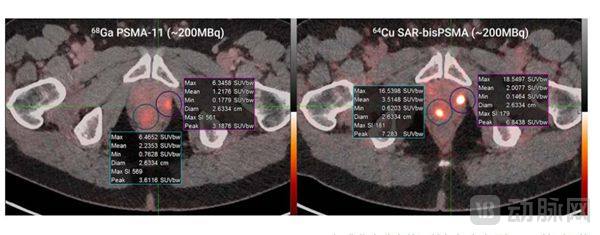
PROPELLER Trial Comparative Results
Comprehensive Intellectual Property Strategy
Clarity places significant emphasis on intellectual property protection. Its patent strategy is designed to cover its SAR technology platform, radiopharmaceutical products, and a “discovery program” focused on developing new products, thereby providing robust protection for existing products and expanding its product portfolio.
Clarity has currently secured intellectual property licenses from the Australian National University, the University of Melbourne, and the Australian Nuclear Science and Technology Organisation (ANSTO), with its patent portfolio covering numerous countries,Including the United States, Australia, Europe, Japan, China, Canada, Singapore, Malaysia, South Korea, Russia, Mexico, and India.
SARTATETMPatent applications for SAR-Bombesin have been approved and granted in major jurisdictions, while the patent application for SAR-bisPSMA has entered the national phase in multiple jurisdictions and was recently granted by the United States Patent and Trademark Office, with an expiration date of June 5, 2038.
Through a comprehensive intellectual property strategy, Clarity has effectively protected its proprietary SAR technology platform, existing products, discovery project pipeline, and manufacturing processes.
Actively Foster Collaboration to Ensure TCT Supply
Clarity is actively pursuing collaborations and has already entered into partnership agreements with the Idaho Accelerator Center (IAC) at Idaho State University, ImaginAb, NorthStar Medical Radioisotopes, Evergreen Theragnostics, and Cardinal Health to ensure a continuous supply of copper radioisotopes and TCT products.
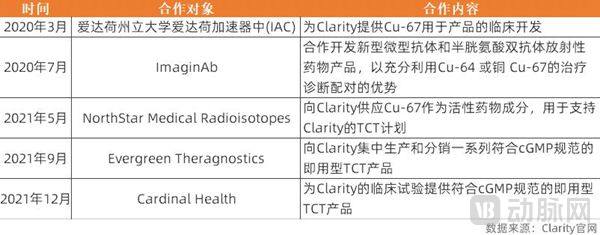
The aforementioned collaboration will help Clarity Pharmaceuticals further leverage the paired advantages of Cu-64 and Cu-67, ensure a seamless supply for theranostic clinical trials (TCT), accelerate clinical trial progress, and better serve cancer treatment.
China’s Nuclear Medicine Market Sees Rapid Growth as Domestic Production of Medical Isotopes Accelerates
The history of radiopharmaceuticals spans over a century. China’s radiopharmaceutical industry, however, only began in the 1950s, starting relatively late and lagging behind developed countries. In 2017, global radiopharmaceutical sales reached $4.5 billion, with the United States accounting for 38%, Europe for 24%, and China for less than 8%. The penetration rate of radiopharmaceuticals in China is far lower than that in mature markets, indicating substantial room for growth.
In recent years, the rapid deployment of nuclear medicine departments, talent, and equipment has been driving the fast growth of China’s radiopharmaceutical industry.
In terms of clinical adoption, the compound annual growth rate (CAGR) of overall radiopharmaceutical sales in sample hospitals from 2012 to 2019 was 31%, with the CAGR for multiple key radiopharmaceutical products exceeding 40%.
In terms of nuclear medicine department construction, as of December 31, 2019, the number of departments (sections) engaged in nuclear medicine specialties across China reached 1,148, representing a 23.8% increase compared with 2017; a total of 12,578 personnel were engaged in nuclear medicine-related work, marking a 38.4% increase compared with 2017.
In terms of the installed base of related medical equipment, positron emission tomography (PET) scanners reached 427 units by the end of 2019, representing a 39.1% increase compared to 2017; single-photon emission computed tomography (SPECT) scanners reached 903 units by the end of 2019, marking a 5.4% increase from 2017.
Due to the highly specialized nature of the radiopharmaceutical industry and its high technical barriers,Currently, China's nuclear medicine market exhibits a duopolistic competitive landscape, with China Isotope & Radiation Corporation and Dongcheng Pharmaceutical commanding the majority of the market share.According to the 2020 annual reports, China Isotope & Radiation Corporation’s nuclear medicine revenue in 2020 was RMB 2.97 billion, while Dongcheng Pharmaceutical’s nuclear medicine revenue in 2020 was RMB 930 million.
China Isotope & Radiation Corporation, established in 1983, is a leading enterprise in the application of isotopes and radiation technology in China. It focuses on the research and development, production, and sales of radiopharmaceuticals, while also operating in the areas of radioactive sources, irradiation services, and independent medical laboratory testing. China Isotope & Radiation Corporation is the largest domestic manufacturer of radiopharmaceuticals for diagnostic imaging and therapy, urea breath test kits and analyzers, and radioimmunoassay kits. Its subsidiaries include Atom High-Tech, Atom Kexing, CNNC Gaotong, Ningbo Jun’an, and CNNC Haidewei.
Dongcheng Pharmaceutical was established in 1998 and formally entered the field of radiopharmaceuticals by acquiring Yunke Pharmaceutical in 2015. Currently, the radiopharmaceutical business has become Dongcheng’s core operation. Its controlled subsidiary, Chengdu Yunke Pharmaceutical, is the first enterprise in China’s radionuclide drug sector to obtain GMP certification. Its flagship product, “Yunke Injection,” is the first independently developed radionuclide drug in China for the clinical treatment of rheumatoid arthritis (RA) and has been awarded a national invention patent. Dongcheng Xinke is a manufacturer and distributor of SPECT radiopharmaceuticals in China and holds products for brachytherapy of tumors, such as iodine [125[I] Sealed Seed Sources and Urea-Based Products for Clinical Diagnosis of HP Infection14C] capsules; Shanghai Yitai Pharmaceutical currently possesses the only product in China that is in clinicalIIbPhase 1.1 Class Therapeutic Radiopharmaceuticals—Rhenium [188Re] Etidronate Injection, for the treatment of bone metastases from malignant tumors.
Technical Breakthroughs and Policy Support for Medical Isotopes,Paved the way for the future development of China’s radiopharmaceutical market.
Currently, China has yet to achieve large-scale breakthroughs in the domestic production of medical isotopes. Medical isotopes are a prerequisite for the research, development, and production of radiopharmaceuticals, determining their therapeutic efficacy. However, with only a few exceptions, the vast majority of radionuclides used in China rely on imports. High-volume medical isotopes such as Molybdenum-99, Iodine-125, Strontium-89, and Lutetium-177 are entirely dependent on imports. Although a small number of isotopes, such as Iodine-131, have achieved domestic production, they still fail to meet the demands of the domestic healthcare market.
In April 2020, the first batch of domestically produced strontium-89 medical isotopes, developed and manufactured by the Nuclear Power Institute of China, was officially delivered to Chengdu CNNC Gaotong. Expert verification confirmed that the relevant indicators reached an internationally advanced level, signifying that China had successfully mastered the key technologies across the entire process of strontium-89 research and development, reactor operation, irradiation, and product manufacturing, thereby resolving the challenges associated with strontium chloride [89The dilemma of heavy reliance on imports for [Sr] injection has been resolved, with formal capability established for supplying strontium chloride, laying the foundation for further expanding, strengthening, and optimizing the domestically produced medical isotope industry.
In 2021, the “Medium- and Long-Term Development Plan for Medical Isotopes (2021–2035)” (hereinafter referred to as the “Plan”), China’s first programmatic document specifically targeting the application of nuclear technology in healthcare, was prominently released. The Plan outlined key tasks for the 14th Five-Year Plan period and the years ahead from three perspectives: industrial supply, demand, and policy. It proposed establishing a stable and self-reliant supply assurance system for medical isotopes, enhancing the technical level of nuclear medicine through strengthened R&D in high-end medical equipment for radiopharmaceuticals and nuclear technologies, and actively promoting the inclusion of eligible radiopharmaceuticals into the basic medical insurance reimbursement list in accordance with established procedures. The issuance of the Plan has accelerated the development of China’s radiopharmaceutical market.
Although China’s radiopharmaceutical industry still lags considerably behind that of developed countries and faces numerous challenges to overcome, the overall development trend is positive. Given the high technical barriers characterizing the current radiopharmaceutical sector and the prevailing homogenization of domestic products, the ability to enter the market early and strategically position oneself, as well as the capacity to rapidly enhance new drug R&D capabilities, may become key factors for companies seeking to seize first-mover advantage.