

Breakthrough in Cancer Therapy: Genetically Modified iPSC-Derived Mesenchymal Stem Cells with Site-Specific TRAIL Integration
Professor Liang Desheng’s team at Central South University employed a non-viral gene targeting strategy to site-specifically integrate the tumor-suppressor gene TRAIL into induced pluripotent stem cells (iPSCs). They demonstrated in animal models the anti-tumor efficacy of iPSC-derived mesenchymal stem cells (iMSCs) with integrated TRAIL, as well as the feasibility of using iMSCs as targeted delivery vehicles for therapeutic agents. The findings were published online on March 10 in the journal Stem Cells Translational Medicine under the title “Site-Specific Integration of TRAIL in iPSC-Derived Mesenchymal Stem Cells for Targeted Cancer Therapy,” with doctoral candidate Wang Zujia as the first author.
Leveraging the tumor microenvironment tropism and low immunogenicity of mesenchymal stem/stromal cells (MSCs), adult tissue-derived MSCs and genetically engineered MSCs have become widely used targeted cellular vehicles for delivering anticancer genes/drugs in cancer therapy research and clinical trials. However, the clinical application of adult/engineered MSCs still faces the following challenges: heterogeneity and limited expansion capacity of adult MSCs, potential immune responses to viral vectors, and risks of off-target effects and insertional mutagenesis associated with gene editing.
To address these challenges, researchers employed self-developed single-strand nicking artificial nucleases (TALENickases) and non-viral gene targeting vectors to achieve site-specific integration of the therapeutic gene TRAIL into human induced pluripotent stem cells (iPSCs). Genetically modified induced mesenchymal stem cells (iMSCs) were then generated via directed differentiation for anticancer research. The results demonstrated that TRAIL-iMSCs significantly induced apoptosis in A375 (melanoma), A549 (lung cancer), HepG2 (liver cancer), and MCF-7 (breast cancer) cell lines in vitro. Intravenously infused TRAIL-iMSCs exhibited pronounced tumor tropism in A375 or MCF-7 xenograft mouse models. TRAIL-mediated activation of apoptotic signaling pathways significantly inhibited tumor growth without evident adverse effects.
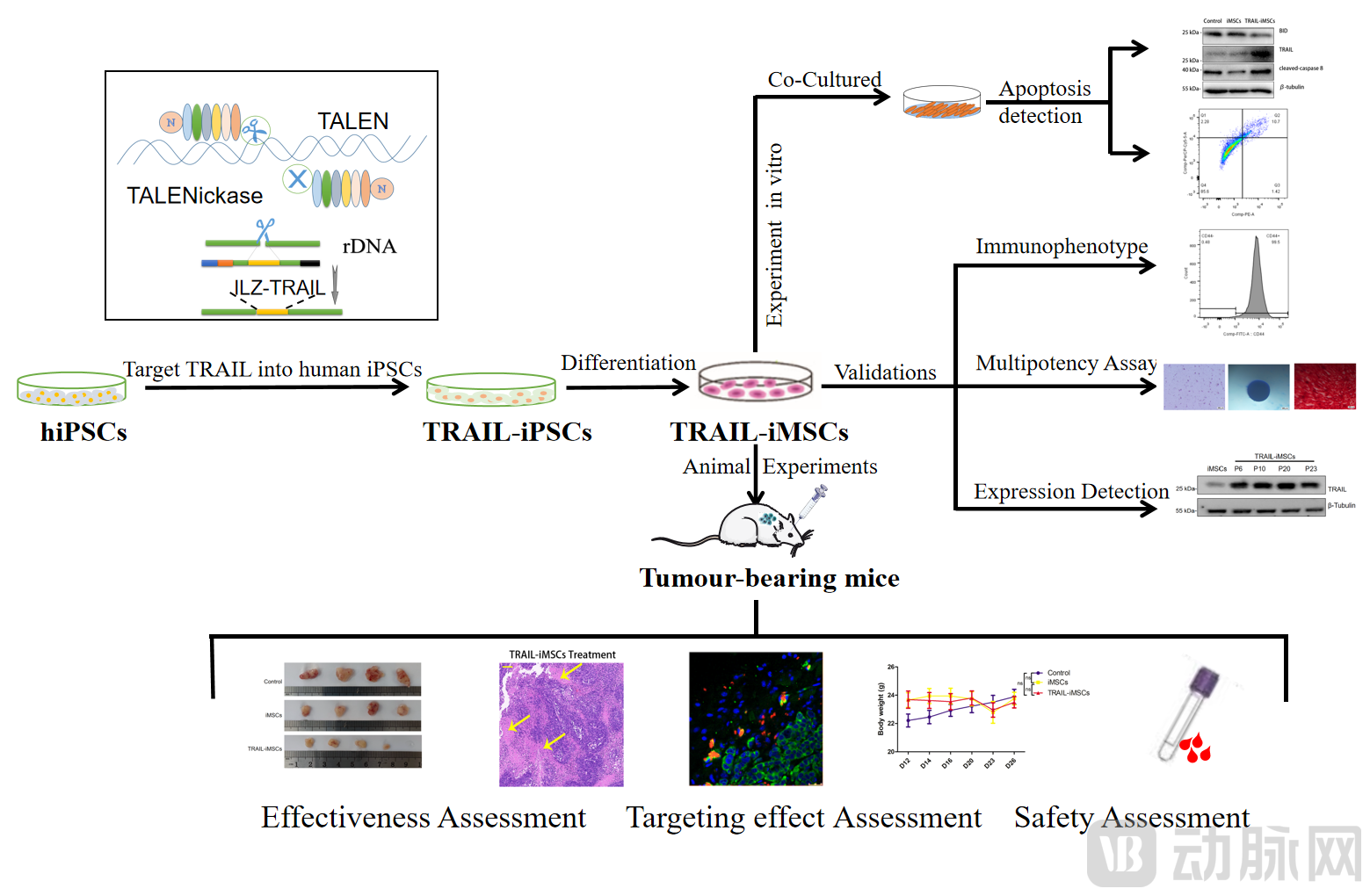
This study provides the first demonstration, at both cellular and animal levels, of the broad-spectrum anticancer efficacy of iPSC-derived iMSCs with site-specific integration of TRAIL. This approach not only offers an unlimited source of highly uniform and relatively controllable therapeutic cells to meet individualized patient needs but also enables industrial-scale manufacturing as a universal off-the-shelf cell therapy product, holding significant promise for clinical application and commercial translation. The research team will next focus on a “multi-gene” site-specific integration strategy, leveraging the advantages of their proprietary multi-gene safe harbor loci to construct “supercharged therapeutic cells” expressing combinations of multiple therapeutic factors, thereby addressing major challenges in treating complex diseases such as cancer and autoimmune disorders that are difficult to manage with single-factor therapies.
Professor Liang Desheng’s team at Central South University is a collaborative R&D partner of Binhu Biology. With over two decades of research and technical expertise in non-viral, targeted gene-modified stem cell therapy for tumors and genetic disorders, the team has pioneered a safer and more efficient strategy for targeted cellular gene therapy. Amidst the current landscape dominated by viral vector-mediated gene therapies, they have achieved a series of independent innovative breakthroughs.
Binhu Biologics is an innovative biotechnology company primarily engaged in the research, development, manufacturing, and provision of therapies and pharmaceuticals for cancer and major genetic diseases, with the goal of achieving revolutionary breakthroughs in the prevention and treatment of cancer and serious illnesses to benefit human health.