

Clue Files for IPO: Pioneering Femtech Company with FDA-Approved Digital Contraception Reaches Over 12 Million Women Globally

Clue
Developer of Female Menstrual Apps
According to PitchBook data, global venture capital funding for the women’s health sector surpassed $1 billion for the first time in 2021. Meanwhile, CB Insights estimates that the global market size for digital women’s health will exceed $50 billion by 2025.
Female Health (Femtech) encompasses software, diagnostics, products, and services related to women's health. At its core, it leverages technology to help women address issues in reproductive health, pregnancy, and postpartum care. Products such as period-tracking apps, connected breast pumps, wearable devices, and sex toys all fall within the Femtech sector.
But in fact, women's health is a relatively new industry. It was only proposed by Danish female entrepreneur Ida Tin in 2016, with the aim of legitimizing the women's health technology market, thereby promoting innovation, attracting investment, and breaking down the barriers and taboos surrounding women's health.
Ida Tin traveled extensively by motorcycle with her parents from a young age. She has witnessed the lives of women around the world, felt their strength, but also seen the many challenges they face, such as being unable to continue their education or pursue their passions due to unintended pregnancies.
She is captivated by stories of strong women fighting for equality and is deeply committed to helping women realize their full potential.Thus, in 2013, she founded Clue and developed an application for tracking menstrual cycles and ovulation, providing female users with services for managing, recording, and sharing information about their physiological cycles. The app now boasts over 12 million active users in more than 190 countries and regions.
The leadership team is entirely female, and more than half of the team members are women.
On International Women’s Day 2021, Ida Tin announced her transition from CEO to Chair of the Board, with Audrey Tsang (formerly Clue’s Chief Product Officer) and Carrie Walter (formerly Clue’s General Counsel) appointed as Co-CEOs. Together with Medical Director Lynae Brayboy, the entire leadership team is now composed exclusively of women.
Ida Tin was born in Copenhagen and earned a bachelor’s degree from Kaos Pilots, Denmark’s creative business school. After graduation, she worked as an organizational consultant at KPMG in India. She later founded Moto Mundo, a motorcycle tour company offering travel services worldwide, and published the bestselling book *Direktøs*, which chronicles her journey of traveling around the world on a motorcycle.
Ida Tin’s travels around the world exposed her to the lives of countless women across different cultures. She was deeply moved by their resilience, yet saddened by the challenges many face—such as being forced to drop out of school, lose their jobs, or abandon their passions due to unintended pregnancies. “I came to realize that if women cannot take control of their own bodies, it will be difficult to create a balanced world,” she reflected. Feeling compelled to act, Ida Tin founded Clue in 2013. Over the nine years from 2013 to 2021, the team grew to approximately 70 members, more than half of whom were women.
Audrey Tsang holds a Master’s degree in Computer Science from Stanford University, as well as an MBA and an MEM from Northwestern University. Prior to joining Clue, Audrey served as the Head of Product for Pinterest’s Home Feed, Director of Product at the mobile hotel booking app Hotel Tonight, and Yelp’s first Product Manager.
Before joining Clue, Carrie Walter worked in the international regulatory department at Freshfields. As General Counsel of Clue, she was responsible for the company’s FDA applications and oversaw its transition into a regulated entity.
Clue Birth Control: Simply record the start date of your period, with 97% contraceptive effectiveness
Clue Birth Control is an FDA-approved digital “birth control pill” embedded within the Clue app as a contraceptive mode.
Clue Birth Control is a novel FABM,It uses patient cycle data to predict which days of the menstrual cycle are high-risk or low-risk.。On high-risk days, users should employ contraceptive measures, such as condoms, every time they engage in sexual activity that could lead to pregnancy.
FABM refers to fertility awareness-based methods of family planning, which involve monitoring various signs and symptoms of fertility throughout the menstrual cycle to identify the “fertile window” (i.e., the days in the cycle when unprotected intercourse is most likely to result in pregnancy). These signs and symptoms include menstrual cycle length, basal body temperature, urinary hormone measurements, and cervical fluid, and they may be used individually or in combination. Fertility signs reflect physiological changes during the menstrual cycle as well as the lifespan of ova and sperm. Women observe, measure, and interpret these fertility signs based on their chosen FABM indicators and avoid unprotected intercourse during the fertile period.
With technological advancements, smartphone applications enable the development of technology-driven fertility awareness-based methods (FABMs). As a novel FABM, Clue Birth Control employs Bayesian prediction algorithms to identify high- and low-risk days for pregnancy within the menstrual cycle, requiring only the start date of menstruation.Unlike traditional FABM, it does not require users to track anything other than the start date of their menstrual period, saving them considerable time and effort.
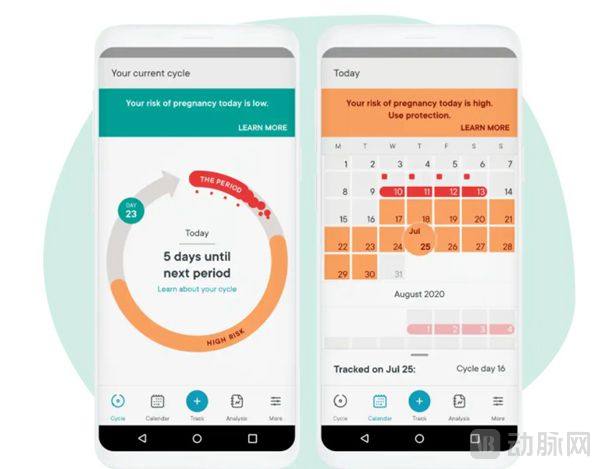
Clue App Interface
The Institute for Reproductive Health (IRH) at Georgetown University evaluated the efficacy of an application named Dynamic Optimal Timing (DOT) in a comprehensive clinical trial. The trial followed 718 women in the United States over 13 cycles of use, examining the relationship between women’s use of the DOT method (both perfect and typical use) and pregnancy outcomes at the end of the study. The study calculated that for women aged 18–39, the perfect-use failure rate for DOT was 1.0%, and the typical-use failure rate was 5.8%, indicating that DOT is effective in preventing pregnancy.In 2019, Clue acquired DOT’s assets (including its algorithms and application) and leveraged them to create Clue Birth Control.
Perfect use refers to the consistent and correct use of a contraceptive method during every act of sexual intercourse.
According to data from the Clue website, Clue Birth Control is 92% effective with typical use and 97% effective with perfect use. This means that among 100 women using Clue Birth Control typically, an estimated 8 will become pregnant within one year. With perfect use, an estimated 3 out of 100 women will become pregnant within one year.
In addition to helping users with contraception, Clue enables them to monitor over 30 health indicators—including skin condition, mood, hair quality, sleep patterns, and cervical mucus—to better understand their physical well-being and receive personalized recommendations. Users can also access a wealth of scientifically grounded articles on women’s health through the Clue platform.
Since its inception, Clue has collaborated with numerous academic institutions, including universities such as Harvard University, Columbia University, Stanford University, the University of Oxford, and the Massachusetts Institute of Technology (MIT), as well as research institutes such as the Kinsey Institute and the Max Planck Institutes.
Over the nine years from 2014 to present, Clue has completed eight funding rounds, raising a total of $47.7 million. Its most recent financing was a venture capital round conducted on December 16, 2021, in which it secured €16 million from investors Balderton and Future Positive Capital.
Similar Domestic Enterprises
In China, enterprises addressing women’s health needs are emerging in large numbers, with business offerings spanning software, diagnostics, products, and services related to women’s health. These offerings cover a wide range of areas, from menstrual cycle tracking and care during pregnancy and lactation to screening and treatment of female-specific conditions.
Meanwhile, with the continuous integration of the internet and various industries, female health applications have been continuously launched, and the user base has continued to expand. According to statistics, from April 2017 to April 2020, the number of users of mobile female physiological health apps in China showed a year-on-year growth trend. In April 2020, the number of users of mobile female physiological health apps in China reached 250 million, a year-on-year increase of 10%.
According to the "Research Report on China's Mobile Women's Health Platform Market in the First Half of 2018" released by the Big Data-Research data center, Meiyou ranked first in the industry with 39.162 million monthly active users (MAUs) in the first half of 2018, while Dayima ranked second with 27.840 million MAUs.
Meiyou primarily provides online intelligent services for women. Its mobile application portfolio includes apps such as Meiyou, Youbaobao, Youzijie, Fanhuan.com, and Yangmao Shengqian, with functionalities covering various aspects of women’s lives, including menstrual health, pregnancy, parenting, and shopping. Public records show that from 2013 to 2016, Meiyou completed eight rounds of financing. In 2016, the company conducted its largest Series E funding round to date, raising nearly RMB 1 billion.
Da Yi Ma officially launched in 2012, entering the female physiological health management market by addressing the essential need for menstrual cycle tracking. It strives to meet core demands related to pregnancy preparation, sexual health, menstruation, and gynecological diseases. Its product portfolio includes various female health management solutions, such as the “Hao Yun Ma” app and “Mei Yue You Xuan,” a lifestyle e-commerce platform. In July 2019, By-Health formally announced that it had completed a strategic investment in the Da Yi Ma app for RMB 62 million.