

From Three Archetypal Models to Hybrid Business Models: Has the AI-Driven Drug Discovery Sector Finally Cracked the Code?
Over the past two years, the AI-driven drug discovery sector has witnessed a wave of “breakneck growth” in the capital markets.
On the one hand,In the secondary market, following the emergence of two star AI drug discovery stocks in 2020—the established player Schrödinger and the newcomer Relay Therapeutics (hereinafter referred to as “Relay”)—two more AI drug discovery unicorns, Recursion Pharmaceuticals (hereinafter referred to as “Recursion”) and Exscientia plc. (hereinafter referred to as “Exscientia”), listed on the Nasdaq in April and October 2021, respectively.
Recently, UK star AI drug discovery company BenevolentAI also announced that it will merge with the special purpose acquisition company (SPAC) Odyssey Acquisition (AMS: ODYSY) through a SPAC merger. The merged entity is expected to list on Euronext in Amsterdam in Q1 of this year.
On the other hand,Including Schrödinger, Relay, Recursion, Exscientia, and Insilico Medicine, Iceland Spar Bio, Xbiome, etc.AI drug development pipelines at multiple AI pharmaceutical companies, among others, are progressively advancing into clinical trials.
Meanwhile,AI-driven pharmaceutical companies have successively announced multiple high-value partnership agreements. For instance, Roche’s Genentech recently announced a collaboration with Recursion, aiming to leverage Recursion’s operating system (OS) to empower the drug discovery process and accelerate the identification of novel targets and advanced therapeutics in neuroscience and oncology. Under the terms of the agreement, Recursion will receive a $150 million upfront payment and is eligible for additional performance-based research milestone payments. If all nearly 40 projects initiated under the partnership are successfully developed and commercialized, Recursion could potentially realize over $12 billion in total value. Other major pharmaceutical companies, including Merck & Co., Sanofi, and Amgen, have also just officially announced new AI-related drug discovery collaborations in recent days.
Ma Jian, CEO of XtalPi, and Feng Ren, CSO of Insilico Medicine, both stated that the growth rate of their companies’ external R&D collaborations has accelerated over the past two years, with rapid increases observed in both the number of partnerships formed and the total value of projects involved.
Does the recognition from the secondary market and the fulfillment of a large number of collaborative orders indicate that AI-driven pharmaceutical companies have now validated their business models?
Let us briefly review the history of AI-driven drug development. Over the past eight years, the industry has experienced stepwise growth, accompanied by continuous evolution in business models. After navigating regulatory gray areas, overcoming pitfalls, and confronting setbacks, AI drug discovery companies have gradually identified sustainable commercial pathways tailored to their own development.
Globally, the AI-driven drug discovery sector has been on the rise since 2014. The emergence of Generative Adversarial Networks (GANs) spurred the industry to explore their application in generating chemical molecules; during the same period, technologies such as image processing and speech recognition were also applied to small molecule identification and target discovery.
It can be said that,The years 2014–2015 marked the nascent stage of development in the AI-driven drug discovery sector.The first wave of AI-driven drug discovery companies (including Exscientia, Atomwise, Recursion, Insilico Medicine, and XtalPi) mostly emerged during this period and successively completed their early-stage financing. At that time, the ecosystem’s recognition of AI in drug discovery was limited. In the early stages of development, these companies faced insufficient funding and limited capabilities in new drug R&D, while also needing to undertake substantial foundational technology accumulation.At that stage, AI-driven drug discovery startups almost exclusively adopted business models centered on providing technical services.
The subsequent two years (2016–2017) were a relatively “quiet” period for AI-driven drug discovery.The entire industry has undergone a transitional period of slow development. Although AI can accelerate and enhance efficiency in certain stages of the new drug development process, its overall advantages are not yet significant.At this stage, some AI-driven drug discovery startups began to vertically extend their technology service chains, pursuing more end-to-end solutions rather than merely improving efficiency at specific points or stages of new drug development.For example, directly providing a molecular compound.
“We initially positioned ourselves as a technology platform company focused exclusively on target discovery services, aiming to serve various enterprises by providing databases and software. Our goal was to leverage algorithms and data solely to help clients identify new drug targets or complete other phase-specific tasks. However, we soon realized that this business model was not viable,” Dr. Feng Ren, CSO of Insilico Medicine, told VCBeat, noting that the company encountered significant obstacles in its development during that stage.
“First, the market size for development was limited: contracts for technical services focused solely on target discovery tended to be relatively small in value. Second, clients’ willingness to collaborate was low, as the outcomes of target discovery are difficult to validate,” said Ren Feng. During that period, many companies, including Insilico Medicine, began to reflect on and explore new business models, attempting to extend their service chains vertically. “Many of our key clients also advised us that if we could generate small-molecule compounds, there would be greater scope for collaboration.” At this stage, AI startups were diligently strengthening their core capabilities.
In 2018, the field of AI-driven drug discovery finally saw modest breakthroughs and a surge in growth.The first batch of AI drug discovery companies,including Schrödinger, Relay Therapeutics, Recursion Pharmaceuticals, Exscientia, and Insilico Medicine,We have begun to sequentially achieve validation milestones, such as the identification of clinical candidate molecules.A growing number of people are beginning to believe in the potential of AI-driven drug discovery, and an increasing number of new players are entering the AI pharmaceutical sector, particularly in China.
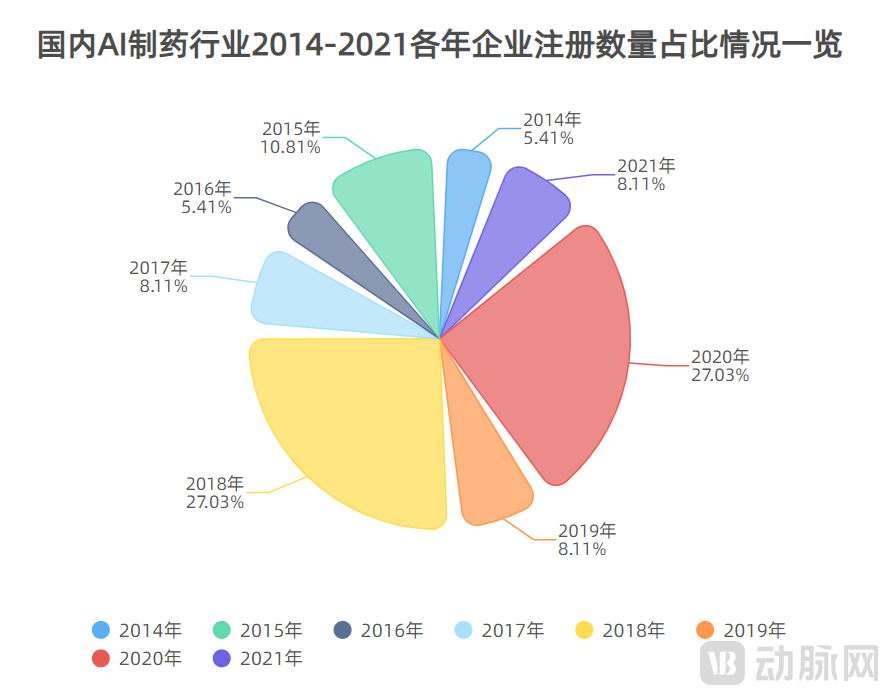
It is evident that 2018 marked the first small peak in the establishment of AI-driven drug discovery startups in China, followed by a second wave in 2020.
(Chart compiled by VCBeat)
Meanwhile, news of collaborations between traditional pharmaceutical companies and AI startups has been incessant. An article published in Drug Discovery Today revealed that 21 leading pharmaceutical companies undertook a total of 148 related initiatives between 2014 and 2018. Among these, 118 involved partnerships with AI-driven pharmaceutical firms for pipeline development.
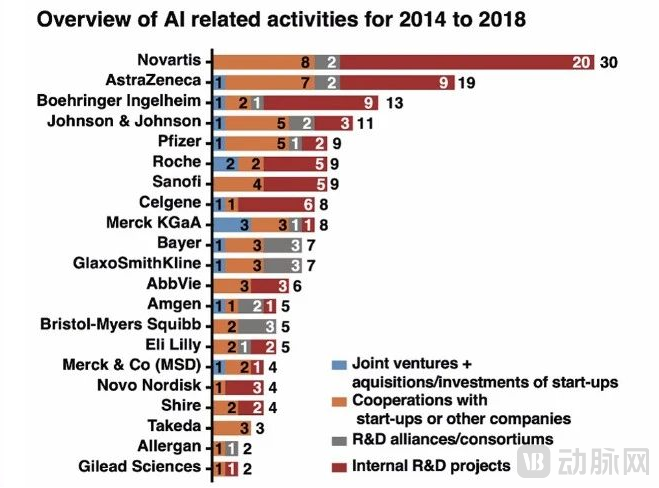
Statistics on the AI Drug Discovery Initiatives of 21 Leading Pharmaceutical Companies from 2014 to 2018 (Image Source: Public Information)
But as mentioned above,The modest contract values seem to signal the revenue ceiling that this batch of AI drug discovery startups may face in the future.If the validation of AI-driven drug discovery outcomes is not proactively advanced to address the purchasing concerns of most pharmaceutical companies, progress in the AI drug discovery industry will remain relatively slow.
At this juncture, AI drug discovery startups that have completed their preliminary technological accumulation and possess relatively ample funding are not only providing AI services with greater breadth and depth but also exploring higher-value-added and sustainable business development models—An increasing number of AI startups are beginning to establish in-house pipelines, independently driving the validation of AI-driven drug discovery outcomes, and advancing the development of AI-enabled therapeutics through either collaborative partnerships or internal R&D efforts.The industry entered a period of accelerated growth (2018–2020).
With the continuous accumulation of data and ongoing validation by platforms, the integration of IT (Information Technology) and BT (Biotechnology) has seemingly become an inevitable trend since 2020.
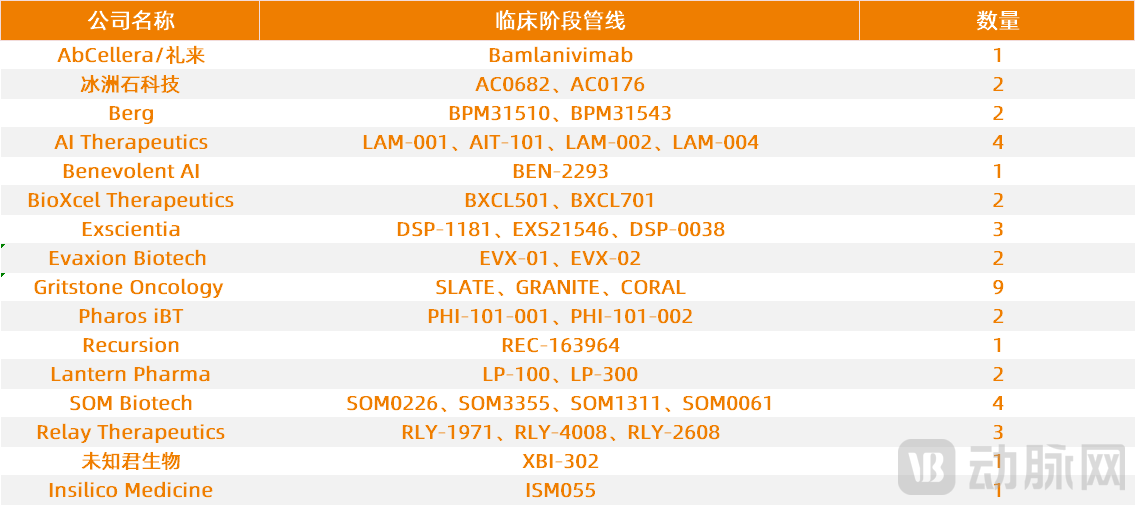
As of the end of December 2021, more than 40 AI-involved R&D pipelines worldwide had entered clinical trials.
(Source: Company official websites; table compiled by VCBeat; information may be incomplete)
On the one hand,An Increasing Proportion of AI Drug Discovery Companies Are Developing In-House Pipelines, with Some Early-Stage Programs Achieving Initial Validation——In February 2020, DSP-1181, a long-acting serotonin receptor (5-HT1A receptor) agonist co-developed by Exscientia and Sumitomo Pharma, initiated Phase I clinical trials in Japan for the treatment of obsessive-compulsive disorder (OCD). Exscientia claimed that this candidate molecule was the world’s first AI-designed drug candidate to enter clinical trials, with the entire project taking less than one year from concept to clinical entry. Subsequently, numerous AI-driven pharmaceutical companies, including Relay Therapeutics, Recursion Pharmaceuticals, BenevolentAI, Insilico Medicine, and Icestone Technology, disclosed that their AI-developed drug candidates had also entered clinical stages.
On the other hand,Startups in the AI drug discovery sector are emerging in large numbers, attracting a surge of investment firms. Many high-tech internet companies, including Google, Tencent, Baidu, Huawei, Alibaba, and ByteDance, have successively entered the AI drug discovery field. Traditional pharmaceutical companies, represented by multinational corporations such as Merck & Co., Sanofi, Novartis, and AstraZeneca, along with numerous innovative biotech firms, have adopted diverse collaboration models and established strategic partnerships with AI drug discovery companies. Most excitingly, several AI drug discovery companies have listed on the NASDAQ, successfully ringing the opening bell.
Based on an analysis of publicly listed AI-driven drug discovery companies, we have identified three major business models. These three models represent the most typical and extreme business paradigms currently prevalent in the AI drug discovery industry.
1SaaS Providers Primarily Offering Software Platform Services
These companies are dedicated to providing the most advanced computational software and hardware tools, accumulating more data through extensive collaborations to support algorithm iteration, thereby helping pharmaceutical companies complete R&D tasks more effectively and efficiently.A typical representative of this business model is Schrödinger. Leveraging over 30 years of technological expertise, Schrödinger has developed a physics-based computational platform that can accurately predict key physicochemical properties of molecules, enabling more efficient and cost-effective discovery of high-quality molecular candidates. Schrödinger enjoys a very high penetration rate among pharmaceutical companies worldwide.
Schrödinger’s business can be primarily divided into two segments:
First, software services: All of the global top 20 pharmaceutical giants are Schrödinger’s clients, and its software is used by more than a thousand research institutions worldwide. Second, drug discovery services: As of the end of 2020, Schrödinger had collaborated with more than 10 different pharmaceutical companies on over 25 drug development projects. Notably, in November 2020, Schrödinger partnered with Bristol Myers Squibb (BMS) to develop small-molecule drugs for oncology, neuroscience, and immunological diseases, including two previously internally developed programs targeting HIF-2α and SOS1/KRAS. This collaboration earned Schrödinger $55 million in milestone payments, with up to $2.7 billion in potential future milestone payments.
According to Schrödinger’s annual report, the company’s total revenue in 2020 was $108 million (a 26% year-over-year increase from 2019), including $92.5 million in software services revenue (a 39% year-over-year increase) and $15.6 million in drug discovery revenue (a 17% year-over-year decrease). As of press time, Schrödinger’s market capitalization stood at approximately $2 billion.
2An AI-powered biotech company focused on developing its internal R&D pipeline
Such companies do not offer external software services and engage in limited collaboration with outside partners, primarily advancing their proprietary pipelines to more rapidly validate the capabilities of their algorithm platforms.A typical representative of this business model is Relay Therapeutics.
Relay claims to combine cutting-edge experimentation and state-of-the-art computational capabilities with Zebi AI technology, a pioneer in applying machine learning to large-scale experimental DNA-encoded library datasets for drug discovery. Currently, projects identified through its proprietary AI-driven drug screening platform include two FGFR2 inhibitors (targeting both wild-type and mutant forms) and an SHP2 allosteric inhibitor, all in Phase I clinical trials. Its preclinical pipeline features candidates such as a PI3Kα mutant inhibitor. As of press time, Relay’s market capitalization stands at approximately $2.4 billion.
3AI CRO companies that provide outsourcing services to pharmaceutical companies, CROs, and other drug development firms
Such companies primarily advance pipeline development through collaborations with a large number of external enterprises, leveraging extensive partnerships to accumulate more data that supports the optimization and iteration of their algorithmic models.A typical representative of this business model is Exscientia.
Exscientia has three drug candidates in clinical development, with four additional pipelines advancing toward Investigational New Drug (IND) applications, comprising a total of 26 active projects. The company maintains extensive partnerships with numerous organizations, including Sumitomo Pharma, Evotec, Bristol Myers Squibb (BMS), Bayer, Sanofi, EQRx, the Bill & Melinda Gates Foundation, the University of Oxford, Rallybio, BlueOak Therapeutics, Huadong Medicine, and Shanghai Pailong Biotechnology.
In 2020 and the first half of 2021, Exscientia’s operating revenues were $9.672 million and $7.697 million, respectively. The company’s revenue streams primarily include R&D service fees paid by partners, milestone payments and sales royalties from new drug development, and licensing fees paid by licensees of its intellectual property. As of press time, Exscientia’s market capitalization stood at approximately $2 billion.
If we look solely at current stock price performance, among the three typical business models mentioned above,AI-powered biotech company Relay Therapeutics appears to have a slight edge in market capitalization.Relay’s market capitalization stands at approximately $2.4 billion, while those of Schrödinger and Exscientia are each around $2 billion. Overall, the valuations of these publicly listed AI-driven drug discovery companies do not differ significantly, making it difficult at present to determine which business model will prove more successful.
So, how have these business models developed in China?
By reviewing the relevant business operations of more than 40 AI-driven drug discovery companies in China, we have found thatThere are currently no prominent domestic examples of SaaS providers that “dominate” the market by offering software platform services akin to Schrödinger; meanwhile, AI CRO and AI Biotech companies have begun to enter their harvest phase.
AI CRO: Gaining Recognition from Pharmaceutical Companies, Surge in Collaborations
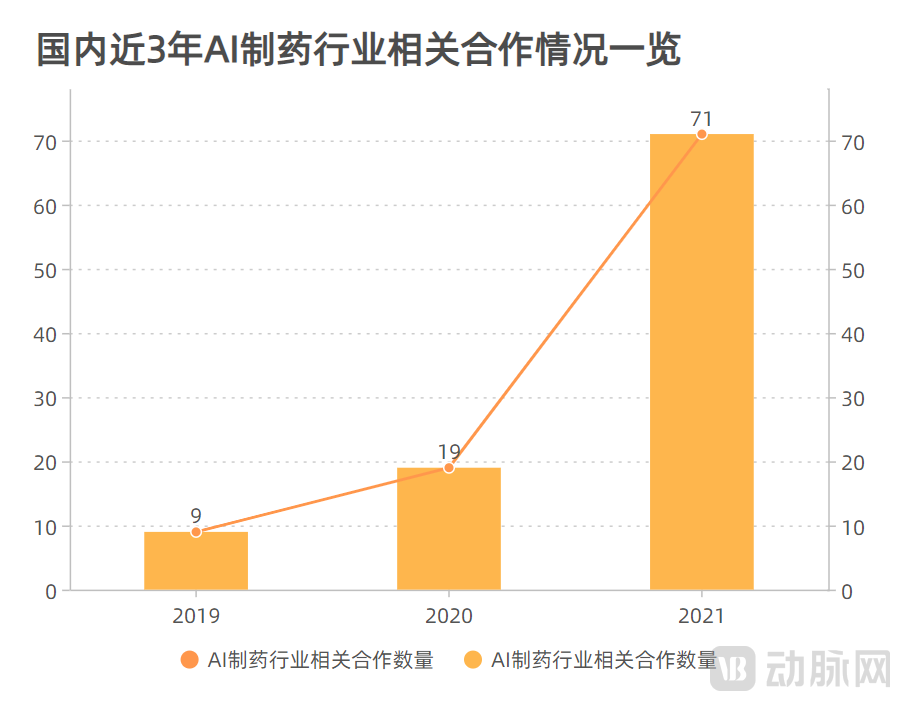
An analysis of collaboration activities in China’s AI-driven drug discovery industry over the past three years reveals a consistent upward trend, with a notable surge in collaborative transactions in 2021. In terms of transaction volume, the number of collaborations in 2020 was double that of 2019; however, the overall number of collaborative events remained relatively low during the 2019–2020 period.
2021 was undoubtedly a turning point for the “implementation” of collaborations in the AI-driven drug discovery industry, with 71 collaboration events recorded—3.7 times the number in 2020. Notably, multiple “repeat partnerships” occurred, indicating that AI-driven drug discovery is gaining increasing recognition from pharmaceutical companies.
Taking XtalPi, a leading domestic player, as an example, the company disclosed 16 collaborative transactions in 2021, accounting for 22.5% of all AI-driven drug discovery collaborations in China that year.Its partners include a host of innovative biotechnology companies and large pharmaceutical firms, such as Jacobio Pharmaceuticals, Qinhao Medicine, 3D Medicines, Qingyu Pharma, SigoBio, Singleron Group, Kintor Pharmaceutical, Ideaya Biosciences (Qide Pharma), Geode Therapeutics, and PhoreMost. Collaborations span therapeutic areas including oncology, psychiatric disorders, and autoimmune diseases, with drug modalities ranging from small-molecule innovator drugs to macromolecular monoclonal antibodies, antibody-drug conjugates (ADCs), engineered enzymes, and peptides. The primary focus of these collaborations is AI-driven integrated computational and experimental drug discovery services.
Regarding XtalPi’s positioning, Wen Shuhao, Co-founder and Chairman of XtalPi Technology, stated, “XtalPi Technology is an AI-driven industrial platform company. While we are currently focused on the pharmaceutical sector, the applications of our technology and platform extend beyond serving the healthcare industry. We aim to leverage our distinctive foundational capabilities in physics, combined with AI, to continuously enhance the efficiency of new drug and new material R&D, thereby unlocking our advantages and creating value across a broader range of industrial scenarios.”
XtalPi, which initially built its reputation on crystal form prediction as its core business, has rapidly expanded into the fields of drug discovery and drug development over the past two years.——The company has developed a series of core technologies, including a new-generation universal force field for drug molecules that offers more comprehensive coverage of chemical space and higher precision, XFEP for high-precision prediction of drug activity, AI-driven molecular structure generation, and models for drug property assessment and targeted optimization. By integrating cutting-edge technologies such as cryo-electron microscopy (cryo-EM), PROTAC, and DNA-encoded libraries (DEL), the company has built an intelligent drug R&D platform for both large and small molecules. This platform covers all R&D stages from post-target discovery to pre-clinical trials, providing services that include hit compound screening, lead compound generation, and lead compound optimization.
Dr. Ma Jian, Co-founder and CEO of XtalPi, revealed that in the collaborative projects XtalPi has undertaken with external partners over the past two years,The “one-stop new drug discovery” business accounts for an increasing share of revenue and has become a core business direction for the company.XtalPi’s business expansion is grounded in the team’s deep insights into market demands. “At our current stage of development, if we merely develop AI algorithms and tools for the market and leave enterprises to apply them on their own—addressing issues only at specific points or within isolated links—we would be unable to sustain the company’s competitive advantages and industry leadership,” said Ma Jian.Current pharmaceutical R&D companies place greater emphasis on the comprehensive implementation and delivery capabilities of AI-driven drug discovery firms, favoring those that can provide more holistic solutions.
What constitutes a more comprehensive solution? “For instance, an AI-driven pharmaceutical company can start from a client-selected target and deliver candidate drug molecules that have undergone preliminary validation and are ready for clinical trial application—taking the process from zero to one—rather than merely providing fragment compounds. Such a company leverages its AI technology platform for compound screening and optimization, combines this with expert experience to make scientifically sound and reliable key decisions, and operates advanced laboratories capable of rapidly conducting targeted validation of critical properties for the generated candidate compounds,” stated Ma Jian. He added that XtalPi has established a complete and robust AI-driven drug discovery workflow, continuously investing in R&D and integrating cutting-edge technologies, with the ultimate goal of optimizing the entire drug development process and thereby delivering sustained value across the broader field of pharmaceutical research and development.
Therefore, as early as 2018, XtalPi established its own large-scale laboratory with the aim of continuously optimizing AI algorithm models through an integrated suite of quantum physics calculations and data feedback from advanced wet labs. This approach has enabled the prediction results generated by XtalPi’s algorithm platform to more closely align with real-world and clinical scenarios, thereby achieving increasingly higher accuracy in predicting molecular activity. In late November last year, XtalPi announced its participation in the IDEA CTO Studio Program and jointly established the “IDEA-XtalPi Artificial Intelligence Laboratory” with the founding institute of IDEA. The two parties will engage in deep R&D collaboration in the field of “AI-based prediction of biomacromolecular structures for innovative drug discovery,” aiming to address numerous technical challenges currently facing the biopharmaceutical industry.
Other AI drug discovery companies that also prioritize the integration of “wet and dry lab experiments” include BioMap, a typical representative of internet technology giants entering the field of AI-driven drug discovery.
Dr. Le Song, a world-renowned machine learning expert who recently joined BioMap as Chief AI Scientist, stated that without closed-loop validation and data supplementation through high-throughput, multi-round wet-lab experiments, it is difficult for AI models to deliver critical value in the field of AI-driven drug discovery.BioMap is currently building an integrated dry-wet laboratory platform, aiming to create a closed-loop system that connects its wet-lab and AI teams. By unifying the planning of AI models and experimental platforms for collaborative operation, BioMap seeks to jointly advance drug discovery.
BioMap aims to fully leverage its advantages in AI models and computational resources, combining them with self-generated experimental data and specialized domain knowledge in medicine and pharmaceuticals to accelerate drug discovery. Through win-win collaborations with traditional pharmaceutical companies, it seeks to provide the industry with more valuable tools.
AI Biotech: Multiple Pipelines Enter Clinical Stage
In December 2021, Insilico Medicine’s new drug candidate ISM055 for the treatment of idiopathic pulmonary fibrosis entered clinical trials, with the first administration to healthy volunteers completed in Australia. Dr. Ren Feng, Chief Scientific Officer (CSO) of Insilico Medicine, revealed that a pre-application had been submitted to the Center for Drug Evaluation (CDE) of China’s National Medical Products Administration (NMPA), and Phase I clinical trials were expected to commence in China in the first half of 2022.
“As a new drug R&D company centered on pipeline development and empowered by an AI technology platform, we aim to accelerate our internal R&D pipeline through our proprietary AI platform. In the future, we will independently advance select pipelines through Phase I, II, and III clinical trials, and even to market approval, while licensing out other pipelines at appropriate stages of development,” Ren Feng revealed to VCBeat.Insilico Medicine currently has nearly 30 internally developed projects at various stages: the most advanced have entered clinical trials, some are at the preclinical candidate (PCC) stage, and others are in earlier phases.
Recently, the Insilico Medicine R&D team announced the integration of AlphaFold into its end-to-end AI-driven drug discovery engine, leading to the identification of a potential first-in-class hit compound targeting CDK20, a novel target lacking available protein structural information. This work marks the first application of AlphaFold in hit compound identification, demonstrating its supportive role in early-stage drug discovery.
Two other representative domestic AI biotech companies, Calcite Tech and Xbiome, also made gains in 2021.
In September 2021, UnknownBiome announced that its investigational fecal microbiota transplantation (FMT) drug, codenamed “XBI-302,” had received Investigational New Drug (IND) approval from the U.S. FDA, officially enabling it to enter clinical trials for the treatment of acute graft-versus-host disease (aGVHD). In the same month, Calcite Biosciences announced that the U.S. FDA had approved its Investigational New Drug (IND) application for AC0682, intended for the treatment of estrogen receptor-positive breast cancer.
In December 2021, Icestone Biosciences announced further positive news, revealing that its androgen receptor (AR)-targeting degrader, AC0176, had received FDA approval to initiate clinical trials for the treatment of metastatic castration-resistant prostate cancer (mCRPC). The Phase I clinical trial is expected to commence in the first quarter of 2022.
The development of new drugs is characterized by long cycles, high risks, and substantial costs, yet it also offers the potential for high returns. Innovative drug assets can unlock significant value explosion potential for AI-driven pharmaceutical companies.
Anonymous investors have expressed to VCBeat that they are more optimistic about AI drug discovery companies focused on in-house R&D: “For AI drug discovery companies offering technical services, their market capitalization and growth are determined by the number of clients and service revenue. If their capabilities are not strong enough, their scale is insufficient, or their client coverage is not broad enough, they will easily face a revenue ceiling. We believe that only a limited number of players in this segment—including SaaS providers offering software platforms and AI CROs—will ultimately succeed, gradually leading to a scenario where a few giants dominate most of the market resources. From a long-term development perspective,”AI-powered biotech companies (with in-house pipelines) will have a competitive advantage—“A company’s strength is determined by its technology and pipeline; its growth hinges on the quality of its pipeline and the likelihood of success, offering greater profit potential and room for imagination.”
In fact, many AI-driven biotech companies in the industry are already exploring pipeline development and advancing new solutions beyond technological breakthroughs. For example, a domestic AI biotech startup focused on immunology R&DHuanyi Bio, aiming to leverage unique AI-integrated multi-omics technologies to decipher the human immune system, construct digital biological models, and facilitate biomarker and target development.
Specifically, they map real-world patient data onto an immunology knowledge graph and apply mechanistic modeling to decipher complex immune regulatory networks. This R&D approach enables more precise matching of targets with indications, thereby significantly improving the success rate of clinical trials. It is reported that Huanyi Biotech has established collaborations with more than ten innovative pharmaceutical and biotechnology companies. One target has already been validated, and seven pipelines are being jointly developed and built in the fields of oncology, autoimmune diseases, neurological disorders, and inflammatory bowel disease (IBD), while the company is also actively advancing its proprietary pipeline. Recently, Huanyi Biotech, together with Bingzhou Shi, WeKnow, and Wangshi Zhihui, was listed among the most active enterprises in China’s AI-driven drug discovery sector by Deep Pharma Intelligence in 2021.
Although XtalPi and Insilico Medicine present themselves externally as an “AI industrial platform” and an “AI Biotech,” respectively, both companies have in fact expanded their business models in distinctive ways, leveraging their respective technological capabilities and team DNA. This serves as a vivid reflection of the current development of China’s AI-driven drug discovery industry.
VCBeat has analyzed and compiled statistics on the business models of more than 40 AI-driven drug discovery companies in China.
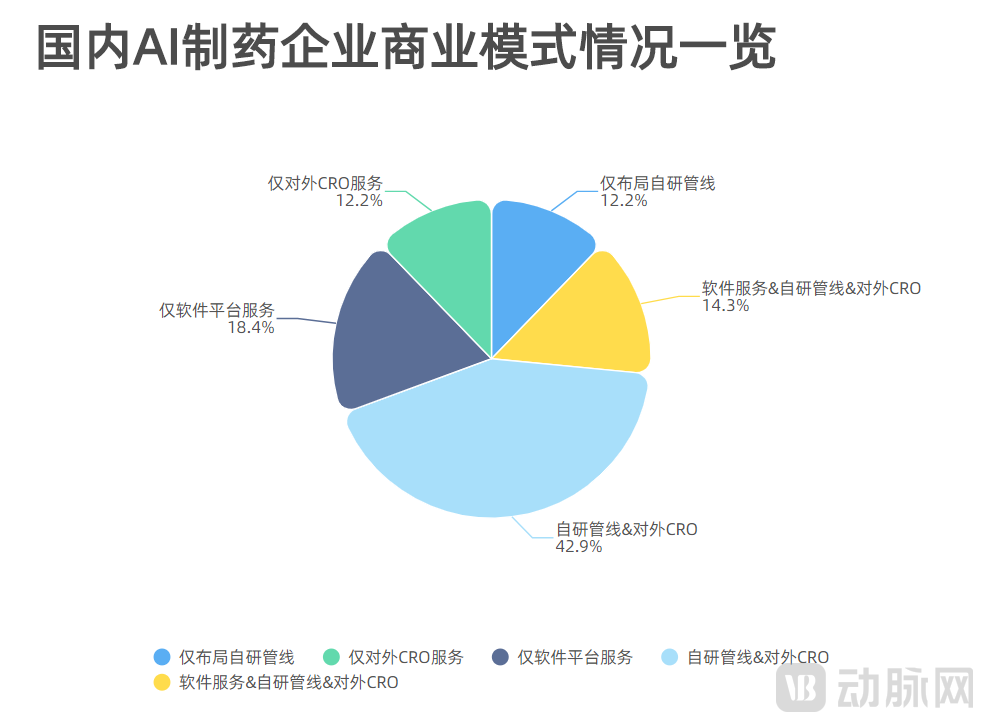
The results show that,Most AI drug discovery companies in China adopt business models that fall between the AI Biotech and AI CRO paradigms, accounting for 42.9% of the total; approximately 14.3% of companies operate with hybrid models spanning three typical archetypes.
In addition, AI-enabled biotech companies that develop only internal R&D pipelines account for 12.2%; SaaS providers offering software platform services account for 18.4%; and AI CRO companies providing outsourcing services to pharmaceutical firms, CROs, and other drug development companies account for 12.2%.
In other words, most AI-driven drug discovery companies in China are more inclined to develop their internal pipelines while simultaneously offering external AI CRO services. The two typical companies highlighted earlier are both pursuing “marginal expansion” by leveraging their respective capabilities and strengths.
Like XtalPi, in addition to its role as an AI CRO service provider, it is also strategically investing in the incubation of startups.. In August 2019, Medicine Tech Inc., an AI-driven drug delivery and formulation R&D company, was established under the incubation of XtalPi and received strategic investment from XtalPi in March 2020; in March 2021, following a successful new drug collaboration with PhoreMost, a UK-based biopharmaceutical company dedicated to “targeting undruggable targets,” XtalPi announced its participation in PhoreMost’s $46 million Series B financing round; in the same month, XtalPi also participated in the RMB 60 million angel financing round of Signet Therapeutics, an innovative cancer targeted therapy developer leveraging disease models; on January 18, 2022, XtalPi announced its participation inA Novel Oncology Immunotherapy Drug R&D Company Based on Immune Metabolic Reprogramming + Artificial Intelligence (AI)Laimang Biotech’s Angel Round Financing.
Dr. Ma Jian stated that the companies invested in and incubated by XtalPi are closely integrated with and highly complementary to XtalPi’s business operations during the drug discovery phase—A key focus of the company’s incubation strategy is its layout across the upstream and downstream segments of the industrial chain.Including strategic synergies with XtalPi’s future development, which will drive the company’s revenue growth, expand customer channels, and strengthen long-term technological barriers, thereby establishing a digitalized and intelligent pharmaceutical industry ecosystem centered on XtalPi that features mutual reinforcement and positive interaction.
Beyond its role as an AI-driven biotech company, Insilico Medicine also provides external software platform services—licensing its generative biology and generative chemistry platforms, which have been validated through internal pipelines, to clients—and engages in collaborative project development with a diverse range of drug R&D companies, including Big Pharma, CROs, and biotech firms.——Currently, Insilico Medicine has established collaborations with more than 30 leading biopharmaceutical companies worldwide. Its partners include Pfizer, Johnson & Johnson, Boehringer Ingelheim, Merck KGaA, Teva Pharmaceutical Industries, Sumitomo Pharma, WuXi AppTec, Astellas Pharma, Taisho Pharmaceutical, Beijing Tide Pharmaceutical, Syngenta, and UCB, among other renowned enterprises.
In this regard, Ren Feng stated, “Data feedback obtained through various channels, including internal projects, external projects, and technical services, can be used to iteratively validate and optimize the company’s AI-driven drug discovery platform, thereby enhancing its accuracy.” Additionally, by engaging in external collaborative projects, the company can also receive corresponding milestone payments and sales royalties from the development of partnered pipelines.
Regarding the diverse business models adopted by different companies, Ren Feng stated, “This is determined by each company’s team DNA and technological strengths. Each company has simply chosen the path best suited to its long-term development at this stage. Overall, the AI-driven drug discovery industry is still in its early stages of development, and companies are continuously exploring viable business models.” Ma Jian also noted, “The various challenges in drug R&D can be mapped onto a two-dimensional coordinate system comprising biological challenges and engineering/technical challenges. Companies must first identify their areas of competitive advantage within this framework, aligned with their core capabilities.”
Thus, we return to the initial question posed at the beginning of this article: Does the recognition from the secondary market and the substantial volume of executed partnership orders indicate that AI-driven pharmaceutical companies have now validated their business models?
We believe this represents only a milestone victory in the field of AI-driven drug discovery, with a long road still ahead before ultimate success is achieved.As the AI-driven drug development industry matures, stakeholders increasingly prioritize the intrinsic value of the drugs themselves over the methods used in their discovery and development.
The current state of development in the AI-driven drug discovery sector resembles that of a toddler taking its first steps, rather than an infant in swaddling clothes. The business models within this field are far from being fully established or “set in stone.” Until AI achieves deep integration with pharmaceuticals, it will continue to “run” forward. Ultimately, the goal of “leveraging AI to empower new drug R&D and accelerate the birth of novel therapeutics” will guide a cohort of outstanding AI-driven drug discovery companies through the test of time.