

Aimooe Breaks Through 'Bottleneck' Technology with Self-Developed Near-Infrared Optical Positioning System for Surgical Robots

AIMOOE
Provider of Near-Infrared Optical Localization Systems
As the 20-year patent protection for the da Vinci Surgical Robot expires, Chinese startups in the surgical robotics sector are seizing the opportunity, leveraging advantages such as product innovation, diversity, and intelligence.
Driven by policy support, enhanced corporate R&D capabilities, and other factors, domestically produced surgical robot products have been successively approved for market launch. Improvements in product innovation and R&D quality have ushered in a period of strong growth. According to statistics from Zheshang Securities, the market size of China’s surgical robotics sector reached USD 425.3 million in 2020, with a compound annual growth rate (CAGR) of 44%, significantly higher than the global average.
However, the grim reality is that while surgical robotic systems—the mainstay of the industry chain—have achieved technological breakthroughs and are gradually realizing domestic substitution in China, the core components of these robots still suffer from insufficient R&D capabilities and heavy reliance on imports. This situation has further become a critical “choke point” hindering the upward development of China’s surgical robotics industry, urging immediate resolution of these industrial challenges.
Deeply Cultivating Near-Infrared Optical Positioning Systems: A Promising Market Outlook
The value of surgical robots lies in their precision and stability.
Traditional surgeries are performed by surgeons; even experienced surgeons may encounter issues during the procedure. Surgical robots can effectively address the challenges associated with manual surgery.
First, due to muscle contraction, the human arm exhibits varying degrees of physiological tremor, which can significantly compromise surgical outcomes. Using the robotic arm of a surgical robot as an extension of the surgeon’s hand to assist in operative procedures can enhance treatment efficacy;
Secondly, issues such as manual measurements using traditional tools, the inability to visualize internal anatomical structures, and reliance on physicians’ subjective judgment necessitate the use of surgical navigation systems, such as optical positioning systems. Serving as the surgeon’s “eyes,” these systems precisely determine the location and orientation of lesion areas, thereby further enhancing localization accuracy and improving surgical precision.
Finally, software systems such as control algorithms serve as the surgeon’s “brain,” assisting in decision-making and surgical maneuvers to improve surgical success rates.
The importance of positioning systems, control algorithms, and robotic arms is self-evident, and all three components originate from the upstream segment of the surgical robot industry chain.
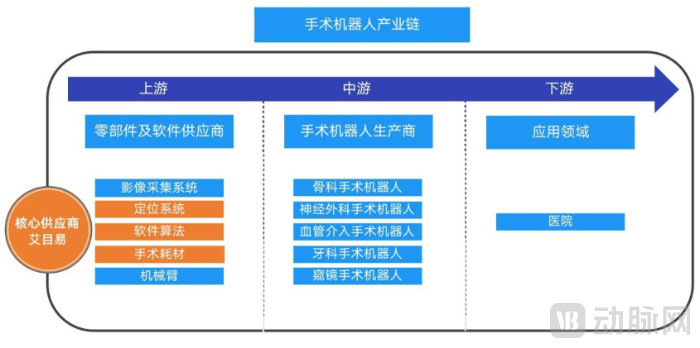
Surgical Robot Industry Chain
Image created by AIMOOE
The immense development potential and broad market prospects of surgical robot systems have long attracted significant financial and human resource investments in research and development from several developed countries. However, due to China’s late start in the research and development of near-infrared optical systems, there is still a long way to go in terms of product maturity.
Guangzhou Aimooe Technology Co., Ltd. (hereinafter referred to as “Aimooe”), established in 2017, specializes in the research and development of core components and solutions for surgical navigation and surgical robots.
Leveraging its deep expertise in technological R&D and profound understanding of clinical applications, AIMOOE successfully developed China’s first “Near-Infrared Optical Positioning System” in 2019, achieving positioning accuracy at an internationally leading level. Through in-depth research ranging from hardware design to internal material structures, the system has demonstrated excellent performance in electromagnetic compatibility and stability.
Yang Rongqian, founder of AIMOOE, told VCBeat:“Lighting, humidity, and temperature vary across different departments, necessitating extensive experimentation and parameter testing for each of these factors. Benefiting from our years of experimental work and product R&D, the system we have developed demonstrates excellent stability in diverse environments, successfully coping with such complex conditions. Therefore, we are confident in our ability to provide positioning systems that meet customer requirements. The positioning system developed and manufactured by AIMOOE not only offers diverse interfaces but also incorporates interactive features such as image and video display, taking into account the usage habits of doctors and nurses during surgeries, thereby making system operation more convenient.”
The “AimPosition Optical Positioning System,” developed by AIMOOE, is now widely used in surgical navigation, surgical robots, and other medical scenarios where “precise positioning” is paramount. The company has established long-term scientific research collaborations with multiple hospitals in Guangdong Province, covering departments such as neurosurgery, orthopedics, dentistry, and interventional radiology. Through these partnerships, it gains familiarity with clinical application scenarios and a thorough understanding of clinical needs, thereby further driving technological iteration.
In 2020, AIMOOE completed the development of a prototype surgical navigation system, established a surgical robot technology platform, and developed its second-generation optical positioning system as well as an industrial optical positioning system. In 2021, AIMOOE expanded outward by actively forging partnerships with leading industry players, thereby laying a foundation for sectoral development while exploring R&D application scenarios, tapping into incremental markets, and accelerating corporate growth.
Currently, its products have been sold to dozens of surgical robot companies in China.
Establishment of three major product pipelines: positioning systems, software algorithms, and surgical consumables
AIMOOE has not only achieved notable success in the research of optical positioning systems, but also established a product pipeline encompassing positioning systems, software algorithms, and surgical consumables.
With years of experience in research on surgical navigation and surgical robotics, technologies such as image processing algorithms, surgical registration algorithms, and robot calibration and control algorithms have reached a relatively advanced level and have been adopted by multiple domestic surgical robotics companies.
Specifically regarding surgical procedures, AIMOOE is already capable of providing relevant products that cover surgical planning, image registration, and automatic positioning.
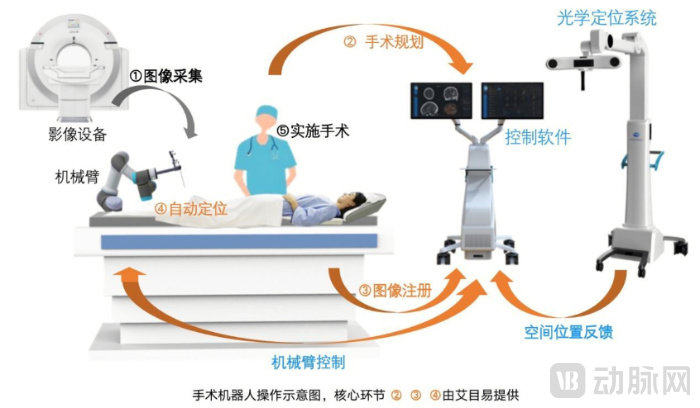
Furthermore, its near-infrared optical positioning system is also applied in the industrial sector to support the upgrading of domestic robotic products and empower the creation of more intelligent application scenarios in industry.
To unleash sufficient kinetic energy to drive corporate growth, AIMOOE collaborates continuously with downstream institutions and manufacturers. Leveraging its advantages in core component R&D and years of accumulated experience in surgical robot navigation, AIMOOE empowers mid- and downstream industry players with its products and technologies. This enables them to achieve rapid industrialization, which in turn accelerates the broader adoption of AIMOOE’s products.
Leveraging its enterprise-grade software development capabilities, AIMOOE also provides custom software development services. Currently, AIMOOE has successfully developed high-end intelligent devices such as surgical navigation systems and dental robots, achieving a “hardware + software” product deployment.
Strengthening Upstream Capabilities, Continuously Expanding Product Application Scenarios
At the conclusion of the discussion, Yang Rongqian outlined his strategic plan for AIMOOE’s future development:“At present, we will continue to focus on the continuous iteration and upgrading of our near-infrared optical systems, while expanding our product portfolio. For instance, our newly launched Version 2.0 products feature significant improvements in design, technical specifications, and algorithms. Meanwhile, as we deepen our understanding of downstream markets and strengthen collaborative partnerships, we have identified new requirements for optical positioning systems. In response, we will further diversify our optical positioning system models to better meet the needs of various clinical departments. We are also committed to enhancing key technical parameters to enable low-latency data transmission, thereby achieving more precise and high-speed positioning.”
“In terms of application areas, in addition to products such as surgical robots and surgical navigation systems, we will also expand into the industrial sector. Currently, we have initiated preliminary collaborations with major domestic industrial robot companies and manufacturers. In the future, we will extend AIMOOE’s products and technologies to industrial applications, empowering intelligent manufacturing and production in the industry. This will open up a broader market space for AIMOOE.”
Building on its upstream foundation, continuously iterating, and expanding into a diverse range of application scenarios are AIMOOE’s next steps.