

64-Year-Old Keio Professor Fuels iPSC Innovation: Heartseed’s $598M Novo Nordisk Deal and Breakthrough Therapy for Heart Failure

Heartseed
Cardiac Regeneration Drug Developer
According to statistics, the global number of patients with heart failure (HF) exceeds 60 million, which is five times the number of cancer patients worldwide. Cardiovascular disease has become the leading cause of death globally. Heart failure is the primary reason for hospitalization among patients aged 65 and older worldwide, with a 30-day readmission rate of 24% and a 1-year readmission rate as high as 60%, imposing a substantial burden on families and healthcare systems.
Currently, the treatment of heart failure primarily relies on long-term pharmacological therapy and the implantation of cardiac electronic devices. For patients with end-stage heart failure, effective treatment can only be achieved through heart transplantation; however, due to the limited availability of suitable donors, there is an urgent need for new technologies and products in the heart failure field to address this unmet market demand.
Regenerative medicine may offer a solution to this challenge. Theoretically, inducing the differentiation of induced pluripotent stem cells (iPSCs) into cardiomyocytes and transplanting them into cardiac tissue could serve as an alternative to heart transplantation. Compared with organ transplantation, iPSC injection is less invasive. Furthermore, iPSCs can differentiate into specific types of cardiovascular cells to generate new cardiomyocytes, and improved cardiac function has been observed in experimental models following iPSC transplantation.
When it comes to iPSCs, Japan is currently at the forefront of development in this field. As early as 2006, Professor Shinya Yamanaka’s team at Kyoto University in Japan was the first to report research on iPSCs in the journal Nature. In 2012 and 2016, two Japanese medical scientists, Shinya Yamanaka and Yoshinori Ohsumi, were awarded the Nobel Prize in Physiology or Medicine for their contributions to regenerative medicine.
There are three reasons for Japan’s rapid development in the field of regenerative medicine.
First is the research and development team.iPSC technology was initially developed based on the research conducted by Professor Shinya Yamanaka’s team in Japan. The advancement of the iPSC field in Japan has largely been driven by collaborations between university and hospital teams. These robust research groups have accelerated scientific discoveries, provided strong theoretical support for clinical translation, and ensured both the safety and innovation of clinical applications.
Secondly, there is the protection provided by laws and regulations.Leveraging its pioneering scientific achievements in the field of induced pluripotent stem cells (iPSCs), Japan established early and comprehensive laws and regulations in this area. In 2013, Japan enacted the Act on the Safety of Regenerative Medicine, providing a legal basis and regulatory framework for the popularization and development of regenerative medicine in the country, thereby accelerating the translation of products in the regenerative medicine sector.
Furthermore, there is support from technology and infrastructure.Japan has achieved relatively mature development in serum-free stem cell culture technology, wherein the cell culture medium contains no serum or any animal-derived components. Furthermore, Japan has established various HLA-typed iPSC banks to accelerate research into practical applications.
Among the numerous stem cell companies in Japan, we have focused on Heartseed, a regenerative medicine pharmaceutical company founded by Keiichi Fukuda. Mr. Fukuda is a 64-year-old professor of cardiology at Keio University (also known as Keio University).
Keiichi Fukuda was the first in the world to demonstrate that bone marrow-derived mesenchymal stem cells can differentiate into cardiomyocytes, pioneering regenerative medicine therapies for heart disease. Building on this foundation, he has demonstrated the potential of using cardiomyocytes differentiated from human embryonic stem (ES) cells and human induced pluripotent stem cells (iPSCs) for the treatment and diagnosis of heart disease.
Yet it has been no small feat for this 64-year-old professor to achieve his current standing in the field of regenerative medicine.
About forty years ago, Keiichi Fukuda, a student at an ordinary prefectural high school in Japan, had no aspirations of entering the medical field; his highest ambition was merely to gain admission to a faculty of science or engineering and become a scientist.
Keiichi Fukuda’s life trajectory changed because both of his parents were diagnosed with cancer.
Due to his parents’ illnesses, frequent hospital visits and interactions with medical staff became a routine part of his life. It was precisely this experience—balancing the care of his parents and younger brother with work-study commitments—that motivated Keiichi Fukuda to pursue medicine at Keio University, aiming to make amends for the regret of losing his parents to cancer.
Keiichi Fukuda once said, “Because of such experiences in my early years, the ‘hitting the wall’ moments in my research career were not painful. I firmly believe that the adversities I faced in my youth would inevitably transform into strengths that enrich my life.”
Empowered by this strength, Keiichi Fukuda embarked on an academic journey spanning more than two decades. In 1983, he graduated from the School of Medicine at Keio University. In 1987, he earned his Ph.D. in Medicine from the Graduate School of Medicine at Keio University. From 1992 to 1995, he pursued advanced studies at Harvard University and the University of Michigan in the United States. In 2005, he was appointed Professor of Regenerative Medicine at the Keio University School of Medicine. In 2010, he became Professor of Cardiovascular Medicine at the Keio University School of Medicine.
Alongside his academic and research pursuits, Keiichi Fukuda has received numerous related honors. He has been awarded the Japan Chapter Award of the American College of Chest Physicians (ACCP), the Medical Research Award from the Tokyo Medical Association, the Sato Award from the Japanese Circulation Society and the Japan Heart Foundation, the Mochida Memorial Academic Award, the Minister of Education, Culture, Sports, Science and Technology Award for Science and Technology, the Minister of State for Science and Technology Policy Award at the Japan Venture Awards 2021, and the Minister of Education, Culture, Sports, Science and Technology Award at the University Venture Commendation 2021, among dozens of other distinctions.
The Allure of Regenerative Medicine in Cardiovascular Disease,
A Single Partnership Deal Worth $598 Million
Building on these technological achievements to further drive translation, including the development of methods for cultivating and purifying regenerative ventricular cardiomyocytes using human iPSCs, improving the survival rate of transplanted cells, and developing transplantation devices, Keiichi Fukuda established Heartseed in 2015.
Headquartered in Tokyo, Japan, Heartseed is a biotechnology and pharmaceutical company specializing in regenerative medicine. The company is dedicated to the clinical application of cardiac regenerative medicine, providing novel therapies for severe conditions such as dilated cardiomyopathy (DCM), dilated-phase hypertrophic cardiomyopathy (D-HCM), myocardial infarction, and heart failure (HF).
To date, Heartseed has completed five rounds of financing, with the largest single round raising $37 million. Its investors include prominent firms such as Angel Bridge, Astellas Venture Management, Shibuya Industrial Co., Ltd., SBI Investment, JMDC Japan, Gene Techno Science, and SMBC Venture Capital.
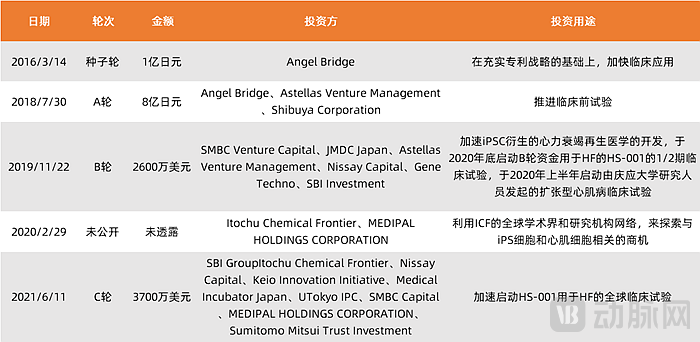
Financing History, compiled based on data from the VCBeat Orange Database
In addition to the continued optimism from investment firms, Heartseed has also garnered favor from pharmaceutical giant Novo Nordisk.
In June 2021, Heartseed and Novo Nordisk announced that they had reached a global exclusive collaboration and licensing agreement regarding the development, manufacturing, and commercialization of Heartseed’s heart failure treatment drug, HS-001.
As disclosed in the agreement, Novo Nordisk holds exclusive global rights to develop, manufacture, and commercialize the core pipeline asset HS-001 outside of Japan; in Japan, Heartseed retains exclusive development rights, with both companies operating under a 50:50 profit-and-cost sharing arrangement. Heartseed is eligible to receive a total ofUp to $598 millionpayment, including a $55 million upfront payment and near-term milestone payments.
Regarding this collaboration, Keiichi Fukuda, Chairman of Heartseed, stated:“We are delighted to establish a partnership with Novo Nordisk, a company renowned for its high level of professionalism and extensive resources, regarding the HS-001 project pipeline. We are also honored by Novo Nordisk’s recognition of our innovation and high potential. This collaboration with Novo Nordisk holds significant importance for advancing Japanese regenerative medicine onto the global stage.”
Marcus Schindler, Chief Scientific Officer and Senior Vice President of Global Drug R&D at Novo Nordisk, stated:“We aim to collaborate with Heartseed to design novel therapeutic solutions for patients with cardiovascular disease. We have achieved innovative clinical outcomes, developed foundational technologies, and accumulated deep expertise in the fields of iPSC biology and cardiac cell transplantation. In the future, Heartseed can leverage our knowledge and capabilities in stem cell biology and manufacturing. Cardiovascular disease is a leading cause of death globally, and this transaction aligns well with our strategic focus on the cardiovascular disease sector.”
Five Steps to Facilitate the Industrialization of iPSC Therapies,
Core Pipeline Has Entered Phase I/II Clinical Trials
Why Has Heartseed Garnered Support from Major Institutions? Let’s Take a Look at Its Unique Advantages.
In terms of R&D methodology, Heartseed is markedly different.Heartseed induces iPSCs to selectively generate a large number of cardiomyocytes, which are then assembled into “cardiomyocyte spheroids” (each comprising approximately 1,000 cardiomyocytes) for transplantation into cardiac tissue. Through its proprietary purification method (patented), the company removes undifferentiated and non-cardiomyocyte cells, thereby minimizing the risks of tumorigenicity and arrhythmia.
This method has confirmed that cardiomyocytes derived from iPSCs engraft into cardiac tissue at a high rate, with further growth of the engrafted cells leading to significant improvement in actual cardiac function. Following effective engraftment into the host myocardium, these differentiated cardiomyocytes are expected to contribute to the long-term improvement of cardiac function in patients with heart failure.
Among the numerous technologies associated with cardiac regenerative medicine, the transplantation method for differentiated cardiomyocytes is a critical factor determining therapeutic efficacy. Transplanted regenerative cardiomyocytes are expected to survive effectively within the patient’s myocardium for an extended period, thereby contributing to the long-term improvement of cardiac function in patients with heart failure.
Transplantation methods are broadly classified into two types: cell sheet transplantation and direct intracardiac injection.
Cell sheet transplantation is considered the easiest transplant method with a lower burden on patients during transplantation. However, in cell sheet transplantation, due to the presence of epicardium and fat layers between the left ventricular myocardium and the transplanted cell sheets, there is no electrical coupling between the recipient heart and the graft. This leads to the possibility that host myocardial cells and transplanted cardiomyocytes cannot contract synchronously, as well as difficulties in long-term survival of the cells, thereby affecting efficacy. In contrast, direct intracardiac injection has been reported to achieve good results in various animal experiments, with differentiated cardiomyocytes directly implanted into the myocardium exhibiting electrical coupling with recipient cardiomyocytes.
Based on the above perspectives, Heartseed’s iPSC industrialization can be broadly divided into five steps:
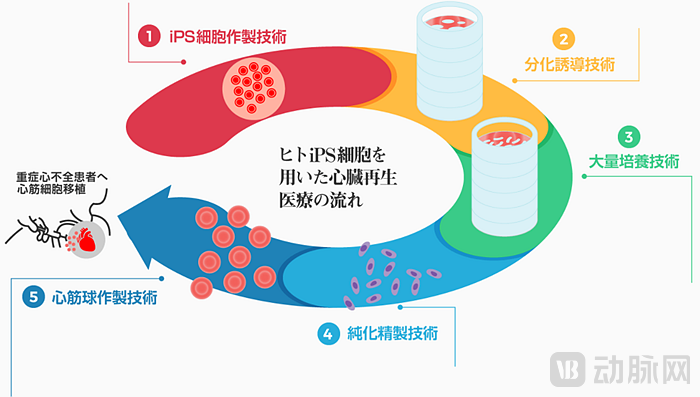 Image source: Heartseed official website
1. iPSC Manufacturing Technology:Like embryonic stem cells (ESCs), induced pluripotent stem cells (iPSCs) possess both differentiation and proliferative capacities; however, differentiation potential varies across cell lines, making it crucial to ensure consistent iPSC quality. Heartseed focuses on H1foo, a linker protein specifically expressed in oocytes. By introducing this gene during iPSC reprogramming, the company has successfully generated high-quality mouse iPSCs, thereby enhancing the efficiency of embryonic development and chimera formation. Currently, Heartseed has partnered with the Center for iPS Cell Research and Application (CiRA) at Kyoto University to validate whether this approach can establish high-quality human iPSCs. Furthermore, most conventional iPSC generation methods involve directly integrating reprogramming genes into the genome after reprogramming adult cells, a process that carries an inherent risk of tumorigenicity. In contrast, Heartseed employs specialized vectors that enable iPSC generation without direct genomic integration of reprogramming genes, thereby minimizing tumorigenic risk.
2. Differentiation Induction Technology:Research findings on cardiac development from numerous companies and institutions, including Heartseed, indicate that the efficiency of differentiating pluripotent stem cells into cardiomyocytes can be significantly enhanced by combining multiple proteins associated with BMP/Activin signaling and Wnt signaling pathways, which are relevant to early heart development. Furthermore, recombinant proteins can be replaced with small-molecule compounds, enabling the production of cardiomyocytes in a more cost-effective and efficient manner. On the other hand, the culture environment is also critical for effectively inducing differentiation into cardiomyocytes. Through collaborative research with other companies, Heartseed has successfully developed a cardiomyocyte differentiation culture medium suitable for clinical applications. When combined with a small-molecule compound-based differentiation induction method, this medium achieves high cardiomyocyte differentiation efficiency.
3. Large-Scale Culture Technology:Unstable proliferation of human induced pluripotent stem cells (iPSCs) remains a key challenge due to uneven culture conditions across layers when using multi-layer culture plates. Heartseed has established a two-dimensional large-scale culture system utilizing multi-layer plates. By implementing a forced aeration system that ensures uniform delivery of oxygen and carbon dioxide to each layer, this approach achieves stable proliferation of human iPSCs, thereby yielding sufficient quantities of differentiated cardiomyocytes for patient transplantation. This method overcomes several limitations associated with three-dimensional culture, including the difficulty in completely removing undifferentiated stem cells, low cell proliferation efficiency, inability to uniformly control cell cluster size, and inconsistent differentiation efficiency into cardiomyocytes.
4. Purification and Cleaning Technology:Undifferentiated iPSCs persist after induction into cardiomyocytes, and their tumorigenicity poses a significant concern when these undifferentiated cells are transplanted into patients. Therefore, prior to transplantation, it is essential to eliminate undifferentiated cells that may lead to tumor formation and purify the cardiomyocyte population. Previously, the mainstream approach involved using fluorescence-activated cell sorting (FACS) to isolate individual cells and recover cardiomyocytes. However, by conducting a detailed analysis of the energy metabolism of iPSCs and cardiomyocytes, Heartseed has developed a specialized culture medium that enables the removal of undifferentiated cells and the recovery of large quantities of cardiomyocytes in a cost-effective and straightforward manner.
5. Myocardial Spheroid Manufacturing Technology:When purified cardiomyocytes are transplanted into cardiac tissue, Heartseed has observed low engraftment survival rates. To address this, Heartseed developed a “cardiomyocyte sphere” approach, in which each sphere aggregates approximately 1,000 cardiomyocytes for transplantation into cardiac tissue. This method enables iPSC-derived cardiomyocytes to achieve high survival rates within cardiac tissue. Following engraftment, the cardiomyocytes continue to mature and grow, significantly improving actual cardiac function. Furthermore, Heartseed has developed a specialized delivery device for transplanting cardiomyocyte spheres and established a cell transplantation system that operates independently of operator skill, thereby reducing the technical burden on surgeons. This innovation is expected to play a crucial role in ensuring consistent therapeutic outcomes after cell transplantation and facilitating the widespread adoption of this therapy.
Based on the aforementioned technologies, Heartseed currently has HS-001 in its development pipeline.
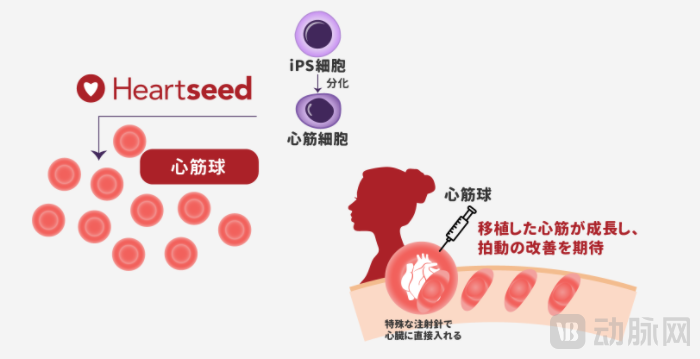 Image source: Heartseed official website
HS-001 is an experimental cell therapy developed by Heartseed, Inc., consisting of purified cardiomyocytes derived from induced pluripotent stem cells (iPSCs).Its indications include heart failure with reduced ejection fraction (HFrEF), such as dilated cardiomyopathy (DCM), old myocardial infarction (OMI), and dilated-phase hypertrophic cardiomyopathy (D-HCM). This therapy safely and effectively injects cardiomyocyte spheroids into the myocardium using a specialized injection needle. The transplanted cardiomyocytes electrically couple with the patient’s native myocardium, enhancing cardiac output through remuscularization and promoting angiogenesis by secreting angiogenic factors to form new blood vessels around the transplantation site.
In March 2021, Japan’s Pharmaceuticals and Medical Devices Agency (PMDA) successfully completed its review of the Phase I/II clinical trial (LAPiS trial) evaluating the safety and efficacy of HS-001 for heart failure caused by ischemic heart disease in Japan. In June 2021, after closing a JPY 4 billion Series C financing round, Heartseed accelerated the global clinical development of HS-001 for heart failure, building on the proof-of-concept established in the Japanese LAPiS Phase I/II study, to assess the safety and efficacy of HS-001 in patients with severe heart failure due to ischemic heart disease.
In addition to HS-001, Heartseed is collaborating with other companies to investigate simpler and more feasible injection methods, such as transendocardial injection via catheter.
Keio University, the first institution of higher education in Japanese history. More than one-tenth of the presidents of publicly listed companies in Japan are graduates of Keio University, earning it the reputation as the “Cradle of Entrepreneurs” in Japan.
Keio University, widely hailed as Asia’s premier private institution of higher learning, has earned widespread acclaim across various sectors for its medical school’s rigorous academic foundation and pragmatic research approach. We look forward to the entrepreneurial success of this Keio University professor, who is over 60 years old, in leveraging iPSC-based regenerative medicine to save patients with heart failure.
China has also achieved relevant results in the field of iPSC-derived therapies for heart failure. In 2020, Nature reported on the world’s first human study of iPSC cell therapy for end-stage heart failure, jointly conducted by Alpha Regenerative Medicine and Nanjing Drum Tower Hospital.
As the first company in China to leverage induced pluripotent stem cell (iPSC) technology for the research, development, and production of cell therapies, Aierpu Regenerative Medicine has demonstrated that its iPSC-derived cardiomyocyte therapy exhibits both excellent efficacy and safety in treating severe heart failure, based on 24-month follow-up data from three patients in the aforementioned clinical trial.
We look forward to the day when heart failure, a major disease, can be effectively treated thanks to the rise of emerging technologies such as iPSCs.