

The Next Decade’s Trillion-Dollar Goldmine: Entry Points into China’s Booming Elder Care Market
In 2020, China’s birth rate fell below 10 per thousand for the first time; however, 60 years earlier, the country was experiencing its “second baby boom” since the founding of the People’s Republic of China, with a birth rate as high as 43.6 per thousand, a death rate dropping below 10 per thousand, and an average annual natural population growth rate reaching 27.5 per thousand. From 1962 to 1972, China saw an average of 26.69 million births per year, totaling 300 million newborns over the decade.
Sixty years on, the former “baby boom” has become today’s “senior surge.” In the decade ahead, starting from 2022, nearly 300 million people in China will sequentially enter old age at 60. This cohort of “newly elderly” has accumulated substantial wealth, boasting stronger consumption power and economic strength, higher expectations for quality of life than previous generations, and a greater willingness to pay for elderly care services.
Rising consumer spending power has created new opportunities for the elderly care service industry. According to estimates based on data from iiMedia Research, China’s elderly care industry reached a scale of RMB 8.78 trillion in 2021. Within this, the elderly care services market accounts for the largest share. Focusing solely on the 40 million elderly individuals with disabilities or dementia as the target population for calculation, China’s “essential-demand” elderly care services market alone has exceeded RMB 2 trillion.
“Maslow’s Hierarchy of Needs” categorizes human needs into five levels, from bottom to top: physiological (food and clothing), safety (job security), social (love and belonging), esteem, and self-actualization. Maslow posited that lower-level needs exert greater influence and possess greater potential; furthermore, lower-level needs must be satisfied before higher-level needs can emerge.
If mapped onto the five-tier hierarchy of needs, at which level does elderly care fall? In reality, elderly care is a multi-layered need that encompasses physiological, safety, social, and dignity-related requirements. The diversification of elderly care needs has given rise to a vast elderly care industry.
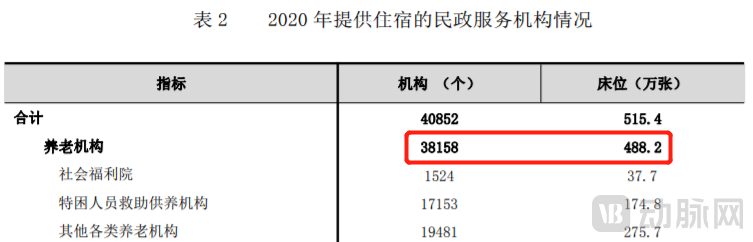
According to the Seventh National Population Census, as of November 1, 2020, China’s population aged 60 and above reached 264.02 million, accounting for 18.7% of the total population. Correspondingly, there are currently 38,000 elderly care institutions of various types across the country, with a total of 4.88 million nursing beds. Despite the apparent shortage of supply relative to demand, the actual vacancy rate is as high as 50%. Based on this figure, the true penetration rate of elderly care institutions among the senior population (aged 60 and above) is less than 1%.
From the perspective of the target population, older adults can be categorized into active seniors and disabled seniors (including those with dementia). In reality, elderly care needs vary across these different groups. Therefore, it is biased to rely solely on nursing home occupancy rates as a consistent indicator of the elderly care demands of the overall older adult population. In fact, elderly care needs differ among older adults of varying age groups and health statuses.
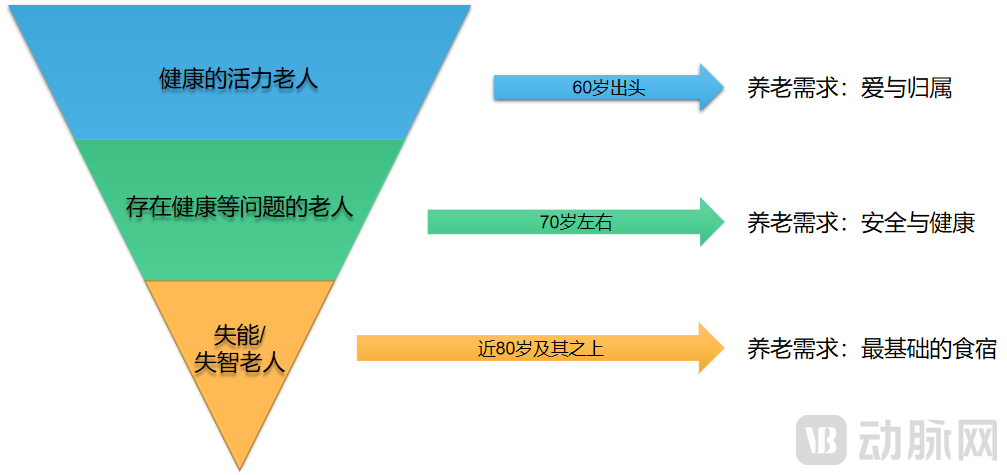
Diverse Elderly Care Needs Across Different Health Statuses (Graphic by VCBeat)
For example, elderly individuals with health issues, or even those who are disabled or suffering from dementia, have safety needs that primarily include protection from threats to personal safety, stability in daily life, avoidance of pain and disease, as well as psychological and mental health support. When the safety needs of older adults are not adequately met, their focus inevitably centers on these security concerns. Consequently, many elderly people exhibit strong subjective demand for medical and healthcare services, which has fueled the growth of the health supplement market, with seniors often being the primary consumers of such products.
Next, let us examine social needs (love and belonging). In addition to deriving love and a sense of belonging from family members, active seniors also need to engage in social interactions to achieve a higher level of recognition and avoid becoming disconnected from society. Consequently, senior universities have emerged in recent years, offering interest-based courses in areas such as health, cooking, and the arts. By addressing the love and belonging needs of the elderly population, these institutions have gained significant market popularity, with enrollment demand so high that seats are often scarce.
It is evident that elderly individuals across different age groups have varying needs for elder care services. Only those services that address the genuine “essential needs” of seniors can stimulate their willingness to pay.
Elderly care services encompass a wide range of offerings, such as in-home meal preparation for seniors living alone, assistance with household chores, and regular follow-up visits to monitor their physical and mental well-being. Based on different care scenarios, these services are broadly categorized into home-based care, community-based care, and institutional care. Wang Haidong, Director of the Department of Elderly Health under the National Health Commission, previously outlined China’s “9073” elderly care framework at a press conference: approximately 90% of Chinese seniors receive care at home, 7% utilize community-based services, and 3% reside in institutional facilities.
Among these three categories of elderly care services, those requiring consumer-side (C-end) payment include certain medical and health services for the elderly and some elderly care and nursing services. For instance, in home-based elderly care services, meal delivery, housekeeping, and caregiving services are typically paid for by the elderly person’s family. In some cases, third-party elderly care service providers introduced through government investment promotion may also offer home- or community-based elderly care services under an embedded care model.
“Embedded elderly care model” refers to the provision of elderly care and support services within the communities where seniors reside, allowing them to enjoy their later years without leaving home for specialized institutional care facilities. Drawing on successful international experiences in elderly care, China has been actively promoting community-based embedded elderly care in recent years, with its first implementation launched as early as 2013 in Zhuanqiao Town, Minhang District, Shanghai.
For example, Tianyu Elderly Care has collaborated with local governments to establish integrated systems spanning home-based, community-based, and institutional care in Shanghai, Jiangsu, Anhui, Shandong, Hubei, Henan, Guangxi, Shaanxi, Sichuan, and other regions. These systems include embedded elderly care service models that leverage digital tools and a terminal network composed of thousands of elder-care assistants to deliver high-quality health and wellness services to millions of seniors. In 2021, the company secured Series A financing led by Hillhouse Capital, with participation from Changling Capital and Wanwu Capital.
Wan Qinjing, Senior Director of the Tianyu Elderly Care brand, told VCBeat that the company’s elderly care services have achieved diversified payment models. While government funding remains the primary source, other payment channels such as insurance and real estate have also been implemented. Currently, the proportion of out-of-pocket payments by individuals remains relatively small.
This model can meet the safety and social needs of most active seniors. However, for healthy active seniors, if only home-based care or housekeeping services are provided, the rigidity of their demand is not significant, leading to a lower willingness to pay among consumer-end users. Conversely, for elderly individuals with dementia or disabilities, community-based elderly care alone is far from sufficient; what is needed more at this stage is professional elderly care institutions integrating medical and nursing services to provide comprehensive care.
As mentioned above, the needs of elderly individuals vary depending on their health status. For those with dementia or disabilities, their most fundamental physiological needs—such as food and clothing—are the most rigid, making them the group most in need of professional elderly care services. The social phenomenon where “one person’s disability throws the entire family off balance” is commonplace; indeed, it has been said that “true elderly care begins when disability sets in.”
According to the “2018–2019 China Long-Term Care Survey Report,” approximately 4.8% of older adults in China have severe disabilities in activities of daily living (ADLs), and 7% have moderate disabilities, resulting in an overall disability rate of 11.8%. The decline in basic self-care abilities is accompanied by a deterioration in independent living capabilities, with 25.4% of older adults requiring comprehensive care, thereby giving rise to a massive elderly care market valued at one trillion yuan.
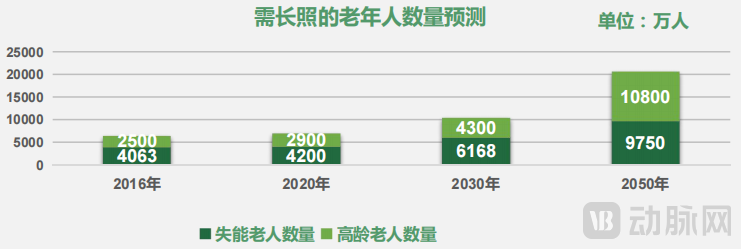
As early as 2016, the Chinese government emphasized that “improving the quality of elderly care services is crucial to the well-being of over 200 million seniors, particularly the more than 40 million who are disabled or partially disabled, and also affects the work and personal lives of their children; it is a significant issue bearing on people’s quality of life.” Indeed, disabled and partially disabled seniors represent the segment with the most pressing demand within the elderly care industry, where needs for daily living assistance and medical nursing have consistently been high-frequency and essential.
Currently, many elderly care institutions still adopt a model that separates medical care from eldercare. Although these facilities are equipped with medical amenities, they operate independently of residential eldercare units. This arrangement proves highly inconvenient for disabled and dementia-afflicted seniors who require recurrent treatment, as they must shuttle back and forth between eldercare institutions and medical facilities. According to statistics from the VCBeat Orange Database, third-party eldercare service resources in China specifically dedicated to integrating medical and eldercare services for disabled and dementia-afflicted seniors remain scarce. The integration of medical and eldercare services organically combines medical resources with eldercare resources, merging daily living assistance with rehabilitative care.
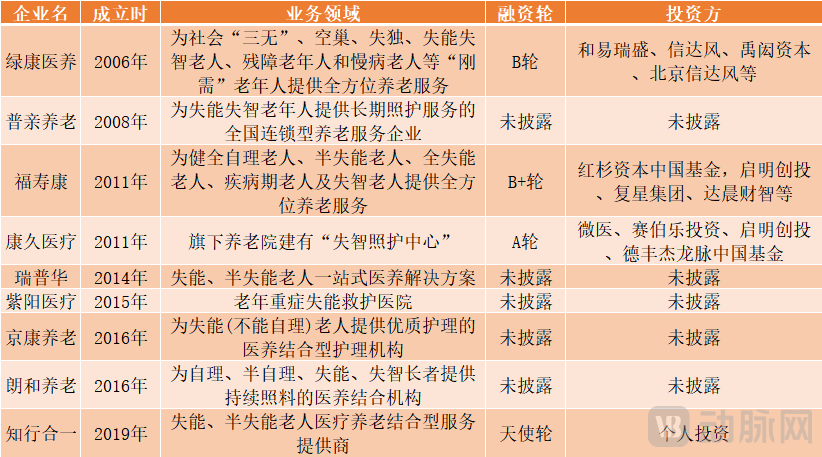
Domestic Enterprises Focusing on Elderly Care Services for the Disabled and Dementia-Affected Population
(Note: Data are compiled from public sources. Companies with inaccurate data or those not included are welcome to contact VCBeat for further discussion.)
As can be seen from the above information, the fastest progress in financing is currentlyFushoukang(Shanghai) Medical Elderly Care Services Co., Ltd. secured a Series B+ financing round amounting to hundreds of millions of RMB in 2021, led by Sequoia Capital China Fund. Established in 2011, the company claims to be China’s largest home-based medical and elderly care service platform. It offers a one-stop, closed-loop service platform that covers the full spectrum of needs and the entire life cycle of elderly individuals, including those who are independent, semi-disabled, fully disabled, in acute disease phases, or living with dementia. Its services encompass professional daily care, medical nursing, specialized nursing, special-needs nursing, rehabilitation guidance, and professional dementia care.
Zhejiang Lukang Medical and Elderly Care Group Co., Ltd. (hereinafter referred to as:Lvkang Medical & Elderly CareGroup) is a specialized group company based in Hangzhou, Zhejiang Province, characterized by its public-private partnership model and integration of medical care with elderly care. Its core business focuses on the investment, operation, and management of elderly care and geriatric rehabilitation nursing institutions, while also covering the entire industry chain of aging health. The company primarily provides comprehensive services—including basic medical care, geriatric rehabilitation, rehabilitative nursing, long-term care, and hospice care (palliative care)—to elderly individuals with urgent needs, such as those who are “three-no” seniors (with no family support, no income, and no ability to work), empty-nesters, bereaved parents who have lost their only child, seniors with physical or cognitive disabilities, disabled elderly individuals, and those suffering from chronic diseases.
Kangjiu MedicalKangjiu Tianyi Nursing Home has established a “Dementia Care Center,” implementing an integrated medical and elderly care model to provide comprehensive health services for the elderly. These services, which encompass daily living assistance, diagnosis and treatment, healthcare, psychological support, emergency rescue, and hospice care, are designed for seniors with disabilities, those with partial disabilities, individuals with dementia, and certain self-care residents.
Coincidentally, Zhuhai CityUnity of Knowledge and ActionThe Health Industry Co., Ltd. has also pioneered the “Medical and Elderly Care Center” (Integrated Medical and Elderly Care Center), which provides specialized integrated medical and caregiving services for disabled elderly individuals. Currently, the company has established six such centers. The project primarily collaborates with public hospitals across China, and the company plans to complete its layout in 19 provinces within three years, establishing 100 Medical and Elderly Care Centers.
Meanwhile, anotherZiyang MedicalNamely, Ziyang (Beijing) Hospital Management Co., Ltd., which focuses onCompany in the Field of Emergency Care for Severely Disabled ElderlyEstablished in 2015 and formerly known as Linhai Ziyang Geriatric Hospital Co., Ltd., the company specializes in operating hospitals for critically ill and severely disabled elderly patients, as well as in the research and development of elderly care products. It has established a professional chain of hospitals dedicated to critical care for the severely disabled, creating specialized services such as “Open ICUs” tailored to the elderly population.
If we isolate the “essential-demand” segment among China’s 260 million elderly population—those who truly need to move into eldercare institutions—there are approximately 40 million disabled seniors who require dedicated, one-on-one care. However, even within this seemingly essential-demand group, the penetration rate for admission to professional eldercare facilities remains below 10%. Where have the remaining 30-plus million disabled seniors ended up? Why have they not entered specialized eldercare institutions?
“High-quality, low-cost public nursing homes have a ‘ten-year wait for a bed,’ while private nursing homes are prohibitively expensive and truly unaffordable.” This glimpse into the reality comes from the response of a family member of an elderly person with disabilities. Most disabled seniors who do not receive care in professional institutional settings remain at home, under the care of close relatives or hired caregivers.
Relevant data indicate that the current monthly fees for public nursing homes in China range from RMB 1,500 to RMB 3,000, while those for private nursing homes typically range from RMB 5,000 to over RMB 10,000. These expenses are primarily covered by the elderly’s personal pensions and partial financial contributions from their children. According to the 2020 Statistical Bulletin on the Development of Human Resources and Social Security, there were 127.62 million retirees participating in the employee basic endowment insurance scheme in 2020, with an average monthly pension of RMB 3,350 per person. Regional disparities in pension benefits fluctuate by approximately RMB 1,000, resulting in a national average pension range of RMB 2,000 to RMB 5,000.
Pensions can cover the cost of public nursing homes, and the state is vigorously expanding the number of beds in such facilities. However, it is worth noting whether the traditional care services provided by public nursing homes can meet the basic needs of disabled elderly individuals; the answer remains debatable.
Luo Zhilin, Chief Advisor of Zhuhai Zhixingheyi Health Industry Co., Ltd., stated, “For disabled elderly individuals with essential needs, what they require is not only custodial care in institutional settings but also medical and nursing services. Without professional integration of medical and elderly care, the current supply and demand are mismatched, failing to provide the necessary medical and nursing care to these disabled elderly residents in elderly care institutions who have such essential needs.”
However, the high pricing of private elderly care institutions presents another challenge. It is understood that most public elderly care facilities generally set their fees in direct alignment with local rates for domestic caregivers. Yet, this price level not only exceeds the pensions of most seniors but also fails to strongly motivate the majority of frugal elderly individuals to voluntarily enter such facilities. This indicates that while there is a rigid demand among disabled seniors for integrated medical and elderly care services, the root of the problem lies in addressing the pain point of high costs at private nursing homes.
In 1970, Japan entered an aging society. With the intensification of population aging and the sharp increase in pension pressures, Japan introduced the Long-Term Care Insurance System in 2000. This social insurance system pools funds through mutual social assistance to provide services or financial support for basic daily care and medical nursing closely related to daily living for individuals with long-term disabilities who have been assessed as meeting specific levels of care needs.
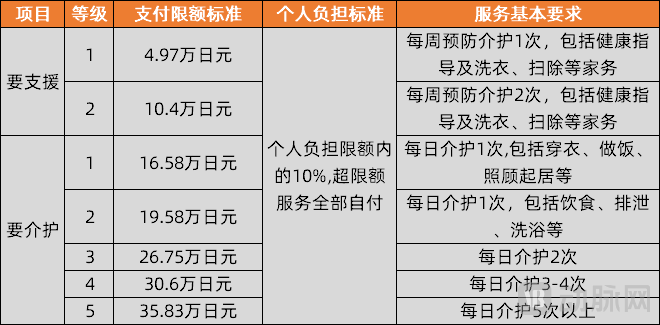
Japan’s “Long-Term Care Insurance Act”
Japan’s Long-Term Care Insurance Law requires citizens to begin paying long-term care insurance premiums at age 40. It provides care and nursing services to elderly individuals aged 65 and older who require assistance, as well as to residents aged 40 to under 65 who need care due to specified diseases. Under this system, seniors are required to cover only 10% of long-term care costs, thereby gaining access to comprehensive coverage under the long-term care insurance scheme. This insurance directly addresses the payment challenge for elderly care services in Japan and has become a core factor enabling profitability among Japanese elderly care institutions. Consequently, long-term care insurance serves as the cornerstone of the operation of Japan’s elderly care industry system.
Upon returning to China, on December 21, 2021, the General Office of the Shanghai Municipal People's Government issued the "Shanghai Long-Term Care Insurance Pilot Measures," establishing a long-term care insurance system to safeguard the basic nursing needs of individuals with disabilities.
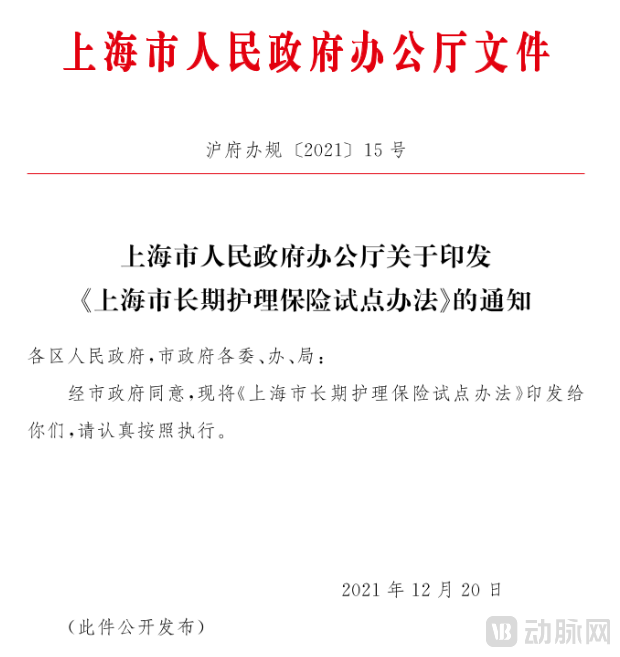
According to the notice on the Shanghai pilot program, 80% of the eligible assessment fees incurred by long-term care insurance participants when applying for long-term care insurance benefits shall be covered by the Long-Term Care Insurance Fund. This has significantly alleviated the financial burden on disabled elderly individuals entering designated care service institutions, effectively addressing their existing payment challenges. It also provides sufficient funding support for the healthy and sustainable operation of elderly care institutions, thereby maximizing the resolution of elderly care issues.
Previously, the state had been actively promoting the implementation of long-term care insurance. As early as 2016, it designated 15 regions, including Nantong in Jiangsu Province, Qingdao in Shandong Province, and Changchun in Jilin Province, to pilot the long-term care insurance system. China’s efforts to promote commercial long-term care insurance have never ceased.
We have witnessed the state’s proactive strategic planning and continuous improvement of the elderly care service industry. Insights from Japan’s elderly care model also reveal potential directions for the future development of China’s senior care sector. By addressing the rigid demands of the aging population, providing dedicated services to seniors, and enhancing their quality of life, we can ensure that all elderly people in China enjoy a secure and dignified later life. Supporting the elderly is, in essence, supporting our future selves.