

How Pharma Brands Can Master Digital Marketing: Insights from Dayima App, China's Leading Women's Health Platform
"Amid the forward momentum of the times and intensifying industrial transformation, the big health industry has emerged as a sector with immense potential. It is poised to surpass the real estate and automotive industries, becoming the primary engine of national economic growth."The “Healthy China” strategy clearly states that by 2030, the total scale of the health service industry will reach RMB 16 trillion. This presents significant development prospects for companies in the broader health sector.
As living standards improve in the modern era, demand for health services is growing. In recent years, online consultations, smart healthcare, and pharmaceutical e-commerce have given people a first taste of the convenience offered by emerging medical services. It is precisely with the support of internet and big data technologies that innovation in pharmaceuticals and healthcare has begun to thrive.
A Decade of Mobile Internet: Connecting Hundreds of Millions of Users on a Unified PlatformAs China's first menstrual health management platform for women, the Dayima App has served over 100 million female users.The acquisition of user traffic and the aggregation of demand provide a technological foundation and convenience for pharmaceutical and health industry companies to connect with users and gain insights into their needs.
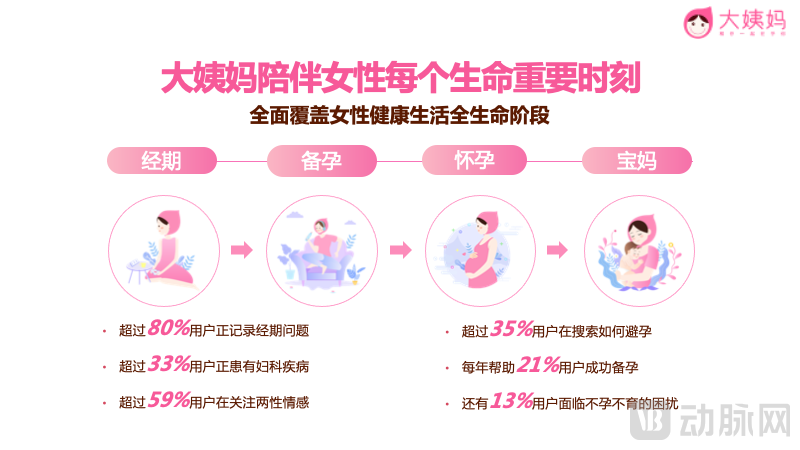
Users’ needs are diverse and complex. In the realm of women’s health, these needs vary across different life stages, such as menstruation, preconception, pregnancy, and postpartum care. During menstruation, women may experience issues like dysmenorrhea and menorrhagia; during the preconception phase, there are demands for disease screening and assisted reproductive technologies, among others.
The health industry sector is also highly complex, encompassing hospitals and medical institutions, pharmaceutical manufacturers, health consumer goods brands, medical services focused on reproductive health, and physicians who disseminate health knowledge...
How to perfectly match user needs with industry supply is the direction that the Dayima App continues to explore.In the process of advancing refined health management and integrating upstream and downstream resources within the pharmaceutical and healthcare industries, the initial “traffic platform” is becoming deeply embedded in the pharmaceutical and healthcare industry chain. It integrates fragmented medical, pharmaceutical, and health care sectors into a cloud-based intelligent platform, converging the entire big health ecosystem—including hospitals, pharmaceutical companies, health supplement manufacturers, and e-commerce platforms—to achieve cross-sector integration and a seamless closed loop.
On user-centric mobile internet platforms, users’ immediate needs serve as the starting point for services, with specific needs triggering targeted health education, product recommendations, and medical solutions, thereby achieving refined and intelligent health management.
First, internet platforms can provide diagnostic and treatment services.Addressing common women's health concerns, thousands of authoritative physicians from China’s top-tier (Grade 3A) hospitals provide diagnostic and treatment services on the Dayima App. In recent years, acceptance of online interactions between doctors and patients has increased. The establishment of telemedicine, online communication, and virtual consultation platforms is bridging the gap with offline clinical services and alleviating some of the pressure on physical healthcare institutions.
In addition to the diagnosis and treatment process,Health consumer products and the pharmaceutical industry are also key participants in the broader health industry.Collaboration between pharmaceutical companies and internet platforms can facilitate online brand promotion and enable the accumulation of product data.
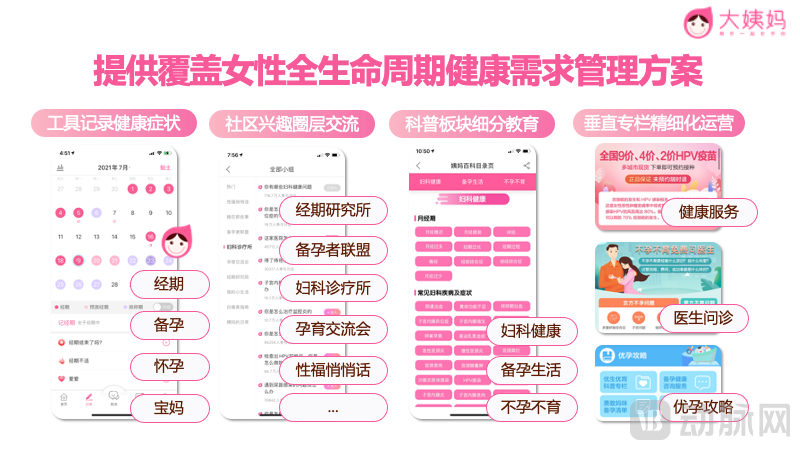
Pharmaceutical companies are facing a fiercely competitive and rapidly changing market.On one hand, as pharmaceutical companies rapidly expand their reach into lower-tier markets, relying solely on traditional offline marketing models has encountered numerous challenges, necessitating the development of a precision marketing platform tailored to user needs. On the other hand,To achieve differentiated competition, pharmaceutical companies need to provide value-added services beyond medications, integrate resources from multiple parties, and reshape their brand positioning and image.
In 2021, the Dayima App and Beijing Tongrentang, a century-old pharmaceutical enterprise, embarked on a new journey combining traditional Chinese medicine with online dissemination. Through expert-led scientific popularization, influencer testimonials, precise recommendations via search interception, and high-traffic exposure placements, this collaboration successfully achieved brand building, reputation enhancement, and significant traffic diversion. Tongrentang’s Wujibaifeng Wan (Black Chicken White Phoenix Pills) and Wuzi Yanzong Wan (Five-Seed Progeny Pills) became focal points of discussion, gaining popularity among women preparing for pregnancy and those seeking menstrual regulation.
Focusing on “female dysmenorrhea,” Haoyisheng Group collaborated with the Dayima App to efficiently aggregate traffic related to “dysmenorrhea” through a combination of premium ad placements, including targeted tag-based advertising and search recommendations. By employing diverse content marketing strategies such as customized content, promotional campaigns, and expert live streams, the partnership enhanced brand exposure and drove sales conversion for Haoyisheng’s Dan’e brand, ultimately alleviating dysmenorrhea for many women.
“Three-Child” Fertility Policy Launches, Elevating the Concept of Eugenic and Healthy Childbearing; Preconception Care and Reproductive Medicine Emerge as Growth Markets. Preconception care and reproductive medicine constitute a highly specialized market with deeply personalized services, making broad-reach, high-volume exposure strategies unsuitable for marketing these companies.
The Dama Yi App has collaborated with brands such as Jinxin Fertility, Elevit, and Jinxiuer to plan numerous public welfare initiatives. During the Mother’s Day campaign co-hosted by the Dama Yi App and Jinxin Fertility, hundreds of mothers shared their real-life experiences with preconception preparation, fostering peer-to-peer communication and promoting knowledge about eugenics, healthy reproduction, and assisted reproductive technologies. For Jinxin Fertility, this initiative provided access to potential users and facilitated brand upgrading.
Furthermore,"Home delivery of products and door-to-door services represent the final link in closing the service loop for internet platforms."The Dayima App, in partnership with Meituan Medicine and chain pharmacies, has customized an Online-to-Offline (O2O) marketing model for the Yasmin brand, providing pharmaceutical companies with tailored home delivery services.
Amid the widespread adoption of the holistic health concept and a general rise in health awareness, prevention-oriented strategies and early intervention have elevated maternal and child healthcare as well as disease prevention and control to a status equally important as disease treatment. This is particularly critical for women’s health, where gynecological screening and preventive care play an indispensable role.
As a women’s health management platform, daily health records and search feedback from users create conditions for early screening, detection, and diagnosis of potential diseases. Furthermore, based on insights derived from user data, the Dayima App places particular emphasis on conveying information about cervical cancer prevention and precautions related to HPV vaccination.
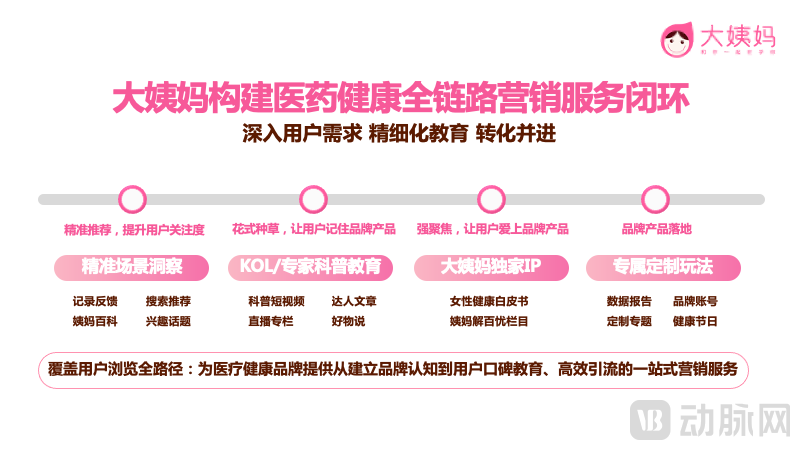
Currently, medical and health institutions are accelerating their transition from a "disease-centered" approach to a "people's health-centered" model.Health education and health promotion initiatives have been incorporated into the hospital’s development strategy, and health science popularization efforts will become part of the criteria for professional title evaluation and promotion assessments for medical staff.Internet platforms have become a strong foothold for health science popularization.
The Dayima App, in partnership with the China Health Promotion Foundation and Bayer, a global pharmaceutical giant ranked among the Fortune 500, jointly launched a public welfare initiative focused on menstrual health for Chinese women. This initiative establishes a distinctive closed-loop pharmaceutical marketing strategy encompassing “disease identification, disease awareness, and improved healthcare-seeking behavior.” Concurrently, in collaboration with the China Primary Health Care Foundation, it initiated a public science popularization project on women’s reproductive health. The project invites over 1,000 renowned obstetricians and gynecologists nationwide to provide authoritative and practical educational content for women affected by various menstrual disorders in the post-pandemic era, thereby assisting them in self-identification and management of these conditions.
The internet-based and video-driven dissemination of health science popularization content has expanded its reach and lowered the barrier for the general public to access professional knowledge.Real-time interactive video live streaming has also enhanced the interactivity of health education. The improvement in collective awareness is strengthening doctor-patient communication, thereby jointly advancing reproductive health and eugenics.
User acquisition on internet platforms has opened a window for the digitalization of the pharmaceutical and health industries. Refined user operations on these platforms, coupled with the in-depth development and application of platform data, have become the breakthrough point for industrial digital transformation. Technology enterprises have emerged as the most dynamic drivers of technological innovation, leading the deepening digitization and intelligentization of the industry.
Leveraging a vertical female user base, the Dayima App employs strategies such as “data + high-quality UGC/KOL accumulation + e-commerce traffic redirection” to provide brands with full-funnel marketing services, spanning from brand exposure and product promotion to sales conversion.
For brands, data-driven precision marketing has become the mainstream approach. By conducting research on user behavior based on brand needs and effectively analyzing users’ basic attributes, content preferences, interest profiles, and community behavioral pathways, brands can receive more optimized recommendations for marketing decision-making.
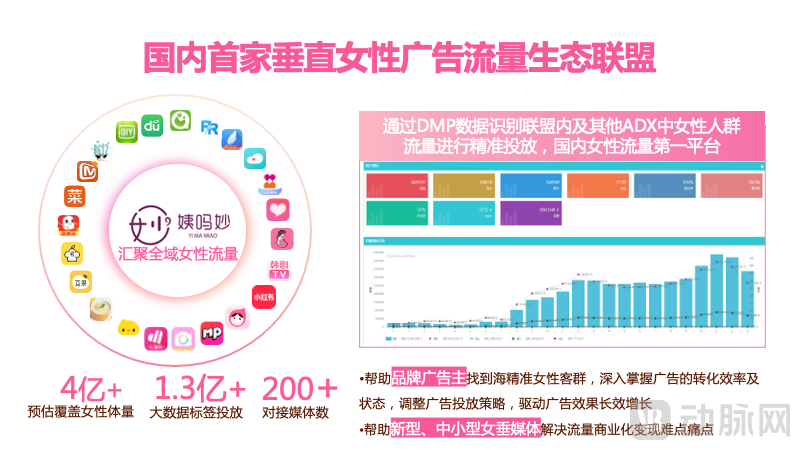
In addition to operating and developing on-platform traffic, the Dayima App aggregates other emerging small and medium-sized vertical internet platforms for women, launching a vertical female advertising traffic ecosystem alliance called “Yi Ma Miao.” This female traffic alliance is estimated to cover 400 million women and connect with over 200 media partners, helping brands identify precise female customer segments, gain in-depth insights into ad conversion efficiency and status, adjust advertising delivery strategies, and drive sustained long-term growth in ad performance.
Leveraging its specialized community platform and robust big data mining capabilities, the Dayima App has gained the ability to export industry data.Over the past eight years, the Dayima App has continuously released annual big data reports on women’s health. By examining contemporary women’s attitudes, perspectives, behaviors, and consumption trends regarding health, marriage and relationships, childbirth, child-rearing, and careers, these reports provide a macro-level overview of emerging needs and trends in the women’s health sector, offering new guidance and insights for the health industry.
Undoubtedly, user data has become the core asset of the Dayima App, serving as the key “link” connecting the upstream and downstream segments of the pharmaceutical and healthcare industry. However, the digital transformation of the healthcare industry is not an overnight process; it still requires active participation from all stakeholders across the industrial chain. As the level of industry digitalization advances, a new ecosystem for pharmaceuticals and healthcare will emerge in the future.