

Will the Home Testing Boom Reach China? Insights from the FDA's Approval of 14 OTC At-Home COVID-19 Tests
2021 can be regarded as the inaugural year of at-home testing.
That year, as the COVID-19 pandemic raged, overseas regulatory authorities such as the European Union and the U.S. Food and Drug Administration (FDA) approved multiple at-home COVID-19 testing kits to effectively curb the spread of the virus, including products developed by Chinese companies. According to statistics from VCBeat, a total of 14 over-the-counter (OTC) at-home self-testing products for COVID-19 received FDA approval in 2021, comprising 11 antigen tests and 3 molecular tests. Among them, the COVID-19 antigen tests developed by Chinese enterprises ACON Biotech and Andon Health were both approved, with Andon Health experiencing multiple consecutive daily limit-ups on its stock price as a result.
In early 2022, home-based testing continued to accelerate. New Horizon Health’s Helicobacter pylori detection product, Youyouguan®, was approved on January 6, 2022, becoming the first H. pylori test kit suitable for “consumer self-testing.” On January 7, Orient Gene’s COVID-19 antigen self-test kit received FDA Emergency Use Authorization (EUA).
Home-based testing refers to a model where users do not need to visit medical institutions, thereby avoiding long-distance travel and prolonged waiting times for sample collection and testing by healthcare professionals. Instead, users can independently complete the entire process of sample collection, testing, and result retrieval at home, or they may perform sample collection at home and mail the samples to a laboratory for analysis, accessing the results remotely. Multiple test items, including those for COVID-19, influenza, vitamins, male testosterone, HIV, and early cancer screening, have significant potential for application in home-based settings.
Home-based testing offers advantages such as convenience, privacy, contactless operation, freedom from environmental constraints, and conservation of medical resources. These characteristics have allowed home-based testing to shine during the special circumstances of epidemic prevention and control, prompting regulatory authorities in various countries to prioritize it.
COVID-19 self-testing kits have undoubtedly propelled home-based testing forward by a significant leap. Previously heated industry debates surrounding market education, regulatory challenges, and technical bottlenecks now appear poised for accelerated breakthroughs. How has the U.S. home-testing market developed? When will the wave of home-based testing arrive in China? This article reviews the dynamics of the domestic and international home-testing markets in 2021.
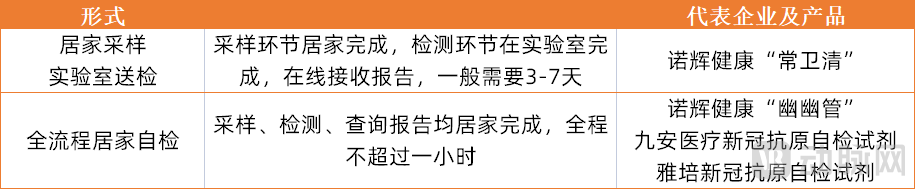
From the perspective of home testing procedures, home testing products can be divided into two categories. One category follows the “home sampling, laboratory testing” model, which is the most prevalent approach in China’s home testing sector. Representative products include New Horizon Health’s colorectal cancer early screening product, “ColoClear.”
Another category is “fully home-based self-testing,” which refers to the entire process of sample collection, testing, and report generation being completed in a home setting, without the involvement of professional medical personnel or the need to visit specialized healthcare institutions. This is considered the most ideal form of home testing and is highly favored by consumers. Best-selling COVID-19 home self-test kits from Abbott and Andon Health both fall into this category.
To control the epidemic and accelerate the widespread adoption of rapid and convenient COVID-19 antigen testing, the FDA has positioned at-home COVID-19 testing as a critical measure. In February 2020, after the U.S. Department of Health and Human Services declared a national public health emergency, the FDA initiated the Emergency Use Authorization (EUA) process to approve applications from in vitro diagnostic manufacturers worldwide seeking to market COVID-19 test kits in the United States.
In November 2020, the FDA approved the first at-home molecular diagnostic test kit for COVID-19, which does not require sample mailing or healthcare professional involvement and can deliver results within 30 minutes.
Subsequently, the U.S. government vigorously promoted the research and development, production, and sales of at-home COVID-19 testing kits, investing billions of dollars to accelerate the Emergency Use Authorization (EUA) application process for related products, rapidly increase manufacturing capacity, reduce kit prices, and distribute them free of charge to the public.
In July 2021, the FDA updated the Emergency Use Authorization (EUA) application process for COVID-19 diagnostic tests, adding for the first time guidance on applications for non-laboratory use diagnostics, including those intended for home, office, school, and point-of-care (POC) settings. In October 2021, the FDA removed the non-laboratory version of the application guidance and introduced a dedicated EUA application guide for molecular and antigen COVID-19 tests intended for home use—“10.6 diagnostic_homeuse_template2.docx”.
In November 2021, the FDA issued revised guidance on regulatory priorities and policies for COVID-19 testing, prioritizing the review of Emergency Use Authorization (EUA) requests for the following types of diagnostic tests: molecular and antigen tests intended for point-of-care testing (POCT) or fully at-home self-testing, with the capacity to rapidly scale up production immediately after EUA issuance; and home specimen collection kits for laboratory-based molecular diagnostic tests, also with the capacity to rapidly scale up production immediately after EUA issuance. This further underscores the FDA’s urgent need for at-home COVID-19 testing kits.
Under the FDA’s active promotion and against the backdrop of normalized pandemic conditions, multiple at-home COVID-19 test kits had received FDA approval by the end of 2021.
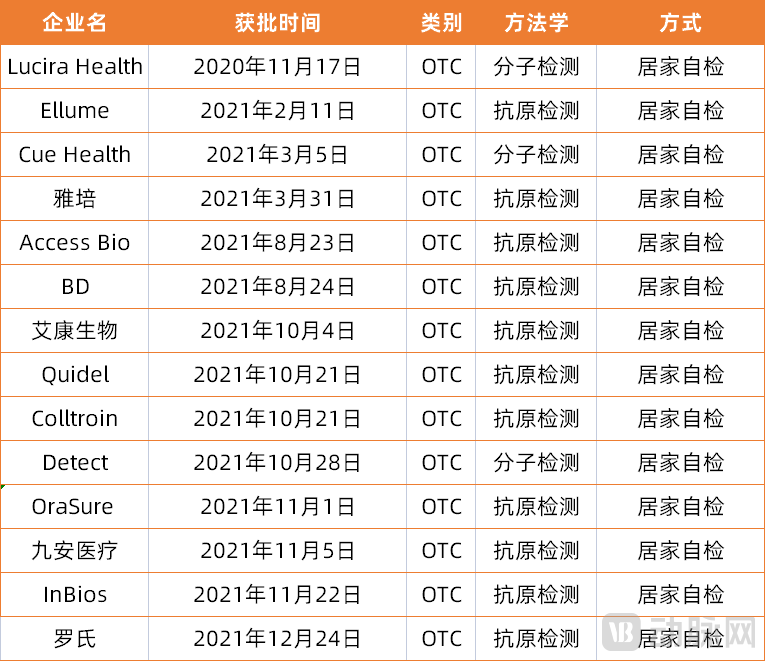
Over-the-Counter At-Home Self-Test Kits for COVID-19 Granted FDA Emergency Use Authorization in 2021
(Source: FDA Official Website)
In 2021, a total of 14 over-the-counter at-home self-test kits for COVID-19 received FDA approval, including three molecular testing products and 11 antigen testing products.
The three approved molecular home self-test kits for COVID-19 utilize isothermal amplification technology. Molecular testing offers high accuracy and is regarded as the “gold standard” for SARS-CoV-2 detection. Previously, nucleic acid testing for COVID-19 could only be performed in laboratories. The COVID-19 nucleic acid test kits developed by Cue Health, Detect, and Lucira Health have pioneered end-to-end home self-testing, marking a significant technological breakthrough in home-based molecular diagnostics.
However, market feedback indicates that at-home self-test kits for COVID-19 based on molecular diagnostics have underperformed. Molecular testing is time-consuming, requiring 30 minutes to an hour, whereas antigen testing takes only 15 minutes or even less. Furthermore, molecular tests are expensive, priced between $50 and $100, while antigen tests can cost as little as a few dollars. Consequently, molecular diagnostic products lack competitiveness in the at-home testing market.
In summary, the focus of at-home COVID-19 testing is on mass screening; therefore, antigen testing is more suitable for home settings, enabling rapid, low-cost identification of suspected cases. Molecular testing, by contrast, is better suited for laboratory settings, where it can be used for targeted screening to further evaluate suspected cases.
In terms of sales channels, approved COVID-19 self-test kits are categorized into over-the-counter (OTC) and prescription-only types. OTC COVID-19 self-test products face fewer restrictions, have broader application scenarios, reach a larger audience, and achieve higher market penetration.
In addition to at-home self-testing kits for COVID-19, the FDA has also approved several at-home sample collection kits that require laboratory analysis.
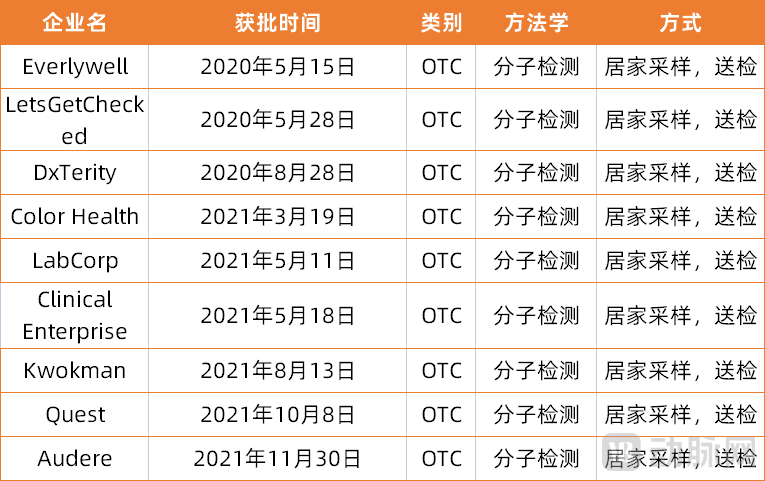
Some COVID-19 test products authorized by the FDA for emergency use that adopt the “home sampling, laboratory testing” model
(Source: FDA Official Website)
The booming trend of at-home self-testing overseas has propelled several companies to prominence, such as Cue Health, which successfully went public in 2021, and Quidel, which acquired Ortho Clinical Diagnostics in late December.
The overseas market for at-home COVID-19 testing is also regarded as the second half of the game for Chinese IVD companies.
In China, the trend toward hyper-competition in the in vitro diagnostics (IVD) sector is becoming increasingly pronounced, while vast opportunities remain to be tapped in overseas markets. Statistical data from securities firms indicate that the population of countries that have approved home-based testing approaches nearly 800 million, making this massive market a new growth engine for Chinese IVD companies.
In the U.S. market, two Chinese companies have received approval for their at-home self-test kits for COVID-19: ACON Biotech and Andon Health.
In October 2021, Flowflex, developed by ACON Biotech, became the first COVID-19 antigen self-test kit approved by the U.S. Food and Drug Administration (FDA) in China. The test utilizes nasal swabs, is easy to use, requires no equipment, and delivers results in just 15 minutes. According to official FDA reports, ACON Biotech was set to reach a monthly production capacity of 100 million test kits by the end of 2021, and to achieve a monthly capacity of 200 million test kits by February 2022.
In November 2021, the COVID-19 antigen home self-test kit developed by iHealth, the U.S. subsidiary of Andon Health, became available for rapid, qualitative in vitro detection of SARS-CoV-2 in anterior nasal swab samples. The test allows for self-collection, delivers results within 15 minutes, and is available over-the-counter (OTC) without a prescription through e-commerce platforms, pharmacies, supermarkets, and other retail channels in the United States. Andon Health stated that it projected the production capacity of its OTC COVID-19 antigen home self-test kits would increase to 200 million tests per month by early 2022.
Following the announcement that iHealth’s at-home COVID-19 antigen test kit had received U.S. approval, Andon Health experienced multiple daily limit-ups, with its share price surging from RMB 6.4 on November 8, 2021, to RMB 56.56 on January 11, 2022, marking 24 daily limit-ups within two months.
In addition to the United States, COVID-19 self-test kits from several Chinese companies have also been approved in countries and regions such as Malaysia and the European Union. For instance, Wondfo Biotech’s novel coronavirus antigen self-test product was approved by TÜV SÜD and obtained the EU CE certificate; Acon Biotech’s Flowflex™ SARS-CoV-2 Antigen Self-Test Kit received approvals in Germany, France, Denmark, Austria, the Czech Republic, the Netherlands, and other countries; Zhongke Xianjian’s independently developed self-use version of the novel coronavirus antigen detection kit (colloidal gold method) passed self-test registration in Malaysia; Getein Biotech’s independently developed and manufactured novel coronavirus antigen detection kit (colloidal gold method) obtained self-test certifications from the Thai Food and Drug Administration (TFDA) and the Malaysian Medical Device Authority (MDA).
Currently, the overseas pandemic continues, with the rapid spread of the Omicron variant driving rising demand for at-home COVID-19 testing products. It is believed that over-the-counter (OTC) antigen self-test kits will remain the mainstream method for COVID-19 detection in overseas markets in the future.
Currently, the landscape of at-home COVID-19 testing differs significantly between international markets and China. Abroad, antigen self-test kits dominate, with at-home self-testing serving as a key pandemic control measure; countries and regions such as the United States, the European Union, South Korea, Malaysia, and Australia have all adopted “self-testing” models. In contrast, China relies on professional healthcare personnel to conduct nucleic acid testing (NAT) and has not implemented at-home self-testing.
The booming overseas home-testing market has spurred Chinese companies into action. In addition to firms such as ACON Biotech and Andon Health, which have successfully exported COVID-19 antigen self-test kits, a large number of enterprises are turning their attention to the Chinese market. They are expanding their portfolios of home-testing products to cover a wider range of types and diseases, striving to break through in the home-use scenario.
For example, Ustar has developed a self-driven microfluidic home self-testing product, which is reportedly the first nucleic acid home self-test kit in China. It enables standardized sample collection and automated result interpretation, allowing users to obtain accurate test results without professional training, making it highly suitable for self-testing by the general public at home. Based on this platform, Ustar is poised to develop a variety of nucleic acid testing products, such as assays capable of detecting and differentiating among four pathogens: influenza A, influenza B, SARS-CoV-2, and SARS-CoV-2 variants.
Xian Da Genes leverages its New Era nucleic acid detection technology, paired with a compact fluorescence detector, to deliver an “All-in-One Nucleic Acid Testing Solution in 10 Minutes.” This solution can be used for pathogen detection and even early screening for diseases such as cancer and Alzheimer’s disease. For home use scenarios, the company has also developed the Gene Mirror app, allowing users to conveniently receive and store test results on their mobile phones.
Pulihua has commercialized molecular point-of-care testing (POCT) products for IVD applications in primary care and home settings. These products are user-friendly, deliver positive results within 10 minutes, and offer sensitivity comparable to quantitative PCR (qPCR). Moreover, the total configuration cost is only one-tenth to one-hundredth that of common molecular POCT products currently on the market, meeting the needs for home deployment. The company’s current product portfolio covers a comprehensive range of application scenarios, including human respiratory tract infections, genital tract infections, genotyping, and pet diseases.
Wondfo Biotech is also focusing on home-based testing. In April 2021, Wang Jihua, Chairman of Wondfo Biotech, stated, “More intelligent home-based testing solutions have already been implemented overseas; Wondfo will increase its investment in home-based testing and launch more intelligent products.”
In addition, multiple companies in China are developing home-based testing products that follow the “home sampling, laboratory testing” model. For instance, Anwo Health has launched a range of home testing products designed to meet users’ diverse health management needs in home settings; ClearMed Biotech focuses on early cancer screening, offering at-home early cancer screening solutions; and Jiajian Health has introduced home testing products such as sexual health tests and HPV tests to address users’ privacy concerns.
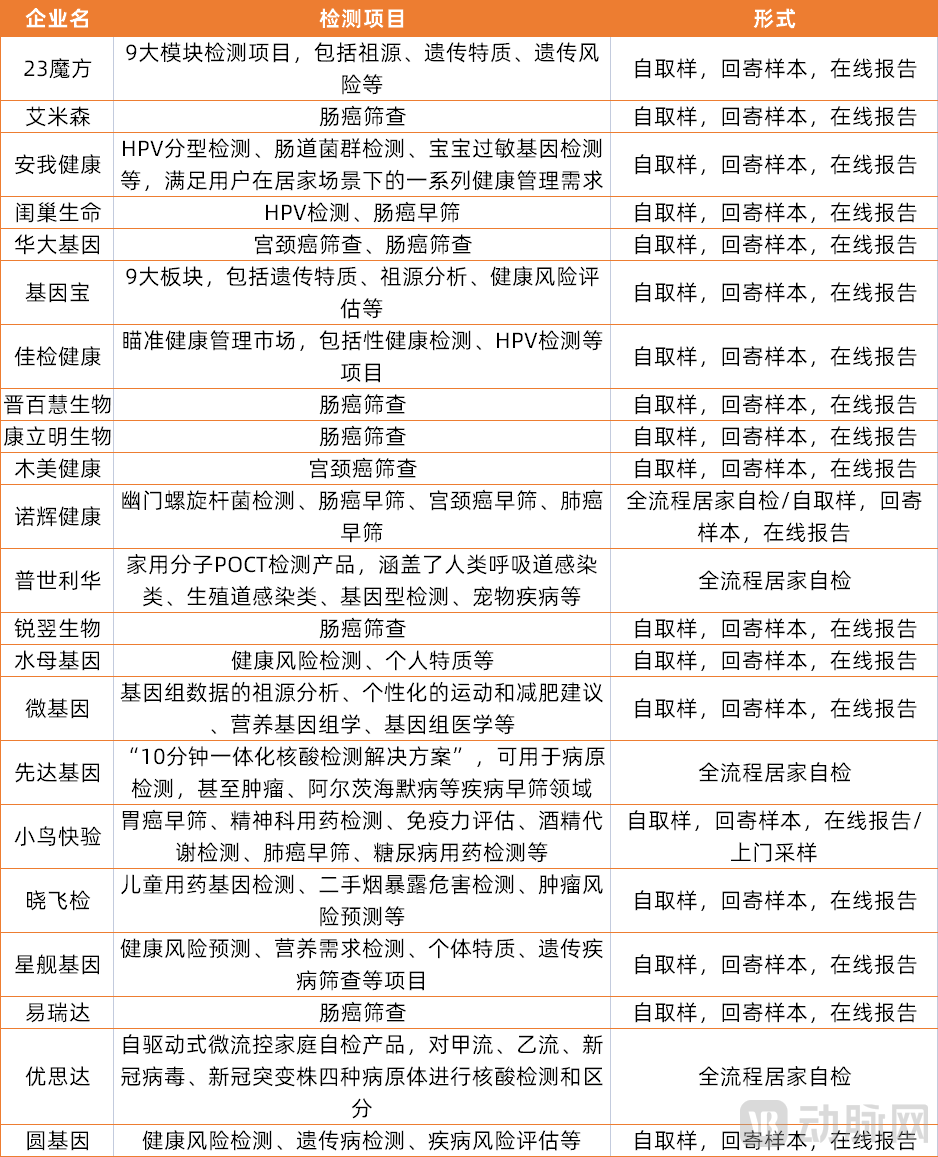
Beyond at-home self-testing for COVID-19, numerous companies in China are also expanding their portfolios to include a broader range of at-home diagnostic tests.
(Compiled based on publicly available information)
It is worth noting that, even before the COVID-19 pandemic, in vitro diagnostic (IVD) companies had already begun to position themselves in the home testing sector, yet with limited success. Many companies failed in the home-use scenario, as technical barriers and market immaturity remained significant obstacles hindering the adoption of home testing products. As one company remarked, “In live-streaming sales rooms, skincare products priced at thousands of yuan sell out instantly, while HPV test kits priced at over 200 yuan struggle to find buyers.”
Can the Popularity of Overseas At-Home COVID-19 Testing Bring a Turning Point to China’s At-Home Testing Market?
VCBeat believes that the thriving landscape of overseas at-home COVID-19 testing has indeed drawn significant attention from numerous Chinese companies to this sector, which already features major players such as Dian Diagnostics and New Horizon Health. While the COVID-19 pandemic has accelerated the development of China’s at-home testing market, a short-term surge in growth is not expected.
Companies such as Cue Health are attempting to expand their at-home testing offerings from COVID-19 to a broader range of conditions, including influenza, vitamin D deficiency, male testosterone levels, female reproductive health, and HIV. Whether this endeavor will succeed remains uncertain. Similarly, the prospects for China’s at-home testing market remain unclear. Future progress will require active participation from all stakeholders—including regulators, investors, companies, and consumers—to achieve breakthroughs in technological innovation, market education, and policy and regulatory frameworks.
Although home-based testing is still in its early stages globally, it is evident that the integration of services from large-scale to small-scale settings, and the expansion from professional medical institutions to ordinary households, represent a major trend in the development of the in vitro diagnostics (IVD) sector. Home-based testing offers broad application scenarios and promising commercial prospects, making it highly attractive and worthy of long-term attention. In the future, companies will need to focus on technological innovation and market education.
Previously, constrained by technological limitations, domestic at-home molecular diagnostic products were almost exclusively based on the “home sampling, laboratory testing” model. Although several compact, integrated molecular testing platforms have since emerged, they still fall short of fully meeting the needs of true at-home testing.
On one hand, integrated molecular diagnostic platforms require further optimization and iteration to reduce testing time and costs while ensuring assay performance and user-friendliness. On the other hand, current testing primarily relies on samples such as saliva and nasal swabs; blood-based assays have not yet been adapted for home testing, necessitating continued technological innovation.
Moreover, for in vitro diagnostic (IVD) items such as early cancer screening, which feature a vast market but involve complex detection technologies, miniaturization is not yet feasible in the short term. These tests primarily reach household settings through a “home sampling, laboratory testing” model, failing to fully unleash the potential of home-based testing. The future of the home testing market will undoubtedly lie in end-to-end home-based processes, with “home sampling, laboratory testing” serving merely as a transitional phase. It will take sustained efforts over an extended period to enable the deployment of more complex testing modalities in home settings.
Home testing products must also prioritize the upload and management of test data. Uploading result data to medical institutions or government systems not only helps consumers achieve refined health management but also assists regulatory authorities in managing test results for infectious diseases, thereby supporting epidemic prevention and control efforts.
In terms of market education, most in vitro diagnostic (IVD) companies sell to professional medical institutions such as hospitals, whereas home-testing products are marketed directly to consumers. These two approaches differ fundamentally in sales strategy and logic, requiring companies to either establish dedicated teams or forge extensive partnerships with internet platforms, pharmacies, and other channels.
In terms of application scenarios, home testing products are primarily focused on disease screening and prevention, with an emphasis on health management initiatives. Products that feature high demand, frequent use, high repurchase rates, user-friendly operation, and the capability to support end-to-end self-testing at home are the preferred choices for the implementation of home-based testing solutions.
Overall, the feasibility of at-home testing has been validated overseas during the COVID-19 pandemic. With technological breakthroughs, market maturation, and the refinement of regulations governing the development and registration of self-testing products, China’s at-home testing market is poised for rapid growth.
On January 6, 2022, New Horizon Health announced that its Helicobacter pylori detection product, YouYouGuan®, had received approval from the National Medical Products Administration (NMPA) for its Class III medical device registration application. It is the “first Helicobacter pylori detection product suitable for ‘consumer self-testing.’” Andon Health is also planning to promote the domestic application of its COVID-19 antigen self-test kits, which will significantly drive the evolution of disease prevention and control from a hospital-centric model to home-based testing.