

How Hospitals Should Select VTE Systems: Medical Device Certification Emerges as a Key Evaluation Criterion

SYNYI AI
Provider of Comprehensive Solutions for Medical Big Data
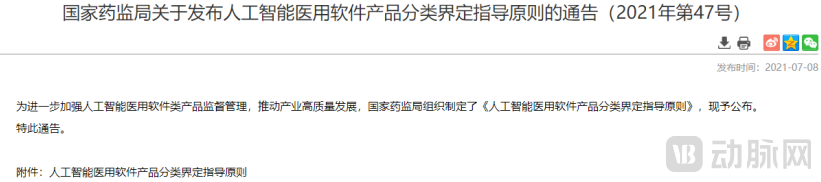
In the “Notice of the National Medical Products Administration on Issuing the Guiding Principles for Classification and Definition of Artificial Intelligence Medical Software Products” released by the National Medical Products Administration (NMPA) in July 2021, it is stated as follows: If a software product processes medical device data, and its core functions involve processing, measurement, model computation, analysis, etc., of such data for medical purposes, it meets the definition of a medical device under the Regulations on the Supervision and Administration of Medical Devices and shall be regulated as a medical device. In practice, however, the classification of software attributes depends not only on the form of the software but also on how physicians use it.
In the past two years, numerous AI systems for medical imaging have successively obtained medical device registration certificates. Although fewer in number, AI systems for medical text processing are also gradually advancing through certification under medical device regulations. One such example is the Intelligent Prevention and Management System for Venous Thromboembolism (VTE) (hereinafter referred to as the “VTE System”).
It primarily involves six key stages: admission assessment, bleeding risk assessment, prevention recommendations, diagnostic assistance, treatment recommendations, and discharge guidance. Centered on these six stages, the artificial intelligence system enables closed-loop management from patient admission to discharge, facilitating the integration of prevention, treatment, and education for healthcare professionals.
To further elucidate the value of artificial intelligence in VTE management and explore the significance of medical device registration certificates, VCBeat conducted an on-site questionnaire survey among clinical healthcare professionals from dozens of Grade A tertiary hospitals during the 2021 China VTE Prevention and Control Conference. As end-users, their perspectives carry greater persuasiveness.
The survey primarily focuses on physicians’ level of interest in AI-based VTE applications and their preferences regarding the procurement of products that have undergone regulatory review and approval.
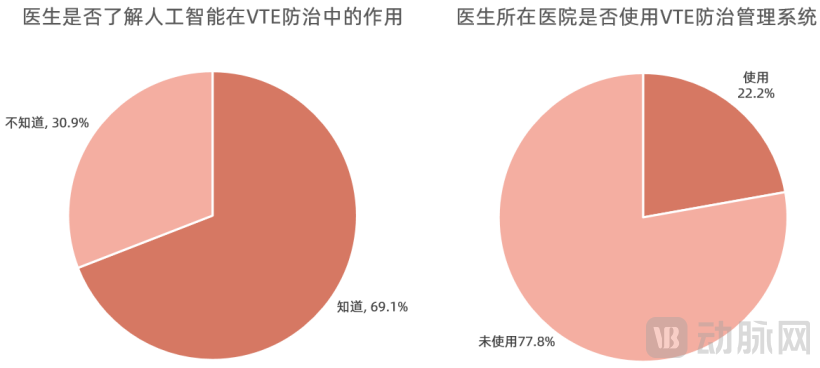
Statistical results show that 83.3% of physicians are aware of the role artificial intelligence (AI) plays in the prevention and treatment of venous thromboembolism (VTE), while only 16.7% reported being unaware of whether AI is applied in VTE prevention and treatment. Furthermore, 22.2% of physicians from tertiary hospitals (Grade A) are currently using AI-based VTE prevention and treatment management systems. This indicates that while physician awareness is relatively high, there is still room for growth in system adoption rates. Driven by policy support, this gap is likely to be filled within the next two years.
Multiple healthcare professionals have stated that VTE systems can undoubtedly play a significant role in improving the quality and efficiency of in-hospital VTE prevention and treatment. However, they are uncertain whether currently available VTE systems on the market comply with industry standards or pose data security risks. Therefore, if procurement or replacement is required in the future, they may prefer VTE systems that have obtained medical device registration certificates to ensure effectiveness and safety during management processes.
The clinical value of VTE systems has been increasingly recognized by healthcare professionals. For companies, the possession or absence of a medical device registration certificate may become a new barrier for VTE systems.
Hospital demand is driving the rapid development of the VTE industry. In its report, “From Grading to In-Depth Clinical Workflows: CDSS Is Swiftly Advancing Toward a Second Leap,” VCBeat Research Institute noted that specialized CDSS solutions are priced between RMB 500,000 and RMB 3 million; based on the current scale of hospitals, this market is estimated at approximately RMB 8 billion.
Faced with such a large in-hospital market, enterprises need to compete on the basic capabilities of their products to meet the actual needs of clinical use; on the other hand, they must ensure product safety, privacy, and other issues, such as obtaining medical device registration certificates and demonstrating the safety and effectiveness of the software to users through authoritative third parties.
Currently, some companies have made progress in the device registration review for VTE systems.
In July 2021, SYNYI·AI’s “Venous Thromboembolism Risk Assessment Software” successfully obtained the medical device registration certificate for venous thromboembolism risk assessment software. VCBeat’s query on the official website of the National Medical Products Administration revealed that this was the first software in China to receive such a medical device certificate.
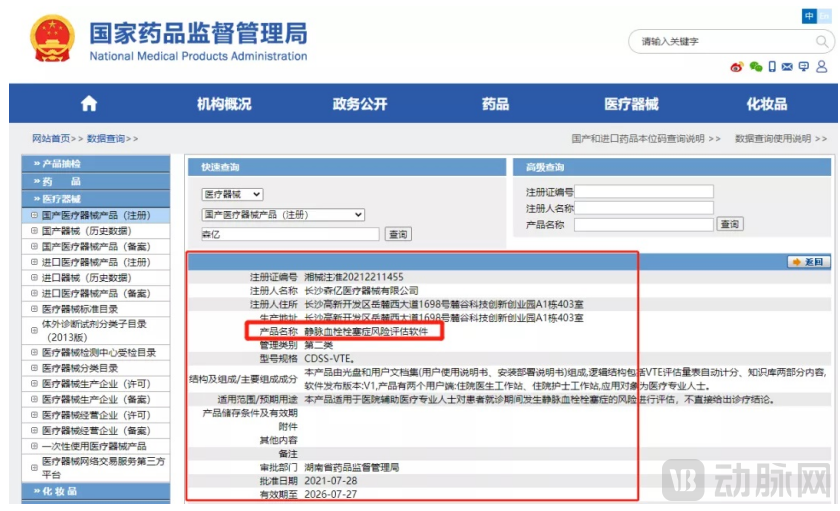
Medical Device Registration Certificate Approved
According to data from the official website of the National Medical Products Administration (NMPA), the Senyi Intelligent VTE System, which has recently obtained medical device certification, primarily consists of two components: an automated scoring module for VTE assessment scales and a knowledge base. The system is designed to assist healthcare professionals in hospitals in evaluating patients’ risk of developing venous thromboembolism (VTE) during their clinical visits, but it does not directly provide diagnostic or therapeutic conclusions.
The system’s recognition by the National Medical Products Administration (NMPA) stems not only from its compliance with official standards and safety specifications but also from the inherent value demonstrated by the VTE system itself. It is foreseeable that a large number of companies will subsequently follow suit in applying for medical device registration approval for their VTE systems.
Recently, the WeChat official account “Medical Management Direct Train” also launched an online survey focusing on device-related aspects of VTE systems. Reportedly, the survey covered hundreds of healthcare administrators. Regarding awareness that VTE risk assessment software falls under the regulatory scope of medical devices, 69.1% of the healthcare administrators indicated they were aware of this.
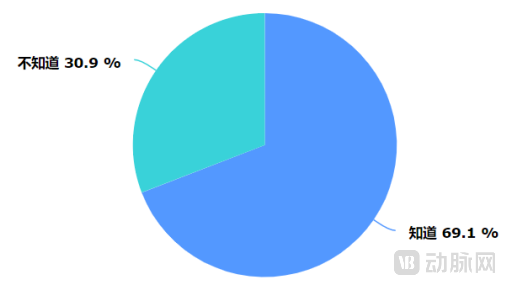
Physicians’ Understanding of the Regulatory Classification of VTE Risk Assessment Software as a Medical Device (Data Source: Healthcare Quality Express)
Regarding the question of whether they are more willing to choose VTE systems with approved medical device registration certificates, 96.8% of healthcare administrators indicated their willingness.
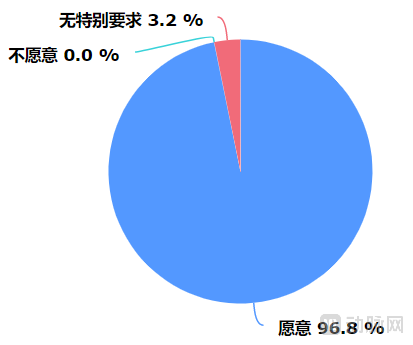
Physicians’ Willingness to Purchase Certified VTE Systems (Data Source: Healthcare Quality Direct))
While approval from the National Medical Products Administration is undoubtedly important, for a VTE system to truly deliver value in hospitals, it is also necessary to achieve consensus among hospital experts.
At the 2021 China VTE Prevention and Control Conference, multiple domestic experts in VTE prevention and control emphasized the role of AI-enabled strategies in improving the quality of VTE prevention and control. Some of these viewpoints have become industry consensus and have been incorporated into the “Recommendations for Quality Evaluation and Management of VTE Prevention and Control (2021 Trial Version)” (hereinafter referred to as the “Management Recommendations”).
As can be seen from the detailed interpretation of the "Management Recommendations" by on-site experts, the current quality control methods for venous thromboembolism (VTE) in hospitals are relativelyComprehensive, holistic, and systematic, yet plagued by issues such as being overly broad and exhaustive, coarse, ambiguous, lacking in operational feasibility, difficult to retrieve, and failing to accurately reflect healthcare quality.
To address these issues, the Management Recommendations were revised based on five key principles: locking in core metrics and specifying their time points, prioritizing five major patient populations, reviewing all confirmed VTE cases, and clarifying data sources for the metrics.However, to fully implement the principles of the Management Recommendations, healthcare professionals must rely on information technology solutions.
Taking the refinement of key metric time points as an example, the revised Management Recommendations focus on four time points for surgical patients—admission, preoperative, postoperative, and discharge—and four nodes for non-surgical patients—admission, pre-transfer, post-transfer, and discharge—to achieve dynamic assessment throughout the care process. This means that for each patient, healthcare professionals are required to complete the assessment scale at least four times, while ensuring the accuracy of each submission.Within limited timeframes, relying solely on manual operations by healthcare professionals has long been insufficient; the implementation of information technology is now urgent.
To demonstrate the effectiveness of venous thromboembolism (VTE) prevention and control, hospitals must identify precise time points to provide efficient and accurate VTE assessments. For the medical administration department, even dedicating all available resources to VTE prevention and control would make it difficult to fully implement the Management Recommendations.
Therefore, experts believe that to meet the requirements of the "Management Recommendations," hospitals should seek reliable intelligent methods for the prevention and treatment of VTE. Although this approach cannot completely eliminate VTE, it can reduce the incidence of VTE to a certain extent.
Under expert consensus, AI-driven VTE systems are poised to become standard equipment for VTE prevention and treatment in major hospitals across China. Products with medical device certification will undoubtedly be more favored by hospital administrators.