

China's Medical Device Exports Surpass $100 Billion as Overseas Markets Emerge as Key Growth Driver
According to legend, Tang Sanzang and his disciples crossed the Tongtian River on their journey to the West to retrieve Buddhist scriptures.
Today, Chinese medical device companies must expand overseas to achieve global growth.
2020, a pivotal turning point, marked the year when Chinese medical device companies collectively expanded into overseas markets.
That year, as the COVID-19 pandemic struck, China’s medical device companies saw their export trade volume multiply.According to data from the General Administration of Customs of China, China’s foreign trade volume in medical devices reached USD 139.853 billion in 2020, a year-on-year increase of 112.0%. Of this, exports amounted to USD 101.5 billion, representing a year-on-year growth of 244.0%.
In the first half of 2021, as the pandemic gradually entered a stabilization phase, China's foreign trade volume in medical devices reached USD 72.323 billion, a year-on-year decrease of 11.6%. Of this, exports amounted to USD 47.931 billion, down 23.1% year on year. However, compared with the same period in 2019, medical device exports still achieved substantial growth.
This is mainly due toAs the pandemic becomes normalized, demand for epidemic prevention supplies declines, the trade volume of medical masks and medical protective clothing in China showed a downward trend compared to the first half of 2020. Among them, the export value of medical masks was $6.917 billion, a year-on-year decrease of 78.8%; the export value of medical protective clothing was $1.552 billion, a year-on-year decrease of 69.8%.
As the wave of global expansion sweeps across the industry, leading Chinese medical device companies are taking the initiative to intensify their overseas efforts.
Mindray Medical is the leading domestic medical device manufacturer in China and a pioneer in overseas expansion. According to Mindray’s 2020 annual report, its products, such as ventilators and patient monitors, were extensively deployed in renowned healthcare institutions abroad during the pandemic. In North America, the company successfully broke into high-end customer segments, including St. Bernard Medical Center, Chambers Memorial Hospital, and the University of Washington Medical Center. Meanwhile, in Europe, it gained access to approximately 100 new high-end customers.
Leveraging its performance during the pandemic, the company secured breakthroughs with over 700 high-end clients in international markets, thereby advancing its brand promotion timeline by at least five years.
MicroPort is also pursuing a globalization strategy, with sales outside China accounting for 55.4% of its total revenue in 2020. Meanwhile, Lepu Medical has consolidated the former foreign trade operations and departments of all its subsidiaries to establish an International Business Division, launching a five-year plan to achieve a tenfold increase in its international business. Previously, the company had planned to set up an overseas R&D center in 2021.
It is evident that, under the globalization strategy, expanding overseas is the overarching direction.
Going global, a key objective is to expand revenue.
As China’s medical market for coronary stents and transcatheter heart valves gradually shifts into a red ocean, with accelerated centralized procurement of high-value consumables and the implementation of DRG/DIP payment models, overall consumable usage has declined, leading to shrinking profit margins for Chinese medical device companies in the domestic market.
In the 2020 centralized procurement of coronary stents, the average price of stents, originally ranging from RMB 10,000 to 20,000, dropped by over 90%, with an average winning bid price of approximately RMB 700.Although the price of coronary stents declined, leading to an increase in sales volume for companies, their sales revenue merely remained flat. Affected by the centralized procurement of coronary stents and the COVID-19 pandemic, MicroPort’s revenue decreased by 18.8% in 2020. The once-boiling market for coronary stents suddenly “cooled down.”
In terms of product R&D, some companies are beginning to develop bioresorbable coronary stents and peripheral stents. In the market, while domestic sales of coronary stents previously generated substantial revenue, some companies have started expanding into overseas markets following the implementation of centralized procurement.
Domestic medical device companies are striving to break through the ceiling of local profitability and seek development in overseas markets. Especially for startups, the domestic market in China is fiercely competitive, with import monopolies and the rise of industry giants; thus, overseas markets can serve as a second growth engine for these enterprises.
In the global expansion of Chinese medical device companies, external drivers play a role alongside internal factors. More than 20 years after China’s accession to the World Trade Organization (WTO), its pace of opening up has not slowed; continued relaxation of market access has made China the second-largest market for Johnson & Johnson’s medical device business. To respond to the “offensive” of overseas giants, domestic companies must also go global.
With the continuous growth of the global population, an aging demographic, and rising healthcare expenditures, the market size for medical devices is also accelerating.According to the *China Medical Device Blue Book (2021 Edition)*, the market size of China’s medical device industry in 2020 was RMB 772.1 billion, while the global medical device market size was USD 493.5 billion, approximately four times that of China’s (estimated at an exchange rate of 6.37).
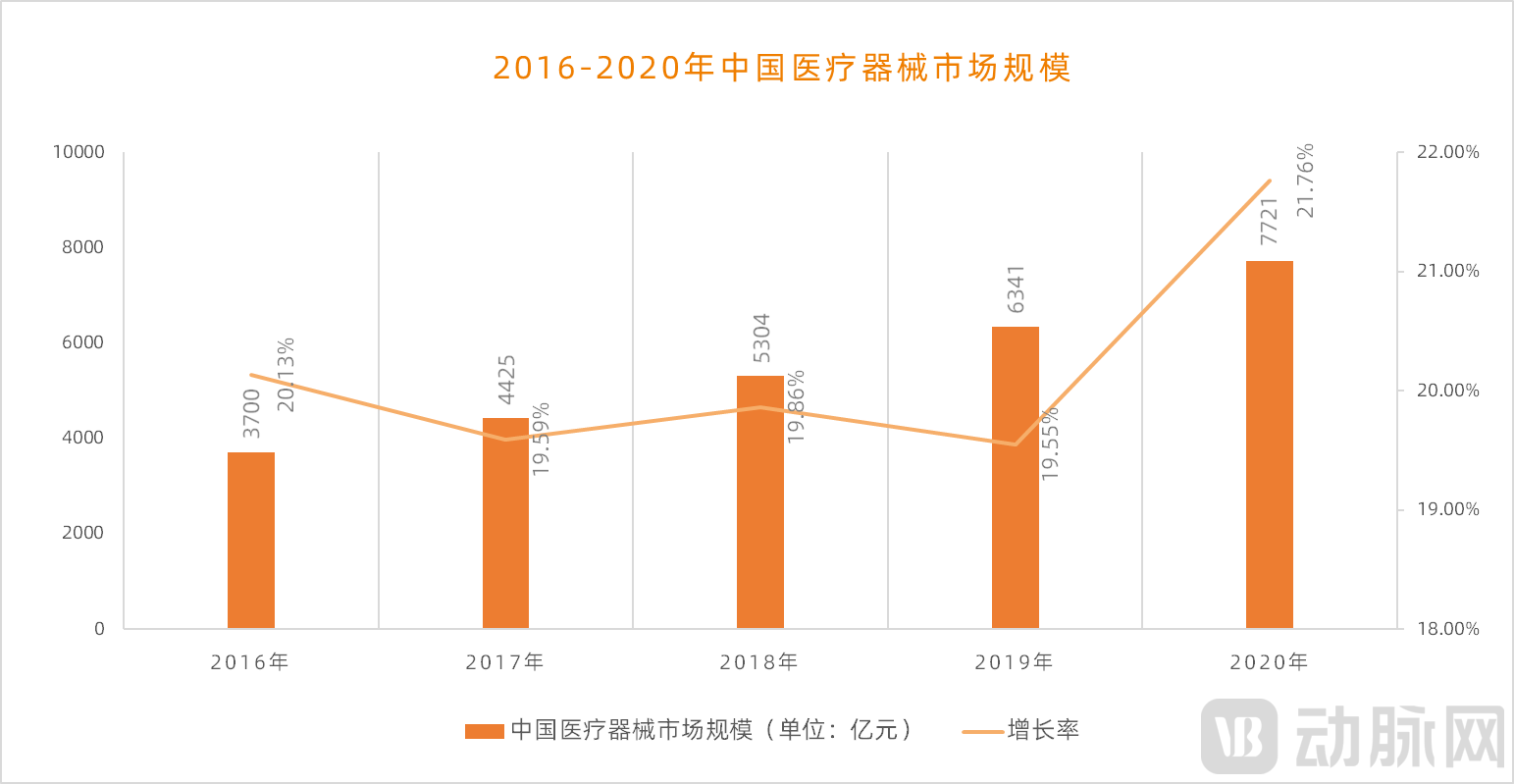
Market Size of China’s Medical Device IndustryData Source: Blue Book of China’s Medical Device Industry (2021 Edition)
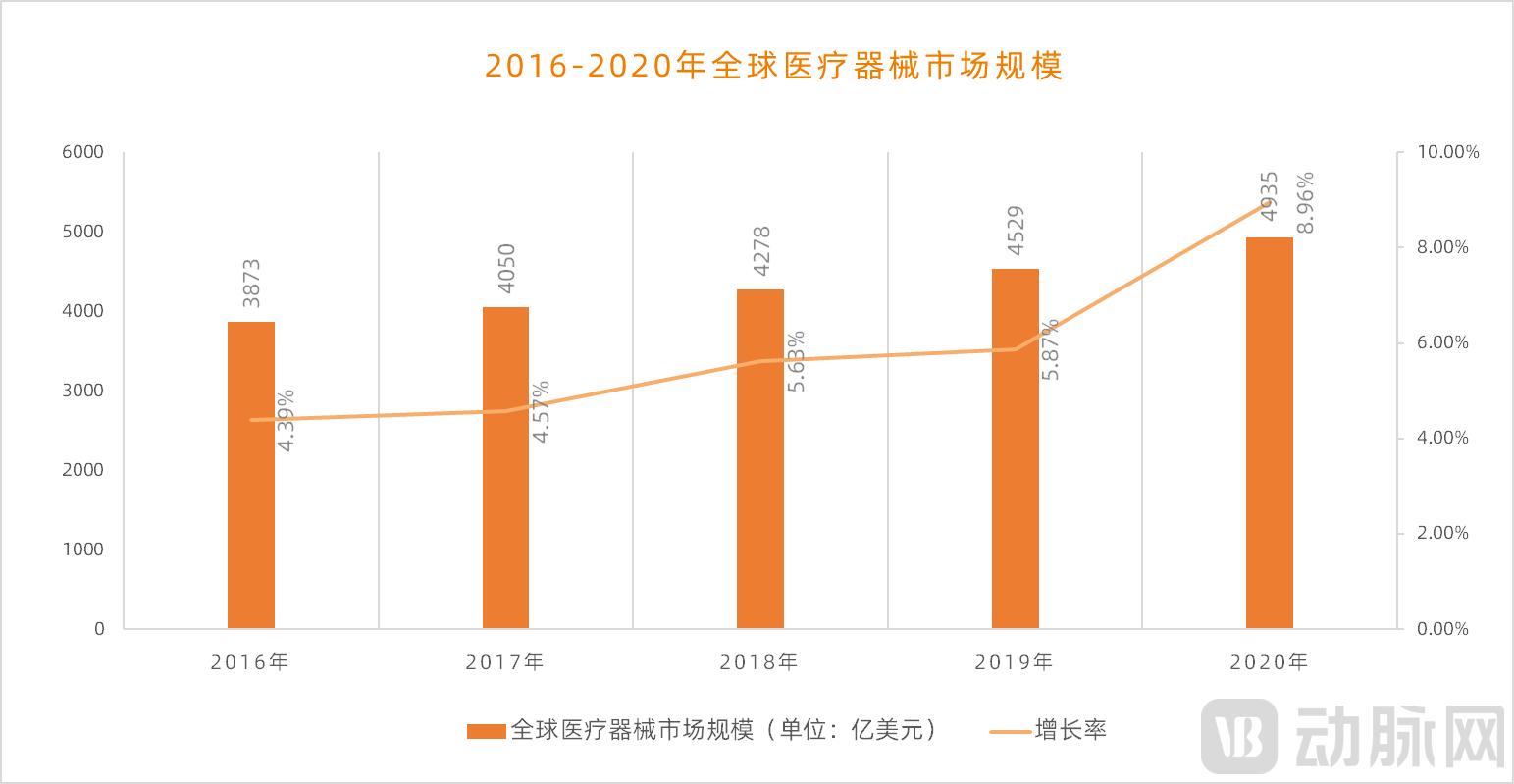
Global Medical Device Market Size Data Source: "Blue Book of Chinese Medical Devices (2021 Edition)"
It is evident that the global market represents a highly lucrative opportunity for Chinese enterprises to capture. Some domestic giants began strategizing their overseas expansion more than a decade ago, particularly targeting the global mid-to-low-end consumables market. Leveraging superior product quality and competitive pricing, Chinese companies are well-positioned to secure a significant foothold.
"Going global is the litmus test for product originality."
Patents serve as a “passport” for Chinese enterprises overseas, while also acting as barriers erected by foreign companies.
In September 2021, Micro-Tech Europe GmbH, a wholly-owned subsidiary of Nanwei Medical in Germany, received a lawsuit for infringement of utility model patents initiated by Boston Scientific, which later resulted in a settlement and patent licensing agreement. Previously, Boston Scientific had repeatedly filed patent infringement lawsuits against Nanwei Medical’s products in the United States and Germany. Therefore, Chinese medical device companies place significant emphasis on their overseas patent portfolios.
Furthermore, in recent years, licensing collaborations (License-in/out) have become a highly prevalent model within the pharmaceutical industry and are gradually gaining traction in the medical device sector. The License-in model facilitates the rapid introduction of overseas innovative products and technologies into China, enabling domestic enterprises to swiftly enter emerging markets; for instance, Jointcare Medical and Grand Pharma have introduced shockwave balloon technology. However, the License-out model, which truly empowers domestic companies to expand globally, has lagged behind. This delay is primarily attributable to the previously insufficient innovativeness of domestically produced medical devices.
Regulatory approval is only one aspect; obtaining certifications such as U.S. FDA clearance and EU CE marking represents the first major hurdle, which many companies leverage to enhance their credibility. The EU CE marking and U.S. FDA clearance differ in their quality control standards and requirements for medical devices.The FDA’s medical device product catalog comprises more than 1,700 categories, classifying medical devices into Class I, II, and III based on risk levels. In contrast, the European Union classifies medical devices into Class I, IIa, IIb, and III according to risk levels, with differing requirements for pre-market clinical trials, safety, and other aspects.
Clinical acceptance is another matter. Although some products have been approved for market entry, they lag behind overseas brands in terms of efficacy and product quality, and thus are not accepted in clinical practice. Expanding into international markets also serves as a test of a company’s product quality and service standards.
An industry insider stated, “If Chinese companies can sell their products in Europe and the United States, it not only demonstrates the high quality of their products but also indicates that these companies have robust quality control systems.”
The standard approach for Chinese companies expanding overseas involves obtaining product certifications and establishing distribution channels abroad. In recent years, there has been a significant surge in interest among overseas distributors in partnering with Chinese enterprises. Furthermore, global expansion presents not only technical and operational challenges but also requires navigating diverse regulatory frameworks and cultural traditions across different regions. To succeed, teams must possess an international perspective, the capability to manage cross-border licensing and collaborations, as well as sufficient resources and influence in overseas markets.
Acquiring Overseas Startups Is a “Shortcut” for Chinese Companies to Rapidly Enter Foreign Markets, modules such as products, local staff, and production systems have been established, awaiting takeover by Chinese enterprises to build their own sales channels.
Furthermore, the ultimate form of Chinese enterprises’ global expansion should not be limited to simple product exports—where products are researched, developed, and manufactured domestically before being exported to secure stable orders in overseas markets. Instead, it must evolve into brand-led globalization, wherein companies establish overseas branches, relocate their entire R&D and production models abroad, and implement appropriate localization strategies.
Whether for foreign enterprises entering the Chinese market or domestic companies expanding overseas, localization remains an immutable principle. To establish a strong foothold abroad, companies must forge long-term partnerships with local businesses and adopt differentiated sales models across various regions. For instance, Huitai Medical primarily relies on a distribution model for domestic sales, while its overseas operations are conducted exclusively through distribution channels.
Global expansion is a double-edged sword, with crises lurking behind the opportunities. Amidst the fervor of going global, startups must remain calm.
First,High Compliance Costs for Enterprises Expanding OverseasCountries have varying requirements for the regulation and market entry of medical devices. The United States and Europe have well-established regulatory frameworks for medical devices, whereas China’s regulatory system was established relatively later. Moreover, the U.S. FDA regulates medical devices using a model similar to that for pharmaceuticals, while China and Europe have enacted separate legislation specifically for medical devices.
Furthermore, China’s healthcare sector has long been “isolated” on the global stage, making innovation and quality key areas where companies must work to overturn prevailing biases.Currently, most of the medical products exported by China are low- to mid-end products, with few high-end innovative products.Chinese medical device companies still lag in high-end innovative devices. In 2020, China’s exports of low-value consumables, such as masks and protective gowns, totaled $64.5 billion, accounting for 63.5% of the country’s total export value.
This is related to the environment and history of China’s medical market. Previously, many enterprises focused on imitation and capturing the domestic market, lacking the ambition and innovation to expand globally. This has also led to foreign giants monopolizing China’s high-end medical market.
Although Chinese medical device companies have frequently innovated in recent years, launching products with performance superior to imported brands—such as bioresorbable stents and ultrasonic scalpels—these product lines have not yet reached profitability. In terms of conventional high-end devices, such as pacemakers and ECMO systems, domestic companies still lack a significant voice in overseas markets.
Price remains a key advantage for Chinese companies.
Domestic companies have made substantial investments in marketing and operations during the early stages, requiring support from local institutions for product approval and promotion. Although some enterprises possess technological and product advantages, their small scale and insufficient accumulation of overseas resources make it difficult to sustain the significant time and financial commitments required over several years.
To adapt to overseas cultures and facilitate market promotion, most companies choose to hire local employees. According to a medical device entrepreneur: “I have an office in the United States, where the costs of salaries and insurance for foreign personnel are very high. The U.S. offers various types of commercial insurance, and even with just one employee, it is necessary to establish a union.”
In addition to personnel costs, companies must also bear the expenses associated with R&D, production, and building proprietary distribution channels. Before a product becomes profitable, these investments will be like stones cast into the depths of the ocean, making no sound. Moreover,Market promotion through overseas channels tends to result in relatively weaker control over end-users and limited interaction with clinicians.This phenomenon is particularly pronounced in the high-end market; if enterprises lack direct access to clinical settings and must rely solely on distributors for liaison, they will be unable to respond promptly to clinical needs.
Furthermore, when planning international expansion, companies need to consider several factors:Market size and growth rate in overseas markets, ease of market access, and stability of local policies and economy。
The selection of overseas markets is crucial, as regulatory approval difficulty for medical devices varies by region, and market size and growth potential must also be taken into account. According to data from the China Chamber of Commerce for Import and Export of Medicines and Health Products, the United States, the United Kingdom, Germany, and Japan are China’s primary export markets, accounting for 47.3% of total exports. In 2020, the United States remained the top destination among all export markets.
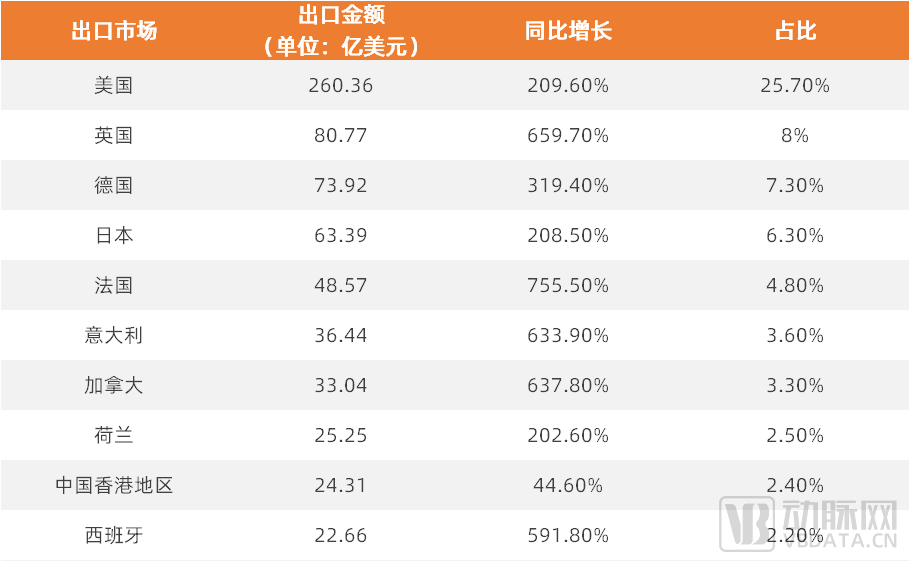
2020 Export Destinations of Chinese Medical Devices Data Source: General Administration of Customs of China
As the country with the most advanced medical resources globally, the United States offers a fertile ground for innovation and clinical trials, attracting multinational medical device giants such as Medtronic and Boston Scientific. In the past, many Chinese companies were committed to breaking into the U.S. market; however, gaining entry has proven challenging due to hurdles like FDA approval and market promotion. Consequently, some companies have opted to first establish a presence in regions such as Europe and Japan before making their move into the United States.
However, for products of identical quality, Chinese companies may face downward pressure on pricing after obtaining FDA approval. Some enterprises pursue FDA certification not to target the U.S. market, but rather to access markets in the Middle East and Latin America. These regions recognize FDA approval, and due to their less developed healthcare resources, there is greater room for price negotiation.
Emerging markets along the “Belt and Road” are gradually becoming important export destinations for China, such as India, Russia, and Vietnam.Nowadays, encouraged by national policies such as the “dual circulation” strategy (with domestic circulation as the mainstay and mutual reinforcement between domestic and international circulation), some enterprises have begun to expand into developing countries. Neusoft Medical’s key focus for overseas expansion is precisely in these developing markets. Currently, Neusoft Medical equipment has been installed in 70% of the countries along the Belt and Road Initiative.
Furthermore, policy changes in overseas countries can affect the market access thresholds for medical device products.
Since July 2018, the United States has imposed additional tariffs on China.According to Mindray Medical’s 2021 semi-annual report, affected by the China-U.S. trade friction, since July 6, 2018, a 25% tariff has been imposed on the company’s exports to the United States of products such as patient monitors, color Doppler ultrasound systems, anesthesia machines, in vitro diagnostic products, and related accessories.
Effective December 1, 2021, 32 countries, including EU member states, the United Kingdom, and Canada, have terminated their Generalized System of Preferences (GSP) tariff policies for China.(Industrialized nations grant universal, non-discriminatory, and non-reciprocal tariff preferences to semi-finished and finished manufactured goods exported from developing countries or regions.) Currently, the only countries that still extend Generalized System of Preferences (GSP) treatment to China are Norway, New Zealand, and Australia.
The imposition of additional tariffs by overseas countries will undoubtedly affect some of China’s low-cost, low-margin enterprises. If these companies raise their prices, their market share in overseas markets may decline. However, in recent years, the proportion of high-value-added products in China’s medical device exports has continued to rise, thereby reducing the overall impact.
The COVID-19 pandemic slowed the pace of overseas expansion for enterprises, causing many medical device companies to put their global expansion plans on hold.
Some medical device giants had already established complete production lines and teams overseas, granting them a certain degree of resilience against sudden epidemic outbreaks. However, most startups lacked sufficient early-stage accumulation, which delayed their international expansion.
Companies manufacturing emergency supplies such as face masks and ventilators possess inherent advantages and have gradually expanded their overseas presence. One of Mindray Medical’s three core business segments is Patient Monitoring & Life Support, which includes devices such as patient monitors and ventilators. As the domestic epidemic situation eased, the company began shifting the production capacity and delivery of its pandemic-response equipment toward international markets.
The COVID-19 pandemic boosted China’s exports of anti-epidemic supplies, but as the situation stabilizes, this “dividend” will not last long.In the first half of 2021, China's exports of medical device products declined compared to the same period last year, primarily due to a decrease in the export volumes of masks, protective suits, and ventilators among anti-epidemic supplies.
However, this sudden public health emergency has exposed the deficiencies in healthcare systems across countries, prompting them to make every effort to address these gaps.
The European Union will launch the EU4Health program, with an expected investment of €9.4 billion over seven years (2021–2027) to build resilient health systems within the EU, including €3.1 billion allocated for strategic reserves of medical supplies; Spain has introduced a €36 billion relief package, providing €1.4 billion to the Ministry of Health and €2.8 billion to regional health systems; and Italy has approved a €25 billion emergency aid package, planning to invest €3.2 billion to support healthcare.
The development of public health systems cannot be achieved without the participation of medical devices, presenting opportunities for device manufacturers worldwide. In the post-pandemic era, governments across various countries will face greater fiscal pressure, making medical device procurers more price-sensitive. One of the advantages of domestically produced products in China is their competitive pricing. However, tariffs imposed by European and American regions on Chinese enterprises may undermine the price advantage of some companies.
In the context of globalization, expanding overseas is an inevitable path for corporate development. However, whether companies can successfully navigate this journey and achieve substantial results requires careful consideration and sustained effort.
References:
Data from the General Administration of Customs of the People's Republic of China and the China Chamber of Commerce for Import and Export of Medicines and Health Products
“Mindray Medical 2020 Annual Report”
“MicroPort 2020 Annual Report”
“LifeTech Scientific’s Overseas Expansion Puzzle (Part I): The Logic, Essence, and Barriers of Its International Business” — Gelonghui
[Review | 112% Growth: These Medical Devices Hold the Greatest Potential in Foreign Trade Markets] — China.com.cn Medical Channel